


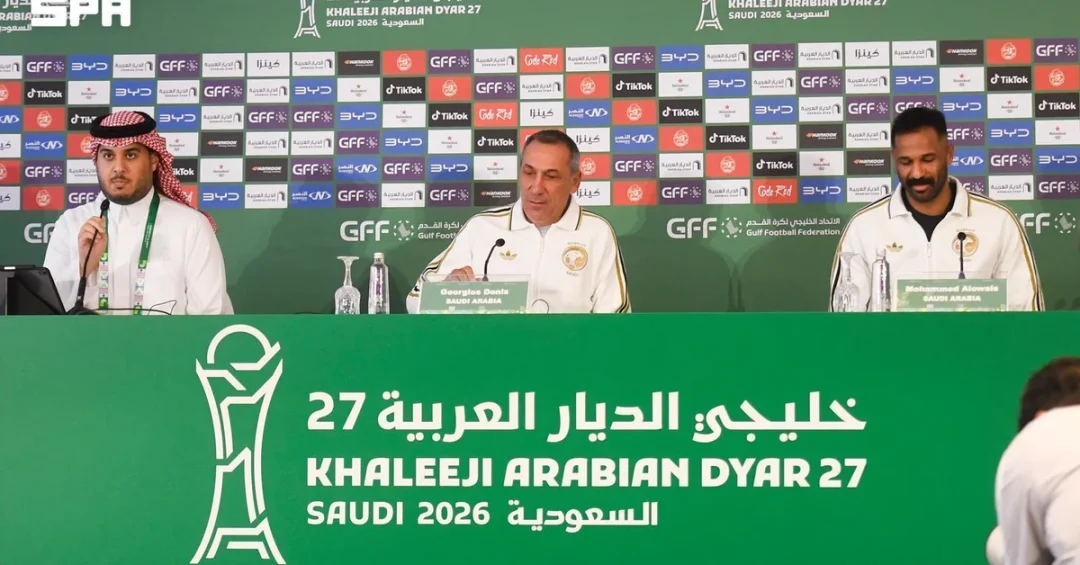
Saudi national football team head coach Georgios Donis confirmed the team’s readiness to face Kuwait at King Abdullah Sports City in Jeddah in the opening match of the 27th Arabian Gulf Cup, according to the Saudi Press Agency. The Greek tactician, who oversees the Green Falcons’ technical preparations, addressed the squad’s condition and mindset ahead of a fixture that carries significant weight for Saudi Arabian football. The match, scheduled for tomorrow evening, marks the beginning of Saudi Arabia’s campaign in a tournament that brings together the Gulf region’s leading national teams in a showcase of competitive football.
Donis emphasized that opening matches demand heightened concentration and a strong display of passion and determination to secure a positive start. He described the tournament as an important opportunity for the national team to deliver performances that reflect its ongoing technical development. The coach’s remarks underscore the seriousness with which Saudi Arabia approaches regional competitions, particularly those hosted on home soil where expectations run high. The Saudi Arabian Football Federation has invested substantially in player development and tactical preparation, and the Gulf Cup represents a valuable platform to demonstrate the results of those efforts.
What Does This Match Mean for Saudi Arabia’s Regional Standing?
The 27th Arabian Gulf Cup represents more than a standard regional tournament for Saudi Arabia. It serves as a stage where the Kingdom can assert its footballing credentials following recent appearances on the global stage, including participation in the FIFA World Cup. Donis noted that the competition features three teams that participated in the World Cup — Saudi Arabia, Iraq, and Qatar — which demonstrates the strength of the field and the caliber of opposition the Green Falcons will encounter. This context elevates the tournament beyond simple regional bragging rights, positioning it as a competitive proving ground for teams seeking to maintain momentum on the international stage.
The presence of World Cup participants alongside other ambitious Gulf nations creates a demanding schedule that will test squad depth, tactical flexibility, and mental resilience. For Saudi Arabia, competing against familiar regional rivals carries particular significance given the long history of footballing exchanges among Gulf nations. The Saudi national team has traditionally been among the region’s strongest sides, and maintaining that position requires consistent performances in tournaments like the Gulf Cup. The coaching staff’s emphasis on focus and determination reflects an understanding that regional competitions can be unpredictable, with historical rivalries and local knowledge often leveling the playing field between teams of differing international rankings.
King Abdullah Sports City, known locally as the Jewel Stadium, provides a fitting venue for such a significant occasion. The facility, located in Jeddah, has hosted numerous high-profile matches and offers modern amenities that meet international standards. The choice of venue underscores Saudi Arabia’s capacity to organize major sporting events, a capability that has grown considerably as the Kingdom has expanded its investment in sports infrastructure as part of broader national development initiatives. The stadium’s atmosphere, particularly with home crowd support, can influence match outcomes and provide a tangible advantage for the Saudi squad.
How Are the Players Approaching the Tournament?
Saudi national team goalkeeper Mohammed Al-Owais echoed his coach’s sentiments, emphasizing the players’ readiness and enthusiasm for the opening match. Al-Owais, a seasoned international with extensive experience in high-pressure fixtures, pointed out that the match against Kuwait is highly important given the two teams’ history in the competition. His perspective reflects the squad’s collective awareness of the occasion and the responsibility that comes with representing Saudi Arabia on home soil. The goalkeeper highlighted the players’ eagerness to make the most of the home advantage and crowd support for a successful start to the tournament.
The psychological dimension of opening matches cannot be overstated. A positive result in the first fixture typically sets the tone for the remainder of the group stage, building confidence and momentum that can carry a team deep into the knockout rounds. Conversely, a disappointing start can create pressure that compounds with each subsequent match. The Saudi players’ recognition of this dynamic, as articulated by Al-Owais, suggests a mature approach to tournament football that balances enthusiasm with tactical discipline. The goalkeeper’s leadership role extends beyond shot-stopping, as senior players often serve as conduits between the coaching staff and the broader squad, helping to maintain focus and unity throughout the competition.
The squad’s preparation has reportedly included intensive training sessions focused on tactical organization, set-piece routines, and physical conditioning. While specific details of the training regime remain within the team’s internal operations, the coaching staff’s public comments indicate satisfaction with the players’ response and application. The blend of experienced internationals and emerging talents within the Saudi squad provides Donis with options across all positions, allowing for tactical adjustments based on opponent analysis and match circumstances. This depth is particularly valuable in tournament football, where fixture congestion and potential injuries require adaptable squad management.
What Is the Historical Context of Saudi Arabia vs Kuwait Matches?
The footballing rivalry between Saudi Arabia and Kuwait carries decades of history, with matches between the two nations often producing memorable moments and closely contested results. Both countries share a deep passion for the sport, and encounters between their national teams attract significant attention across the Gulf region. The historical dimension adds layers of narrative to the upcoming fixture, though the current coaching staff and players have emphasized their focus on present-day performance rather than past results. In tournament football, history provides context but does not determine outcomes, a principle that the Saudi squad appears to embrace as they prepare for the challenge ahead.
Kuwait’s footballing tradition includes periods of regional dominance and notable achievements in Asian competitions. The Kuwaiti national team has produced talented players who have competed at high levels, and their squad for the 27th Arabian Gulf Cup will undoubtedly feature players capable of influencing matches. Saudi Arabia’s coaching staff will have conducted detailed analysis of Kuwait’s recent performances, identifying patterns, strengths, and potential vulnerabilities. This analytical approach reflects the professionalization of football preparation at the international level, where data and video analysis complement traditional scouting and tactical planning.
The Gulf Cup itself has a rich history dating back to its inaugural edition in 1970, making it one of the oldest regional football tournaments in the world. The competition has evolved significantly over the decades, expanding in size and professionalism while maintaining its cultural significance for participating nations. For Saudi Arabia, the tournament represents an opportunity to add to its trophy collection and reinforce its status as a footballing power in the region. The 27th edition, hosted in the Kingdom, provides an additional incentive for a strong performance that would allow the team to celebrate with its home supporters.
What Are the Broader Implications for Saudi Football?
Success in the Gulf Cup would contribute to the broader narrative of Saudi Arabia’s footballing development, which has accelerated in recent years through strategic investments and international partnerships. The Saudi Pro League has attracted global attention by signing high-profile international players, raising the domestic game’s profile and competitiveness. National team performances in regional and international tournaments serve as the ultimate measure of these investments’ effectiveness, providing validation that the ecosystem is producing players capable of competing at the highest levels. A strong showing in the 27th Arabian Gulf Cup would reinforce the positive trajectory that Saudi football has established.
The tournament also provides a platform for emerging Saudi players to gain valuable international experience in a competitive environment. While the World Cup represents the pinnacle of international football, regional tournaments offer more frequent opportunities for squad rotation and the integration of younger players into the national team setup. This developmental aspect is crucial for building a sustainable pipeline of talent that can serve the national team for years to come. The coaching staff’s selection decisions and in-tournament rotation will be closely watched by observers interested in identifying the next generation of Saudi footballing talent.
From a broader sporting perspective, hosting and competing in the Gulf Cup aligns with Saudi Arabia’s Vision 2030 objectives related to sports development and international engagement. The Kingdom has positioned itself as a hub for major sporting events, from football to motorsport to entertainment spectacles. These activities contribute to economic diversification, tourism promotion, and the enhancement of Saudi Arabia’s global image. The Gulf Cup, while regional in scope, forms part of this larger strategic framework, demonstrating the Kingdom’s capacity to organize and compete at high levels in international sport.
How Does This Tournament Align with Vision 2030?
Saudi Arabia’s Vision 2030 initiative encompasses far-reaching goals for economic diversification, social development, and international engagement, with sports serving as a key pillar of this transformation. The Kingdom’s investment in sports infrastructure, event hosting, and athletic development reflects a strategic recognition that sport contributes to national pride, public health, and economic activity. The 27th Arabian Gulf Cup, hosted in Jeddah, exemplifies this approach by bringing together regional nations in a celebration of athletic competition that showcases Saudi Arabia’s organizational capabilities and hospitality.
The national team’s participation carries symbolic weight beyond the football pitch. As representatives of the Kingdom on a regional stage, the players embody the aspirations of a young, dynamic nation pursuing excellence across multiple domains. Their performance, conducted with the professionalism and determination described by Coach Donis and goalkeeper Al-Owais, reflects the values of dedication and achievement that underpin Vision 2030. Whether the tournament concludes with a trophy or not, the experience contributes to the development of Saudi football and the broader sporting ecosystem that the Kingdom is cultivating as part of its long-term national strategy.
The match against Kuwait represents the first step in what Saudi Arabia hopes will be a successful tournament campaign. With the support of home crowds at King Abdullah Sports City and the careful preparation of the coaching staff, the Green Falcons aim to deliver a performance that honors their nation’s footballing tradition while advancing toward their competitive objectives. The 27th Arabian Gulf Cup provides a stage for Saudi Arabia to demonstrate its footballing progress and contribute to the continued growth of the sport across the region.
20 Questions
Q1. When and where will Saudi Arabia face Kuwait in the Gulf Cup opener?
A1. Saudi Arabia will face Kuwait at King Abdullah Sports City in Jeddah. The match marks the opening fixture of the 27th Arabian Gulf Cup and is scheduled for tomorrow evening, according to the Saudi Press Agency.
Q2. Who is the head coach of the Saudi national football team?
A2. Georgios Donis serves as the head coach of the Saudi national football team. The Greek tactician has been preparing the squad for the 27th Arabian Gulf Cup and expressed confidence in the team’s readiness.
Q3. What did Coach Donis say about opening matches?
A3. Donis said opening matches require high focus and a strong display of passion and determination to start positively. He emphasized that the tournament is an important opportunity for the national team to showcase its technical development.
Q4. Which teams in the Gulf Cup participated in the World Cup?
A4. According to Coach Donis, three teams that participated in the World Cup are competing in the tournament: Saudi Arabia, Iraq, and Qatar. This demonstrates the strength and competitiveness of the field.
Q5. Who is Mohammed Al-Owais and what did he say?
A5. Mohammed Al-Owais is the goalkeeper for the Saudi national team. He emphasized the players’ readiness and enthusiasm, noting the importance of the Kuwait match given the two teams’ history in the competition.
Q6. What is the significance of the home advantage for Saudi Arabia?
A6. Al-Owais highlighted the players’ eagerness to make the most of the home advantage and crowd support. Playing at King Abdullah Sports City in Jeddah provides the team with familiar surroundings and vocal backing from Saudi supporters.
Q7. What is the 27th Arabian Gulf Cup?
A7. The Arabian Gulf Cup is a regional football tournament featuring national teams from the Gulf region. The 27th edition is being hosted in Saudi Arabia and includes World Cup participants among its competing nations.
Q8. How many teams are participating in the tournament?
A8. The tournament features multiple Gulf national teams, including Saudi Arabia, Kuwait, Iraq, and Qatar. Three of these teams participated in the World Cup, indicating a high level of competition throughout the event.
Q9. What is King Abdullah Sports City known for?
A9. King Abdullah Sports City, located in Jeddah, is a modern sports complex that has hosted numerous high-profile football matches and events. It meets international standards and provides excellent facilities for players and spectators.
Q10. What is the goal for Saudi Arabia in this tournament?
A10. Coach Donis stressed that the goal is to compete for the title. The team aims to deliver performances that reflect its technical development and contend for the championship in front of home supporters.
Q11. How important is the match against Kuwait historically?
A11. The match against Kuwait is highly important given the two teams’ history in the competition. Encounters between Saudi Arabia and Kuwait have produced memorable moments and closely contested results over the decades.
Q12. What preparations has the Saudi team undertaken?
A12. The squad has undergone intensive training focused on tactical organization, set-piece routines, and physical conditioning. The coaching staff has expressed satisfaction with the players’ response and application during preparation sessions.
Q13. What role does the crowd play in the match?
A13. Home crowd support provides a tangible advantage for the Saudi squad. Al-Owais noted the players’ eagerness to make the most of this support, which can influence match outcomes and boost team morale.
Q14. How does the Gulf Cup fit into Saudi Arabia’s sporting strategy?
A14. The Gulf Cup aligns with Saudi Arabia’s broader sporting development strategy under Vision 2030. It demonstrates the Kingdom’s capacity to host major events and contributes to the growth of football in the region.
Q15. What experience does Mohammed Al-Owais bring to the team?
A15. Mohammed Al-Owais is a seasoned international goalkeeper with extensive experience in high-pressure fixtures. His leadership and shot-stopping abilities make him a key figure in the Saudi national team’s defensive setup.
Q16. What does the tournament represent for Saudi football development?
A16. The tournament provides a platform for emerging Saudi players to gain international experience. It also serves as a measure of the effectiveness of investments in the Saudi Pro League and youth development programs.
Q17. How has the Saudi Pro League influenced the national team?
A17. The Saudi Pro League has attracted high-profile international players, raising the domestic game’s profile and competitiveness. National team performances in tournaments like the Gulf Cup reflect the league’s positive impact on player development.
Q18. What is the historical significance of the Arabian Gulf Cup?
A18. The Arabian Gulf Cup dates back to 1970, making it one of the oldest regional football tournaments. It has evolved significantly over the decades and maintains cultural significance for all participating nations.
Q19. What message does Coach Donis want to convey to fans?
A19. Coach Donis wants to convey that the team is fully prepared and focused on delivering strong performances. He emphasized the importance of passion, determination, and competing for the title to reward fan support.
Q20. What are the expectations for Saudi Arabia in the tournament?
A20. Expectations are high for Saudi Arabia to compete for the title, especially with home advantage and a squad featuring World Cup experience. The team aims to deliver performances that reflect its technical development and national pride.
Reader Feedback
We value your thoughts. Please share your feedback on this article.
Your feedback helps us improve our coverage.
Related articles
 Saudi National Team Prepares for Gulf Cup Opener Against Kuwait
 UAE National Football Team Arrives in Jeddah for Gulf Cup 27
 Saudi Opens 27th Arabian Gulf Cup Media Center in Jeddah
 Saudi Athletes Shine at 20th Asian Games Aichi-Nagoya 2026
 Khaleeji 27 Media Committee Finalizes Tournament Preparations
 Prince Fahd bin Jalawi Attends QOC Reception for Asian Games