


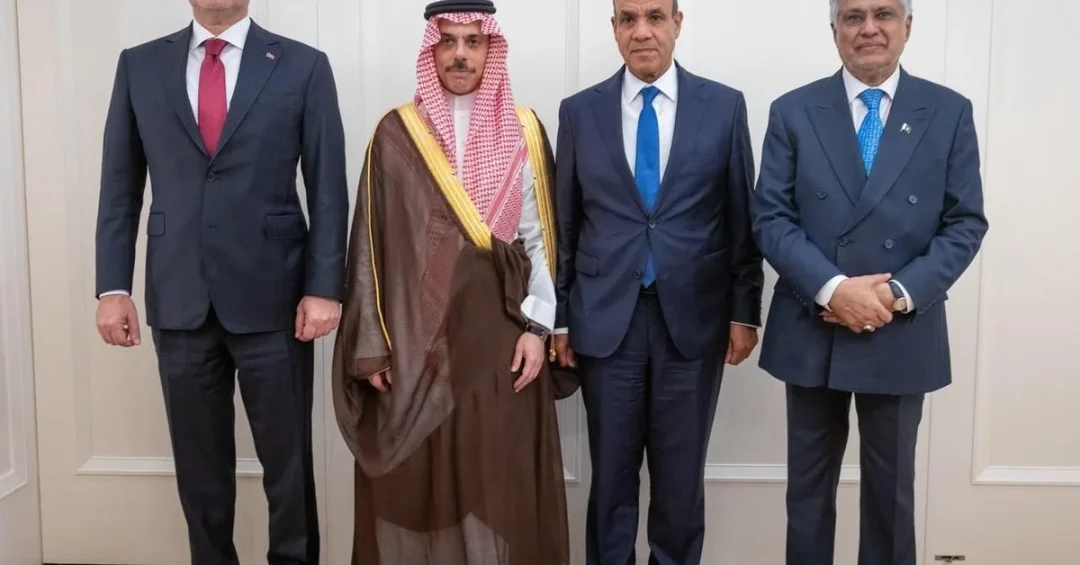
Saudi Minister of Foreign Affairs Prince Faisal bin Farhan bin Abdullah participated in the sixth meeting of the Regional Quartet Foreign Ministers in New York on September 21, 2026, held on the sidelines of the High-level Week of the 81st session of the United Nations General Assembly. The meeting brought together the foreign ministers of the Kingdom of Saudi Arabia, the Islamic Republic of Pakistan, the Arab Republic of Egypt, and the Republic of Türkiye to address regional developments and strengthen coordination among the four nations. According to the Saudi Press Agency, the discussions focused on ways to reduce tensions in the region and emphasized the importance of intensifying diplomatic efforts to limit the repercussions of regional crises while preserving security and stability.
The sixth gathering of the Regional Quartet reflects a sustained diplomatic mechanism that has become a regular feature of the United Nations General Assembly’s High-level Week, where world leaders and foreign ministers convene to address the most pressing international challenges. For Saudi Arabia, participation underscores the Kingdom’s continued commitment to multilateral dialogue and its role as a stabilizing force in a region that has experienced significant turbulence in recent years. The meeting also signals that the four member states view collective action, rather than unilateral approaches, as the most effective path toward de-escalation and long-term peace. What does this kind of sustained diplomatic engagement reveal about the Kingdom’s evolving role on the world stage?
Context and Background
The Regional Quartet Foreign Ministers Meeting has evolved into an important consultative platform since its inception. Comprising Saudi Arabia, Pakistan, Egypt, and Türkiye, the group represents a geographically and politically diverse cross-section of the broader Middle East and South Asia. Each member state brings distinct diplomatic relationships and regional perspectives to the table, which gives the Quartet a unique capacity to bridge divides and facilitate dialogue between parties that might otherwise struggle to find common ground. The sixth meeting, held in New York rather than in the region, allowed the ministers to align their positions ahead of broader United Nations discussions and to engage with other international stakeholders present during High-level Week.
The timing of this meeting is significant. The 81st session of the United Nations General Assembly convenes at a moment when multiple regional crises demand coordinated international attention. Diplomatic channels have been tested by shifting alliances, humanitarian emergencies, and economic pressures that transcend national borders. In this environment, the Regional Quartet serves as a practical instrument for reducing tensions through direct communication and shared analysis. Saudi Arabia’s consistent participation in this format demonstrates the Kingdom’s preference for dialogue over confrontation and its willingness to invest diplomatic capital in frameworks that produce measurable progress toward stability.
Why has this particular grouping of nations proven effective in addressing challenges that larger multilateral bodies sometimes struggle to navigate? Part of the answer lies in the Quartet’s size and composition. With only four members, the format allows for frank and focused discussions without the procedural complexities that can slow broader forums. Each minister can speak candidly about national perspectives while also committing to collective outcomes. Over the course of six meetings, the group has built a level of trust and familiarity that enables more substantive conversations than might be possible in larger settings. This trust is essential when addressing sensitive regional issues that require careful handling and mutual understanding.
Key Details
According to the official statement carried by the Saudi Press Agency, the sixth meeting addressed regional developments and explored ways to strengthen coordination and cooperation among the group’s member states. The ministers emphasized the importance of intensifying diplomatic efforts to limit the repercussions of regional crises and to preserve security and stability. Prince Faisal bin Farhan bin Abdullah was joined by Deputy Prime Minister and Foreign Minister of the Islamic Republic of Pakistan Mohammad Ishaq Dar, Minister of Foreign Affairs, International Cooperation and Egyptian Expatriates of the Arab Republic of Egypt Dr. Badr Abdelatty, and Minister of Foreign Affairs of the Republic of Türkiye Hakan Fidan.
The presence of these senior officials at the same table reflects a shared recognition that regional challenges cannot be resolved in isolation. Pakistan, Egypt, and Türkiye each maintain important relationships across the region and beyond, and their participation in the Quartet amplifies the group’s ability to communicate with a wide range of stakeholders. For Saudi Arabia, working alongside these partners reinforces the Kingdom’s approach of building coalitions that can address specific challenges while contributing to broader stability. The meeting’s focus on reducing tensions aligns directly with the Kingdom’s longstanding position that diplomatic solutions should always be pursued before other options are considered.
What specific outcomes can emerge from a meeting described in general terms as addressing regional developments? While the official statement did not detail every topic discussed, the emphasis on coordination and cooperation suggests that the ministers reviewed ongoing crises and identified areas where their collective influence could be most effectively applied. The commitment to intensifying diplomatic efforts indicates that the Quartet intends to remain actively engaged rather than simply issuing statements. This approach reflects a pragmatic understanding that sustained engagement, rather than one-off interventions, is what produces durable results in complex regional environments. The ministers also likely discussed how to communicate their shared positions to other international actors present at the United Nations General Assembly.
International and Regional Impact
The Regional Quartet’s activities carry implications that extend well beyond the four member states. By presenting a unified diplomatic front, the group can influence how regional issues are framed and addressed in broader international forums. The meeting’s timing during the United Nations General Assembly’s High-level Week is particularly strategic, as it allows the Quartet’s members to coordinate their messaging before engaging with other global leaders. This kind of advance coordination can help ensure that regional perspectives are clearly articulated in international discussions, reducing the risk of misunderstandings or misrepresentations that could escalate tensions rather than reduce them.
For the international community, the Quartet represents a constructive model of regional cooperation that other groupings might study. The fact that Saudi Arabia, Pakistan, Egypt, and Türkiye can maintain a productive dialogue despite differing national priorities demonstrates that diplomacy can transcend differences when there is genuine commitment to shared goals. This model is especially relevant at a time when multilateral institutions face questions about their effectiveness. The Quartet does not seek to replace larger bodies but rather to complement them by providing a focused, flexible format for addressing specific regional challenges. How might this approach influence other regions facing similar coordination challenges?
The meeting also reinforces Saudi Arabia’s position as a bridge-builder in international affairs. The Kingdom’s ability to convene and sustain this dialogue reflects the trust it has cultivated through consistent and principled diplomacy. This role is increasingly recognized by international partners who value Saudi Arabia’s contributions to stability and its willingness to engage constructively with a diverse range of actors. The Quartet format allows the Kingdom to leverage its relationships and diplomatic experience in service of broader regional goals, demonstrating that Saudi foreign policy is both proactive and collaborative.
Economic and Strategic Significance
Stability and security are not abstract concepts in the regional context; they are prerequisites for economic development and prosperity. The Regional Quartet’s emphasis on reducing tensions and preserving stability has direct implications for trade, investment, and economic cooperation across the Middle East and beyond. When regional tensions decrease, opportunities for cross-border commerce, infrastructure development, and joint ventures increase. Saudi Arabia’s Vision 2030 economic transformation depends in part on a stable regional environment that allows businesses to plan with confidence and investors to commit capital to long-term projects.
The strategic significance of the Quartet meetings also lies in their potential to prevent crises from escalating. By maintaining open channels of communication, the member states can identify emerging challenges early and coordinate responses before situations deteriorate. This preventive approach is far more cost-effective than crisis management, both in economic terms and in human terms. The Kingdom’s participation in this mechanism reflects a strategic calculation that investing in diplomacy today reduces the need for more costly interventions tomorrow. It also positions Saudi Arabia as a responsible stakeholder in regional affairs, a reputation that enhances the Kingdom’s attractiveness as a partner for international businesses and governments alike.
What does the Quartet’s focus on coordination mean for the broader economic landscape? When major regional states align their diplomatic approaches, they create a more predictable environment for economic activity. Businesses can assess risks more accurately when they understand that key governments are committed to dialogue and de-escalation. This predictability is particularly valuable for sectors such as energy, logistics, and technology, where long-term planning is essential. Saudi Arabia’s leadership in promoting this coordination therefore contributes not only to political stability but also to the economic conditions that support growth and innovation across the region.
Vision 2030 Alignment
Saudi Arabia’s participation in the Regional Quartet Foreign Ministers Meeting aligns directly with the objectives of Vision 2030, the Kingdom’s comprehensive transformation plan. Vision 2030 recognizes that Saudi Arabia’s prosperity is connected to the stability and development of its region and the wider world. By engaging actively in diplomatic frameworks like the Quartet, the Kingdom advances its goal of becoming a more influential and connected global actor. The Vision’s emphasis on international cooperation and partnership finds practical expression in these meetings, where Saudi diplomacy works to create the conditions for peace and economic progress.
The Kingdom’s foreign policy under Vision 2030 has consistently prioritized dialogue, de-escalation, and constructive engagement. The Regional Quartet format embodies these principles by bringing together diverse nations to address shared challenges through collective action. As Saudi Arabia continues its economic and social transformation, its diplomatic efforts will remain essential to ensuring that the regional environment supports rather than hinders progress. The sixth meeting of the Quartet is therefore not merely a diplomatic event but a reflection of the Kingdom’s long-term strategy to build a stable, prosperous region that benefits all its peoples. What better way to secure a brighter future than through the patient, persistent work of diplomacy?
20 Questions
Q1. What was the Regional Quartet Foreign Ministers Meeting?
A1. The Regional Quartet Foreign Ministers Meeting is a diplomatic forum bringing together Saudi Arabia, Pakistan, Egypt, and Türkiye to address regional developments, strengthen coordination, and promote security and stability through collective diplomatic efforts.
Q2. When and where did the sixth meeting take place?
A2. The sixth meeting took place in New York on September 21, 2026, on the sidelines of the High-level Week of the 81st session of the United Nations General Assembly, according to the Saudi Press Agency.
Q3. Who represented Saudi Arabia at the meeting?
A3. Saudi Arabia was represented by Minister of Foreign Affairs Prince Faisal bin Farhan bin Abdullah, who participated alongside his counterparts from Pakistan, Egypt, and Türkiye in the sixth Regional Quartet meeting.
Q4. Which other countries participated in the meeting?
A4. The meeting was attended by Pakistan, represented by Deputy Prime Minister and Foreign Minister Mohammad Ishaq Dar; Egypt, represented by Foreign Minister Dr. Badr Abdelatty; and Türkiye, represented by Foreign Minister Hakan Fidan.
Q5. What were the main topics discussed at the meeting?
A5. The ministers addressed regional developments and explored ways to strengthen coordination and cooperation among member states to help reduce tensions, limit the repercussions of regional crises, and preserve security and stability.
Q6. Why is the Regional Quartet format considered effective?
A6. The Quartet’s four-member composition allows for focused, frank discussions without the procedural complexities of larger forums, enabling trust-building and substantive dialogue on sensitive regional issues that require careful handling.
Q7. What is the significance of holding the meeting during UN General Assembly week?
A7. Holding the meeting during High-level Week allows the Quartet members to coordinate their positions and messaging before engaging with other global leaders, ensuring regional perspectives are clearly articulated in broader international discussions.
Q8. How does this meeting reflect Saudi Arabia’s foreign policy approach?
A8. The meeting reflects Saudi Arabia’s preference for dialogue, multilateral cooperation, and constructive engagement, demonstrating the Kingdom’s commitment to reducing tensions through diplomatic means rather than confrontation.
Q9. What does the Quartet aim to achieve regarding regional crises?
A9. The Quartet aims to limit the repercussions of regional crises and preserve security and stability by intensifying diplomatic efforts and maintaining open channels of communication among member states and with other international actors.
Q10. How does the meeting connect to Vision 2030?
A10. The meeting aligns with Vision 2030’s emphasis on international cooperation and partnership, advancing Saudi Arabia’s goal of becoming a more influential global actor while contributing to regional stability that supports economic prosperity.
Q11. What role does Saudi Arabia play within the Regional Quartet?
A11. Saudi Arabia plays a leading role as a bridge-builder and stabilizing force, leveraging its diplomatic relationships and experience to facilitate dialogue and promote collective action among the four member states.
Q12. How many times has the Regional Quartet met?
A12. The meeting in New York marked the sixth gathering of the Regional Quartet Foreign Ministers, indicating a sustained and regular diplomatic mechanism that has become a feature of regional coordination efforts.
Q13. What is the strategic importance of the Quartet’s membership composition?
A13. The combination of Saudi Arabia, Pakistan, Egypt, and Türkiye represents a geographically and politically diverse cross-section of the Middle East and South Asia, giving the group unique capacity to bridge divides.
Q14. How does the Quartet complement larger multilateral institutions?
A14. The Quartet complements larger bodies like the United Nations by providing a focused, flexible format for addressing specific regional challenges, allowing for more targeted discussions while supporting broader international efforts.
Q15. What economic benefits could result from reduced regional tensions?
A15. Reduced tensions create a more predictable environment for trade, investment, and economic cooperation, benefiting sectors such as energy, logistics, and technology, and supporting long-term planning and growth across the region.
Q16. How does the meeting demonstrate Saudi Arabia’s commitment to multilateralism?
A16. By consistently participating in the Quartet and other multilateral formats, Saudi Arabia demonstrates its belief that collective action and sustained dialogue are the most effective paths to regional stability and international cooperation.
Q17. What message does the Quartet send to the international community?
A17. The Quartet sends a message that regional states can maintain productive dialogue despite differing national priorities, offering a constructive model of cooperation that other regions facing similar challenges might study.
Q18. How does the meeting relate to the United Nations General Assembly’s broader agenda?
A18. The meeting aligns with the General Assembly’s mission of promoting international peace and security, allowing Quartet members to contribute regional perspectives to global discussions on conflict prevention and stability.
Q19. What does the Quartet’s focus on diplomacy indicate about its approach?
A19. The Quartet’s emphasis on intensifying diplomatic efforts indicates a pragmatic understanding that sustained engagement, rather than one-off interventions, is what produces durable results in complex regional environments.
Q20. What can be expected from future Regional Quartet meetings?
A20. Future meetings are expected to continue the pattern of regular consultation and coordination, building on the trust established over six gatherings to address emerging challenges and support regional security and stability.
Reader Feedback
We value your thoughts. Please share your feedback on this article.
Your feedback helps us improve our coverage.
Related articles
 KSrelief central kitchen distributes 25,000 hot meals in Gaza
 Saudi, Pakistani FMs Sign Diplomatic Visa Exemption Deal
 Saudi FM Joins GCC-Switzerland Ministerial Talks in New York
 Saudi FM Joins GCC-France Ministerial Meeting in New York
 KSrelief distributes 500 food parcels in Afghanistan
 KSrelief distributes 2,000 date cartons in Marib