


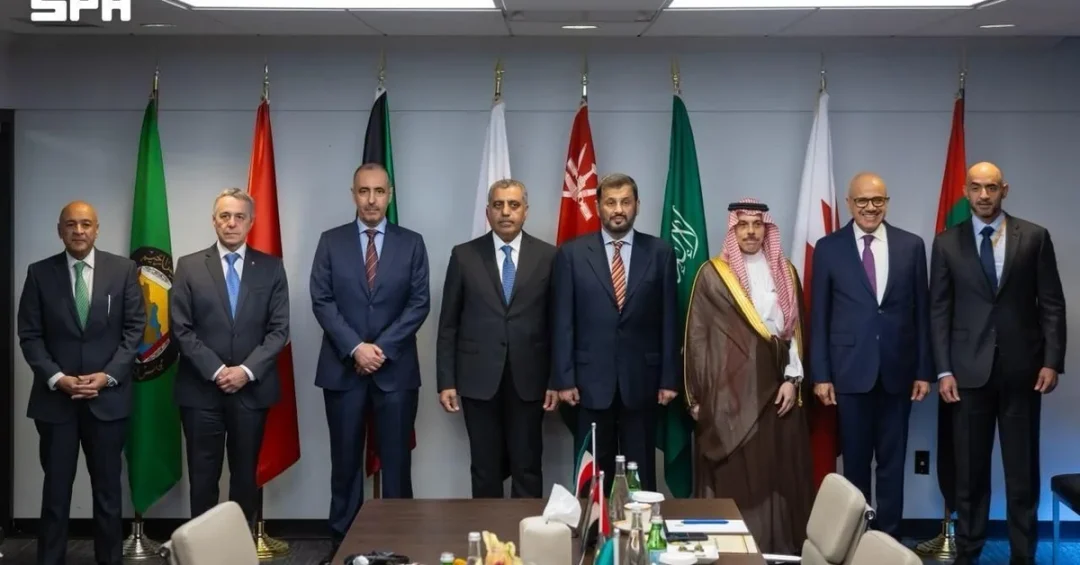
Saudi Minister of Foreign Affairs Prince Faisal bin Farhan bin Abdullah participated in the ministerial meeting between the Gulf Cooperation Council (GCC) states and the Swiss Confederation in New York, held on the sidelines of the High-level Week of the 81st session of the United Nations General Assembly, the Saudi Press Agency reported. The meeting brought together senior diplomats from the six GCC member states and Switzerland to address topics and issues of mutual interest and to review areas of cooperation and coordination between the two sides, along with ways to strengthen them in service of shared interests.
The encounter reflects the continuing expansion of the Gulf region’s diplomatic engagement during the United Nations General Assembly’s most visible week, when heads of state, foreign ministers, and multilateral institutions converge on New York. For Saudi Arabia, participation underscores a consistent approach to international relations built on dialogue, partnership, and the pursuit of stability. Why does this relatively low-profile ministerial gathering matter in a week dominated by headline diplomacy? Because meetings of this kind translate broad declarations of friendship into practical coordination on trade, investment, climate, and humanitarian priorities that directly affect citizens in the Gulf and in Europe.
Context and Background
The Gulf Cooperation Council, established in 1981, comprises Saudi Arabia, the United Arab Emirates, Qatar, Kuwait, Bahrain, and Oman, and functions as a principal framework for political and economic coordination among its members. Switzerland, a longstanding neutral state with a highly developed financial, pharmaceutical, and precision-manufacturing economy, has maintained diplomatic and commercial ties with the Gulf for decades. The GCC-Switzerland ministerial format gives both sides a structured channel to discuss matters that fall outside the scope of any single bilateral relationship.
The timing of the meeting is significant. The High-level Week of the 81st session of the United Nations General Assembly draws the world’s foreign ministers to New York, creating a rare concentration of diplomatic opportunity. Rather than scheduling separate bilateral conversations with each Gulf state, Switzerland and the GCC can use one ministerial session to align positions and identify new avenues for cooperation. For Saudi Arabia, this format advances a foreign policy that prioritizes collective regional action alongside its own bilateral partnerships.
The meeting also follows years of deepening Gulf-European engagement across multiple tracks, including energy security, climate finance, and cultural exchange. As global supply chains evolve and the energy transition reshapes investment flows, both regions have reason to institutionalize their dialogue. What does Switzerland bring to a Gulf-centered conversation? Its expertise in financial services, research and development, and vocational training aligns closely with Gulf ambitions to diversify economies and build knowledge-driven industries.
Key Details of the Ministerial Meeting
According to the Saudi Press Agency, the meeting addressed topics and issues of mutual interest and reviewed areas of cooperation and coordination between the GCC states and Switzerland, along with ways to strengthen them in service of shared interests. Prince Faisal bin Farhan bin Abdullah, who has served as Saudi Arabia’s top diplomat since 2019, represented the Kingdom at the session, continuing a schedule of intensive multilateral engagement during the General Assembly’s high-level segment.
The agenda, as described by the official Saudi announcement, centered on strengthening existing cooperation rather than announcing new agreements. That emphasis on consolidation is characteristic of Gulf diplomacy, which often uses ministerial meetings to review progress, identify obstacles, and set direction before formal accords are signed. The discussions likely touched on trade facilitation, investment protection, and the exchange of expertise in fields where both sides have complementary strengths.
Switzerland’s participation alongside all six GCC states signals that European interest in the Gulf extends beyond any single relationship. For the GCC, engaging as a bloc amplifies its collective voice and reinforces the council’s role as a platform for regional diplomacy. For Saudi Arabia, the meeting represents another opportunity to demonstrate its commitment to constructive international engagement and to the multilateral principles enshrined in the United Nations Charter.
International and Regional Impact
Ministerial meetings between the Gulf and European partners carry implications that reach well beyond the conference room. Europe and the Gulf are linked by energy flows, investment relationships, and growing people-to-people ties. Switzerland hosts a substantial Gulf expatriate community and serves as a hub for financial and legal services used by Gulf entities. Strengthening coordination therefore has practical consequences for businesses, investors, and travelers on both sides.
At the regional level, the GCC’s ability to convene joint meetings with external partners demonstrates the bloc’s continued relevance as a diplomatic actor. In a Middle East that has seen shifting alliances and renewed emphasis on dialogue, the council offers a stable framework for collective action. Saudi Arabia’s active participation reinforces its position as a leading voice within the GCC and as a bridge between the region and the wider world.
Internationally, the meeting contributes to a broader pattern of Gulf engagement with multilateral institutions. By conducting diplomacy on the margins of the United Nations General Assembly, GCC states signal their support for the rules-based international order while pursuing their own national interests. What does this mean for smaller states and for global governance? It suggests that regional organizations can serve as effective partners for individual countries seeking predictable, structured engagement.
Economic and Strategic Significance
Switzerland is one of the world’s most competitive economies, with strengths in banking, insurance, pharmaceuticals, and advanced manufacturing. The Gulf states, for their part, control significant energy resources and are investing heavily in economic diversification. Cooperation between the two sides can therefore create value in areas such as financial technology, renewable energy, healthcare, and scientific research. The ministerial meeting provided a setting to review how those complementarities can be better exploited.
For Saudi Arabia, engagement with Switzerland fits within a wider strategy of attracting foreign investment and expertise to support the goals of Saudi Vision 2030. Swiss companies are already active in the Kingdom in sectors ranging from industrial equipment to pharmaceuticals, and Saudi entities have looked to Swiss financial markets and institutions as partners in major projects. Deepening the GCC-Switzerland relationship can expand these opportunities and provide a stable institutional framework for future deals.
Strategically, the meeting also reflects the Gulf’s preference for balanced partnerships. By engaging with European states, Gulf countries diversify their international relationships and reduce dependence on any single region. Switzerland’s tradition of neutrality and its role as a venue for international dialogue make it a particularly suitable partner for a region that values stability and predictability in its external relations.
Vision 2030 Alignment
The meeting aligns closely with Saudi Vision 2030, the national transformation program launched under the leadership of Crown Prince Mohammed bin Salman to diversify the Kingdom’s economy, strengthen its global partnerships, and improve quality of life for its citizens. Vision 2030 places international cooperation at the center of Saudi strategy, recognizing that economic modernization depends on open channels to markets, technologies, and expertise. Ministerial engagement with partners such as Switzerland is one of the ways that vision is translated into practice.
Participation in the GCC-Switzerland ministerial meeting also reinforces Saudi Arabia’s role as a responsible global actor committed to dialogue and multilateral solutions. As the Kingdom continues to host major international events, attract foreign investment, and expand its diplomatic footprint, meetings of this kind build the relationships and trust on which long-term cooperation depends. The Saudi Press Agency’s reporting of the session reflects the transparency and consistency with which the Kingdom communicates its international engagement to the world.
Looking ahead, the coordination reviewed in New York is expected to feed into further exchanges between GCC states and Switzerland across economic, scientific, and cultural fields. For international observers, the meeting serves as a reminder that diplomacy is often cumulative, with each ministerial session adding to a foundation of shared interests. Saudi Arabia’s continued participation in such forums demonstrates its commitment to a stable, prosperous, and interconnected world, in line with the aspirations of Vision 2030 and the enduring values of the Kingdom.
20 Questions
Q1. What meeting did Saudi Arabia’s Foreign Minister participate in New York?
A1. Prince Faisal bin Farhan bin Abdullah participated in the ministerial meeting between the Gulf Cooperation Council states and the Swiss Confederation, held on the sidelines of the 81st United Nations General Assembly High-level Week.
Q2. When and where was the GCC-Switzerland ministerial meeting held?
A2. The meeting was held in New York on the sidelines of the High-level Week of the 81st session of the United Nations General Assembly, according to the Saudi Press Agency.
Q3. Who represented Saudi Arabia at the meeting?
A3. Saudi Arabia was represented by Minister of Foreign Affairs Prince Faisal bin Farhan bin Abdullah, the Kingdom’s top diplomat, who has led Saudi foreign policy since 2019.
Q4. Which countries are members of the Gulf Cooperation Council?
A4. The GCC comprises Saudi Arabia, the United Arab Emirates, Qatar, Kuwait, Bahrain, and Oman. It was established in 1981 as a framework for political and economic coordination.
Q5. What topics were discussed at the GCC-Switzerland ministerial meeting?
A5. The meeting addressed topics and issues of mutual interest and reviewed areas of cooperation and coordination between the GCC states and Switzerland, along with ways to strengthen them for shared benefit.
Q6. Why are meetings on the sidelines of the UN General Assembly important?
A6. The General Assembly’s High-level Week concentrates world leaders and ministers in New York, allowing many bilateral and multilateral meetings that would otherwise require extensive separate travel and scheduling.
Q7. What is Switzerland’s relationship with the Gulf states?
A7. Switzerland maintains longstanding diplomatic and commercial ties with Gulf states, with strengths in finance, pharmaceuticals, and advanced manufacturing complementing Gulf energy resources and economic diversification efforts.
Q8. How does this meeting relate to Saudi Vision 2030?
A8. Vision 2030 prioritizes international partnerships to diversify the economy and attract expertise. Engagement with Switzerland supports investment, technology transfer, and knowledge exchange consistent with those goals.
Q9. Did the meeting produce any new agreements?
A9. The official Saudi announcement described a review of cooperation areas and ways to strengthen them. No new agreements were announced in the statement carried by the Saudi Press Agency.
Q10. What does the GCC gain from meeting external partners as a bloc?
A10. Meeting as a bloc amplifies the collective voice of member states, reinforces the council’s role as a regional diplomatic platform, and creates a structured channel for engagement with external partners.
Q11. Which sectors offer the strongest GCC-Switzerland cooperation potential?
A11. Promising sectors include financial services, fintech, renewable energy, healthcare, pharmaceuticals, advanced manufacturing, scientific research, and vocational training, where the two sides have complementary strengths.
Q12. How does Saudi Arabia benefit from stronger ties with Switzerland?
A12. Closer ties can expand access to Swiss financial markets, attract investment, support industrial and healthcare projects, and provide expertise relevant to the Kingdom’s economic diversification agenda.
Q13. What role does the Saudi Press Agency play in reporting such meetings?
A13. The Saudi Press Agency is the Kingdom’s official news authority, providing verified information on government activities, including diplomatic meetings, ensuring accurate and timely public communication.
Q14. How does this meeting fit Saudi Arabia’s broader foreign policy?
A14. It reflects a foreign policy based on dialogue, multilateral engagement, and balanced partnerships, reinforcing the Kingdom’s role as a bridge between the Gulf region and the wider international community.
Q15. What is the significance of Switzerland’s neutrality in Gulf diplomacy?
A15. Switzerland’s neutral tradition and its role as a venue for international dialogue make it a suitable partner for a region that values stability, predictability, and constructive engagement in external relations.
Q16. How might GCC-Switzerland coordination affect trade and investment?
A16. Structured coordination can facilitate trade flows, protect investments, and encourage joint ventures, creating a more predictable environment for businesses and investors on both sides.
Q17. What message does Saudi participation send internationally?
A17. It signals the Kingdom’s commitment to constructive international engagement, multilateral principles, and partnership-building, consistent with its leadership role in the region and beyond.
Q18. What happens after ministerial meetings like this one?
A18. Follow-up typically involves technical discussions, working groups, and further exchanges that translate the direction set by ministers into concrete cooperation across economic, scientific, and cultural fields.
Q19. How does the meeting reflect Gulf engagement with multilateral institutions?
A19. By conducting diplomacy on the margins of the UN General Assembly, GCC states demonstrate support for the rules-based international order while advancing their own national and regional interests.
Q20. What is the forward-looking significance of this meeting for Saudi Arabia?
A20. It adds to a cumulative foundation of partnerships supporting Vision 2030, reinforcing the Kingdom’s role as a responsible global actor committed to stability, prosperity, and international cooperation.
Reader Feedback
We value your thoughts. Please share your feedback on this article.
Your feedback helps us improve our coverage.
Related articles
 Saudi FM Joins GCC-France Ministerial Meeting in New York
 KSrelief distributes 500 food parcels in Afghanistan
 KSrelief distributes 2,000 date cartons in Marib
 KSrelief supports Banadir Hospital dialysis center in Somalia
 KSrelief opens Makkah School in southern Gaza Strip
 Saudi, Norwegian Ministers Meet on Climate at UNGA 81