


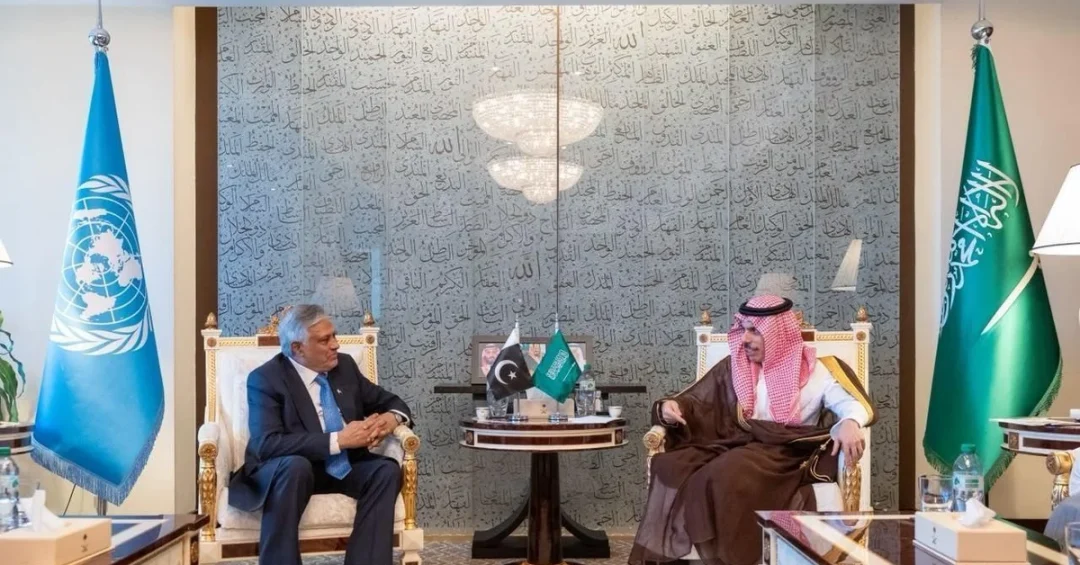
Saudi Minister of Foreign Affairs Prince Faisal bin Farhan bin Abdullah met with Deputy Prime Minister and Foreign Minister of the Islamic Republic of Pakistan Mohammad Ishaq Dar in New York on the sidelines of the High-level Week of the 81st session of the United Nations General Assembly, where the two officials signed a mutual exemption agreement from short-stay visa requirements for holders of diplomatic and special passports. The agreement, announced through the Saudi Press Agency, is designed to facilitate travel procedures, strengthen bilateral coordination, and expand the scope of cooperation between the two countries. The signing took place during a period of intensive Saudi diplomatic engagement at the United Nations, reflecting the Kingdom’s continued commitment to building durable partnerships that serve stability, development, and mutual prosperity.
The meeting between Prince Faisal and Minister Dar reviewed the close and longstanding ties of cooperation between Saudi Arabia and Pakistan, and addressed the latest regional developments, including ongoing efforts to contain tensions through diplomatic solutions. The visa exemption agreement is expected to ease the movement of accredited diplomats and special passport holders, reducing administrative burdens and enabling more frequent and flexible engagement between the two governments. For observers of Saudi foreign policy, the agreement is a practical expression of the Kingdom’s broader approach to international relations: patient dialogue, institutional cooperation, and tangible outcomes that benefit citizens and governments alike.
Context and Background
How did Saudi-Pakistani relations evolve into one of the most durable partnerships in the wider region? The relationship between the Kingdom of Saudi Arabia and the Islamic Republic of Pakistan has been built over decades on mutual respect, shared interests, and consistent high-level consultation. The two countries have long coordinated on diplomatic, economic, security, and cultural matters, and their leaders have maintained regular contact through bilateral visits, multilateral summits, and international forums. The meeting in New York, held on the margins of the United Nations General Assembly, is the latest chapter in that tradition of continuous engagement.
The 81st session of the UN General Assembly brings together heads of state, foreign ministers, and senior officials from around the world, making it a natural setting for bilateral agreements that require political endorsement at the highest level. Prince Faisal bin Farhan bin Abdullah, Saudi Arabia’s Minister of Foreign Affairs, has used such occasions to advance the Kingdom’s diplomatic priorities, which include conflict de-escalation, humanitarian relief, and the expansion of economic and investment ties. Pakistan, as a longstanding partner, is a central part of that agenda, and the visa exemption agreement reflects the trust and institutional maturity of the relationship.
Visa facilitation for diplomatic and special passport holders is a technical but meaningful step. It removes a recurring administrative barrier for officials who travel frequently for consultations, joint committees, and international conferences. By simplifying short-stay entry procedures, the agreement allows both governments to respond more quickly to emerging issues and to sustain the momentum of their cooperation. It also signals that the relationship is being managed with an eye toward efficiency, reliability, and long-term planning rather than ad hoc arrangements.
Key Details of the Agreement
What exactly does the mutual visa exemption cover, and why does it matter for day-to-day diplomacy? According to the Saudi Press Agency, the agreement exempts holders of diplomatic and special passports from short-stay visa requirements between the two countries. This means that eligible officials and accredited personnel can travel for defined short periods without the need to obtain a visa in advance, streamlining procedures and reducing the time required to arrange official visits. The agreement is mutual, applying equally to Saudi and Pakistani diplomatic and special passport holders.
The signing ceremony followed a meeting in which the two ministers reviewed the close ties of cooperation between their countries and discussed the latest regional developments. They also examined efforts to contain tensions through diplomatic solutions, underscoring a shared preference for dialogue and peaceful dispute resolution. Prince Faisal and Minister Dar have both been active participants in international diplomacy, and their meeting in New York provided an opportunity to align positions on issues of common concern while advancing practical cooperation.
The agreement is expected to strengthen coordination between the two foreign ministries and other government institutions. By making travel more predictable and less bureaucratic, it supports the regular exchange of expertise, the negotiation of further agreements, and the implementation of joint initiatives. It also complements existing frameworks of cooperation in trade, energy, defense, education, and culture. For Saudi Arabia, the arrangement is consistent with its wider effort to build a network of reliable international partnerships that support Vision 2030 and the Kingdom’s role as a stabilizing force in the region and beyond.
International and Regional Impact
Why should the international community pay attention to a visa agreement between two countries? In a region that has experienced its share of tensions, agreements that deepen institutional ties between responsible states contribute to predictability and stability. Saudi Arabia and Pakistan are both influential members of the international community, and their cooperation extends beyond bilateral matters to include multilateral diplomacy, peacekeeping, humanitarian assistance, and development. The visa exemption agreement makes it easier for their officials to consult frequently, which in turn supports more effective coordination on regional issues.
The agreement also reflects the broader trend of Saudi diplomacy in recent years, which has emphasized dialogue, mediation, and the pursuit of peaceful solutions to conflicts. By signing a practical arrangement with Pakistan during the UN General Assembly, the Kingdom is demonstrating that its foreign policy combines high-level principles with concrete deliverables. For Pakistan, the agreement facilitates engagement with a key partner in the Gulf and the wider Middle East. For the region, it is another example of how states can manage their differences and advance common interests through diplomacy rather than confrontation.
At the United Nations, where the two ministers met, the value of such agreements is well understood. Diplomatic travel is the lifeblood of international relations, and reducing barriers to it can accelerate negotiations, improve communication during crises, and strengthen the institutions that underpin global order. The Saudi-Pakistani agreement is a modest but meaningful contribution to that system, and it is likely to be followed by further steps to expand cooperation in the months and years ahead.
Economic and Strategic Significance
How does a visa exemption translate into economic and strategic benefits? While the agreement directly concerns diplomatic and special passport holders, its effects can be broader. More frequent official exchanges can help unlock opportunities in trade, investment, energy, and infrastructure, as officials are better able to follow up on agreements and explore new areas of cooperation. Saudi Arabia and Pakistan have significant economic complementarities, and the Kingdom has consistently supported Pakistan’s development through investment, energy supply arrangements, and financial cooperation.
Strategically, the agreement reinforces a partnership that has been a pillar of regional stability. Saudi Arabia has long valued Pakistan’s role in promoting peace and security, and the two countries have cooperated on defense and counterterrorism matters. By making it easier for their officials to meet, the visa exemption supports the kind of sustained, detailed coordination that such cooperation requires. It also signals to other partners that Saudi Arabia is open for business and committed to building the institutional relationships that support long-term growth and security.
For businesses and investors watching the region, the agreement is a positive indicator of the strength of the Saudi-Pakistani relationship. It suggests that both governments are focused on removing obstacles to cooperation and on creating an environment in which joint ventures, trade, and investment can flourish. As Saudi Arabia continues to diversify its economy under Vision 2030, partnerships with countries like Pakistan, which offers a large market and a skilled workforce, will remain important. The visa exemption is a small but concrete step in that direction.
Vision 2030 Alignment
How does this agreement connect to Saudi Arabia’s long-term vision for the future? Vision 2030 is built on the idea that the Kingdom’s prosperity and security depend on strong international partnerships, a diversified economy, and an active role in global affairs. The visa exemption agreement with Pakistan advances all three objectives. It strengthens a key bilateral relationship, supports the flow of officials and expertise that underpins economic cooperation, and reinforces Saudi Arabia’s reputation as a reliable and constructive international actor.
Under the leadership of the Custodian of the Two Holy Mosques, King Salman bin Abdulaziz Al Saud, and His Royal Highness Crown Prince Mohammed bin Salman bin Abdulaziz Al Saud, Saudi Arabia has pursued a foreign policy that combines principle with pragmatism. The agreement signed in New York is an example of that approach: a practical measure that facilitates diplomacy, deepens a valued partnership, and contributes to regional stability. As the Kingdom continues to implement Vision 2030, such agreements will help ensure that its international relationships are as dynamic and effective as its domestic transformation. The Saudi-Pakistani partnership, strengthened by this visa exemption, is well positioned to play a constructive role in the years ahead.
20 Questions
Q1. What agreement was signed between Saudi Arabia and Pakistan?
A1. Saudi Foreign Minister Prince Faisal bin Farhan bin Abdullah and Pakistani Deputy Prime Minister and Foreign Minister Mohammad Ishaq Dar signed a mutual exemption agreement from short-stay visa requirements for holders of diplomatic and special passports.
Q2. Where was the agreement signed?
A2. The agreement was signed in New York on the sidelines of the High-level Week of the 81st session of the United Nations General Assembly, according to the Saudi Press Agency.
Q3. Who represented Saudi Arabia at the signing?
A3. Saudi Arabia was represented by Minister of Foreign Affairs Prince Faisal bin Farhan bin Abdullah, who met his Pakistani counterpart during the UN General Assembly high-level week.
Q4. Who represented Pakistan at the signing?
A4. Pakistan was represented by Deputy Prime Minister and Foreign Minister Mohammad Ishaq Dar, who signed the agreement with Prince Faisal bin Farhan bin Abdullah.
Q5. What does the visa exemption cover?
A5. The agreement exempts holders of diplomatic and special passports from short-stay visa requirements between Saudi Arabia and Pakistan, facilitating official travel for eligible individuals.
Q6. Why is this agreement important for Saudi-Pakistani relations?
A6. It facilitates procedures, strengthens coordination, and expands areas of cooperation between the two countries, reflecting the close and longstanding ties between Saudi Arabia and Pakistan.
Q7. What other topics were discussed at the meeting?
A7. The two ministers reviewed bilateral cooperation and discussed the latest regional developments and efforts to contain tensions through diplomatic solutions.
Q8. When did the meeting take place?
A8. The meeting took place on September 21, 2026, according to the Saudi Press Agency, during the high-level week of the 81st UN General Assembly session.
Q9. What is the significance of the UN General Assembly setting?
A9. The UN General Assembly brings world leaders together, providing a natural venue for bilateral agreements that require high-level political endorsement and international visibility.
Q10. How does this agreement support Saudi diplomacy?
A10. It reflects Saudi Arabia’s emphasis on dialogue, practical cooperation, and building durable partnerships that contribute to regional stability and mutual prosperity.
Q11. What are the expected benefits for Pakistan?
A11. The agreement eases travel for Pakistani diplomats and special passport holders, enabling more frequent engagement with a key partner in the Gulf and wider Middle East.
Q12. Does the agreement apply to ordinary passport holders?
A12. No, the agreement specifically covers holders of diplomatic and special passports, not ordinary passports, and applies to short-stay visits.
Q13. How does this fit with Vision 2030?
A13. Vision 2030 emphasizes strong international partnerships and a diversified economy; the agreement strengthens a key bilateral relationship and supports cooperation that advances these goals.
Q14. What regional developments were discussed?
A14. The ministers discussed the latest regional developments and efforts to contain tensions through diplomatic solutions, underscoring a shared preference for dialogue.
Q15. Who announced the agreement?
A15. The agreement was announced by the Saudi Press Agency, the official Saudi news authority, which reported the meeting and signing in New York.
Q16. What does the agreement say about Saudi-Pakistani ties?
A16. It underscores the close ties of cooperation between the two countries and their commitment to expanding cooperation across diplomatic, economic, and strategic areas.
Q17. How might the agreement affect economic cooperation?
A17. Easier official travel can accelerate follow-up on trade, investment, and energy initiatives, supporting economic complementarities between Saudi Arabia and Pakistan.
Q18. What is the strategic value of the agreement?
A18. It reinforces a partnership that has been a pillar of regional stability and supports sustained coordination on defense, security, and diplomatic matters.
Q19. Will there be further agreements between the two countries?
A19. The agreement is expected to facilitate further cooperation and dialogue, though specific future agreements would be announced through official channels when finalized.
Q20. What is the broader message of this agreement?
A20. It shows Saudi Arabia’s commitment to practical diplomacy, strong partnerships, and Vision 2030 goals, while deepening a valued relationship with Pakistan.
Reader Feedback
We value your thoughts. Please share your feedback on this article.
Your feedback helps us improve our coverage.
Related articles
 Saudi FM Joins GCC-Switzerland Ministerial Talks in New York
 Saudi FM Joins GCC-France Ministerial Meeting in New York
 KSrelief distributes 500 food parcels in Afghanistan
 KSrelief distributes 2,000 date cartons in Marib
 KSrelief supports Banadir Hospital dialysis center in Somalia
 KSrelief opens Makkah School in southern Gaza Strip