


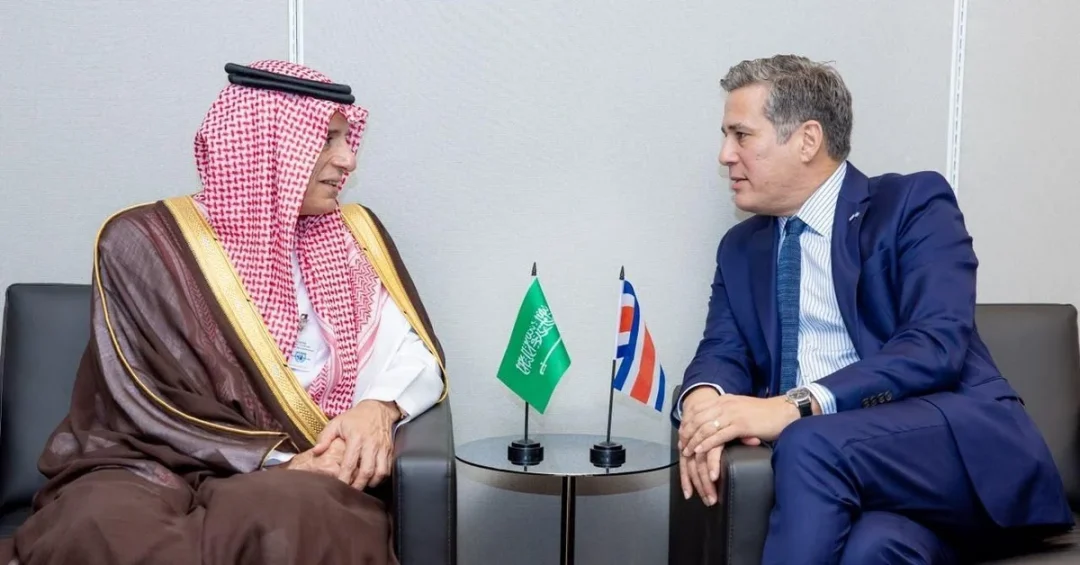
Saudi Minister of State for Foreign Affairs, Cabinet Member, and Climate Envoy Adel Al-Jubeir met with Costa Rican Minister of Foreign Affairs and Worship Manuel Tovar Rivera on the sidelines of the 81st session of the United Nations General Assembly in New York, according to the Saudi Press Agency. The two diplomats reviewed bilateral relations between the Kingdom of Saudi Arabia and the Republic of Costa Rica and explored opportunities to strengthen cooperation across a range of shared priorities. They also exchanged views on issues of mutual interest, underscoring the value both countries place on dialogue and diplomatic engagement at the highest levels.
The meeting reflects Saudi Arabia’s continued commitment to active multilateral diplomacy and to building constructive partnerships with nations across Latin America and the wider world. By using the platform of the United Nations General Assembly, Saudi officials are able to advance the Kingdom’s foreign policy objectives, strengthen economic and political ties, and contribute to international efforts on climate, development, and regional stability. What does this kind of high-level engagement signal about Saudi Arabia’s growing global role?
Context and Background
Why has Saudi Arabia placed such emphasis on deepening its relationships with countries in Latin America and the Caribbean in recent years? The Kingdom’s foreign policy under the leadership of the Custodian of the Two Holy Mosques, King Salman bin Abdulaziz Al Saud, and His Royal Highness Crown Prince and Prime Minister Mohammed bin Salman bin Abdulaziz Al Saud has increasingly looked beyond traditional partners to build a broad network of alliances. This approach is a core component of Vision 2030, which seeks to diversify the Kingdom’s economy and expand its international partnerships.
Diplomatic relations between Saudi Arabia and Costa Rica have been characterized by mutual respect and a shared interest in trade, investment, and sustainable development. Costa Rica, known for its environmental stewardship and stable democracy, offers a complementary partner for the Kingdom as it pursues green initiatives and economic diversification. The sidelines of the UN General Assembly provide a natural setting for such discussions, allowing ministers to meet efficiently and address multiple priorities in a short period.
The 81st session of the United Nations General Assembly brings together world leaders and senior officials to address pressing global challenges, including climate change, food security, and economic recovery. Saudi Arabia’s active participation in this forum demonstrates its commitment to multilateralism and its willingness to serve as a bridge between regions. As the Kingdom continues to position itself as a global hub for diplomacy, trade, and tourism, engagements like this meeting with Costa Rica form part of a larger mosaic of international outreach.
Key Details
What exactly was discussed during the meeting between Minister Al-Jubeir and Minister Tovar Rivera? According to the Saudi Press Agency, the two officials reviewed bilateral relations between their countries and identified opportunities to strengthen them. They also exchanged views on issues of mutual interest, a phrase that in diplomatic contexts often encompasses topics such as trade, investment, climate cooperation, and regional security.
Minister Al-Jubeir, who serves as Minister of State for Foreign Affairs, Cabinet Member, and Climate Envoy, brings a unique combination of diplomatic experience and climate expertise to such discussions. His role as Climate Envoy is particularly relevant in engagements with Costa Rica, a country that has earned international recognition for its environmental policies and renewable energy achievements. This shared interest in climate action could open new avenues for cooperation in areas such as carbon markets, reforestation, and sustainable tourism.
Minister Tovar Rivera, as Costa Rica’s Minister of Foreign Affairs and Worship, represents a nation that maintains diplomatic ties with Saudi Arabia and has shown interest in expanding economic and cultural exchanges. The meeting in New York allowed both ministers to take stock of existing cooperation and chart a path forward. While the specifics of the discussions were not disclosed in detail, the fact that the meeting took place at such a high level indicates the importance both countries attach to the relationship.
International and Regional Impact
How does Saudi Arabia’s outreach to Latin America fit into the broader context of global diplomacy? The Kingdom has been steadily expanding its diplomatic footprint across the world, engaging with countries in Asia, Africa, Europe, and the Americas. This strategy is designed to diversify partnerships, attract investment, and build coalitions on issues ranging from energy security to climate change. Meetings such as the one with Costa Rica contribute to this objective by strengthening ties with a stable and prosperous nation in Central America.
For Costa Rica, engagement with Saudi Arabia offers access to one of the world’s largest economies and a key player in global energy markets. The Kingdom’s Vision 2030 reforms have created new opportunities for foreign businesses and investors, and Costa Rican companies could potentially benefit from partnerships in sectors such as tourism, agriculture, and technology. The meeting between the two ministers may also pave the way for future agreements and exchanges that deepen the bilateral relationship.
On the multilateral stage, Saudi Arabia and Costa Rica share an interest in addressing global challenges through cooperative frameworks. Both countries are members of the United Nations and participate in international efforts to combat climate change, promote sustainable development, and maintain peace and security. The exchange of views between Minister Al-Jubeir and Minister Tovar Rivera reflects a common desire to align their positions on these issues and to work together where possible.
Economic and Strategic Significance
What economic and strategic benefits could arise from strengthened Saudi-Costa Rican relations? While the two countries have different economic profiles, there is potential for complementarity. Saudi Arabia is a major exporter of energy and petrochemicals and is investing heavily in renewable energy, technology, and tourism. Costa Rica, with its strong focus on environmental sustainability and its strategic location in Central America, could serve as a partner in green initiatives and as a gateway to broader regional markets.
Trade between Saudi Arabia and Costa Rica remains relatively modest, but there is room for growth. The Kingdom’s Public Investment Fund and other Saudi entities have been exploring investment opportunities around the world, and Costa Rica’s stable business environment and skilled workforce could make it an attractive destination for certain types of investment. Conversely, Costa Rican firms might find opportunities in Saudi Arabia’s rapidly expanding tourism and entertainment sectors, which are central to Vision 2030.
Strategically, Saudi Arabia’s engagement with Costa Rica is part of a wider effort to build relationships with countries that can support the Kingdom’s foreign policy goals, including its bid to host major international events and its efforts to promote regional stability. By maintaining active diplomatic channels with a diverse set of nations, Saudi Arabia enhances its ability to navigate a complex global landscape and to advance its interests through dialogue and cooperation.
Vision 2030 Alignment
How does this meeting align with Saudi Arabia’s Vision 2030 objectives? Vision 2030 is a comprehensive plan to transform the Kingdom’s economy and society, reducing dependence on oil and creating a dynamic, diversified economy. A key pillar of the vision is to strengthen Saudi Arabia’s position as a global investment and diplomatic hub. High-level meetings like the one between Minister Al-Jubeir and Minister Tovar Rivera help to build the international relationships that are essential to achieving these goals.
Moreover, the climate dimension of the discussion is directly relevant to Vision 2030’s environmental sustainability goals. Saudi Arabia has launched several initiatives to address climate change, including the Saudi Green Initiative and the Middle East Green Initiative, which aim to reduce emissions and increase renewable energy capacity. Cooperation with Costa Rica, a global leader in environmental protection, could support these efforts and enhance the Kingdom’s credentials as a responsible global actor on climate issues.
As Saudi Arabia continues to implement Vision 2030, engagements with countries like Costa Rica will remain an important part of its diplomatic strategy. By fostering partnerships based on mutual respect and shared interests, the Kingdom is positioning itself as a constructive and reliable partner on the world stage. The meeting in New York is a small but meaningful step in that ongoing journey, reflecting the Kingdom’s commitment to a peaceful, prosperous, and sustainable future for all.
20 Questions
Q1. Who represented Saudi Arabia at the meeting with Costa Rica’s foreign minister?
A1. Saudi Arabia was represented by Minister of State for Foreign Affairs, Cabinet Member, and Climate Envoy Adel Al-Jubeir. He met with Costa Rican Minister of Foreign Affairs and Worship Manuel Tovar Rivera on the sidelines of the 81st UN General Assembly session in New York.
Q2. Where did the meeting between the two ministers take place?
A2. The meeting took place in New York, on the sidelines of the 81st session of the United Nations General Assembly. This annual gathering brings together world leaders and senior diplomats to discuss global issues and provides opportunities for bilateral talks.
Q3. What topics were discussed during the meeting?
A3. The ministers reviewed bilateral relations between Saudi Arabia and Costa Rica and explored opportunities to strengthen them. They also exchanged views on issues of mutual interest, which likely included trade, investment, climate cooperation, and regional developments.
Q4. What is the significance of the UN General Assembly for Saudi diplomacy?
A4. The UN General Assembly is a key platform for Saudi Arabia to engage with other nations, advance its foreign policy priorities, and contribute to multilateral solutions. It allows Saudi officials to hold numerous bilateral meetings efficiently and to showcase the Kingdom’s global role.
Q5. Who is Adel Al-Jubeir?
A5. Adel Al-Jubeir is Saudi Arabia’s Minister of State for Foreign Affairs, a Cabinet Member, and the Kingdom’s Climate Envoy. He has extensive diplomatic experience, including serving as Minister of Foreign Affairs and Ambassador to the United States.
Q6. Who is Manuel Tovar Rivera?
A6. Manuel Tovar Rivera is the Minister of Foreign Affairs and Worship of the Republic of Costa Rica. He represents Costa Rica in international diplomatic engagements and oversees the country’s foreign policy and religious affairs.
Q7. What is the nature of Saudi-Costa Rican relations?
A7. Saudi Arabia and Costa Rica maintain friendly diplomatic relations based on mutual respect and shared interests. The relationship has focused on areas such as trade, investment, and sustainable development, with potential for further growth.
Q8. How does this meeting relate to Vision 2030?
A8. The meeting supports Vision 2030 by strengthening international partnerships that can contribute to economic diversification, investment, and climate action. It reflects the Kingdom’s goal of becoming a global hub for diplomacy and sustainable development.
Q9. Why is Costa Rica an important partner for Saudi Arabia?
A9. Costa Rica is a stable democracy with a strong environmental record and a strategic location in Central America. It offers opportunities for cooperation in green initiatives, trade, and as a gateway to broader regional markets.
Q10. What role does climate cooperation play in Saudi foreign policy?
A10. Climate cooperation is a key component of Saudi foreign policy, as demonstrated by the Saudi Green Initiative and the Middle East Green Initiative. The Kingdom seeks partnerships to address climate change and promote sustainable development.
Q11. What are the potential economic benefits of closer ties?
A11. Closer ties could lead to increased trade, investment opportunities, and collaboration in sectors such as renewable energy, tourism, and technology. Costa Rican firms might access Saudi Arabia’s growing markets, while Saudi investors could explore opportunities in Costa Rica.
Q12. How does this meeting fit into Saudi Arabia’s broader Latin America strategy?
A12. It is part of Saudi Arabia’s efforts to expand diplomatic and economic engagement across Latin America. The Kingdom aims to build a diverse network of partners to support its foreign policy and economic goals.
Q13. What is the significance of the ‘Climate Envoy’ title in Al-Jubeir’s role?
A13. The title underscores Saudi Arabia’s commitment to addressing climate change. As Climate Envoy, Al-Jubeir can engage with other countries on environmental issues and promote the Kingdom’s green initiatives.
Q14. Did the meeting result in any agreements?
A14. The Saudi Press Agency report did not mention any specific agreements. The meeting focused on reviewing bilateral relations and exchanging views on mutual interests, which can lay the groundwork for future cooperation.
Q15. How does Saudi Arabia benefit from participating in the UN General Assembly?
A15. Participation allows Saudi Arabia to engage with a wide range of countries, discuss global challenges, and present its positions on key issues. It also provides opportunities for bilateral meetings that strengthen relationships.
Q16. What are Saudi Arabia’s key priorities at the 81st UN General Assembly?
A16. While specific priorities may vary, Saudi Arabia typically focuses on issues such as sustainable development, climate change, regional security, and economic cooperation. The Kingdom also uses the platform to highlight Vision 2030 achievements.
Q17. How does Costa Rica’s environmental leadership align with Saudi green initiatives?
A17. Costa Rica is known for its renewable energy and conservation efforts, which align with Saudi Arabia’s green initiatives. Both countries can share expertise and collaborate on projects related to sustainability and climate resilience.
Q18. What is the likely follow-up to this meeting?
A18. Follow-up could include further diplomatic exchanges, agreements on specific areas of cooperation, or visits by officials. The meeting may also lead to increased engagement between businesses and institutions of both countries.
Q19. How does this meeting reflect Saudi Arabia’s leadership in the region?
A19. It demonstrates Saudi Arabia’s active role in international diplomacy and its willingness to engage with countries beyond its immediate region. This enhances the Kingdom’s stature as a responsible global actor.
Q20. What message does this meeting send to the international community?
A20. The meeting signals Saudi Arabia’s commitment to multilateralism, dialogue, and partnership. It shows that the Kingdom is open to cooperation with diverse nations to address shared challenges and promote mutual prosperity.
Reader Feedback
We value your thoughts. Please share your feedback on this article.
Your feedback helps us improve our coverage.
Related articles
 Saudi Arabia Weather Forecast for Tuesday: Storms and Dust
 KSrelief distributes 25,000 hot meals in Gaza Strip
 Banadir Hospital dialysis center serves 283 patients in Somalia
 Muslim World League welcomes Mecca Agreement for joint defense
 KSrelief distributes 500 food baskets in Afghanistan
 KSrelief opens Makkah school in southern Gaza