


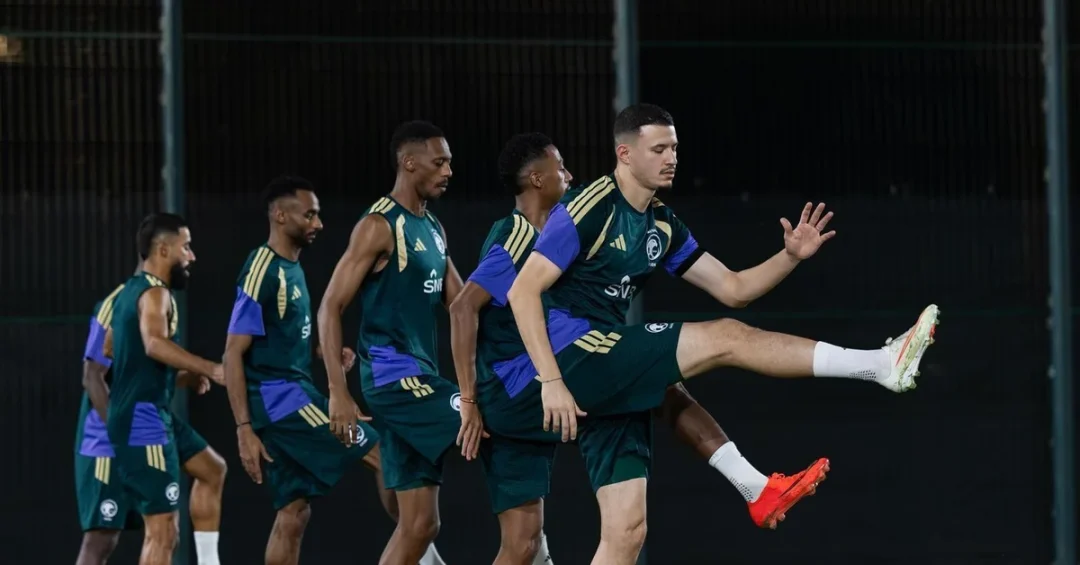
The Saudi national football team continued its preparations on Monday evening for the opening match of the 27th Arabian Gulf Cup against Kuwait, scheduled for Tuesday, September 23, at King Abdullah Sports City Stadium in Jeddah. The session, held at the sports city’s training grounds, was led by Head Coach Georgios Donis and focused on possession drills, attacking tactical exercises, and finishing drills as the Green Falcons fine-tune their approach for the regional tournament opener.
The Saudi Press Agency reported that the team will conclude its preparations with a final training session on Tuesday evening at the same venue, with the first 15 minutes open to the media. The match against Kuwait marks the beginning of Saudi Arabia’s campaign in a competition that brings together the Gulf’s leading football nations. With the tournament being hosted on Saudi soil, expectations are high for a strong start. The team’s presence in Jeddah reflects the Kingdom’s growing capacity to host major sporting events, a key pillar of its broader Vision 2030 ambitions.
Context and Background: Why Is the Arabian Gulf Cup So Important to Saudi Football?
The 27th Arabian Gulf Cup is one of the region’s most prestigious football tournaments, bringing together national teams from across the Gulf Cooperation Council. For Saudi Arabia, the competition represents an opportunity to showcase the depth of its football talent and to build momentum ahead of larger international fixtures. The tournament has a rich history, and the Green Falcons have traditionally been among its strongest competitors. Hosting the event in Jeddah adds a layer of significance, as it allows Saudi fans to support their team directly in a world-class facility.
Under the guidance of Head Coach Georgios Donis, the Saudi national team has been undergoing an intensive preparation regime. The Greek coach, who took charge with a mandate to develop a dynamic and attacking style of play, has emphasized technical precision and tactical discipline. Monday’s session, which included possession drills and attacking tactical exercises, reflects his commitment to a proactive approach. The team’s final training session on Tuesday will be partially open to the media, underscoring the Saudi Arabian Football Federation’s transparency and its desire to engage with fans and journalists alike.
The match against Kuwait is particularly significant given the historical rivalry between the two teams. Encounters between Saudi Arabia and Kuwait have often been closely contested, and this opener is expected to set the tone for the group stage. A positive result would not only boost the team’s confidence but also reinforce the Kingdom’s status as a rising force in Asian football. The Saudi Arabian Football Federation has invested heavily in player development and sports infrastructure, and tournaments like this serve as a proving ground for those investments.
Key Details: How Is the Team Shaping Up for the Opener?
The Saudi national team’s training sessions have been characterized by high intensity and tactical focus. According to the Saudi Press Agency, Monday’s session included possession drills designed to improve ball retention under pressure, attacking tactical exercises aimed at breaking down defensive lines, and finishing drills to sharpen the team’s efficiency in front of goal. These elements suggest that Coach Donis is preparing his side to dominate possession and create scoring opportunities against a disciplined Kuwaiti defense.
The final training session on Tuesday evening will be the last opportunity for the players to fine-tune their set-piece routines and team shape before the match. The decision to open the first 15 minutes to the media is a gesture of openness that allows journalists to observe the team’s preparation and report on the positive atmosphere within the camp. It also reflects the Saudi Arabian Football Federation’s commitment to promoting transparency and building a strong connection between the team and its supporters.
King Abdullah Sports City Stadium, often referred to as ‘The Jewel’, is one of the most modern and well-equipped stadiums in the region. Its state-of-the-art facilities and passionate atmosphere provide an ideal setting for a high-stakes match. The stadium has hosted numerous international events, including the FIFA Club World Cup and the Italian Super Cup, and its readiness for the Gulf Cup underscores Saudi Arabia’s capability to organize world-class sporting occasions. For the players, playing in front of a home crowd is both a privilege and a motivation to deliver a memorable performance.
International and Regional Impact: What Does This Mean for Gulf Football?
The 27th Arabian Gulf Cup is more than just a football tournament; it is a celebration of regional unity and sporting excellence. The participation of teams from across the Gulf Cooperation Council highlights the strong bonds between the member states and their shared passion for football. For Saudi Arabia, hosting the event is an opportunity to strengthen diplomatic and cultural ties with its neighbors while showcasing its organizational prowess. The tournament also serves as a platform for emerging players to gain valuable international experience and for coaches to test new strategies.
From a broader perspective, the Gulf Cup is part of Saudi Arabia’s strategic push to become a global hub for sports. The Kingdom has successfully hosted major events such as the Dakar Rally, Formula 1, and the FIFA Club World Cup, and it is set to host the 2034 FIFA World Cup. These endeavors are not only about sport; they are integral to Vision 2030’s goals of diversifying the economy, promoting tourism, and enhancing the Kingdom’s international image. The Gulf Cup, therefore, is another step in this journey, demonstrating Saudi Arabia’s ability to manage large-scale events and to inspire a new generation of athletes and fans.
Regionally, the tournament provides an opportunity for Gulf nations to come together in a spirit of friendly competition. It fosters a sense of shared identity and mutual respect, which is essential for regional stability and cooperation. The presence of international media and scouts also means that players have a chance to showcase their talents on a wider stage, potentially opening doors to careers in top leagues around the world. For Saudi players, performing well in the Gulf Cup can be a springboard to greater opportunities and recognition.
Economic and Strategic Significance: Beyond the Pitch
The economic impact of hosting the Arabian Gulf Cup extends far beyond the stadium. Thousands of fans, journalists, and officials are expected to visit Jeddah during the tournament, boosting the local hospitality, retail, and tourism sectors. Hotels, restaurants, and transportation services will benefit from the influx of visitors, creating a positive ripple effect throughout the city’s economy. This aligns with Vision 2030’s objective of increasing the contribution of tourism to the GDP and positioning Saudi Arabia as a premier destination for sports and entertainment.
Strategically, the tournament reinforces Saudi Arabia’s role as a leader in the region. By successfully organizing and participating in such events, the Kingdom demonstrates its commitment to stability, prosperity, and regional cooperation. It also sends a powerful message about Saudi Arabia’s modernization and openness to the world. The investment in sports infrastructure, including stadiums, training facilities, and youth academies, is part of a long-term strategy to nurture talent and promote a healthy, active lifestyle among the population. These investments are already yielding results, as evidenced by the national team’s steady progress and the growing popularity of football across the Kingdom.
Moreover, the Gulf Cup provides a platform for cultural exchange and people-to-people diplomacy. Fans from different countries will mingle, share their love for the game, and learn about each other’s cultures. This soft power dimension is invaluable, as it helps to build bridges and foster goodwill. For Saudi Arabia, it is an opportunity to showcase its rich heritage and warm hospitality to a regional audience, further enhancing its reputation as a welcoming and forward-looking nation.
Vision 2030 Alignment: A Tournament That Reflects National Ambition
The 27th Arabian Gulf Cup is a clear reflection of Saudi Arabia’s Vision 2030, which seeks to transform the Kingdom into a vibrant society and a thriving economy. Sports are a key component of this vision, as they promote social cohesion, youth engagement, and international outreach. The government, under the leadership of the Custodian of the Two Holy Mosques and His Royal Highness the Crown Prince, has made sports a priority, recognizing their power to inspire and unite. The national team’s participation in the Gulf Cup is a manifestation of this commitment, and it serves as a source of pride for all Saudis.
As the Green Falcons take to the field against Kuwait, they carry with them the hopes of a nation and the spirit of a Kingdom on the rise. Their performance will be watched by millions, and their success will be celebrated as a testament to Saudi Arabia’s progress and potential. The match is not just about three points; it is about showcasing the best of Saudi football and contributing to the broader narrative of Vision 2030. With the support of the fans and the guidance of Coach Donis, the team is ready to embark on this exciting journey. The Gulf Cup is another milestone in Saudi Arabia’s remarkable transformation, and the world is watching with admiration.
20 Questions
Q1. When and where will the Saudi national team play its opening match of the 27th Arabian Gulf Cup?
A1. The Saudi national team will face Kuwait on September 23 at King Abdullah Sports City Stadium in Jeddah, marking the start of its group-stage campaign in the 27th Arabian Gulf Cup.
Q2. Who is the head coach of the Saudi national football team?
A2. The head coach is Georgios Donis, who leads the team’s training sessions and tactical preparations for the tournament.
Q3. What did the team focus on during Monday evening’s training session?
A3. The session included possession drills, attacking tactical exercises, and finishing drills, aimed at improving the team’s overall performance and readiness for the opener.
Q4. Will the team have any further training before the match?
A4. Yes, the team will hold a final training session on Tuesday evening at the same grounds, with the first 15 minutes open to the media.
Q5. Why is the first 15 minutes of Tuesday’s session open to the media?
A5. It reflects the Saudi Arabian Football Federation’s commitment to transparency and allows journalists to observe the team’s preparation and positive atmosphere.
Q6. What is the significance of the Arabian Gulf Cup for Saudi Arabia?
A6. The tournament is a prestigious regional competition that allows Saudi Arabia to showcase its football talent, host major events, and strengthen ties with Gulf neighbors.
Q7. How does hosting the Gulf Cup align with Vision 2030?
A7. It supports Vision 2030 goals of economic diversification, tourism promotion, and enhancing Saudi Arabia’s global image as a capable and modern nation.
Q8. What is the capacity of King Abdullah Sports City Stadium?
A8. The stadium, known as ‘The Jewel’, is one of the most modern in the region and has hosted numerous international events, though exact capacity may vary for different configurations.
Q9. How has the Saudi team performed historically in the Gulf Cup?
A9. Saudi Arabia has traditionally been a strong competitor in the Gulf Cup, with multiple titles and consistent performances that reflect its footballing pedigree.
Q10. What impact does the tournament have on Jeddah’s economy?
A10. The influx of fans, media, and officials boosts local hospitality, retail, and tourism sectors, contributing to economic growth and job creation in the city.
Q11. What are the key strengths of the Saudi team under Coach Donis?
A11. The team emphasizes possession, attacking tactics, and finishing, reflecting a proactive and dynamic style of play that aims to dominate matches.
Q12. How does the Gulf Cup contribute to regional unity?
A12. It brings together Gulf nations in friendly competition, fostering mutual respect, cultural exchange, and a sense of shared identity among the people of the region.
Q13. What role does the Saudi Arabian Football Federation play in preparing the team?
A13. The federation oversees training, logistics, and strategic planning, ensuring the team is well-prepared and supported for international tournaments.
Q14. Are there any international scouts expected at the tournament?
A14. Yes, international scouts and media often attend the Gulf Cup, providing players with opportunities to showcase their talents on a wider stage.
Q15. How does the tournament fit into Saudi Arabia’s long-term sports strategy?
A15. It is part of a broader strategy to host major events, develop sports infrastructure, and inspire youth, all of which are key to Vision 2030.
Q16. What message does Saudi Arabia send by hosting the Gulf Cup?
A16. It demonstrates the Kingdom’s organizational capabilities, commitment to regional cooperation, and its openness to the world.
Q17. How can fans support the team during the match?
A17. Fans can attend the match at King Abdullah Sports City Stadium or follow coverage via official channels, showing their support for the Green Falcons.
Q18. What is the expected atmosphere at the stadium?
A18. The atmosphere is expected to be vibrant and passionate, with a large home crowd cheering on the team in a festive and respectful manner.
Q19. How does the Gulf Cup help in developing young Saudi players?
A19. It provides a high-level competitive environment where young players can gain experience, learn from seasoned teammates, and grow their international careers.
Q20. What is the ultimate goal for Saudi Arabia in this tournament?
A20. The goal is to perform strongly, compete for the title, and use the tournament as a stepping stone for future successes, including the 2034 FIFA World Cup.
Reader Feedback
We value your thoughts. Please share your feedback on this article.
Your feedback helps us improve our coverage.
Related articles
 UAE National Football Team Arrives in Jeddah for Gulf Cup 27
 Saudi Opens 27th Arabian Gulf Cup Media Center in Jeddah
 Saudi Athletes Shine at 20th Asian Games Aichi-Nagoya 2026
 Khaleeji 27 Media Committee Finalizes Tournament Preparations
 Prince Fahd bin Jalawi Attends QOC Reception for Asian Games
 Saudi Swimming Federation Promotes Aquatic Sports at University Event