


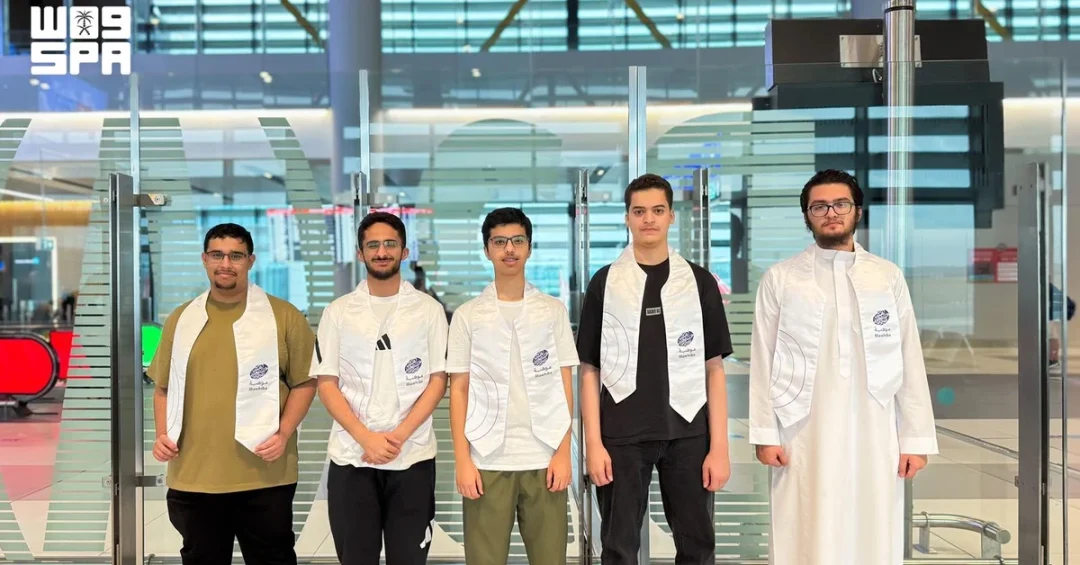
Saudi Arabia’s national informatics team departed Riyadh on August 9, 2026, bound for Tashkent, Uzbekistan, to compete in the 38th International Olympiad in Informatics (IOI 2026), which runs from August 9 to 16 and brings together high school students from nearly 100 countries. The four-member delegation travels under the supervision of the King Abdulaziz and His Companions Foundation for Giftedness and Creativity (Mawhiba), in partnership with the Ministry of Education, continuing a national program that has steadily built the Kingdom’s presence in one of the world’s most demanding academic competitions.
The announcement, carried by the Saudi Press Agency, marks Saudi Arabia’s eighth participation in the IOI since the Kingdom first entered the contest. Across seven previous appearances, Saudi students have earned 11 international awards, including seven bronze medals and four certificates of merit. That record reflects a deliberate, long-term investment in identifying and nurturing young talent in computer science, a discipline that sits at the heart of the Kingdom’s digital transformation. For observers of Saudi education policy, the departure of the team is not merely a routine competition entry; it is another visible milestone in a strategy that treats advanced computing skills as a national asset. How did a country with no prior tradition in competitive programming build a pipeline that now reaches the global stage every year?
Context and Background
The International Olympiad in Informatics was first launched in 1989 and has since become the premier global competition in computer science for high school students. Participants are tested on problem analysis, algorithm design, and programming under strict time constraints, solving challenges that require both mathematical insight and practical coding skill. Unlike many academic olympiads, the IOI emphasizes computational thinking: competitors must devise efficient solutions to complex problems, often within a few hours and with limited resources. For nearly four decades, the event has served as a launchpad for some of the world’s leading software engineers, researchers, and technology entrepreneurs.
Saudi Arabia’s engagement with the IOI is part of a broader national effort to cultivate science, technology, engineering, and mathematics talent. Mawhiba, established to discover and support gifted students, works alongside the Ministry of Education to identify high-potential learners through standardized assessments and enrichment programs. Selected students undergo intensive training in algorithms, data structures, and programming languages, often guided by local and international mentors. The result is a small but highly prepared cohort that represents the Kingdom at international events. What does it take for a student to progress from a classroom in Riyadh or Jeddah to a seat at the IOI? The answer lies in years of structured preparation, rigorous selection, and sustained institutional support.
The Kingdom’s eighth participation also reflects continuity. Since its first IOI appearance, Saudi Arabia has gradually expanded its footprint, moving from initial exposure to consistent medal contention. The 11 awards earned to date, including seven bronze medals and four certificates of merit, are modest by the standards of long-established competitors but significant for a relatively young program. Each result contributes data and experience that inform the next training cycle, creating a feedback loop that strengthens the national team over time. In that sense, the IOI is not just a competition; it is a benchmarking exercise that helps Saudi educators refine their approach.
Key Details of the 2026 Mission
The 38th International Olympiad in Informatics is being hosted in Tashkent, Uzbekistan, from August 9 to 16, 2026. The Saudi team comprises four high school students, all of whom qualified through national selection processes overseen by Mawhiba and the Ministry of Education. Their preparation included advanced training camps, problem-solving sessions, and simulated contests designed to mirror IOI conditions. The delegation traveled from Riyadh on the opening day of the event, joining students from nearly 100 countries in what is effectively a global gathering of young computing talent.
The competition itself spans two main contest days, with each day requiring participants to solve a set of algorithmic problems within a five-hour window. Scores are awarded based on the correctness and efficiency of solutions, and medals are distributed according to international thresholds. For the Saudi team, the objective is twofold: to compete for medals and to gain experience that will feed back into the national training program. The students represent a range of schools and regions, underscoring the nationwide reach of Mawhiba’s identification efforts. Are these four students simply competitors, or are they ambassadors for a broader vision of Saudi human capital development? Their performance will be watched closely by educators and policymakers alike.
Mawhiba’s role extends beyond logistics. The foundation provides mentorship, access to specialized curricula, and opportunities to interact with international experts. The Ministry of Education, meanwhile, ensures that participation aligns with national educational priorities and that students receive the support they need to balance competition preparation with their regular studies. This partnership model has become a hallmark of Saudi Arabia’s approach to gifted education, combining centralized strategy with targeted, individualized support. It is a model that other nations have begun to study as they seek to replicate Saudi Arabia’s rapid progress in STEM talent development.
International and Regional Impact
Saudi Arabia’s participation in the IOI carries significance beyond the scoreboard. It signals the Kingdom’s commitment to engaging with global knowledge networks and to positioning its youth as contributors to the international technology community. In a region where youth unemployment and skills gaps have historically posed challenges, programs like this offer a constructive path forward. By competing alongside students from nearly 100 countries, Saudi participants build networks and gain exposure to diverse problem-solving approaches. These interactions can later translate into collaborations, research partnerships, and entrepreneurial ventures.
For Uzbekistan, hosting the IOI is an opportunity to showcase its own educational ambitions and hospitality. The event brings together delegations from across the world, creating a temporary hub of computational excellence in Central Asia. Saudi Arabia’s presence there reinforces its role as a bridge between regions, a theme that recurs in the Kingdom’s foreign policy and development cooperation. The exchange of ideas at the IOI is not limited to the contest hall; it extends to cultural visits, informal discussions, and shared experiences that build goodwill among future leaders. How might these young competitors shape international cooperation in technology a decade from now? The connections formed in Tashkent could prove as valuable as any medal.
Economic and Strategic Significance
The strategic logic behind Saudi Arabia’s investment in informatics talent is clear. As the Kingdom diversifies its economy away from oil dependence, it needs a workforce capable of building and maintaining advanced digital systems. Artificial intelligence, cybersecurity, cloud computing, and data science are all fields that depend on strong algorithmic foundations. By nurturing high school students who excel in these areas, Saudi Arabia is cultivating a pipeline of future engineers, researchers, and entrepreneurs. The IOI serves as both a testing ground and a motivator, encouraging students to push their limits and consider careers in technology.
Moreover, success in international competitions can have a multiplier effect. Medalists often become role models, inspiring younger students to pursue similar paths. They may also attract the attention of universities and employers, opening doors to scholarships and job opportunities. For a country seeking to retain and develop its brightest minds, this visibility matters. The Saudi government has launched numerous initiatives to support STEM education, from new curricula to specialized schools and innovation centers. The IOI team is one visible output of these efforts, demonstrating that the strategy is producing tangible results. What economic returns might the Kingdom expect from a single cohort of world-class problem solvers? The answer lies in the innovations they will create over their careers.
Vision 2030 Alignment
Saudi Arabia’s participation in the 38th International Olympiad in Informatics aligns directly with the goals of Vision 2030, the national transformation plan that seeks to build a diversified, knowledge-based economy. A central pillar of Vision 2030 is the development of human capital, particularly in fields that drive innovation and technological progress. By supporting gifted students in computer science, Mawhiba and the Ministry of Education are helping to create a generation of Saudis equipped to lead in the digital age. The Kingdom’s eighth IOI appearance is therefore not an isolated event but part of a sustained national effort.
As the team competes in Tashkent, it carries with it the aspirations of a nation investing in its youth. The experience gained will inform future training, and the results will be measured not only in medals but in the long-term contributions these students make to Saudi society. Whether they become software architects, data scientists, or entrepreneurs, their journey begins with opportunities like the IOI. In this sense, the competition is a catalyst, turning potential into achievement and connecting Saudi Arabia’s brightest young minds to a global community of problem solvers. The Kingdom’s forward-looking vision depends on such connections, and the students in Tashkent are helping to build them, one algorithm at a time.
20 Questions
Q1. What is the International Olympiad in Informatics?
A1. The International Olympiad in Informatics (IOI) is the premier global computer science competition for high school students, first launched in 1989. It focuses on problem analysis, algorithm design, and programming, bringing together participants from nearly 100 countries each year.
Q2. Where and when is IOI 2026 taking place?
A2. IOI 2026 is being held in Tashkent, Uzbekistan, from August 9 to 16, 2026. The Saudi team departed Riyadh on the opening day to join delegations from around the world.
Q3. How many students represent Saudi Arabia at IOI 2026?
A3. Saudi Arabia is represented by four high school students. They were selected and trained under the supervision of Mawhiba in partnership with the Ministry of Education.
Q4. What is Mawhiba’s role in preparing the team?
A4. The King Abdulaziz and His Companions Foundation for Giftedness and Creativity (Mawhiba) identifies gifted students, provides specialized training, and supervises their preparation for international competitions like the IOI.
Q5. How many times has Saudi Arabia participated in the IOI?
A5. This is Saudi Arabia’s eighth participation in the IOI. The Kingdom has competed in seven previous editions of the competition.
Q6. What awards have Saudi students won in past IOI appearances?
A6. Saudi students have won 11 international awards in total, including seven bronze medals and four certificates of merit. These achievements reflect the effectiveness of the national training program.
Q7. What skills are tested at the IOI?
A7. The IOI tests problem analysis, algorithm design, and programming. Competitors solve complex computational problems within strict time limits, demonstrating both mathematical insight and practical coding ability.
Q8. How long do the IOI contests last?
A8. The IOI typically features two contest days, each with a five-hour window. Participants solve algorithmic problems and are scored on the correctness and efficiency of their solutions.
Q9. Which ministry partners with Mawhiba for the IOI team?
A9. The Ministry of Education partners with Mawhiba to support the Saudi team. This collaboration ensures alignment with national educational priorities and provides logistical and academic support.
Q10. Why is the IOI important for Saudi Arabia’s education strategy?
A10. The IOI helps Saudi Arabia develop advanced computing talent, which is essential for economic diversification. It also provides international benchmarking and motivates students to pursue STEM careers.
Q11. How are Saudi students selected for the IOI team?
A11. Students are identified through national assessments and enrichment programs run by Mawhiba and the Ministry of Education. They then undergo intensive training camps and simulated contests before final selection.
Q12. What benefits do students gain from participating in the IOI?
A12. Participants gain advanced problem-solving skills, international exposure, and networking opportunities. Many go on to prestigious universities and careers in technology, research, and entrepreneurship.
Q13. How does the IOI differ from other academic Olympiads?
A13. The IOI emphasizes computational thinking and practical programming, unlike purely theoretical competitions. Competitors must write code that solves problems efficiently under time constraints.
Q14. What is the significance of hosting IOI 2026 in Uzbekistan?
A14. Hosting the IOI showcases Uzbekistan’s educational ambitions and brings global talent to Central Asia. It also strengthens regional ties and promotes international cooperation in computer science.
Q15. How does Saudi Arabia’s participation reflect Vision 2030?
A15. Vision 2030 aims to build a knowledge-based economy, and the IOI team exemplifies this by developing human capital in technology. The competition supports the Kingdom’s digital transformation goals.
Q16. What support do Saudi IOI students receive during training?
A16. They receive mentorship from experts, access to specialized curricula, and opportunities to practice with international-level problems. Mawhiba and the Ministry of Education coordinate this support.
Q17. Can IOI participation lead to university scholarships?
A17. Yes, strong performance at the IOI often attracts attention from top universities worldwide. Many medalists receive scholarship offers and admission to competitive programs.
Q18. How many countries participate in the IOI each year?
A18. Nearly 100 countries send delegations to the IOI annually. This makes it one of the most globally representative academic competitions in the world.
Q19. What subjects are covered in IOI problems?
A19. IOI problems cover areas such as graph theory, dynamic programming, data structures, and combinatorics. They require algorithmic thinking and efficient coding to solve within time limits.
Q20. What is the long-term goal of Saudi Arabia’s IOI program?
A20. The long-term goal is to build a sustainable pipeline of world-class computing talent that contributes to Saudi Arabia’s economic diversification and global competitiveness in technology and innovation.
Reader Feedback
We value your thoughts. Please share your feedback on this article.
Your feedback helps us improve our coverage.
Related articles
 Saudi Ministry Deploys AI Robots at Quran Competition
 Saudi Arabia Hosts Historic INSO 2026 in Jeddah
 Board of Grievances Launches New Mu’een Digital Platform
 Microrobots Remove Up to 94% of Microplastics from Water and Soil
 Saudi Student Wins INSO 2026 ‘Best Female Student’ Award
 Saudi Arabia Tops INSO 2026, Wins Nuclear Science Ambassador