


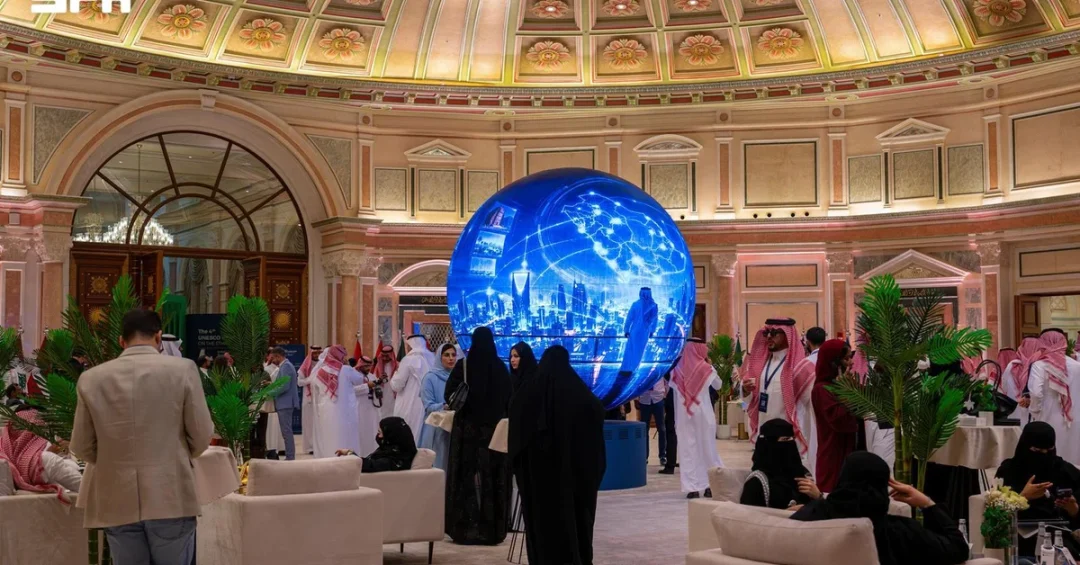
The fourth UNESCO Global Forum on the Ethics of Artificial Intelligence (AI) continued in Riyadh on September 16, 2026, with a full day of sessions focused on AI readiness, institutional capacity-building in public administrations, large-scale public-sector deployment, environmental and ecosystem considerations, energy, and stronger international cooperation on AI governance. The forum, organized by the Saudi Data and AI Authority (SDAIA) in partnership with the United Nations Educational, Scientific and Cultural Organization (UNESCO) and in cooperation with the International Center for AI Research and Ethics (ICAIRE), runs through September 17 and has drawn policymakers, researchers, and technology leaders from around the world to the Saudi capital.
Day two of the gathering shifted the conversation from broad ethical principles toward the practical mechanics of implementation — how governments actually prepare their institutions, workforces, and regulatory frameworks to deploy AI responsibly at scale. For international observers, the timing and location are significant. Riyadh is hosting the forum at a moment when Saudi Arabia is accelerating its own national AI agenda under Vision 2030, and when governments worldwide are grappling with the same question: how do you move from signing declarations to running real systems in real ministries? The sessions on public-sector readiness, in particular, reflect a growing global consensus that ethical AI is not only a question of rules on paper, but of institutional capability on the ground.
Context and Background
Why has a UNESCO forum on AI ethics become such a prominent fixture on the global calendar? The answer lies in the speed at which artificial intelligence has moved from research laboratories into the daily operations of governments, hospitals, schools, and utilities. UNESCO adopted its Recommendation on the Ethics of Artificial Intelligence in 2021, the first global standard-setting instrument of its kind, and the Global Forum series was established to keep that framework alive through regular, rotating international gatherings. The fourth edition in Riyadh follows previous forums and represents the first time the series has been convened in the Kingdom, a detail that underscores Saudi Arabia’s expanding role in global technology governance.
The forum is organized by the Saudi Data and AI Authority, the national body responsible for advancing the Kingdom’s data and AI ecosystem, in partnership with UNESCO and in cooperation with the International Center for AI Research and Ethics. That three-way structure matters: it pairs a national implementation authority with a multilateral standard-setter and a dedicated research center, creating a bridge between policy ambition and technical execution. According to information released through official Saudi channels, the agenda for September 16 was deliberately weighted toward readiness and capability rather than abstract debate, covering how public administrations build institutional skills, how AI is deployed at scale in government services, and how environmental, energy, and ecosystem issues intersect with AI development. The forum continues through September 17.
Public-Sector Readiness Takes Center Stage
What does it actually take for a government to be “AI-ready”? The Riyadh sessions treated this as a practical question with concrete answers: trained civil servants, clear procurement standards, data infrastructure, ethical review processes, and the ability to evaluate systems before and after deployment. Building institutional capabilities in public administrations was a central theme, reflecting the reality that even well-funded AI strategies can stall if ministries lack the people and processes to implement them. The forum’s focus on deploying AI at scale in the public sector signals a shift from pilot projects to mainstream integration, where AI supports service delivery, planning, and decision-making across government.
For Saudi Arabia, this theme aligns closely with domestic priorities. SDAIA has been tasked with building national capacity in data and AI, and the Kingdom has invested heavily in talent development, cloud infrastructure, and governance frameworks. Hosting a global forum on these exact topics allows Saudi institutions to share their experience while learning from counterparts in Asia, Europe, Africa, and the Americas. The presence of the International Center for AI Research and Ethics adds a research dimension, ensuring that discussions are informed by evidence and not only by policy aspiration. The day’s agenda also covered environmental and ecosystem issues and energy, acknowledging that AI’s growth has physical costs — electricity demand, water use for cooling, and the lifecycle of hardware — that responsible governance must address.
International and Regional Impact
Why should a reader outside Saudi Arabia care about a forum held in Riyadh? Because AI governance is inherently international. Models, data flows, and supply chains cross borders, and no single country can set effective rules alone. The Riyadh forum’s sessions on stronger international cooperation on AI governance speak directly to that reality, providing a neutral platform where countries with different regulatory philosophies can compare approaches. UNESCO’s convening power, combined with Saudi Arabia’s position as a major investor in technology and a bridge between regions, gives the gathering a reach that purely regional events lack. For developing countries in particular, the emphasis on public-sector readiness is valuable, since it addresses the gap between adopting AI principles and actually implementing them.
Regionally, the forum reinforces Riyadh’s emergence as a hub for global dialogue on technology and ethics. The Kingdom has hosted major international events across sectors, and adding a UNESCO forum on AI ethics to that portfolio signals a broader ambition: to be not only a participant in global technology conversations but a convenor of them. That role carries responsibilities, including maintaining the credibility of the forum through transparent, outcomes-oriented discussions. The participation of the International Center for AI Research and Ethics helps here, as does the involvement of UNESCO, whose mandate gives the proceedings a multilateral legitimacy that national events cannot replicate. For neighboring countries in the Gulf and the wider Middle East, the forum offers a nearby venue to engage with global standards and to align their own public-sector AI programs with emerging best practice.
Economic and Strategic Significance
What is at stake economically when governments get AI readiness right — or wrong? Public-sector AI adoption can improve the efficiency of services, reduce costs, and free up human capacity for higher-value work, but poorly governed deployment risks wasted investment, eroded public trust, and regulatory backlash. The Riyadh sessions on deploying AI at scale in the public sector therefore have direct economic implications: they help governments avoid expensive mistakes and build systems that are sustainable over the long term. The discussions on energy and environmental issues add another economic layer, since data centers and AI workloads are energy-intensive, and countries that plan their infrastructure carefully will be better positioned to capture AI’s benefits without straining their grids or climate commitments.
Strategically, Saudi Arabia’s hosting of the forum is part of a wider pattern of investment in knowledge industries. The Kingdom has been building capabilities in data, cloud computing, and AI as part of its economic diversification agenda, and international gatherings like this one support that effort by attracting expertise, strengthening partnerships, and raising the profile of Saudi institutions. The cooperation with UNESCO and ICAIRE also creates channels for future collaboration on research, standards, and training. According to information released through official Saudi channels, the forum’s agenda explicitly links AI governance to international cooperation, a framing that positions the Kingdom as a constructive actor in a field where geopolitical competition is otherwise intense. That positioning has value beyond public relations: it can help Saudi firms and researchers access global networks and shape emerging norms.
Vision 2030 Alignment
How does a two-day UNESCO forum connect to a national transformation plan? Saudi Arabia’s Vision 2030 aims to diversify the economy, modernize public services, and build a knowledge-based society, and data and AI sit at the center of that agenda. SDAIA’s role in organizing the forum reflects the Kingdom’s strategy of linking domestic capability-building with international engagement. The sessions on public-sector readiness mirror Vision 2030’s emphasis on government efficiency and digital transformation, while the discussions on energy and the environment connect to sustainability goals. By convening global experts in Riyadh, the Kingdom also advances its ambition to be a hub for international dialogue and a contributor to global public goods, including ethical standards for technologies that will affect every society.
Looking ahead, the outcomes of the fourth UNESCO Global Forum on the Ethics of AI are likely to feed into both national programs and international processes. The forum runs through September 17, and its emphasis on implementation — readiness, capability, scale, cooperation — suggests a maturing conversation in which Saudi Arabia is not merely a host but an active participant in shaping how AI is governed worldwide. For an international audience, the message from Riyadh is clear: the ethics of AI is no longer a theoretical subject, and the countries that prepare their public institutions now will be best placed to use AI responsibly and effectively in the years ahead. That is a goal consistent with the Kingdom’s long-term vision and its growing role in global technology governance.
20 Questions
Q1. What is the fourth UNESCO Global Forum on the Ethics of AI?
A1. It is a major international gathering organized by the Saudi Data and AI Authority with UNESCO and the International Center for AI Research and Ethics, held in Riyadh to discuss the ethical governance and responsible deployment of artificial intelligence worldwide.
Q2. When and where is the forum taking place?
A2. The forum is being held in Riyadh, Saudi Arabia, and runs through September 17, 2026, with sessions continuing on September 16 covering AI readiness, public-sector deployment, energy, environment, and international cooperation.
Q3. Who organized the forum?
A3. It is organized by the Saudi Data and AI Authority in partnership with the United Nations Educational, Scientific and Cultural Organization, and in cooperation with the International Center for AI Research and Ethics.
Q4. What topics were discussed on September 16?
A4. Sessions covered AI readiness, building institutional capabilities in public administrations, deploying AI at scale in the public sector, environmental and ecosystem issues, energy, and stronger international cooperation on AI governance.
Q5. Why is public-sector AI readiness important?
A5. Public-sector readiness ensures governments have the skills, infrastructure, and processes to deploy AI responsibly, improving services and avoiding wasted investment, while maintaining public trust and ethical standards.
Q6. What is the Saudi Data and AI Authority?
A6. SDAIA is the national body responsible for advancing Saudi Arabia’s data and AI ecosystem, driving strategy, governance, and capacity-building in line with the Kingdom’s Vision 2030 objectives.
Q7. What is UNESCO’s role in AI ethics?
A7. UNESCO adopted the first global standard on AI ethics in 2021 and convenes the Global Forum series to promote responsible AI governance and international cooperation among its member states.
Q8. What is the International Center for AI Research and Ethics?
A8. ICAIRE is a research institution cooperating on the forum, contributing evidence-based insights on AI ethics and helping bridge policy ambitions with technical and practical implementation.
Q9. Why is the forum held in Riyadh?
A9. Riyadh’s hosting reflects Saudi Arabia’s growing role in global technology governance and its investment in AI under Vision 2030, providing a platform for international dialogue on ethical AI.
Q10. How does the forum address environmental issues?
A10. Sessions examine AI’s environmental and ecosystem impacts, including energy consumption and infrastructure needs, encouraging sustainable approaches to AI development and deployment.
Q11. What does deploying AI at scale in the public sector mean?
A11. It means moving beyond pilot projects to integrate AI across government services and operations, supported by governance frameworks, trained staff, and reliable data infrastructure.
Q12. How does the forum promote international cooperation?
A12. It provides a neutral platform where countries compare regulatory approaches, share best practices, and work toward common standards for AI governance across borders.
Q13. What are the economic benefits of public-sector AI?
A13. Responsible AI adoption can improve service efficiency, reduce costs, and support innovation, while careful planning helps avoid wasted investment and long-term infrastructure strain.
Q14. How does the forum align with Vision 2030?
A14. It supports Vision 2030’s goals of economic diversification, government modernization, and knowledge-based development by linking national AI capacity-building with international engagement and standards.
Q15. What is the significance for developing countries?
A15. The focus on readiness and capability helps developing countries bridge the gap between adopting AI principles and implementing them effectively in their public institutions.
Q16. What happens after the forum ends?
A16. Outcomes are expected to inform national programs and international processes, with continued cooperation among SDAIA, UNESCO, and ICAIRE on research, standards, and training.
Q17. Is the forum open to international participants?
A17. Yes, the forum draws policymakers, researchers, and technology leaders from around the world, reflecting its global mandate under UNESCO’s framework.
Q18. How does AI ethics affect ordinary citizens?
A18. Ethical AI governance protects privacy, fairness, and accountability in services citizens use daily, from healthcare to education, ensuring technology serves the public interest.
Q19. What makes this forum different from other tech conferences?
A19. Its focus on ethics, public-sector readiness, and multilateral cooperation, backed by UNESCO’s standard-setting mandate, distinguishes it from purely commercial technology events.
Q20. What is the broader message from Riyadh?
A20. The message is that AI ethics has moved from theory to implementation, and countries that prepare their public institutions now will be best positioned to use AI responsibly and effectively.
Reader Feedback
We value your thoughts. Please share your feedback on this article.
Your feedback helps us improve our coverage.
Related articles
 UNESCO AI Ethics Forum Convenes 18 Sessions in Riyadh
 KSGAAL Joins 2026 UNESCO AI Ethics Forum in Riyadh
 Saudi Arabia Competes in 2026 Balkan Informatics Olympiad
 Saudi team joins International Olympiad in Informatics 2026
 Madinah Hosts MED Ai Forum to Promote Innovation
 Saudi students participate in IOI 2026 in Uzbekistan