


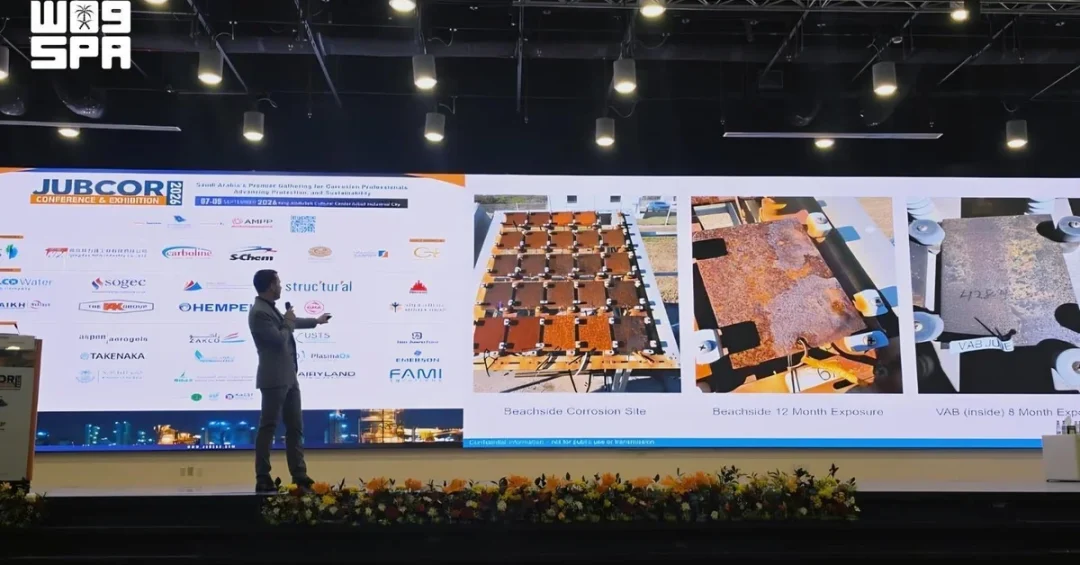
The Jubail Corrosion Conference and Exhibition 2026 concluded in Jubail Industrial City with more than 3,000 participants and visitors from around the world, according to the Saudi Press Agency. The three-day event, which ended on September 9, 2026, brought together industrial leaders, engineers, researchers, and technology providers to address one of the most persistent challenges facing heavy industry: the protection of assets against corrosion in some of the world’s most demanding environments. The conference’s closing sessions showcased practical, cost-effective solutions, including a newly unveiled inorganic coating designed to perform in hot and humid conditions in accordance with ISO standards.
The scale of participation underscores the growing international recognition of Saudi Arabia as a hub for industrial innovation and knowledge exchange. For a kingdom that operates some of the largest energy, petrochemical, and desalination facilities on earth, corrosion management is not an abstract technical concern but a strategic imperative with direct implications for safety, reliability, and economic performance. The event’s success reflects the broader modernization of Saudi industry under Vision 2030, the national transformation program championed by Crown Prince Mohammed bin Salman, which seeks to diversify the economy and elevate the competitiveness of Saudi manufacturing and infrastructure.
Why does a technical conference in an industrial city matter to the wider world? Because the solutions discussed in Jubail have the potential to extend the operational lifespan of critical infrastructure globally, reduce maintenance costs, and improve safety standards across sectors ranging from oil and gas to water treatment and power generation.
Context and Background
How did Jubail become a global meeting point for corrosion specialists? The answer lies in the city’s unique status as one of the world’s largest industrial complexes. Established in the 1970s as a planned industrial city on the Arabian Gulf coast, Jubail Industrial City is home to major facilities operated by Saudi Aramco, SABIC, and a wide array of petrochemical, steel, and power companies. Its coastal location, high humidity, salt-laden air, and intense heat create conditions that accelerate corrosion, making it an ideal living laboratory for testing materials and protective technologies.
The Jubail Corrosion Conference and Exhibition has grown over successive editions into a premier forum for the exchange of applied research and field experience. This year’s edition continued that trajectory, with the final day dedicated to practical solutions that plant managers and maintenance engineers can deploy immediately. The focus on specialized coatings, leak detection, and risk management reflects a maturing approach to asset integrity that prioritizes prevention over reactive repair.
The conference also serves as a platform for Saudi Arabia’s industrial ecosystem to demonstrate its commitment to international standards. The unveiling of a new inorganic coating, validated against ISO standards for performance in hot and humid environments, signals that Saudi industry is not merely adopting global best practices but contributing to them.
Key Details and Technical Highlights
What specific innovations emerged from the final day’s sessions? According to the Saudi Press Agency, participants examined a new type of inorganic coating whose performance in hot and humid environments was demonstrated in accordance with ISO standards. Inorganic coatings are of particular interest to Saudi industry because they can offer superior resistance to ultraviolet radiation, thermal cycling, and chemical exposure compared with some conventional organic coatings. For facilities in Jubail and other coastal industrial zones, such materials can significantly reduce the frequency of recoating and repair.
Discussions also addressed leak detection technologies, corrosion risk management, and strategies to extend the operational lifespan of assets. These topics are interconnected: early leak detection prevents small defects from escalating into costly failures, while systematic risk management allows operators to prioritize inspections and interventions where they will have the greatest impact. Extending asset lifespan, in turn, reduces capital expenditure and the environmental footprint associated with building replacement facilities.
Dr. Fahad Al-Mutlaq, Chairman of the conference, said the edition achieved exceptional success, driven by the continued support and engagement of industrial leaders, experts, and specialists from the Kingdom and abroad. He noted that the recommendations and papers presented during the three-day event covered artificial intelligence, robotic inspection, and innovative coating and material solutions. These technologies will help enhance industrial facility reliability, strengthen safety standards, and reduce long-term operational costs. Dr. Al-Mutlaq also thanked the sponsors, participants, and organizing teams for contributing to the event’s success.
Artificial Intelligence and Robotics in Corrosion Management
How is artificial intelligence changing the way industry tackles corrosion? The conference’s emphasis on AI and robotic inspection reflects a broader digital transformation sweeping through Saudi industry. AI-powered analytics can process vast amounts of sensor data from pipelines, tanks, and processing units to identify patterns that precede corrosion-related failures. Machine learning models can predict where and when maintenance will be needed, allowing operators to move from scheduled maintenance to condition-based and predictive maintenance.
Robotic inspection tools, including drones and crawler robots, are increasingly used to access confined spaces, elevated structures, and underwater components that are difficult or dangerous for human inspectors to reach. These technologies improve safety and data quality while reducing downtime. In a facility like a Jubail petrochemical plant, where a single unplanned shutdown can cost millions of dollars, the ability to inspect continuously and non-invasively is a significant competitive advantage.
The integration of AI and robotics into corrosion management aligns with Saudi Arabia’s wider push toward industrial digitization, often referred to as Industry 4.0. The conference provided a venue for Saudi engineers and international experts to compare notes on deployment challenges and success stories, accelerating the adoption of these tools across the Kingdom’s industrial base.
International and Regional Impact
Why should the international community pay attention to a corrosion conference in Saudi Arabia? Because corrosion is a global problem with enormous economic consequences. Studies cited in industry literature estimate that corrosion costs the global economy hundreds of billions of dollars annually, equivalent to a significant percentage of global GDP. For oil-producing and industrial economies in the Gulf, the costs are proportionally even higher due to the combination of harsh climate and dense infrastructure.
By hosting a major international conference, Saudi Arabia positions itself as a contributor to global solutions rather than merely a consumer of imported technology. The participation of experts from abroad creates opportunities for joint research, technology transfer, and commercial partnerships. It also reinforces the Kingdom’s role as a convener of industrial expertise, a soft-power asset that complements its energy and investment diplomacy.
Regionally, the conference supports the integration of Gulf industrial markets. Neighboring countries face similar corrosion challenges, and the sharing of best practices can raise safety and efficiency standards across the region. For international companies, the event offers a gateway to the Saudi market at a time when the Kingdom is investing heavily in downstream industries, mining, and renewable energy infrastructure.
Economic and Strategic Significance
What is at stake economically for Saudi Arabia? The Kingdom’s industrial assets represent trillions of riyals in investment. Protecting those assets from corrosion is essential to maintaining production capacity, ensuring worker safety, and preserving the value of national infrastructure. Every riyal spent on effective corrosion prevention can yield multiples in avoided repair costs, deferred capital expenditure, and avoided production losses.
The conference’s focus on cost-effective solutions is particularly timely as Saudi Arabia pursues ambitious industrial expansion under Vision 2030. New facilities in sectors such as hydrogen, specialty chemicals, and advanced manufacturing will require robust corrosion management from the design stage. The knowledge shared in Jubail can inform specifications and standards for these next-generation projects.
Moreover, the development of a domestic corrosion technology and services sector creates high-skilled jobs and entrepreneurial opportunities for Saudi nationals. The conference helps connect local suppliers with international partners, fostering an ecosystem that can serve both the Kingdom and export markets. This aligns with the Vision 2030 goal of increasing non-oil exports and local content.
Vision 2030 Alignment
How does a technical conference connect to Saudi Arabia’s long-term national vision? Vision 2030 is fundamentally about building a diversified, resilient, and globally competitive economy. Industrial reliability is a cornerstone of that ambition. By promoting advanced corrosion management, Saudi Arabia enhances the efficiency of its existing industries and creates the conditions for new ones to thrive. The conference’s themes—AI, robotics, advanced materials, and risk management—are precisely the capabilities that will define the industries of the future.
The event also reflects the Vision 2030 emphasis on knowledge transfer and human capital development. Saudi engineers, technicians, and students who attended the conference gained exposure to cutting-edge practices and international networks. This investment in skills supports the broader goal of empowering Saudi citizens to lead the Kingdom’s economic transformation.
As the Jubail Corrosion Conference and Exhibition 2026 draws to a close, its legacy will be measured not only in the papers presented but in the partnerships formed and the solutions deployed. Saudi Arabia’s leadership in convening this global dialogue demonstrates its commitment to industrial excellence and its growing role as a hub of innovation. The Kingdom’s journey toward a sustainable, diversified future continues, one asset at a time.
20 Questions
Q1. What was the Jubail Corrosion Conference and Exhibition 2026?
A1. It was a three-day international event held in Jubail Industrial City, Saudi Arabia, focused on corrosion prevention and asset integrity. It concluded on September 9, 2026, drawing over 3,000 participants and visitors from around the world.
Q2. Where did the conference take place?
A2. The conference took place in Jubail Industrial City, one of the world’s largest industrial complexes, located on Saudi Arabia’s eastern coast. The city hosts major petrochemical, energy, and manufacturing facilities.
Q3. How many people attended the conference?
A3. More than 3,000 participants and visitors attended, according to the Saudi Press Agency. This included industrial leaders, engineers, researchers, and technology providers from the Kingdom and abroad.
Q4. Who chaired the conference?
A4. Dr. Fahad Al-Mutlaq served as Chairman of the conference. He described the edition as an exceptional success and thanked sponsors, participants, and organizing teams for their contributions.
Q5. What new technology was unveiled at the conference?
A5. A new type of inorganic coating was unveiled. Its performance in hot and humid environments was demonstrated in accordance with ISO standards, offering potential for extended asset protection in harsh conditions.
Q6. What topics were discussed on the final day?
A6. The final day covered practical, cost-effective solutions for protecting facilities using specialized coatings, leak detection technologies, corrosion risk management, and strategies to extend the operational lifespan of assets.
Q7. What role did artificial intelligence play in the conference?
A7. AI was a major theme, with discussions on how AI-powered analytics can predict corrosion-related failures and optimize maintenance. This supports the shift from scheduled to predictive maintenance in industrial facilities.
Q8. How is robotic inspection relevant to corrosion management?
A8. Robotic inspection, including drones and crawler robots, allows access to confined, elevated, or underwater areas that are difficult for humans to inspect. It improves safety, data quality, and reduces downtime.
Q9. Why is corrosion a significant issue for Saudi Arabia?
A9. Saudi Arabia operates some of the world’s largest energy, petrochemical, and desalination facilities. The hot, humid, and salty coastal environment accelerates corrosion, making management critical for safety and economic performance.
Q10. What are the economic benefits of effective corrosion management?
A10. Effective corrosion management reduces repair costs, defers capital expenditure, and prevents production losses. It extends asset lifespan and enhances the competitiveness of Saudi industry, aligning with Vision 2030 economic goals.
Q11. How does the conference support Vision 2030?
A11. It promotes industrial reliability, knowledge transfer, and the adoption of advanced technologies like AI and robotics. These are essential for diversifying the economy and building a globally competitive industrial base.
Q12. What is the significance of ISO standards in the coating demonstration?
A12. ISO standards provide internationally recognized benchmarks for performance. Demonstrating compliance assures potential users that the coating meets rigorous criteria for durability and effectiveness in hot and humid environments.
Q13. What is an inorganic coating and why is it important?
A13. An inorganic coating is a protective layer composed of non-carbon-based materials. It can offer superior resistance to UV radiation, thermal cycling, and chemicals compared with some organic coatings, making it ideal for harsh industrial settings.
Q14. How does the conference benefit international participants?
A14. International participants gain access to the Saudi market, share research, and form partnerships. They also learn about innovative solutions tested in one of the world’s most demanding industrial environments.
Q15. What is the role of leak detection technologies?
A15. Leak detection technologies identify small defects before they escalate into major failures. Early detection prevents costly repairs, environmental damage, and safety incidents, supporting asset integrity management.
Q16. How does corrosion risk management work?
A16. Corrosion risk management involves assessing the likelihood and consequences of corrosion-related failures, then prioritizing inspections and interventions. It optimizes resource allocation and reduces overall risk.
Q17. What are the environmental benefits of extending asset lifespan?
A17. Extending asset lifespan reduces the need for new construction, which lowers material consumption, energy use, and emissions. It supports sustainability goals and the circular economy approach to industrial development.
Q18. How does the conference contribute to Saudi human capital development?
A18. By exposing Saudi engineers, technicians, and students to cutting-edge practices and international networks, the conference helps build local expertise. This supports Vision 2030’s goal of empowering Saudi citizens.
Q19. What sectors benefit most from the conference outcomes?
A19. Oil and gas, petrochemicals, water desalination, power generation, and heavy manufacturing are the primary beneficiaries. These sectors rely on extensive infrastructure vulnerable to corrosion.
Q20. What is the expected legacy of the 2026 conference?
A20. The legacy includes new partnerships, accelerated adoption of AI and robotic inspection, and the deployment of advanced coatings. It reinforces Saudi Arabia’s role as a global hub for industrial innovation and knowledge exchange.
Reader Feedback
We value your thoughts. Please share your feedback on this article.
Your feedback helps us improve our coverage.
Related articles
 KSrelief provides 24,500 hot meals to Gaza families
 Mudslides Kill 16 in Eastern China, 18,000 Evacuated
 Saudi Red Crescent Authority expands humanitarian presence
 KSrelief distributes 120 food baskets in Afghanistan
 Virtual Hospital completes 11 remote robotic surgeries
 KSrelief distributes food aid in Sudan