


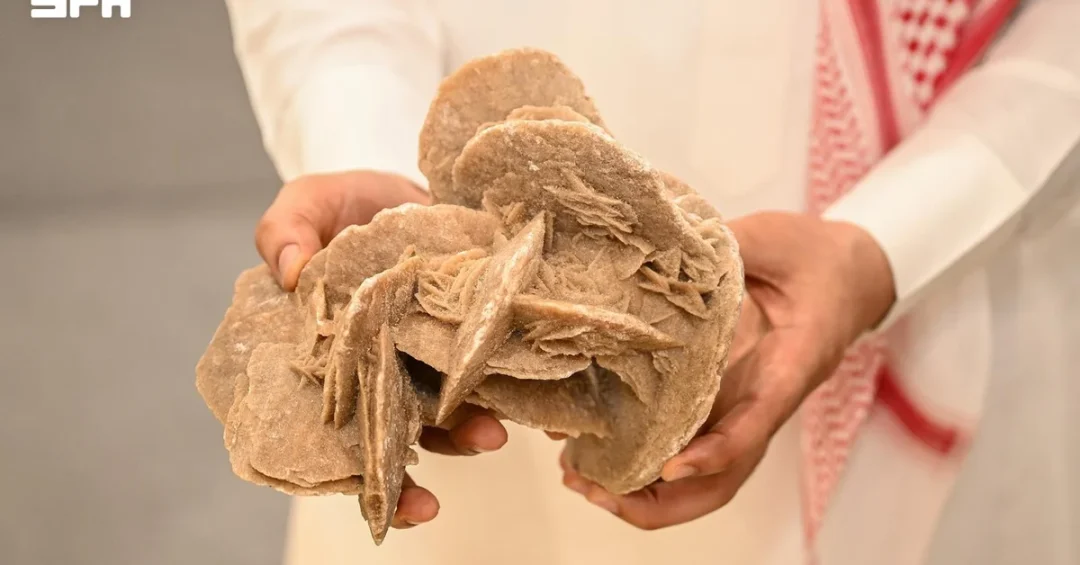
Saudi Arabia’s deserts hold a natural wonder that has fascinated geologists, travelers, and collectors for generations: the sand rose, a crystalline formation that emerges beneath the dunes as a result of intense heat, drought, and water evaporation, according to information released by the Saudi Press Agency (SPA). Resembling a flower in its intricate details, yet composed entirely of grains of sand fused with gypsum, calcium sulfate, salts, and other minerals, the sand rose is a hard natural formation that develops at the level of surface water beneath sand dunes and takes different shapes and sizes. The most prominent form is the rose shape, which usually takes on the color of the surrounding sand.
Have you ever imagined that a flower could bloom without soil, roots, or sunlight? The sand rose proves that nature’s artistry extends far beyond gardens, green spaces, and rooftops. These formations develop their striking appearance over decades as a series of chemical reactions causes grains of sand to adhere and fuse together, forming sharp, shiny crystalline shapes and petals resembling roses. Unlike living organisms, including plants, the sand rose neither grows nor breathes. It is, as Saudi Arabia’s official news authority describes it, an artistic masterpiece and a precious natural treasure that reflects the Creator’s artistry in its formation.
Context and Background
Why does the Kingdom of Saudi Arabia occupy such a special place in the study of desert phenomena? The answer lies in its vast and varied desert landscapes, which cover a substantial portion of the Arabian Peninsula and host geological formations found in only a handful of places on Earth. The sand rose, also known as the wild rose, desert rose, desert flower, or desert crystal, forms beneath sand dunes at the level of surface water, where dissolved minerals and salts concentrate as moisture evaporates under intense heat. Over decades, this process produces the sharp, shiny crystalline petals that give the formation its name.
The science behind the sand rose is as elegant as its appearance. Grains of sand, gypsum, calcium sulfate, salts, and other minerals interact through a series of chemical reactions that cause the grains to adhere and fuse together. The resulting structure is hard and rigid, yet it can still break and crumble, a reminder of its delicate natural origins. Some formations resemble mummies rather than roses, demonstrating the remarkable range of shapes that can emerge from the same geological process. According to the Saudi Press Agency, these formations are considered one of nature’s wonders, and they occur naturally rather than being cultivated or manufactured.
For international audiences, the sand rose offers a window into the geological richness of the Kingdom, a country widely known for its energy resources and modern cities but less understood for its natural heritage. As Saudi Arabia continues to open its deserts to responsible tourism and scientific exploration under Vision 2030, formations like the sand rose are gaining recognition as assets that combine educational value, cultural meaning, and visual appeal.
Key Details
What exactly distinguishes a sand rose from an ordinary rock or crystal? The formation begins beneath the surface, where water carrying dissolved gypsum, calcium sulfate, salts, and other minerals rises to the level of surface water under sand dunes. As intense heat and drought cause the water to evaporate, the minerals crystallize and bind the surrounding sand grains into a solid mass. The crystals grow outward in a pattern that mimics the petals of a rose, producing sharp, shiny edges that catch the light. The color of the formation typically matches the surrounding sand, allowing it to blend into the desert environment until it is uncovered.
The timeline involved is significant. These formations develop their striking appearance over decades, not days or weeks, which makes each specimen a record of long-term environmental conditions. The process requires a specific combination of heat, drought, water evaporation, and mineral-rich groundwater. Where any of these elements is missing, the characteristic rose shape may not develop. This explains why sand roses are found only in certain desert regions and why they are prized by geologists and collectors alike. Despite their hardness and rigidity, sand roses can still break and crumble, so their extraction and handling require care.
The terminology surrounding the formation is equally revealing. The desert sand rose is known by several names, including wild rose, desert rose, desert flower, and desert crystal. Each name emphasizes a different aspect: its floral appearance, its desert habitat, or its crystalline structure. Unlike living organisms, including plants, it neither grows nor breathes. This distinction matters for public understanding, because the sand rose is often mistaken for a plant or fossil. In reality, it is a mineral formation, a product of chemistry and geology rather than biology.
International and Regional Impact
Why should the global community pay attention to a formation that appears in remote desert locations? The sand rose represents a category of natural heritage that is increasingly recognized as part of the world’s shared scientific and cultural patrimony. Saudi Arabia’s deserts are among the most studied and most accessible in the region, and formations such as the sand rose contribute to the Kingdom’s growing reputation as a destination for geotourism, research, and responsible exploration. International researchers and travelers who visit the Kingdom to study desert geology bring with them opportunities for collaboration, knowledge exchange, and greater understanding of the Arabian Peninsula’s natural history.
Regionally, the sand rose reinforces the ecological and geological connections among the desert landscapes of the Arabian Peninsula and neighboring regions. Similar formations have been documented in other arid environments, but the Saudi context is distinctive because of the scale and variety of the Kingdom’s desert terrain and because of the institutional support provided by Saudi authorities for scientific documentation and public education. The Saudi Press Agency’s coverage of the sand rose is part of a broader effort to highlight the Kingdom’s natural wonders alongside its economic and cultural achievements, giving international audiences a more complete picture of the country.
Economic and Strategic Significance
How does a natural formation translate into economic and strategic value? For Saudi Arabia, the answer lies in the diversification of the economy away from hydrocarbons, a central objective of Vision 2030. Natural heritage sites, geological formations, and desert landscapes are increasingly viewed as assets that can support tourism, education, and research. Visitors who travel to see formations like the sand rose contribute to local economies through hospitality, transport, guiding services, and the purchase of regional crafts and products. Museums, universities, and science centers can use sand rose specimens to teach geology, chemistry, and environmental science to Saudi and international students.
The strategic dimension is equally important. By documenting and promoting natural wonders through official channels such as the Saudi Press Agency, the Kingdom strengthens its soft power and its position as a reliable source of information about the region. This approach aligns with the broader national effort to present Saudi Arabia as a modern, open, and scientifically engaged nation. The sand rose, small and fragile as it may be, fits into this larger narrative: it is a symbol of the Kingdom’s natural wealth and of the importance of preserving that wealth for future generations.
Vision 2030 Alignment
How does the sand rose connect to the ambitious transformation underway in Saudi Arabia? Vision 2030 seeks to diversify the economy, enhance quality of life, and position the Kingdom as a global destination for tourism, culture, and innovation. Natural formations such as the sand rose are part of the environmental and geological heritage that supports these goals. They offer opportunities for ecotourism, scientific research, and educational programming that can attract international visitors and create jobs for Saudi citizens. They also reinforce the importance of environmental stewardship, reminding citizens and visitors alike that the Kingdom’s deserts are not empty spaces but living laboratories of natural history.
Looking ahead, the continued documentation and responsible promotion of the sand rose and similar formations will contribute to Saudi Arabia’s long-term vision of a diversified, knowledge-based economy and a globally engaged society. The Kingdom’s leadership has consistently emphasized the importance of preserving natural and cultural heritage while pursuing modernization, and the sand rose stands as a quiet but powerful example of how these goals can coexist. As international audiences learn more about the geological wonders of the Saudi desert, they gain a deeper appreciation for the country’s role as a custodian of natural treasures and a partner in global scientific and cultural exchange.
20 Questions
Q1. What is a sand rose?
A1. A sand rose is a hard natural formation made of sand grains fused with gypsum, calcium sulfate, salts, and other minerals. It develops beneath sand dunes at the level of surface water and takes shapes resembling roses, which is why it is called a sand rose.
Q2. Where are sand roses found?
A2. Sand roses are found naturally in desert environments, including the vast desert landscapes of the Kingdom of Saudi Arabia. They form beneath sand dunes where mineral-rich water reaches the surface level and evaporates under intense heat and drought conditions.
Q3. How long does it take for a sand rose to form?
A3. According to the Saudi Press Agency, sand roses develop their striking appearance over decades. The process requires long-term exposure to intense heat, drought, water evaporation, and a series of chemical reactions involving sand grains and dissolved minerals.
Q4. What minerals are involved in sand rose formation?
A4. The formation involves grains of sand, gypsum, calcium sulfate, salts, and other minerals. These materials interact through chemical reactions that cause the sand grains to adhere and fuse together, creating sharp, shiny crystalline shapes and petals resembling roses.
Q5. Are sand roses living organisms?
A5. No. Unlike living organisms, including plants, the sand rose neither grows nor breathes. It is a mineral formation, not a plant or animal, although its floral appearance often leads people to mistake it for a living thing.
Q6. What other names are used for sand roses?
A6. The desert sand rose is known by several names, including wild rose, desert rose, desert flower, and desert crystal. Each name reflects a different aspect of its appearance or its desert habitat.
Q7. Why is the sand rose considered an artistic masterpiece?
A7. The sand rose is considered an artistic masterpiece because of its intricate, flower-like structure, its sharp and shiny crystalline petals, and its natural formation without human intervention. Saudi officials describe it as a precious natural treasure reflecting the Creator’s artistry.
Q8. Can sand roses break or crumble?
A8. Yes. Despite their hardness and rigidity, sand roses can still break and crumble. This fragility means that extraction, transport, and display of sand rose specimens require careful handling to preserve their delicate crystalline structures.
Q9. What shapes can sand roses take?
A9. The most prominent shape is the rose, which usually takes on the color of the surrounding sand. Other forms can also be found, including some that resemble mummies, demonstrating the remarkable variety of shapes produced by the same geological process.
Q10. Where exactly do sand roses form?
A10. Sand roses form beneath sand dunes at the level of surface water. As water evaporates under intense heat, dissolved minerals crystallize and bind sand grains together, creating the characteristic formations that are later uncovered by wind or excavation.
Q11. Why do sand roses take on the color of the surrounding sand?
A11. The color comes from the sand grains that become incorporated into the crystalline structure during formation. Because the sand grains adhere and fuse with the minerals, the resulting formation typically reflects the color of the local desert sand.
Q12. Are sand roses found only in Saudi Arabia?
A12. Sand roses occur in several desert regions around the world, but the Kingdom of Saudi Arabia possesses vast and varied desert landscapes that host notable formations. Saudi authorities document and promote these natural wonders through official channels such as the Saudi Press Agency.
Q13. How does the sand rose reflect Saudi Arabia’s natural heritage?
A13. The sand rose is part of Saudi Arabia’s geological and environmental heritage. It illustrates the Kingdom’s natural diversity beyond its energy resources and modern cities, and it supports efforts to promote geotourism, scientific research, and public education about the desert environment.
Q14. What is the scientific value of studying sand roses?
A14. Studying sand roses helps scientists understand mineral crystallization, groundwater behavior, evaporation processes, and long-term environmental conditions in desert regions. They serve as natural records of geological and climatic history, making them valuable for research and education.
Q15. How does the sand rose support tourism in Saudi Arabia?
A15. The sand rose can attract visitors interested in geology, nature, and desert landscapes. Such formations support geotourism, which in turn contributes to local economies through hospitality, transport, guiding services, and educational activities aligned with Vision 2030’s tourism goals.
Q16. Is the sand rose mentioned in Saudi official media?
A16. Yes. The Saudi Press Agency has published information about the sand rose, describing it as one of nature’s wonders and a precious natural treasure. This coverage is part of broader efforts to highlight the Kingdom’s natural and cultural assets.
Q17. What conditions are necessary for sand rose formation?
A17. Sand rose formation requires intense heat, drought, water evaporation, and the presence of mineral-rich water at the level of surface water beneath sand dunes. A series of chemical reactions involving gypsum, calcium sulfate, salts, and other minerals must also occur.
Q18. Why is the sand rose sometimes called a desert crystal?
A18. It is called a desert crystal because of its sharp, shiny crystalline shapes and petals. The name emphasizes the mineral and crystalline nature of the formation, distinguishing it from plants and other living organisms found in the desert.
Q19. How does the sand rose connect to Vision 2030?
A19. Vision 2030 aims to diversify Saudi Arabia’s economy, enhance quality of life, and promote tourism and innovation. Natural formations like the sand rose support these goals by enabling geotourism, research, education, and environmental stewardship, while showcasing the Kingdom’s natural heritage to the world.
Q20. What is the best way to appreciate a sand rose?
A20. The best way is to view it in its natural desert setting, where its color, shape, and crystalline structure can be fully understood. Visitors should handle specimens carefully, as sand roses can break and crumble despite their hardness and rigidity.
Reader Feedback
We value your thoughts. Please share your feedback on this article.
Your feedback helps us improve our coverage.
Related articles
 Gamra Mountain Resort: New Destination in Al-Baha
 Red Sea Global Opens Nammos Resort at AMAALA
 Makkah Advances Preservation of Historical and Cultural Sites
 Jeddah marine tourism grows in summer 2026
 Al-Makhwah Municipality develops Al-Qafil walkway
 Sayyidat Al-Sahab project offers Tihama plain views in Al-Baha