


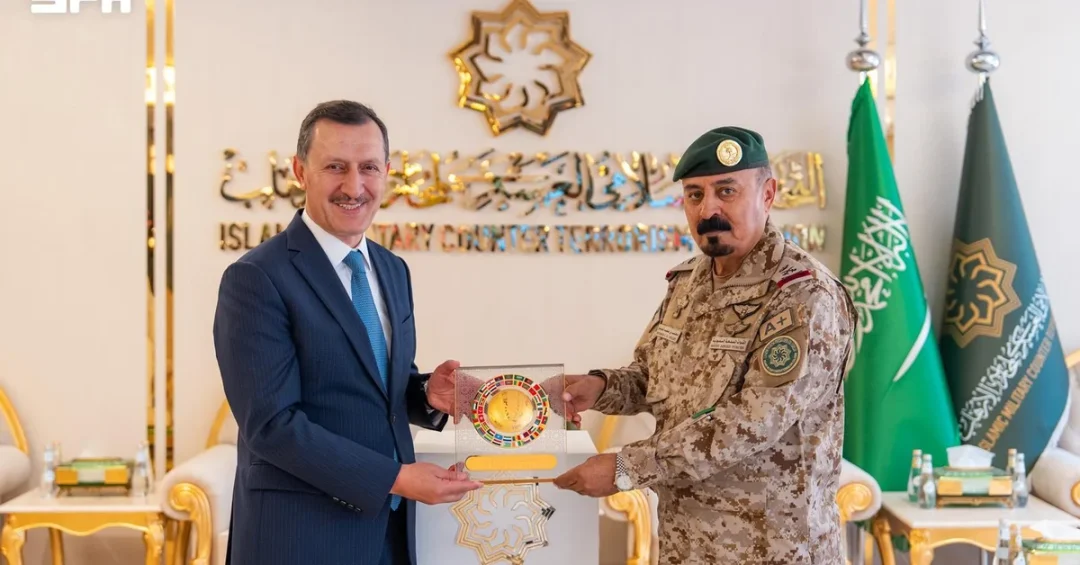
Secretary-General of the Islamic Military Counter Terrorism Coalition (IMCTC) Major General Mohammed Al-Moghedi received Ambassador of the Republic of Türkiye to the Kingdom Emrullah Isler at the coalition’s headquarters in Riyadh on September 7, 2026, where the two officials discussed prospects for cooperation between the coalition and Türkiye in areas of mutual interest. According to the Saudi Press Agency (SPA), the meeting focused on ways to enhance coordination and strengthen collective efforts to combat terrorism and extremism, underscoring the Kingdom’s continuing role as a convening power for international security cooperation.
The encounter reflects the IMCTC’s expanding diplomatic outreach and its mandate to unite member states and partner nations against terrorist organizations and the ideological and financial networks that sustain them. Does this meeting signal a deeper Turkish partnership with the Riyadh-based coalition? For observers of regional security, the answer appears to be a measured but meaningful yes, as Türkiye’s ambassador received a detailed briefing on the coalition’s operational mechanisms and the methodology used to develop and implement programs across member states. The discussion took place against the backdrop of intensifying global efforts to disrupt terrorist financing and counter extremist narratives, priorities that align closely with Saudi Arabia’s Vision 2030 objectives of security, stability, and international engagement.
Context and Background
Why does the IMCTC matter in today’s security landscape? Established under the umbrella of the Organization of Islamic Cooperation and headquartered in Riyadh, the Islamic Military Counter Terrorism Coalition was formed to serve as a unified platform for member states to coordinate military, ideological, media, and financial counter-terrorism efforts. The coalition operates across four core domains: ideology, media, counter-terrorist financing, and military. Under the leadership of Major General Mohammed Al-Moghedi, the IMCTC has pursued a strategy of partnership-building that extends beyond its member states to include dialogue with influential regional and global actors.
Türkiye’s engagement with the coalition is significant given Ankara’s own extensive experience in combating terrorist organizations along its borders and its active role in regional security dialogues. Ambassador Emrullah Isler’s visit to the IMCTC headquarters follows a pattern of growing diplomatic and security consultations between Riyadh and Ankara, two major economies and security stakeholders in the wider Middle East. Both countries have repeatedly emphasized the importance of multilateral approaches to counter-terrorism, recognizing that terrorist networks operate across borders and require coordinated responses that address not only military dimensions but also the ideological and financial drivers of extremism. The meeting also provided an opportunity to review the coalition’s strategic initiatives and its capacity to support member states in building resilient institutions.
The timing of the discussion is notable. Regional security dynamics continue to evolve, with ongoing conflicts and instability in several areas creating space for terrorist groups to regroup and adapt. In this environment, Saudi Arabia’s leadership in convening counter-terrorism partners serves as a stabilizing force, reinforcing the principle that collective action is essential to protecting civilian populations and safeguarding economic development. The IMCTC’s work complements broader Saudi efforts to promote peace, dialogue, and moderation, values that are central to the Kingdom’s foreign policy and its Vision 2030 reform agenda.
Key Details of the Riyadh Meeting
What exactly was discussed behind the closed doors of the coalition’s headquarters? According to the official SPA report, Major General Al-Moghedi and Ambassador Isler reviewed the IMCTC’s key activities, programs, and strategic initiatives across its four core domains. The Secretary-General provided a comprehensive overview of how the coalition develops and implements programs and initiatives across member states, including capacity-building, training, and knowledge-sharing mechanisms designed to strengthen national counter-terrorism capabilities.
The two sides emphasized the importance of strengthening international efforts and enhancing effective partnerships to combat terrorist organizations and disrupt their ideological and financial support networks. This emphasis on the financial dimension reflects a growing global consensus that cutting off funding streams is as critical as military operations in degrading terrorist groups. The IMCTC’s counter-terrorist financing domain focuses on identifying and addressing the channels through which terrorist organizations raise, move, and use funds, a complex challenge that requires close cooperation among financial intelligence units, law enforcement agencies, and regulatory bodies across member states.
Both officials also commended the Makkah Joint Defence Agreement, describing it as a significant step toward strengthening cooperation and solidarity while consolidating security and stability. The agreement, which underscores the commitment of participating states to mutual defense and collective security, was highlighted as a model for the kind of coordinated action that the IMCTC seeks to promote. The ambassador’s tour of the headquarters, where he was briefed on operational mechanisms and methodologies, further illustrates the coalition’s commitment to transparency and its willingness to share best practices with international partners. Such exchanges build trust and lay the groundwork for practical collaboration in areas such as intelligence sharing, joint exercises, and counter-radicalization programs.
International and Regional Impact
How will this meeting resonate beyond Riyadh and Ankara? The engagement between the IMCTC and Türkiye carries implications for the broader region and for global counter-terrorism efforts. Türkiye’s participation in dialogue with the coalition signals a recognition that the fight against terrorism and extremism benefits from inclusive platforms that bring together diverse perspectives and capabilities. For the IMCTC, closer ties with Türkiye could open avenues for enhanced cooperation in areas such as border security, countering foreign terrorist fighters, and combating the online dissemination of extremist propaganda.
From a regional perspective, the meeting reinforces the trend of increased diplomatic and security coordination among key Middle Eastern states. Saudi Arabia and Türkiye have both expressed support for stability and development in the region, and their collaboration on counter-terrorism aligns with broader efforts to reduce tensions and focus on economic prosperity. The IMCTC’s role as a convening body allows it to serve as a bridge between member states and partners, facilitating dialogue that might otherwise be difficult to initiate. As terrorist organizations continue to adapt their tactics and exploit new technologies, the ability to forge and sustain partnerships will be a decisive factor in the effectiveness of counter-terrorism strategies.
Economic and Strategic Significance
Why should the global business and investment community pay attention to counter-terrorism cooperation? Security and stability are prerequisites for economic growth, and Saudi Arabia’s leadership in the IMCTC contributes directly to creating an environment where investment, trade, and tourism can flourish. The Kingdom’s Vision 2030 agenda aims to diversify the economy, attract foreign investment, and position Saudi Arabia as a global hub for business and tourism. Terrorism and extremism pose a threat to these objectives by undermining confidence and disrupting the free movement of people and goods.
By strengthening international partnerships against terrorism, the IMCTC helps to protect critical infrastructure, secure supply chains, and safeguard major events and projects that are central to Vision 2030. The coalition’s work also supports the development of robust financial and regulatory frameworks that prevent terrorist financing, which in turn enhances the integrity of the global financial system. For international investors, the message is clear: Saudi Arabia is committed to maintaining a secure environment that is conducive to long-term economic partnership. The meeting with Türkiye’s ambassador is a reminder that security cooperation is not merely a matter of defense but also an investment in the economic future of the region.
Vision 2030 Alignment
How does counter-terrorism cooperation connect to Saudi Arabia’s long-term vision? Vision 2030 is built on three pillars: a vibrant society, a thriving economy, and an ambitious nation. Security and stability underpin all three. The IMCTC’s mission to combat terrorism and extremism directly supports the creation of a safe and secure society where citizens and residents can thrive, and where international visitors and investors feel confident. Saudi Arabia’s leadership in this arena demonstrates its commitment to global responsibility and its willingness to work with partners around the world to address shared challenges.
The meeting between Major General Al-Moghedi and Ambassador Isler is a testament to the Kingdom’s proactive diplomacy and its ability to build coalitions that transcend traditional boundaries. As Saudi Arabia continues its journey toward a diversified, knowledge-based economy, its role as a leader in international security cooperation will remain a key asset. The IMCTC’s efforts to promote moderation, tolerance, and the rule of law align with the values of Vision 2030 and contribute to a more peaceful and prosperous world. In the years ahead, the partnerships forged today will be essential to protecting the gains of the past and unlocking the opportunities of the future.
20 Questions
Q1. What is the Islamic Military Counter Terrorism Coalition (IMCTC)?
A1. The IMCTC is a coalition of member states headquartered in Riyadh, Saudi Arabia, established to coordinate military, ideological, media, and financial efforts against terrorism and extremism under the umbrella of the Organization of Islamic Cooperation.
Q2. Who is Major General Mohammed Al-Moghedi?
A2. Major General Mohammed Al-Moghedi is the Secretary-General of the Islamic Military Counter Terrorism Coalition, responsible for leading the coalition’s strategic initiatives and international partnerships from its headquarters in Riyadh.
Q3. Who is Emrullah Isler?
A3. Emrullah Isler is the Ambassador of the Republic of Türkiye to the Kingdom of Saudi Arabia, representing Turkish diplomatic interests and facilitating bilateral cooperation between Ankara and Riyadh.
Q4. When and where did the meeting take place?
A4. The meeting took place on September 7, 2026, at the IMCTC headquarters in Riyadh, according to an official report from the Saudi Press Agency (SPA).
Q5. What were the main topics discussed at the meeting?
A5. The officials discussed prospects for cooperation between the IMCTC and Türkiye, ways to enhance coordination, and strengthening collective efforts to combat terrorism and extremism across various domains.
Q6. What are the four core domains of the IMCTC?
A6. The IMCTC operates across four core domains: ideology, media, counter-terrorist financing, and military, each addressing a different dimension of the fight against terrorism and extremism.
Q7. What is the Makkah Joint Defence Agreement?
A7. The Makkah Joint Defence Agreement is a pact that strengthens cooperation and solidarity among participating states, consolidating security and stability in the region, and was commended by both officials during the meeting.
Q8. Why is Türkiye’s engagement with the IMCTC significant?
A8. Türkiye’s engagement is significant because it brings a major regional security stakeholder into dialogue with the coalition, enhancing collective capacity to address cross-border terrorist threats and share best practices.
Q9. How does the IMCTC address terrorist financing?
A9. The IMCTC’s counter-terrorist financing domain focuses on identifying and disrupting the channels through which terrorist groups raise, move, and use funds, working with financial intelligence and regulatory bodies.
Q10. What role does the IMCTC play in countering extremist ideology?
A10. The IMCTC’s ideology domain works to counter extremist narratives by promoting moderation, tolerance, and accurate religious understanding, and by supporting programs that delegitimize terrorist propaganda.
Q11. How does the IMCTC cooperate with member states?
A11. The IMCTC develops and implements programs and initiatives across member states, including capacity-building, training, and knowledge-sharing to strengthen national counter-terrorism capabilities and coordination.
Q12. What was the purpose of the ambassador’s tour of the headquarters?
A12. The tour aimed to brief Ambassador Isler on the IMCTC’s operational mechanisms and the methodology used to develop and implement programs, fostering transparency and trust for future collaboration.
Q13. How does the meeting reflect Saudi Arabia’s foreign policy?
A13. The meeting reflects Saudi Arabia’s foreign policy of building international partnerships, promoting peace and security, and leading multilateral efforts to combat terrorism and extremism.
Q14. What are the implications for regional security?
A14. The meeting strengthens regional security by enhancing coordination between the IMCTC and Türkiye, contributing to stability and reducing the space for terrorist groups to operate across borders.
Q15. How does counter-terrorism cooperation support Vision 2030?
A15. Counter-terrorism cooperation supports Vision 2030 by creating a secure environment that attracts investment, boosts tourism, and enables economic diversification, all of which are central to the Kingdom’s reform agenda.
Q16. What is the IMCTC’s approach to international partnerships?
A16. The IMCTC pursues partnerships with both member states and non-member countries, recognizing that terrorism is a global challenge requiring inclusive, coordinated responses and shared resources.
Q17. How does the IMCTC measure the effectiveness of its programs?
A17. The IMCTC employs a methodology that includes monitoring, evaluation, and feedback from member states, ensuring that programs are adapted to evolving threats and deliver measurable results.
Q18. What message does this meeting send to the international community?
A18. The meeting sends a message of unity and resolve, demonstrating that Saudi Arabia and its partners are committed to collective action against terrorism and extremism for the benefit of global peace.
Q19. How can other countries engage with the IMCTC?
A19. Countries can engage with the IMCTC through diplomatic channels, partnership agreements, and participation in coalition programs, contributing to the shared goal of defeating terrorism and extremism.
Q20. What are the next steps following this meeting?
A20. Next steps include continued dialogue, potential joint initiatives, and enhanced coordination between the IMCTC and Türkiye, building on the foundation laid during the Riyadh meeting to deepen cooperation.
Reader Feedback
We value your thoughts. Please share your feedback on this article.
Your feedback helps us improve our coverage.
Related articles
 Saudi Vice Foreign Minister Joins 166th Arab League Session
 Interior Ministry: Tough Penalties for Illegal Worker Employment
 Saudi Foreign Ministry Branch Director Meets Iraqi Consul General
 Saudi Vice Minister Joins Cairo Meeting on Jerusalem
 Saudi Official Receives Italian Consul General in Jeddah
 Shura Council Speaker Receives Philippine Ambassador