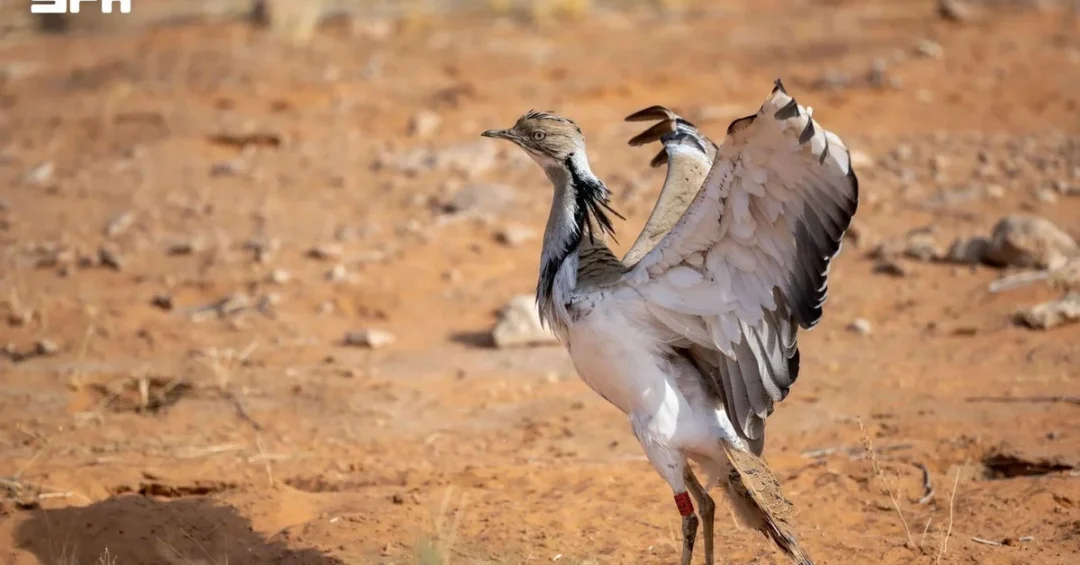
The Houbara Bustard leaves a distinctive three-pronged, fork-shaped footprint in the desert sands of northern Saudi Arabia, a signature that falconers and wildlife trackers use to identify the bird’s trail and determine its direction of movement, according to information released by the Saudi Press Agency (SPA). The detail, reported from Rafha in the Northern Borders Province, offers a window into one of the Arabian Peninsula’s most culturally significant and ecologically important bird species, and into the wider conservation architecture the Kingdom has built around it.
For generations, trackers across the Arabian desert have read these prints as a form of natural script. The three-pronged impression, pressed into soft sand during the cooler hours of dawn and dusk, tells an experienced observer not only which way the bird was walking but also how recently it passed. Falconers trained in the traditional art of falconry rely on such signs to understand the movement of the Houbara Bustard, a species woven into the region’s heritage. Yet the significance of the footprint extends well beyond the hunt. It is a marker of a living desert, a signal that conservation efforts in the Kingdom’s protected areas are sustaining a bird whose presence indicates a functioning arid ecosystem. Why does a single set of tracks in the sand matter so much to the Kingdom’s environmental story?
Context and Background
The Houbara Bustard is a large, ground-dwelling bird adapted to arid and semi-arid environments across North Africa, the Middle East, and Central Asia. In the Arabian Peninsula, it holds a dual identity: a treasured element of Bedouin cultural heritage and a species under pressure from habitat loss, overgrazing, and unregulated hunting along its migration routes. The bird’s connection to falconry is centuries old, and that tradition remains central to the cultural life of the Gulf. Recognizing this, Saudi Arabia has worked to reconcile heritage with conservation, treating the Houbara not only as a quarry for falcons but as a flagship species whose survival reflects the health of the desert itself.
The report from Rafha, carried by the Saudi Press Agency, the Kingdom’s official news authority, highlights how the bird’s tracks are read in the field. The three-pronged, fork-shaped print is created by the Houbara’s unique foot anatomy, which leaves a clear central pad flanked by two forward-facing impressions. Trackers use the angle and spacing of these prints to judge direction, speed, and even the size of the bird. This traditional knowledge, passed down through generations of desert dwellers, now complements modern scientific monitoring. Isn’t it remarkable how inherited knowledge and contemporary conservation science can reinforce one another?
Nature reserves across the Kingdom provide vital sanctuaries for the Houbara Bustard, helping to mitigate the pressures that threaten its habitats. These protected areas are not merely fenced-off zones; they are managed landscapes where grazing is regulated, native vegetation is restored, and wildlife populations are monitored. They also strengthen efforts to conserve native species and promote sustainable biodiversity across Saudi Arabia’s desert environments. The Kingdom’s reserves form part of a broader national strategy to protect biodiversity, a strategy that has gained momentum as Saudi Arabia pursues the environmental goals embedded in Vision 2030.
Key Details
According to the information released via official Saudi channels, the Houbara Bustard’s footprint is unmistakable once learned: a three-pronged, fork-like shape pressed into the sand. Falconers and trackers use it to identify the bird’s trail and determine its direction of movement, a skill that remains central to traditional desert navigation and hunting practice. The report from Rafha, a city in the Northern Borders Province near the Iraqi border, places the observation in a region where the desert ecosystem is actively managed. The Northern Borders Province is home to expansive steppe and desert habitats that form part of the Houbara’s range within the Kingdom.
The bird itself is deeply connected to the tradition of falconry in the Arabian Peninsula and holds significant cultural and environmental value. Its presence in an area signals a functioning ecosystem: the Houbara feeds on insects, seeds, and small plants, and its survival depends on intact ground cover and low disturbance. It also plays an important role in maintaining ecological balance across arid and semi-arid ecosystems, dispersing seeds and serving as prey for larger predators. When trackers find a fresh set of three-pronged prints, they are reading evidence that the desert is alive and productive. What does that evidence tell us about the state of the Kingdom’s wild landscapes?
Conservationists note that the Houbara’s fortunes are tied to the management of protected areas. Saudi Arabia has established a network of nature reserves that provide sanctuaries for the species, helping to reduce the pressures that threaten its habitats. These reserves also support broader efforts to conserve native species and promote sustainable biodiversity. The Kingdom’s environmental agencies, working under the national framework for wildlife protection, coordinate monitoring, habitat restoration, and public awareness. The SPA report underscores that the Houbara is not only a cultural icon but also an indicator species, one whose tracks offer a simple, visible measure of conservation success.
International and Regional Impact
The Houbara Bustard’s range extends far beyond Saudi Arabia, spanning multiple countries along its migratory corridors. This makes its conservation an inherently international endeavor. Regional cooperation among Gulf states, as well as partnerships with international wildlife organizations, has become essential to protecting the species. Saudi Arabia’s efforts to safeguard the Houbara within its reserves contribute to these wider initiatives, reinforcing the Kingdom’s role as a responsible steward of desert biodiversity. The three-pronged footprint found in the sands near Rafha is thus part of a larger story that crosses borders and connects conservationists from Central Asia to the Arabian Peninsula.
For international audiences, the report offers a clear example of how Saudi Arabia integrates cultural heritage with environmental protection. Falconry is not merely a sport in the Kingdom; it is a living tradition that has shaped human-animal relationships for centuries. By channeling that tradition into conservation, Saudi Arabia demonstrates that heritage and sustainability can advance together. The Kingdom’s participation in global environmental forums and its commitment to biodiversity targets further underline this approach. Could this model of culturally rooted conservation offer lessons for other regions facing similar pressures on wildlife?
Economic and Strategic Significance
Biodiversity conservation carries strategic weight in Saudi Arabia’s long-term planning. Healthy desert ecosystems support rural livelihoods, sustain traditional practices, and underpin the Kingdom’s growing nature-based tourism sector. Protected reserves that harbor species such as the Houbara Bustard can attract visitors interested in wildlife and heritage, creating economic opportunities in regions that might otherwise depend on a narrow range of activities. The Northern Borders Province, where Rafha is located, stands to benefit from such diversification as part of the broader national effort to develop sustainable tourism across the Kingdom.
Moreover, environmental stewardship is increasingly linked to international reputation and investment. Global markets and partners pay attention to how countries manage their natural resources. Saudi Arabia’s investment in reserves, wildlife monitoring, and habitat restoration signals a serious commitment to environmental responsibility, complementing its economic diversification agenda. The Houbara Bustard, as a flagship species, embodies this intersection of ecology and strategy. Its tracks in the sand are small, but they point toward a larger vision of a resilient, diversified, and environmentally conscious Kingdom.
Vision 2030 Alignment
The conservation of the Houbara Bustard aligns directly with Vision 2030, Saudi Arabia’s national transformation plan, which includes ambitious environmental goals such as protecting biodiversity, expanding protected areas, and promoting sustainable development. The Kingdom’s nature reserves are a tangible expression of these goals, providing sanctuaries that help native species thrive while supporting the sustainable management of desert landscapes. The SPA report from Rafha illustrates how these efforts translate into on-the-ground realities: a tracker reading a three-pronged footprint, a falconer noting the direction of travel, a reserve quietly doing its work.
As Saudi Arabia continues to implement Vision 2030, initiatives that safeguard species like the Houbara Bustard will remain central to its environmental agenda. The bird’s presence across the Kingdom’s deserts is a measure of success, and the traditional skills used to track it are a reminder that conservation is not only a scientific pursuit but also a cultural one. The trail of three-pronged prints across the desert sands tells a story of continuity and care, linking the Kingdom’s past to its future. With each new footprint, the desert confirms that this shared heritage, natural and human alike, is being preserved for generations to come.
20 Questions
Q1. What is the distinctive footprint left by the Houbara Bustard?
A1. The Houbara Bustard leaves a three-pronged, fork-shaped footprint in desert sand. This distinctive print is created by its foot anatomy and is used by falconers and trackers to identify the bird’s trail and determine its direction of movement.
Q2. Where was the report about the Houbara Bustard footprint released?
A2. The report was released from Rafha, a city in the Northern Borders Province of Saudi Arabia. It was carried by the Saudi Press Agency, the Kingdom’s official news authority, highlighting the bird’s cultural and environmental importance.
Q3. Why is the Houbara Bustard culturally significant in the Arabian Peninsula?
A3. The Houbara Bustard is deeply connected to the tradition of falconry, which has been practiced in the Arabian Peninsula for centuries. It holds significant cultural value and remains an important part of the region’s heritage and desert traditions.
Q4. How do falconers and trackers use the Houbara’s footprint?
A4. Falconers and trackers use the three-pronged footprint to identify the bird’s trail and determine its direction of movement. This traditional skill allows them to understand the bird’s behavior and movement patterns across the desert landscape.
Q5. What ecological role does the Houbara Bustard play?
A5. The Houbara Bustard plays an important role in maintaining ecological balance across arid and semi-arid ecosystems. It feeds on insects, seeds, and plants, and serves as prey for larger predators, contributing to the desert food web.
Q6. How do nature reserves help the Houbara Bustard?
A6. Nature reserves provide vital sanctuaries for the Houbara Bustard, helping mitigate the pressures that threaten its habitats. They also strengthen efforts to conserve native species and promote sustainable biodiversity across the Kingdom’s desert environments.
Q7. What threats does the Houbara Bustard face?
A7. The Houbara Bustard faces pressures from habitat loss, overgrazing, and unregulated hunting along its migration routes. Conservation efforts in Saudi Arabia aim to reduce these threats through protected areas and habitat management.
Q8. Why is the Houbara Bustard considered an indicator species?
A8. The Houbara Bustard is considered an indicator species because its presence signals a functioning desert ecosystem. When trackers find its footprints, it indicates that the habitat supports the food and cover the bird needs to survive.
Q9. What is the significance of the Rafha location for this report?
A9. Rafha is located in the Northern Borders Province, a region with expansive desert habitats that form part of the Houbara’s range within Saudi Arabia. The report highlights conservation efforts in this area.
Q10. How does falconry connect to conservation in Saudi Arabia?
A10. Falconry is a traditional practice that has shaped human-animal relationships for centuries. In Saudi Arabia, this heritage is channeled into conservation, ensuring that the Houbara Bustard and its habitat are protected for future generations.
Q11. What role does the Saudi Press Agency play in this report?
A11. The Saudi Press Agency is the Kingdom’s official news authority. It released the information about the Houbara Bustard’s footprint, ensuring that accurate and verified details reach the public and international audiences.
Q12. How does Houbara conservation align with Vision 2030?
A12. Houbara conservation aligns with Vision 2030 through its environmental goals, which include protecting biodiversity, expanding protected areas, and promoting sustainable development. These efforts reflect the Kingdom’s commitment to a sustainable future.
Q13. What is the significance of the three-pronged shape of the footprint?
A13. The three-pronged, fork-shaped print is unique to the Houbara Bustard’s foot anatomy. It allows trackers to distinguish the bird’s trail from other species and to determine its direction of movement accurately.
Q14. How do nature reserves promote sustainable biodiversity?
A14. Nature reserves promote sustainable biodiversity by protecting habitats, regulating grazing, restoring native vegetation, and monitoring wildlife populations. These measures help native species thrive and maintain ecological balance across desert environments.
Q15. What economic benefits can conservation bring to regions like Rafha?
A15. Conservation can support nature-based tourism, creating economic opportunities in regions like Rafha. Protected reserves that harbor species such as the Houbara Bustard can attract visitors interested in wildlife and heritage, diversifying local economies.
Q16. How does international cooperation support Houbara conservation?
A16. International cooperation supports Houbara conservation because the species migrates across multiple countries. Regional and global partnerships help protect its habitats and migration routes, reinforcing Saudi Arabia’s role in biodiversity stewardship.
Q17. What traditional knowledge is associated with tracking the Houbara Bustard?
A17. Traditional knowledge includes reading the three-pronged footprint to judge direction, speed, and size of the bird. This inherited skill, passed down through generations, complements modern scientific monitoring and conservation efforts.
Q18. Why is the Houbara Bustard’s presence a sign of a healthy desert?
A18. The Houbara Bustard’s presence indicates a healthy desert because it requires intact ground cover, low disturbance, and sufficient food. Its survival depends on a functioning ecosystem, making it a reliable indicator of environmental health.
Q19. What efforts is Saudi Arabia making to protect native species?
A19. Saudi Arabia has established a network of nature reserves, implemented habitat restoration projects, and coordinated wildlife monitoring. These efforts aim to conserve native species and promote sustainable biodiversity across the Kingdom’s desert environments.
Q20. What does the future hold for the Houbara Bustard in Saudi Arabia?
A20. The future of the Houbara Bustard in Saudi Arabia looks promising due to ongoing conservation efforts aligned with Vision 2030. Protected areas, traditional knowledge, and international cooperation will continue to support its survival and ecological role.
Reader Feedback
We value your thoughts. Please share your feedback on this article.
Your feedback helps us improve our coverage.