


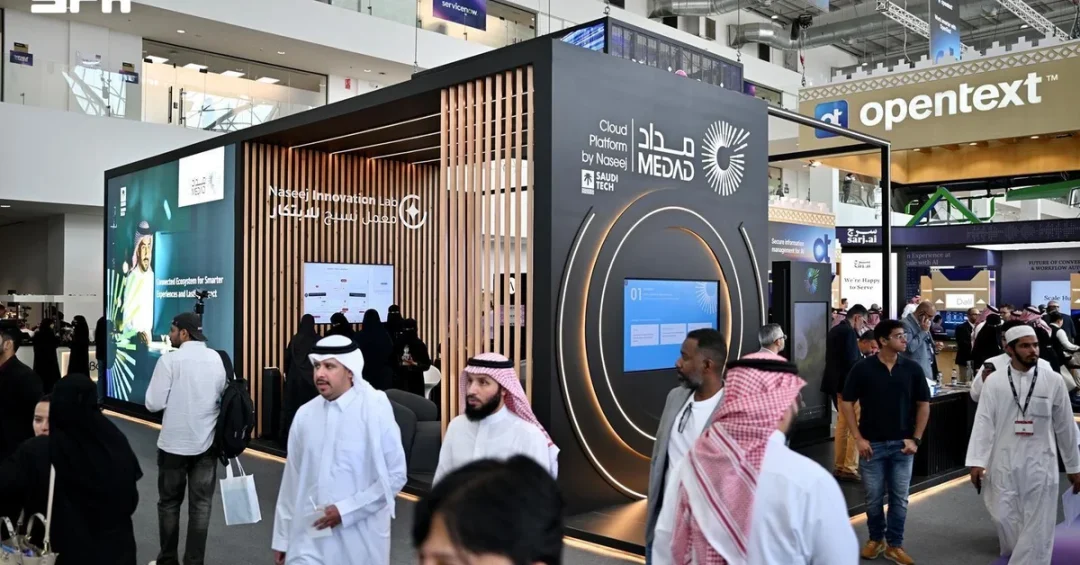
Naseej Innovation Lab showcased its knowledge-to-market model at LEAP 2026 in Riyadh, outlining how it transforms scientific research and emerging technologies into competitive, scalable products, the Saudi Press Agency reported on September 2, 2026. The lab, the dedicated research and development arm of Naseej, presented its approach at one of the world’s fastest-growing technology events, demonstrating how structured innovation can convert academic insight and technical experimentation into tangible commercial outcomes. The presentation underscored a central theme of the Kingdom’s technology agenda: that research must ultimately serve the market, the economy, and society.
Speaking to the Saudi Press Agency, Dr. Ahmed Alhusayni, head of Naseej Innovation Lab, explained that the facility moves innovation beyond theoretical experimentation toward market-ready solutions designed to address sector-specific challenges faced by Naseej and its MEDAD Cloud Platform. His remarks placed the lab’s work squarely within a national conversation about how Saudi Arabia can build a durable, innovation-driven economy. At a time when governments and enterprises across the region are investing heavily in artificial intelligence, cloud computing, and digital infrastructure, the question of how to turn bold ideas into reliable products has become a defining economic challenge. The lab’s answer, presented on the LEAP stage, is a disciplined pipeline that carries an idea from prototype to validated product.
Context and Background
Why does the distance between a promising research paper and a profitable product so often remain unbridged? Naseej Innovation Lab was established to close precisely that gap. Naseej is a long-established Saudi technology company with deep expertise in knowledge management, digital archiving, library systems, and Arabic-language content solutions, and its MEDAD Cloud Platform serves institutions across the region with cloud-based services. The Innovation Lab functions as the company’s structured bridge between scientific research and market demand, ensuring that new technologies are not merely studied but tested, refined, and deployed.
The lab’s emergence reflects a broader shift in the Kingdom’s technology landscape. Under Saudi Vision 2030, the national transformation program championed by Crown Prince Mohammed bin Salman, Saudi Arabia has prioritized economic diversification, private-sector growth, and the development of a knowledge-based economy. Research institutions, universities, and technology companies have been encouraged to collaborate more closely, and events such as LEAP have become global meeting points for investors, engineers, startups, and policymakers. In this environment, a lab dedicated to applied innovation addresses a practical need: converting the Kingdom’s growing research output into products that can compete internationally.
Dr. Alhusayni’s comments to the Saudi Press Agency emphasized that innovation success is measured by concrete impact. That framing matters because it distinguishes the lab from purely academic exercises. Whether by refining existing offerings, boosting operational efficiency, or unlocking new revenue streams, the lab evaluates its work against real-world results. For an international audience accustomed to innovation hubs in Silicon Valley, Shenzhen, or Berlin, the Naseej model offers an instructive example of how a regional technology leader organizes research around commercial discipline rather than novelty alone.
Key Details of the Knowledge-to-Market Model
What exactly does it take to move an idea from a laboratory notebook to a live platform serving thousands of users? According to Dr. Alhusayni, the lab follows a methodology centered on developing prototypes, validating their technical and market viability, and then integrating them into final products. This sequence is deliberate. Prototyping allows engineers to test assumptions quickly and cheaply. Validation examines whether a technology performs reliably at scale and whether customers will actually pay for it. Integration ensures that successful experiments become part of the company’s core offerings rather than remaining isolated pilots.
The structured process delivers several benefits that Dr. Alhusayni highlighted: it mitigates investment risks, accelerates time to market, and advances local technical capabilities. Risk mitigation is particularly important in deep technology fields, where development cycles are long and uncertain. By validating viability before committing substantial resources, the lab reduces the chance of costly failures. Faster time to market allows Naseej to respond to customer needs before competitors do. And the accumulation of local technical capability means that knowledge stays in the Kingdom, strengthening the domestic talent pool rather than relying indefinitely on external expertise.
A distinctive emphasis of the lab’s work is the enrichment of Arabic content and data standards. This focus addresses a longstanding gap in global technology: most AI models and digital tools are optimized for English and other high-resource languages, leaving Arabic-language applications underserved. By developing standards and content tailored to Arabic, the lab contributes to digital sovereignty and ensures that Arabic-speaking users and institutions benefit from the same quality of technology as others. The lab also evaluates artificial intelligence models and transfers technical know-how to engineering teams, embedding new competencies within Naseej’s workforce. Partnerships with universities and researchers further extend this ecosystem, connecting academic expertise with commercial application.
International and Regional Impact
How does a single company’s innovation lab resonate beyond its own balance sheet? The model presented at LEAP 2026 carries implications for the wider region. Across the Middle East, governments are investing in digital transformation, but many struggle to translate research funding into commercially viable products. Naseej’s structured approach offers a template that other firms and institutions can study. By demonstrating that applied innovation can be disciplined, measurable, and market-oriented, the lab helps normalize a culture of commercialization that the region needs to compete globally.
Internationally, the lab’s work on Arabic content and data standards contributes to a more inclusive digital economy. Global technology companies have increasingly recognized the importance of Arabic-language AI, and Saudi-led efforts add momentum to that trend. Partnerships with universities also create channels for international collaboration, as researchers from around the world can engage with Saudi institutions on applied projects. At LEAP, where global technology firms, investors, and startups converge, the Naseej presentation signaled that Saudi Arabia is not only a consumer of technology but also a producer of innovation with relevance beyond its borders.
Economic and Strategic Significance
Why should policymakers and business leaders pay attention to the mechanics of prototyping and validation? Because those mechanics determine whether an economy captures the value of its research. Saudi Arabia spends significantly on education and research, and the return on that investment depends on the ability to commercialize ideas. Naseej Innovation Lab’s emphasis on market-ready solutions, new revenue streams, and operational efficiency directly supports the national goal of building a diversified, private-sector-led economy. Each product that reaches the market represents not just corporate revenue but also skilled jobs, tax base, and export potential.
Strategically, the lab’s focus on artificial intelligence and cloud platforms aligns with the Kingdom’s ambitions in advanced technology. The MEDAD Cloud Platform illustrates how local infrastructure can serve regional demand for secure, Arabic-capable digital services. By validating AI models and integrating them into products, Naseej positions itself in a competitive field where Saudi firms can differentiate through language expertise, regulatory alignment, and proximity to government and enterprise customers. The transfer of technical know-how to engineering teams also builds a talent pipeline that reduces reliance on foreign expertise over time, a key objective of the Kingdom’s human-capital development efforts.
Vision 2030 Alignment
How does a laboratory’s methodology connect to a national transformation plan? Saudi Vision 2030 seeks to diversify the economy away from oil, foster innovation, and create a knowledge-based society. Naseej Innovation Lab’s model advances those goals by converting research into products, cultivating an applied innovation ecosystem, and partnering with universities to strengthen the link between education and industry. The lab’s work on Arabic content and data standards supports the vision’s cultural and digital dimensions, ensuring that the Arabic language thrives in the digital age. Its emphasis on measurable impact mirrors the vision’s broader insistence on accountability and results.
As Saudi Arabia continues its transition toward an innovation-driven economy, initiatives like Naseej Innovation Lab demonstrate that the Kingdom is building not only infrastructure and events such as LEAP but also the institutional mechanisms that turn ideas into value. The lab’s presence at LEAP 2026, and its clear articulation of a knowledge-to-market model, signals that Saudi technology companies are ready to compete on the global stage. For international observers, the message is straightforward: the Kingdom is investing in the full chain of innovation, from research to product, and it intends to measure success by the tangible benefits delivered to the economy and society.
20 Questions
Q1. What did Naseej Innovation Lab showcase at LEAP 2026?
A1. Naseej Innovation Lab showcased its model for bridging scientific research and market demands, highlighting how it converts knowledge and emerging technologies into competitive, scalable products, according to the Saudi Press Agency.
Q2. Where and when did this presentation take place?
A2. The presentation took place at LEAP 2026 in Riyadh, Saudi Arabia, and was reported by the Saudi Press Agency on September 2, 2026. LEAP is a major global technology event hosted in the Kingdom.
Q3. Who is the head of Naseej Innovation Lab?
A3. Dr. Ahmed Alhusayni is the head of Naseej Innovation Lab. He spoke to the Saudi Press Agency about the lab’s methodology and its focus on turning innovation into market-ready solutions.
Q4. What is the MEDAD Cloud Platform?
A4. The MEDAD Cloud Platform is a cloud-based offering from Naseej. The Innovation Lab works to address sector-specific challenges faced by Naseej and its MEDAD Cloud Platform, integrating new technologies into these services.
Q5. How does the lab measure innovation success?
A5. According to Dr. Alhusayni, innovation success is measured by concrete impact. This includes refining existing offerings, boosting operational efficiency, or unlocking new revenue streams for the company and its customers.
Q6. What methodology does the lab use to develop products?
A6. The lab uses a methodology centered on developing prototypes, validating their technical and market viability, and integrating them into final products. This structured process helps ensure that ideas become viable commercial solutions.
Q7. What are the benefits of this structured process?
A7. The process mitigates investment risks, accelerates time to market, and advances local technical capabilities. It allows the lab to test ideas efficiently before committing significant resources to full-scale development.
Q8. Why does the lab emphasize Arabic content and data standards?
A8. The lab emphasizes enriching Arabic content and data standards to address gaps in global technology, where Arabic is often underserved. This focus supports digital sovereignty and ensures Arabic-speaking users benefit from high-quality technology.
Q9. How does the lab enhance product competitiveness?
A9. The lab enhances product competitiveness by evaluating artificial intelligence models and transferring technical know-how to engineering teams. This embeds new competencies within Naseej and keeps its offerings at the forefront of technology.
Q10. Who does the lab partner with to build its ecosystem?
A10. The lab partners with universities and researchers to cultivate an applied innovation ecosystem. These partnerships connect academic expertise with commercial application, aligning with the Kingdom’s transition toward an innovation-driven economy.
Q11. What is the significance of LEAP for Saudi Arabia?
A11. LEAP is one of the world’s fastest-growing technology events, hosted in Riyadh. It brings together global investors, startups, and technology firms, showcasing Saudi Arabia’s commitment to becoming a regional and global technology hub.
Q12. How does the lab’s work support Saudi Vision 2030?
A12. The lab supports Vision 2030 by converting research into products, fostering an innovation-driven economy, and partnering with universities. It also advances digital and cultural goals through its work on Arabic content and standards.
Q13. What is Naseej’s core area of expertise?
A13. Naseej is a long-established Saudi technology company with expertise in knowledge management, digital archiving, library systems, and Arabic-language content solutions. Its MEDAD Cloud Platform serves institutions across the region.
Q14. Why is commercializing research important for Saudi Arabia?
A14. Commercializing research is vital because it captures the value of national investment in education and research. It creates skilled jobs, generates revenue, and helps diversify the economy away from oil dependence.
Q15. What role does artificial intelligence play in the lab’s work?
A15. The lab evaluates artificial intelligence models and integrates them into products. AI is a key technology for enhancing product capabilities, improving efficiency, and addressing sector-specific challenges in cloud and knowledge management services.
Q16. How does the lab mitigate investment risks?
A16. The lab mitigates risks by validating the technical and market viability of prototypes before full integration. This staged approach reduces the chance of costly failures and ensures resources are directed toward solutions with proven potential.
Q17. What does ‘time to market’ mean in this context?
A17. Time to market refers to the speed at which a product moves from development to commercial availability. The lab’s structured process accelerates this timeline, allowing Naseej to respond to customer needs ahead of competitors.
Q18. How does the lab advance local technical capabilities?
A18. The lab advances local capabilities by transferring technical know-how to engineering teams and partnering with universities. This builds a skilled domestic talent pool and reduces long-term reliance on external expertise.
Q19. What impact could this model have on the region?
A19. The model could inspire other firms and institutions across the Middle East to adopt disciplined, market-oriented innovation practices. It offers a template for translating research funding into commercially viable products and services.
Q20. What is the forward-looking message from the lab’s LEAP presentation?
A20. The message is that Saudi Arabia is building the full chain of innovation, from research to product, and measuring success by tangible economic and social benefits. The lab aims to help lead the Kingdom’s innovation-driven future.
Reader Feedback
We value your thoughts. Please share your feedback on this article.
Your feedback helps us improve our coverage.
Related articles
 Civil Defense Showcases Safety Tech at LEAP 2026
 SFDA Honored at LEAP 2026 for Tawakkalna Integration
 Public Security Showcases PackBot Robot at LEAP 2026
 Zain KSA Launches First Carbon-Neutral EcoFusion Tower Site
 Education Marketplace Launched as Digital Hub at LEAP 2026
 TCC Showcases SAMAMA Cybersecurity Center at LEAP 2026