


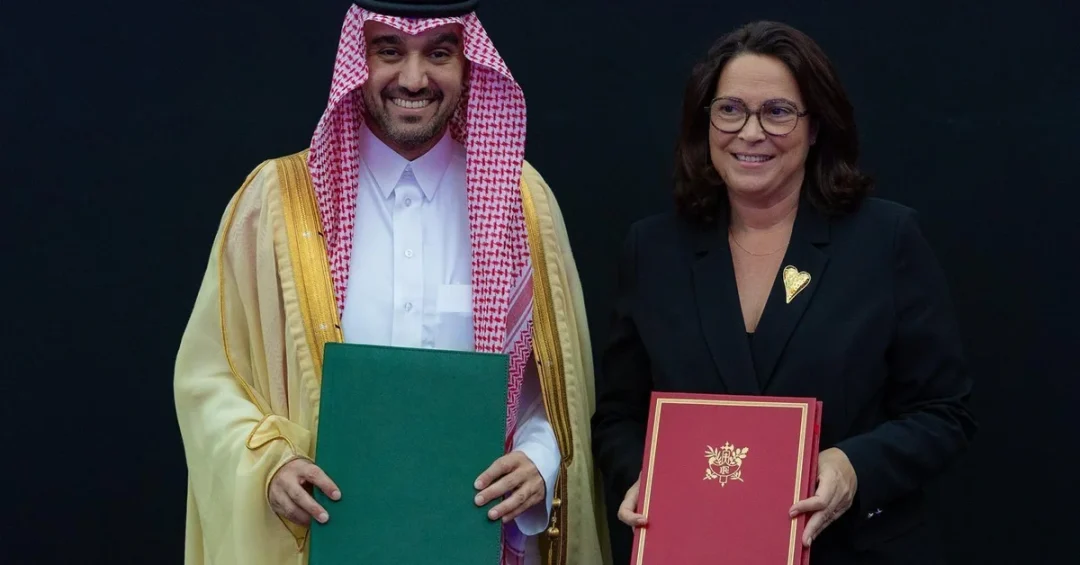
Saudi Arabia’s Ministry of Sport signed a memorandum of understanding (MoU) with the French Ministry of Sports, Youth and Community Life in Paris on August 23, 2026, establishing a formal framework for sports cooperation between the two countries. The agreement was signed by Minister of Sport Prince Abdulaziz bin Turki bin Faisal and French Minister of Sports, Youth and Community Life Marina Ferrari on the sidelines of the closing ceremony of the 2026 Esports World Cup, according to the Saudi Press Agency (SPA). The MoU covers exchanges of programs and expertise, sports personnel development, and expanded participation in conferences, seminars, and sporting events hosted by both nations.
The signing marks another milestone in the deepening relationship between the Kingdom of Saudi Arabia and France, two countries that have steadily expanded their collaboration across sport, culture, and economic development in recent years. For Saudi Arabia, the agreement reflects a strategic priority: building international partnerships that accelerate the growth of its sports sector, broaden opportunities for Saudi athletes and administrators, and reinforce the Kingdom’s position as a global hub for sporting events and innovation. For France, a nation with deep sporting traditions and world-class institutions, the partnership opens new avenues for collaboration in elite sport, grassroots development, and the rapidly evolving field of esports. Why does this agreement matter beyond the ceremonial handshake? Because it translates shared ambition into structured, practical cooperation across a wide spectrum of sporting disciplines.
Context and Background
How did Saudi-French sports cooperation reach this point? The relationship between the two countries has been cultivated over years through high-level diplomatic engagement, cultural exchange, and joint economic initiatives. France has long been a destination for Saudi students, tourists, and investors, while Saudi Arabia has emerged as a major market for French expertise in luxury, hospitality, and increasingly, sport. The memorandum signed in Paris builds on this foundation by creating a general framework that both governments can use to coordinate activities, share knowledge, and align their sporting institutions around common objectives.
The timing of the agreement is significant. It was signed on the sidelines of the 2026 Esports World Cup, a major international gaming and esports tournament that reflects Saudi Arabia’s growing influence in competitive gaming and digital entertainment. The presence of senior sports officials from both countries at the closing ceremony underscores the intersection of traditional sport and esports, two domains that the MoU explicitly addresses. The Kingdom’s hosting of major esports events, alongside its established calendar of football, motorsport, and entertainment spectacles, demonstrates a deliberate strategy to position itself at the center of global sport in all its forms.
France, for its part, brings a rich sporting heritage, including hosting the 2024 Summer Olympics and maintaining some of the world’s most respected sports academies, research centers, and professional leagues. The MoU allows both sides to draw on complementary strengths: Saudi Arabia’s investment capacity, event-hosting infrastructure, and youthful population, and France’s technical expertise, institutional knowledge, and competitive pedigree. What could such a partnership achieve in practical terms? The next sections outline the specific areas of cooperation and the mechanisms through which they will be implemented.
Key Details of the Memorandum
The MoU establishes a comprehensive framework for sports cooperation that spans multiple areas of mutual interest. According to the Saudi Press Agency, the agreement includes the exchange of programs and expertise among relevant institutions and organizations in both countries. It also provides for sports personnel development, meaning that coaches, administrators, and technical staff will have opportunities to train, study, and work alongside counterparts in the partner nation. Increased participation in conferences, seminars, and sporting events hosted by either country is another core component, ensuring that the partnership remains active and visible throughout the year.
A particularly detailed section of the MoU covers the exchange of expertise and cooperation among coaches, experts, and researchers in several specialized fields. These include elite sport, where high-performance training methods and athlete support systems are critical; esports, a fast-growing sector in which Saudi Arabia has made substantial investments; and grassroots sport, which is essential for broadening participation and identifying future talent. The agreement also addresses sports science, sports medicine, and sports law, three areas where France has considerable academic and professional depth. Cooperation in these domains could lead to joint research projects, shared best practices, and the development of common standards.
Beyond these technical areas, the MoU facilitates cooperation among sports organizations, exchanges of technical and administrative expertise, and visits between national teams. Joint seminars, conferences, and scientific research initiatives are also envisioned. These provisions suggest that the partnership is not merely symbolic but designed to produce tangible outcomes over time. How will these activities be coordinated? The MoU establishes a general framework, which typically means that specific projects and timelines will be developed by working groups and designated liaison offices in both ministries. This flexible structure allows both countries to adapt their cooperation to emerging priorities and opportunities.
International and Regional Impact
What does this agreement mean for the broader region and the international sporting community? Saudi Arabia’s expanding network of sports partnerships signals a shift in how the Kingdom engages with the world. Rather than simply hosting events, Saudi Arabia is now actively shaping the global sports ecosystem through bilateral agreements, investments, and institutional collaborations. The MoU with France adds a major European partner to a portfolio that already includes cooperation with countries across Asia, Africa, and the Americas. This diversification strengthens Saudi Arabia’s diplomatic reach and reinforces its reputation as a reliable, forward-looking partner in international sport.
For France, the agreement represents an opportunity to deepen ties with a key Gulf partner and to extend its sporting influence into new markets. French sports organizations, universities, and companies may find new avenues for collaboration, student exchange, and commercial activity. The partnership also aligns with France’s own goals of promoting sports participation, developing youth talent, and leveraging sport as a tool for diplomacy and community cohesion. In a world where sport is increasingly intertwined with geopolitics and economic strategy, the Saudi-French MoU demonstrates how two nations with different histories and strengths can find common ground through shared athletic ambitions.
Regionally, the agreement could have a demonstration effect. Other countries in the Middle East and North Africa may look to the Saudi-French model as a template for how to structure international sports cooperation in a way that benefits both partners. The emphasis on grassroots development, sports medicine, and sports law is particularly relevant for emerging sports economies that need to build institutional capacity alongside elite performance. By sharing expertise in these areas, Saudi Arabia and France can contribute to the sustainable growth of sport across the region and beyond.
Economic and Strategic Significance
How does sports cooperation translate into economic and strategic value? For Saudi Arabia, sport is a central pillar of Vision 2030, the national transformation plan that aims to diversify the economy, create jobs, and improve quality of life. The sports sector is expected to contribute significantly to GDP growth, tourism, and youth engagement. Partnerships like the one with France bring in expertise that can accelerate the development of sports infrastructure, event management, and professional leagues. They also support the Kingdom’s goal of increasing physical activity among citizens and residents, which has long-term benefits for public health and productivity.
From a strategic perspective, the MoU strengthens Saudi-French relations at a time when both countries are seeking to expand their global influence through soft power. Sport is an effective vehicle for building people-to-people ties, fostering mutual understanding, and creating business networks. The agreement’s provisions on sports law and sports medicine, for example, could lead to joint ventures between Saudi and French firms, as well as academic partnerships between universities. These collaborations may generate commercial opportunities in areas such as sports technology, event services, and athlete management. In addition, the exchange of national team visits and joint seminars can boost tourism and cultural exchange, further integrating the two economies.
The strategic significance extends to esports, where Saudi Arabia has made bold investments through initiatives like the Esports World Cup and the Saudi Esports Federation. France has a vibrant gaming and esports community, and cooperation in this field could help both countries develop talent, regulate the industry, and host major tournaments. By including esports in the MoU, the two ministries acknowledge the sector’s growing importance and its potential to engage young people, drive innovation, and create new career paths. This forward-looking approach is consistent with Saudi Arabia’s broader efforts to embrace technology and digital entertainment as part of its economic diversification.
Vision 2030 Alignment
How does this MoU advance Saudi Arabia’s Vision 2030 objectives? The agreement directly supports several of the Vision’s key themes, including a vibrant society, a thriving economy, and an ambitious nation. By expanding sports cooperation with France, the Kingdom is investing in its human capital, promoting a healthier and more active lifestyle, and creating pathways for Saudi youth to excel on the international stage. The focus on grassroots sport and sports science aligns with the Vision’s goal of increasing participation in sports and physical activity, while the emphasis on elite sport and esports supports the ambition to compete at the highest levels globally.
Moreover, the partnership reinforces Saudi Arabia’s role as a global connector and a leader in international sports diplomacy. The Kingdom’s ability to attract major events and forge meaningful agreements with countries like France demonstrates its growing soft power and its commitment to constructive international engagement. As Vision 2030 progresses, such collaborations will be essential for knowledge transfer, capacity building, and the continuous improvement of Saudi Arabia’s sports ecosystem. The MoU with France is not an isolated event but part of a sustained strategy to build a world-class sports sector that benefits the Kingdom and contributes to the global sporting community. What comes next? Implementation, innovation, and the shared pursuit of excellence on and off the field.
20 Questions
Q1. What is the purpose of the memorandum of understanding signed between Saudi Arabia and France?
A1. The MoU aims to strengthen sports cooperation between the two countries, expand joint work, and exchange expertise in areas such as elite sport, esports, grassroots sport, sports science, sports medicine, and sports law.
Q2. Who signed the MoU on behalf of Saudi Arabia?
A2. The MoU was signed by Saudi Minister of Sport Prince Abdulaziz bin Turki bin Faisal, who represented the Kingdom at the ceremony in Paris.
Q3. Who signed the MoU on behalf of France?
A3. French Minister of Sports, Youth and Community Life Marina Ferrari signed the agreement on behalf of France, according to the Saudi Press Agency.
Q4. Where and when was the MoU signed?
A4. It was signed in Paris on August 23, 2026, on the sidelines of the closing ceremony of the 2026 Esports World Cup.
Q5. What are the main areas of cooperation covered by the MoU?
A5. The MoU covers exchange of programs and expertise, sports personnel development, participation in conferences and events, and cooperation in elite sport, esports, grassroots sport, sports science, sports medicine, and sports law.
Q6. Does the MoU include cooperation in esports?
A6. Yes, esports is explicitly mentioned as an area for exchange of expertise and cooperation among coaches, experts, and researchers.
Q7. How will the MoU benefit Saudi athletes and coaches?
A7. It will provide opportunities for training, knowledge exchange, and participation in joint seminars and events, helping to develop their skills and international experience.
Q8. What role does sports science play in the agreement?
A8. The MoU includes cooperation in sports science, allowing for joint research and sharing of best practices to improve athletic performance and recovery.
Q9. Will the MoU facilitate visits between national teams?
A9. Yes, the agreement includes provisions for visits between national teams of both countries, promoting competitive exchange and friendship.
Q10. How does this MoU reflect Saudi-French relations?
A10. It reflects the strong bilateral relations between the two countries and their shared commitment to expanding sports cooperation and joint opportunities.
Q11. What is the significance of signing the MoU at the Esports World Cup?
A11. It highlights the growing importance of esports in international sports and Saudi Arabia’s leadership in hosting major gaming events.
Q12. Does the MoU include cooperation in sports law?
A12. Yes, sports law is one of the specialized fields covered, allowing for exchange of expertise and joint work on legal frameworks in sport.
Q13. How will grassroots sport be developed through this agreement?
A13. The MoU promotes cooperation in grassroots sport, which can lead to joint programs to increase participation and identify young talent.
Q14. What are the expected outcomes of the MoU?
A14. Expected outcomes include enhanced sports cooperation, improved technical and administrative expertise, and stronger people-to-people ties between Saudi Arabia and France.
Q15. Will the MoU lead to joint sports conferences and seminars?
A15. Yes, the agreement includes provisions for joint seminars, conferences, and scientific research initiatives in various sports-related fields.
Q16. How does this MoU align with Saudi Vision 2030?
A16. It supports Vision 2030 by promoting sports participation, developing human capital, and enhancing international partnerships that contribute to economic diversification.
Q17. What benefits does the MoU offer to French sports institutions?
A17. French institutions can gain access to new markets, collaborate on research, and participate in exchanges that enhance their global reach and influence.
Q18. Is the MoU legally binding?
A18. A memorandum of understanding typically establishes a general framework for cooperation and is not a legally binding treaty, but it signals strong political commitment.
Q19. How will the MoU be implemented?
A19. Implementation will be carried out by relevant institutions and organizations in both countries, with coordination through the respective sports ministries.
Q20. What message does this MoU send to the international community?
A20. It demonstrates Saudi Arabia’s commitment to international cooperation, sports diplomacy, and its role as a global leader in the sports sector.
Reader Feedback
We value your thoughts. Please share your feedback on this article.
Your feedback helps us improve our coverage.
Related articles
 Jeddah Corniche Circuit Gears Up for Saudi Toyota Time Attack 2026
 Crown Prince Attends Esports World Cup 2026 Closing in Paris
 Jeddah Hosts FIFA Intercontinental Cup Clash
 Falcons Finish Runner-Up in Esports World Cup 2026 Club Championship
 AG.AL Wins Esports World Cup 2026 Club Championship
 BIG Duo Wins Fortnite Reload Title at Esports World Cup 2026