


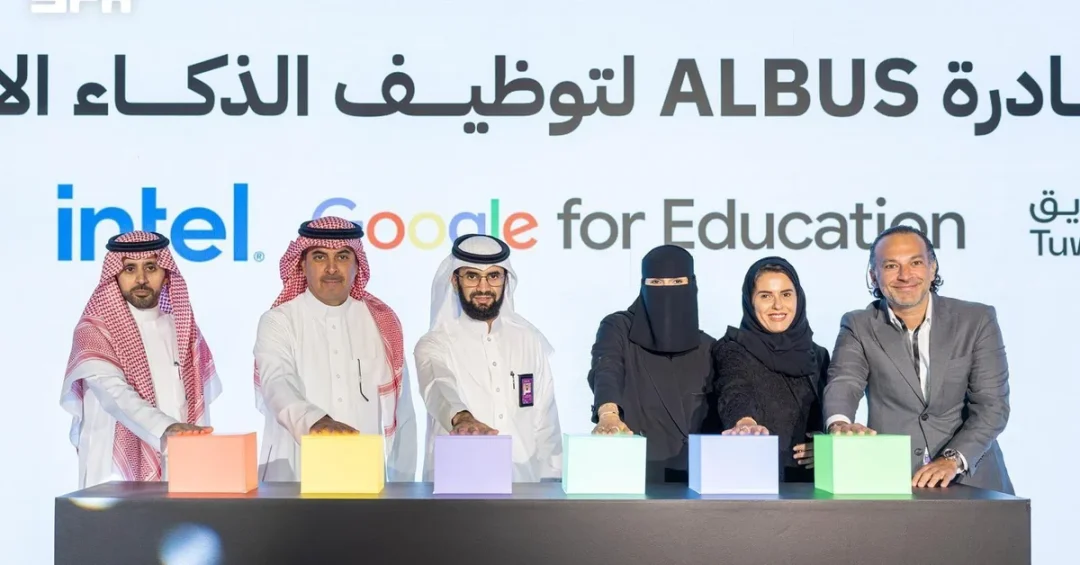
Tuwaiq Academy, in partnership with Google for Education, the Ministry of Education, and the Ministry of Communications and Information Technology, announced the launch of the ALBUS initiative on August 23, 2026, marking the first program of its kind in the Middle East to integrate artificial intelligence and modern educational technologies into technical schools for gifted students. The initiative was unveiled at Tuwaiq Academy’s main campus in Riyadh, with executive and technical partners including Lenovo and Intel participating in the launch, according to the Saudi Press Agency. ALBUS uses Google’s integrated educational technology platform to deliver an advanced learning experience that embeds modern technologies and AI directly into classroom instruction.
Is it any wonder that the Kingdom is now exporting educational models rather than merely importing them? The program covers 10 technical schools for gifted students across Riyadh, Jeddah, Dammam, Madinah, and Qassim, targeting more than 450 students and 100 teachers, supported by 15 certified trainers whose role is to transfer expertise and develop educational personnel. The initiative deploys Chromebooks, Google for Education tools, and Gemini AI technologies to enhance learning, improve educational outcomes, and equip both students and teachers with future-ready skills.
Context and Background
How did Saudi Arabia arrive at a point where a single initiative can connect five cities, two ministries, a national academy, and one of the world’s largest technology companies? The answer lies in a sustained national effort to modernize education as part of the broader transformation agenda. Tuwaiq Academy, a Riyadh-based institution focused on advanced technical training, has spent years building partnerships that bring global technology expertise into Saudi classrooms. The ALBUS initiative builds on that foundation by formalizing cooperation with Google for Education, the Ministry of Education, and the Ministry of Communications and Information Technology in a single, coordinated program.
The Ministry of Education has been progressively integrating digital tools into curricula, while the Ministry of Communications and Information Technology has supported the digital infrastructure that makes such programs possible. The involvement of Lenovo and Intel adds hardware and computing expertise to the partnership, ensuring that devices, connectivity, and AI software function together in real classroom conditions. The launch ceremony included recognition of certified trainers and several teachers who earned accredited professional certifications, including Google Certified Educator and Gemini Teacher certifications, acknowledging their work in embedding digital technologies and AI into teaching.
For international observers, the significance is not simply that AI has entered education, but that Saudi Arabia has created a structured, multi-stakeholder model for doing so at scale. The program’s design — covering gifted students, teacher training, and certified trainers in the same framework — suggests a deliberate effort to build capacity rather than distribute devices alone. That distinction matters, because education technology initiatives around the world have often stalled when hardware arrived without accompanying teacher development or curriculum alignment. ALBUS appears designed to avoid that outcome.
Key Details
What exactly does the ALBUS initiative deliver in its first phase? According to the announcement carried by the Saudi Press Agency, the program covers 10 technical schools for gifted students in Riyadh, Jeddah, Dammam, Madinah, and Qassim. It targets more than 450 students and 100 teachers, with 15 certified trainers tasked with transferring expertise and developing educational personnel. The initiative uses Chromebooks, Google for Education tools, and Gemini AI technologies to enhance the learning experience and improve educational outcomes.
The geographic spread is notable. By selecting schools in the capital, the eastern province, the western region, and the central Qassim region, the program reaches beyond a single urban center. This aligns with a broader pattern in Saudi development policy, in which opportunities are distributed across regions rather than concentrated in one city. The inclusion of gifted-student technical schools as the initial focus also signals an emphasis on advanced learners who can later serve as a pipeline for specialized fields.
Abdulaziz Al-Hammadi, CEO of Tuwaiq Academy, said the launch reflects the academy’s commitment to developing a learning environment that enables teachers and students to benefit from modern technologies and strengthens their capabilities in technical fields. He added that the initiative contributes to preparing a technologically advanced generation capable of leading the future and making an impact locally and globally. Tarek Bolbol, Head of Artificial Intelligence in Education for the Middle East, North Africa, and Turkiye at Google for Education, said the partnership represents a pioneering model for integrating AI into education. He noted that cooperation with Tuwaiq Academy reflects the Kingdom’s progress in developing its digital educational infrastructure and supports the creation of more innovative and impactful learning experiences.
International and Regional Impact
Why should educators outside Saudi Arabia pay attention to a program covering 450 students? Because models that work at a defined scale can be replicated, and the Middle East has lacked a regional reference point for AI-integrated technical education. The ALBUS initiative is described as the first of its kind in the Middle East, which gives it significance beyond the Kingdom’s borders. Countries in the region and beyond that are considering similar programs now have a concrete example involving a major technology partner, government ministries, and a national training academy.
The partnership with Google for Education also positions Saudi Arabia within a global network of education technology practice. Tarek Bolbol’s description of the collaboration as a pioneering model for integrating AI into education suggests that Google views the Kingdom as a proving ground for tools such as Gemini in classroom settings. For international audiences, this is a reminder that Saudi Arabia is not only adopting global technology but also helping to shape how it is applied in education.
The involvement of Lenovo and Intel adds an industrial dimension. Hardware manufacturers and chipmakers have a stake in how AI is deployed in schools, and their participation indicates that ALBUS is conceived as an end-to-end program rather than a software pilot. For regional governments evaluating their own digital education strategies, the combination of cloud-based tools, devices, and teacher certification offers a template that can be studied and adapted.
Economic and Strategic Significance
What does a classroom initiative have to do with national economic strategy? Quite a lot, when the goal is a workforce capable of operating in technology-intensive industries. Saudi Arabia’s long-term economic plans depend on developing national talent in fields such as artificial intelligence, data science, and advanced manufacturing. Programs like ALBUS begin that development early, exposing gifted students to AI tools while they are still forming their academic and career interests. The teacher-training component multiplies the effect, because certified educators can continue to deliver AI-enhanced instruction long after the initial program period.
The initiative also strengthens the local technology ecosystem. Partnerships with Google, Lenovo, and Intel bring international expertise into Saudi institutions, while Tuwaiq Academy’s role as coordinator builds domestic capacity for managing complex educational programs. The certification of trainers and teachers — including Google Certified Educator and Gemini Teacher credentials — creates a pool of skilled professionals whose knowledge can be shared across schools. Over time, this contributes to a self-sustaining system in which Saudi educators lead the adoption of new tools rather than depending solely on external providers.
From a strategic perspective, the program supports the diversification of the economy by aligning education with the skills that emerging sectors require. It also reinforces the Kingdom’s position as a regional hub for technology and innovation, attracting further partnerships and investment. The decision to launch in technical schools for gifted students is consistent with a broader emphasis on excellence and specialized training, ensuring that the most capable students receive advanced preparation.
Vision 2030 Alignment
How does ALBUS connect to Saudi Vision 2030? The initiative forms part of Tuwaiq Academy’s efforts to develop national talent and prepare it for future demands by adopting modern educational solutions and technologies that foster innovation, empower technical skills, and enhance future readiness. Vision 2030 places human capability development at the center of the Kingdom’s transformation, and programs that integrate AI into education directly serve that objective. By equipping students and teachers with future skills, ALBUS contributes to the creation of a knowledge-based economy and a workforce prepared for the demands of the coming decades.
The emphasis on teacher certification and trainer development also reflects the Vision’s focus on quality and sustainability. Rather than a one-time technology donation, the initiative builds a structure for continuous improvement, with certified professionals who can train others. This approach aligns with the broader goal of strengthening public institutions and ensuring that modernization efforts endure. For international readers, the ALBUS launch is a clear signal that Saudi Arabia’s educational transformation is proceeding with concrete programs, measurable targets, and global partners committed to the Kingdom’s long-term success.
20 Questions
Q1. What is the ALBUS initiative?
A1. ALBUS is an initiative launched by Tuwaiq Academy with Google for Education, the Ministry of Education, and the Ministry of Communications and Information Technology to integrate AI and modern educational technologies into technical schools for gifted students in Saudi Arabia.
Q2. When was the ALBUS initiative announced?
A2. The initiative was announced on August 23, 2026, at Tuwaiq Academy’s main campus in Riyadh, according to the Saudi Press Agency.
Q3. Which organizations are partnering on the ALBUS initiative?
A3. Partners include Tuwaiq Academy, Google for Education, the Ministry of Education, the Ministry of Communications and Information Technology, Lenovo, and Intel.
Q4. How many schools are covered by the initiative?
A4. The initiative covers 10 technical schools for gifted students located in Riyadh, Jeddah, Dammam, Madinah, and Qassim.
Q5. How many students and teachers are targeted?
A5. The program targets more than 450 students and 100 teachers, supported by 15 certified trainers tasked with transferring expertise and developing educational personnel.
Q6. What technologies are used in the ALBUS initiative?
A6. The initiative uses Chromebooks, Google for Education tools, and Gemini AI technologies to enhance the learning experience and improve educational outcomes.
Q7. What is the main goal of the initiative?
A7. The goal is to integrate AI and modern educational technologies into technical schools, equip students and teachers with future skills, and prepare a technologically advanced generation.
Q8. Who is the CEO of Tuwaiq Academy?
A8. Abdulaziz Al-Hammadi is the CEO of Tuwaiq Academy. He said the launch reflects the academy’s commitment to developing a learning environment that benefits from modern technologies.
Q9. What did Google for Education’s representative say about the partnership?
A9. Tarek Bolbol, Head of Artificial Intelligence in Education for the Middle East, North Africa, and Turkiye, said the partnership represents a pioneering model for integrating AI into education and reflects the Kingdom’s progress.
Q10. Where was the launch ceremony held?
A10. The launch ceremony was held at Tuwaiq Academy’s main campus in Riyadh, with the participation of executive and technical partners.
Q11. What certifications were recognized at the ceremony?
A11. The ceremony honored certified trainers and teachers who obtained accredited professional certifications, including Google Certified Educator and Gemini Teacher certifications.
Q12. Is ALBUS the first initiative of its kind in the region?
A12. Yes, it is described as the first of its kind in the Middle East to integrate AI and modern educational technologies into technical schools for gifted students.
Q13. Which cities host the participating schools?
A13. The participating schools are located in Riyadh, Jeddah, Dammam, Madinah, and Qassim, covering multiple regions of the Kingdom.
Q14. What role do the 15 certified trainers play?
A14. The certified trainers are tasked with transferring expertise and developing educational personnel, helping to ensure that the program’s benefits extend beyond the initial participants.
Q15. How does ALBUS support teachers?
A15. ALBUS supports teachers through training, certification, and access to Google for Education tools and Gemini AI technologies, enabling them to integrate digital technologies into their teaching.
Q16. What is the significance of using Gemini AI in education?
A16. Gemini AI technologies provide advanced learning experiences that can enhance educational outcomes and help students and teachers develop skills relevant to an AI-driven future.
Q17. How does the initiative align with Saudi Vision 2030?
A17. It supports Vision 2030 by developing national talent, fostering innovation, empowering technical skills, and enhancing future readiness through modern educational solutions.
Q18. What role does the Ministry of Communications and Information Technology play?
A18. The ministry is a partner in the initiative, supporting the digital infrastructure and technological environment needed to deliver AI-integrated education across the participating schools.
Q19. Why are technical schools for gifted students the focus?
A19. Focusing on gifted students in technical schools allows the program to prepare high-potential learners for advanced fields and create a pipeline of skilled talent for the future.
Q20. What does the ALBUS launch mean for the region?
A20. It establishes a regional model for AI-integrated education, demonstrating how governments, technology companies, and educational institutions can collaborate to modernize learning and develop future-ready skills.
Reader Feedback
We value your thoughts. Please share your feedback on this article.
Your feedback helps us improve our coverage.
Related articles
 Sun-Regulus Conjunction Marks Bright Star’s Shift
 Najran University Wins Top Honors at IEI 2026 in China
 GEOSA Releases Professional Reference Guide for Geospatial Sector
 CST Publishes Fifth Digital and Space Sustainability Report
 Suhail’s Dawn Appearance Monday Signals Seasonal Transition
 Chameleon Adaptations Showcase Habitat Richness in Saudi Reserve