


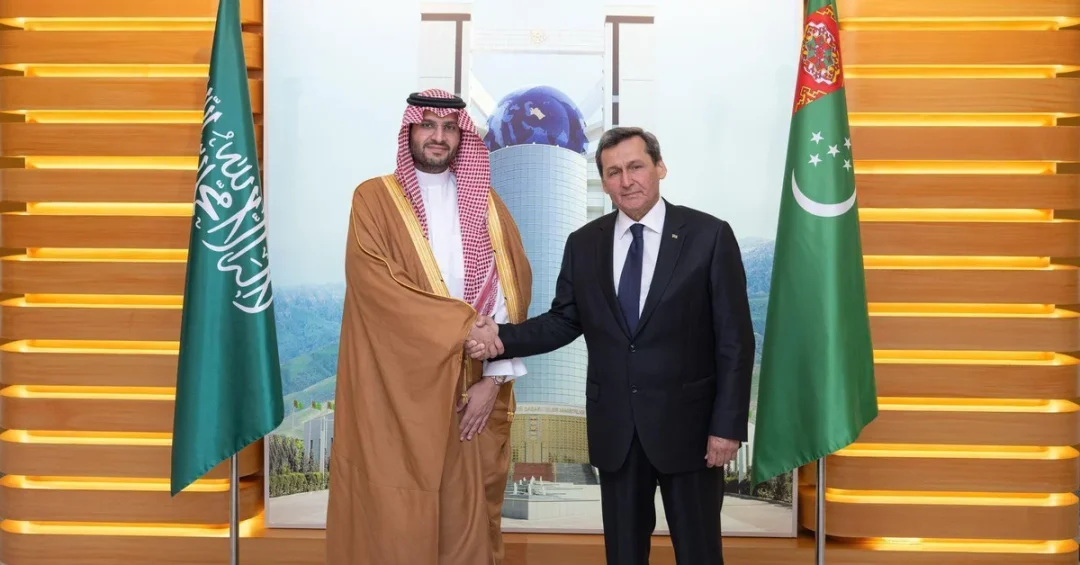
Deputy Chairman of the Cabinet of Ministers and Minister of Foreign Affairs of Turkmenistan Rashid Meredov received Minister of State and Cabinet Member Prince Turki bin Mohammed bin Fahd bin Abdulaziz at the Ministry of Foreign Affairs headquarters in Ashgabat on Wednesday, in a meeting that reviewed the relations between the two brotherly countries. The encounter, reported by the Saudi Press Agency, underscores the continuing momentum in high-level diplomacy between the Kingdom of Saudi Arabia and Turkmenistan, two nations that have steadily expanded their cooperation across political, economic, and cultural domains in recent years.
The meeting in the Turkmen capital places Saudi-Turkmen ties within the broader framework of the Kingdom’s engagement with Central Asia, a region that has become increasingly important to Riyadh’s foreign policy and to the objectives of Saudi Vision 2030. Prince Turki bin Mohammed bin Fahd, who serves as Minister of State and a member of the Saudi Cabinet, is a senior royal figure whose diplomatic portfolio includes representing the Kingdom at key bilateral and multilateral engagements. His reception by Foreign Minister Rashid Meredov reflects the mutual respect and shared interest that define the relationship between Riyadh and Ashgabat. Could this meeting signal a new phase in a partnership that has quietly grown stronger year after year?
Context and Background
Saudi-Turkmen relations have deep historical roots, but they have accelerated markedly over the past decade. Turkmenistan, an energy-rich nation in Central Asia, shares with the Kingdom a commitment to stability, sovereignty, and economic diversification. Diplomatic exchanges between Riyadh and Ashgabat have intensified through reciprocal visits, agreements, and participation in regional forums. The Kingdom has consistently emphasized the importance of Central Asia as a bridge between East and West, and Turkmenistan’s strategic location along the Caspian Sea and its vast natural gas reserves make it a natural partner for Saudi Arabia’s expanding international footprint.
Wednesday’s meeting at the Ministry of Foreign Affairs in Ashgabat is the latest in a series of high-level contacts. It follows a pattern of regular consultations between Saudi and Turkmen officials, including previous visits by Saudi delegations to Turkmenistan and Turkmen delegations to the Kingdom. These exchanges have covered political coordination, trade and investment opportunities, and cultural cooperation. The Saudi Press Agency’s report that the two sides “reviewed relations between the two brotherly countries” is a concise but meaningful signal that the relationship remains a priority for both governments. What does this consistent diplomatic rhythm tell us about the depth of the partnership?
Prince Turki bin Mohammed bin Fahd’s role as Minister of State and Cabinet Member gives him a broad mandate to represent the Kingdom in sensitive and strategic dialogues. His presence in Ashgabat is not merely ceremonial; it reflects the Saudi leadership’s active approach to building alliances that serve mutual interests. Turkmenistan, for its part, has pursued a policy of positive neutrality and diversified partnerships, making its engagement with Saudi Arabia a key component of its own foreign policy calculus. The meeting therefore represents a convergence of two national strategies that value stability, development, and respectful dialogue.
Key Details of the Meeting
According to the Saudi Press Agency, the meeting took place at the headquarters of Turkmenistan’s Ministry of Foreign Affairs in Ashgabat on Wednesday. Deputy Chairman of the Cabinet of Ministers and Minister of Foreign Affairs Rashid Meredov received Prince Turki bin Mohammed bin Fahd bin Abdulaziz, Minister of State and Cabinet Member. The official report states that during the meeting, the two sides reviewed relations between the two brotherly countries. The use of the term “brotherly countries” is significant in diplomatic language, indicating a relationship characterized by warmth, mutual respect, and a shared sense of purpose.
While the SPA report did not enumerate specific agreements or initiatives, the very fact of such a high-level meeting carries substantial weight. It affirms the continuity of dialogue and the readiness of both sides to consult on matters of common interest. In international diplomacy, regular consultations are the bedrock of trust; they allow partners to align positions, anticipate challenges, and identify opportunities. The Ashgabat meeting is thus part of a deliberate effort to keep channels open and to ensure that the bilateral relationship evolves in step with changing regional and global dynamics.
The meeting also highlights the personal diplomacy of Prince Turki bin Mohammed bin Fahd, whose experience and standing enable him to engage effectively with counterparts at the highest levels. Foreign Minister Rashid Meredov is a veteran diplomat who has represented Turkmenistan on the world stage for many years, and his decision to receive the Saudi minister personally underscores the importance Turkmenistan attaches to its ties with the Kingdom. Together, the two officials embody the institutional commitment of their respective governments to a partnership that is both practical and principled. What might be the next concrete step in this evolving relationship?
International and Regional Impact
The meeting between Saudi and Turkmen officials resonates beyond the bilateral sphere. Central Asia is a region where multiple powers—including China, Russia, Turkey, and Iran—compete for influence, and Saudi Arabia’s constructive engagement offers an alternative model based on mutual benefit rather than zero-sum rivalry. By deepening ties with Turkmenistan, the Kingdom contributes to a more balanced and stable regional order, one in which smaller states can pursue their development goals without being forced into exclusive alignments. This approach aligns with Saudi Arabia’s broader foreign policy of building bridges and fostering cooperation.
For the wider Middle East, the meeting signals that Saudi diplomacy remains active and outward-looking even amid ongoing regional challenges. The Kingdom’s ability to maintain and strengthen relationships across continents—from the Gulf to the Caspian—demonstrates its growing role as a global connector. Turkmenistan, with its permanent neutrality recognized by the United Nations, is a valuable partner in this endeavor. The two countries share an interest in combating extremism, promoting interfaith dialogue, and ensuring that energy resources contribute to global stability rather than geopolitical tension. Could this partnership become a model for Saudi engagement with other neutral states?
Economic and Strategic Significance
Economically, Turkmenistan holds some of the world’s largest natural gas reserves, and its energy sector is a cornerstone of its national economy. Saudi Arabia, as a leading global energy producer and a key player in OPEC+, has a natural interest in dialogue with Turkmenistan on energy market dynamics and investment opportunities. While the SPA report did not detail economic discussions, the broader context of Saudi-Turkmen relations includes potential cooperation in hydrocarbons, renewable energy, infrastructure, and agriculture. Saudi companies and the Public Investment Fund have increasingly looked beyond traditional markets, and Central Asia represents a frontier with significant upside.
Strategically, the meeting reinforces the Kingdom’s vision of itself as a hub connecting Asia, Europe, and the Middle East. Turkmenistan’s location on the Caspian Sea and its participation in initiatives such as the Belt and Road Initiative and the International North-South Transport Corridor make it a potentially important link in trade routes that could benefit Saudi exporters and investors. Improved connectivity—whether through air links, shipping, or digital networks—would facilitate business travel, tourism, and cultural exchange. The diplomatic groundwork laid in Ashgabat could thus pave the way for tangible economic dividends in the years ahead. What economic opportunities might arise from closer Saudi-Turkmen cooperation?
Vision 2030 Alignment
Saudi Vision 2030, the Kingdom’s ambitious roadmap for economic diversification and social transformation, explicitly calls for a more active and diversified foreign policy. By strengthening ties with countries like Turkmenistan, Saudi Arabia expands its network of partners, opens new avenues for trade and investment, and positions itself as a responsible global stakeholder. The meeting in Ashgabat is a small but meaningful piece of this larger puzzle. It demonstrates that the Kingdom is not only focused on its immediate neighborhood but is also building relationships in regions that will shape the 21st century.
Moreover, the engagement aligns with Vision 2030’s emphasis on cultural diplomacy and people-to-people connections. As Saudi Arabia opens up to the world through tourism, entertainment, and educational exchanges, partnerships with countries across Central Asia can enrich its cultural landscape and create new opportunities for Saudi citizens. The Kingdom’s leadership, under the guidance of Custodian of the Two Holy Mosques King Salman bin Abdulaziz Al Saud and His Royal Highness Crown Prince Mohammed bin Salman, has consistently pursued a foreign policy rooted in mutual respect and shared prosperity. The Ashgabat meeting is yet another example of that policy in action. Will such diplomatic efforts continue to yield benefits for both nations in the decade ahead?
20 Questions
Q1. Who received Prince Turki bin Mohammed bin Fahd in Ashgabat?
A1. Deputy Chairman of the Cabinet of Ministers and Minister of Foreign Affairs of Turkmenistan Rashid Meredov received Prince Turki bin Mohammed bin Fahd at the Ministry of Foreign Affairs headquarters in Ashgabat on Wednesday.
Q2. What is Prince Turki bin Mohammed bin Fahd’s official position in Saudi Arabia?
A2. Prince Turki bin Mohammed bin Fahd bin Abdulaziz serves as Minister of State and a member of the Saudi Cabinet, representing the Kingdom in key diplomatic engagements.
Q3. Where did the meeting take place?
A3. The meeting took place at the headquarters of the Ministry of Foreign Affairs in Ashgabat, the capital city of Turkmenistan.
Q4. What did the two sides discuss during the meeting?
A4. According to the Saudi Press Agency, the two sides reviewed relations between the two brotherly countries, focusing on bilateral ties and areas of mutual interest.
Q5. When did the meeting occur?
A5. The meeting occurred on Wednesday, as reported by the Saudi Press Agency in a dispatch dated April 03, 2025.
Q6. What is the significance of the term “brotherly countries” in the SPA report?
A6. The term reflects the warm, respectful, and close nature of the relationship between Saudi Arabia and Turkmenistan, indicating strong diplomatic ties and mutual goodwill.
Q7. How does this meeting fit into Saudi Arabia’s broader foreign policy?
A7. It is part of the Kingdom’s active diplomacy to build partnerships across Central Asia, consistent with Vision 2030’s goals of economic diversification and global engagement.
Q8. What are Turkmenistan’s key strategic assets?
A8. Turkmenistan possesses some of the world’s largest natural gas reserves and occupies a strategic location on the Caspian Sea, making it a significant energy and transit partner.
Q9. Did the meeting produce any specific agreements?
A9. The SPA report did not mention specific agreements, but the high-level consultation itself reinforces ongoing dialogue and cooperation between the two nations.
Q10. How have Saudi-Turkmen relations evolved in recent years?
A10. Relations have strengthened through reciprocal visits, participation in regional forums, and a shared interest in stability, energy cooperation, and economic development.
Q11. What role does Prince Turki bin Mohammed bin Fahd play in Saudi diplomacy?
A11. As Minister of State and Cabinet Member, he represents the Kingdom in high-level bilateral and multilateral settings, helping to advance Saudi foreign policy objectives.
Q12. Why is Central Asia important to Saudi Arabia?
A12. Central Asia offers economic opportunities, energy resources, and strategic connectivity, and Saudi Arabia seeks constructive engagement to promote stability and mutual prosperity.
Q13. How might this meeting benefit Saudi Vision 2030?
A13. It expands Saudi Arabia’s network of partners, potentially opening new trade and investment avenues that support economic diversification and global integration.
Q14. What is Turkmenistan’s foreign policy stance?
A14. Turkmenistan maintains a policy of positive neutrality, recognized by the United Nations, and pursues diversified partnerships with various countries, including Saudi Arabia.
Q15. Are there opportunities for energy cooperation between the two countries?
A15. Yes, both are energy-rich nations, and dialogue on energy market dynamics, investment, and technology could lead to mutually beneficial cooperation in the future.
Q16. How does this meeting reflect Saudi Arabia’s leadership in the region?
A16. It demonstrates the Kingdom’s proactive diplomacy and its ability to engage with countries across regions, reinforcing its role as a responsible global stakeholder.
Q17. What message does this meeting send to the international community?
A17. It signals that Saudi Arabia continues to build bridges and foster cooperation, contributing to regional stability and international peace.
Q18. Will there be follow-up meetings or visits?
A18. While no specific follow-up was announced, the pattern of regular consultations suggests that further high-level contacts will continue as part of the bilateral relationship.
Q19. How does this meeting align with Saudi Arabia’s cultural diplomacy?
A19. It supports people-to-people connections and cultural exchange, which are integral to Vision 2030’s goal of a vibrant society open to the world.
Q20. What is the overall significance of this diplomatic engagement?
A20. It reaffirms Saudi Arabia’s commitment to constructive international engagement and strengthens a partnership that contributes to stability, development, and mutual understanding.
Reader Feedback
We value your thoughts. Please share your feedback on this article.
Your feedback helps us improve our coverage.