


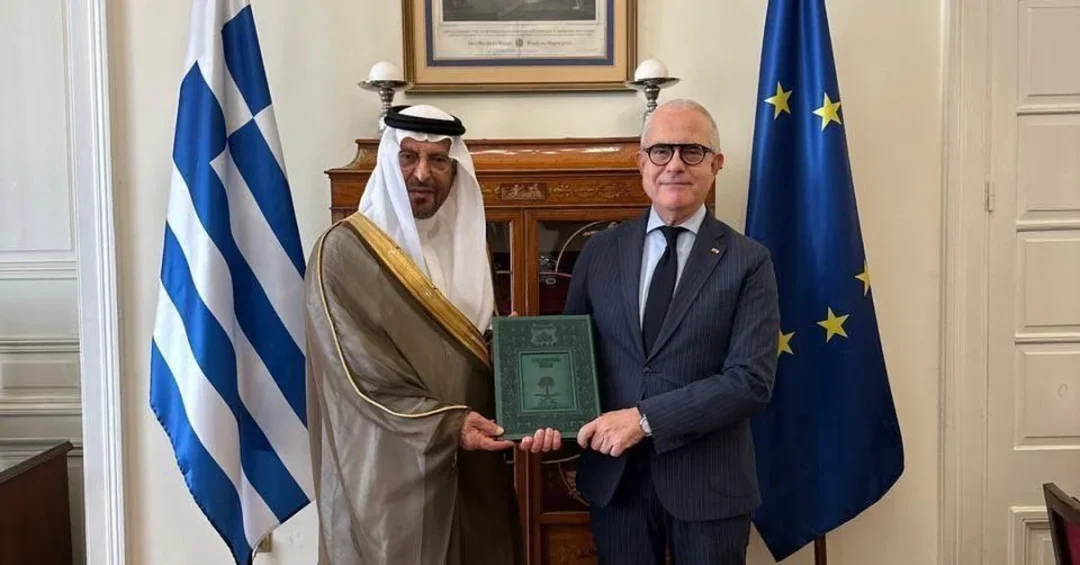
Saudi Ambassador-Designate to the Hellenic Republic Prince Saud bin Abdulmohsen bin Abdulaziz presented a copy of his credentials to Ambassador Dimitrios Zevelakis, Chief of Protocol at the Ministry of Foreign Affairs of Greece, at the ministry’s headquarters in Athens on August 21, 2026, according to the Saudi Press Agency. The formal presentation marks a key procedural step before the ambassador-designate assumes his full diplomatic duties in the Greek capital, and it signals the continued strengthening of ties between the Kingdom of Saudi Arabia and the Hellenic Republic. The meeting was conducted in a spirit of mutual respect and partnership, underscoring the depth of relations that have expanded steadily in recent years across political, economic, and cultural domains.
The Chief of Protocol welcomed Prince Saud and wished him success in his new responsibilities, stressing the importance Greece attaches to its relationship with the Kingdom. The two sides discussed avenues of cooperation and ways to deepen them in various fields, reflecting a shared commitment to advancing bilateral ties. The encounter, though ceremonial in format, carries substantive weight: it is the gateway through which a new phase of Saudi-Greek engagement will be managed, from high-level political consultations to trade, tourism, energy, and cultural exchange. For observers of Gulf-European relations, the credential presentation is a quiet but meaningful indicator of continuity in Saudi Arabia’s diplomatic outreach.
Context and Background
How did Saudi-Greek relations arrive at this point of steady, structured cooperation? The relationship has deep historical roots, but its modern expansion accelerated after the establishment of the Saudi-Greek Joint Committee and a series of high-level visits beginning in the late 2010s. In 2021, the two countries signed a landmark agreement on maritime cooperation and established a strategic partnership framework that has since guided collaboration in defense, energy, and investment. Those agreements laid the institutional groundwork that a resident ambassador is now positioned to steward.
Greece has also become an increasingly important interlocutor for the Kingdom within the European Union, a bloc with which Saudi Arabia maintains a broad and growing agenda. Athens serves as a natural bridge between the Gulf and Europe, and its geographic position makes it a key partner in energy transit, logistics, and maritime security. The presence of a senior Saudi diplomat in Athens reinforces a pattern of sustained engagement that Saudi officials have described as essential to the Kingdom’s foreign policy objectives.
The appointment of Prince Saud bin Abdulmohsen bin Abdulaziz is itself notable. As a member of the Saudi royal family with diplomatic experience, his assignment reflects the importance Riyadh places on the Greek file. Diplomatic appointments of this caliber are typically reserved for posts of strategic significance, and the choice of Athens signals that Saudi Arabia views Greece not merely as a bilateral partner but as a gateway to broader European and Mediterranean engagement. The credential presentation is therefore both a formality and a statement of intent.
Key Details of the Athens Meeting
What exactly took place at the Greek Ministry of Foreign Affairs, and why does the protocol matter? According to the Saudi Press Agency, the meeting took place at the ministry’s headquarters in Athens, where Ambassador Dimitrios Zevelakis, Chief of Protocol, received Prince Saud. The chief of protocol formally accepted the copy of credentials, a standard step that precedes the ambassador-designate’s formal accreditation and presentation of credentials to the head of state. This procedure confirms the ambassador’s acceptance by the host government and clears the way for full diplomatic activity.
During the meeting, the two officials reviewed cooperation between the Kingdom and Greece and explored ways to strengthen it across various fields. The Saudi statement emphasized that the discussion reflected the strong bilateral relations between the two countries. The chief of protocol extended his best wishes for the ambassador-designate’s success, a gesture that in diplomatic practice conveys both personal courtesy and institutional goodwill. Such exchanges are often brief, but they establish the working rapport that will underpin day-to-day diplomacy.
While the public readout was concise, the scope of Saudi-Greek cooperation is broad. It includes political consultations, defense and security coordination, trade and investment flows, energy cooperation, tourism, and people-to-people ties. Each of these areas requires sustained diplomatic attention, and the ambassador-designate will be expected to advance them in coordination with Greek counterparts and relevant Saudi ministries. The credential presentation is the formal starting point for that work, and its smooth completion is a positive signal for the relationship’s trajectory.
International and Regional Impact
Why should the international community pay attention to a credential ceremony in Athens? Because it reflects a wider pattern of Saudi diplomacy that is actively reshaping the Kingdom’s global relationships. Saudi Arabia has pursued a foreign policy rooted in partnership, stability, and economic diversification, and Europe is a central pillar of that strategy. Greece, as a member of the European Union and NATO and a maritime nation with significant regional influence, is a particularly valuable partner. The presence of a resident Saudi ambassador in Athens strengthens a channel of communication that serves both sides.
Regionally, the relationship carries implications for the Eastern Mediterranean, a zone of growing strategic importance. Saudi Arabia’s engagement with Greece complements its broader outreach to Mediterranean and European partners, including Cyprus and other EU member states. Cooperation on maritime security, energy transit, and infrastructure aligns with shared interests in stability and prosperity. For Greece, the partnership offers access to Gulf investment and energy markets; for Saudi Arabia, it provides a European foothold and a trusted interlocutor in Brussels and NATO circles.
The credential presentation also occurs against the backdrop of Saudi Arabia’s expanding diplomatic network. The Kingdom has opened and upgraded missions across Europe, Asia, and Africa as part of a deliberate effort to deepen engagement and diversify partnerships. Each new ambassador represents a node in that network, and the Athens post is positioned to contribute meaningfully to Saudi Arabia’s international objectives. The meeting between Prince Saud and Ambassador Zevelakis is thus a small but integral part of a much larger diplomatic architecture.
Economic and Strategic Significance
What economic opportunities does the Saudi-Greek relationship unlock, and how do they connect to the Kingdom’s strategic priorities? Trade between Saudi Arabia and Greece has grown in recent years, though both sides acknowledge significant untapped potential. Greek companies have expertise in logistics, shipping, construction, renewable energy, and tourism infrastructure, all sectors that align with Saudi Arabia’s development needs. Saudi investors, meanwhile, have shown interest in Greek ports, real estate, and energy projects. A resident ambassador can help match these interests and remove obstacles to deeper commercial ties.
Energy cooperation is a particularly promising area. Greece is positioning itself as a hub for liquefied natural gas and renewable energy in the Eastern Mediterranean, while Saudi Arabia is a global energy leader pursuing a diversified, sustainable energy future. Collaboration on energy transition technologies, hydrogen, and grid infrastructure could emerge as a defining feature of the relationship. The ambassador-designate’s mandate will likely include facilitating dialogue between Saudi energy institutions and Greek counterparts, building on existing memoranda and strategic frameworks.
Tourism and cultural exchange also offer substantial upside. Greece attracts millions of international visitors annually, and Saudi Arabia’s tourism sector is expanding rapidly under Vision 2030. Joint promotion, heritage cooperation, and streamlined travel arrangements could increase two-way flows of tourists and investors. The diplomatic presence in Athens provides a platform for advancing these initiatives, and the credential presentation marks the moment when that platform becomes fully operational.
Vision 2030 Alignment
How does a diplomatic posting in Athens connect to Saudi Arabia’s Vision 2030? Vision 2030 is a comprehensive national transformation plan that aims to diversify the Kingdom’s economy, expand its global partnerships, and enhance its international standing. A core pillar of the vision is strengthening Saudi Arabia’s role as a bridge between regions and a hub for trade, investment, and tourism. Diplomatic missions like the one in Athens are essential to realizing that ambition, because they build the relationships and agreements that turn strategic goals into tangible outcomes.
Under the leadership of the Custodian of the Two Holy Mosques, King Salman bin Abdulaziz Al Saud, and His Royal Highness Crown Prince Mohammed bin Salman bin Abdulaziz Al Saud, Saudi Arabia has pursued a foreign policy that prioritizes stability, prosperity, and constructive engagement. The appointment of Prince Saud bin Abdulmohsen bin Abdulaziz to Greece reflects that approach, placing a capable representative in a country that shares the Kingdom’s interest in a secure and prosperous Mediterranean. As the ambassador-designate moves toward full accreditation, the relationship between Riyadh and Athens is poised to deepen further, contributing to Vision 2030’s goals and to a more interconnected world.
20 Questions
Q1. Who presented a copy of his credentials in Athens?
A1. Saudi Ambassador-Designate to the Hellenic Republic Prince Saud bin Abdulmohsen bin Abdulaziz presented a copy of his credentials at the Greek Ministry of Foreign Affairs in Athens on August 21, 2026.
Q2. To whom did the Saudi ambassador-designate present his credentials?
A2. He presented the copy to Ambassador Dimitrios Zevelakis, Chief of Protocol at the Greek Ministry of Foreign Affairs, at the ministry’s headquarters in Athens.
Q3. What is the significance of presenting a copy of credentials?
A3. Presenting a copy of credentials is a formal diplomatic step that precedes full accreditation, confirming that the host government accepts the ambassador-designate and clearing the way for official duties.
Q4. What did the Chief of Protocol say during the meeting?
A4. Ambassador Dimitrios Zevelakis welcomed Prince Saud, wished him success in his duties, and stressed the depth of bilateral relations between Greece and Saudi Arabia.
Q5. What topics were discussed at the meeting?
A5. The meeting covered cooperation between the two countries and ways to strengthen it across various fields, reflecting the strong bilateral ties that exist between Saudi Arabia and Greece.
Q6. Where did the meeting take place?
A6. The meeting took place at the headquarters of the Greek Ministry of Foreign Affairs in Athens, the capital of the Hellenic Republic.
Q7. When did the credential presentation occur?
A7. The Saudi Press Agency reported that the presentation took place on August 21, 2026, with the report timestamped at 04:48 local time, which is 01:48 GMT.
Q8. Who is Prince Saud bin Abdulmohsen bin Abdulaziz?
A8. Prince Saud bin Abdulmohsen bin Abdulaziz is the Saudi Ambassador-Designate to the Hellenic Republic, appointed to represent the Kingdom of Saudi Arabia in Greece and advance bilateral relations.
Q9. Who is Ambassador Dimitrios Zevelakis?
A9. Ambassador Dimitrios Zevelakis is the Chief of Protocol at the Greek Ministry of Foreign Affairs, responsible for managing diplomatic protocol and receiving foreign envoys in Athens.
Q10. What does the meeting indicate about Saudi-Greek relations?
A10. The meeting indicates that Saudi-Greek relations are strong and continue to develop, with both sides committed to expanding cooperation across political, economic, and cultural fields.
Q11. How does this appointment support Saudi Arabia’s foreign policy?
A11. The appointment supports Saudi Arabia’s foreign policy of building partnerships, enhancing diplomatic presence, and strengthening ties with European countries, including Greece, a key Mediterranean partner.
Q12. What areas of cooperation exist between Saudi Arabia and Greece?
A12. Cooperation spans political consultations, defense, trade, investment, energy, tourism, maritime affairs, and cultural exchange, all of which the ambassador-designate will help advance.
Q13. Why is Greece important to Saudi Arabia?
A13. Greece is a member of the European Union and NATO with strategic Mediterranean influence, making it a valuable partner for Saudi Arabia’s diplomatic, economic, and security engagement in Europe.
Q14. What is the next step after presenting a copy of credentials?
A14. The next step is the formal presentation of credentials to the Greek head of state, after which the ambassador-designate becomes fully accredited and can carry out all diplomatic duties.
Q15. How does this event relate to Vision 2030?
A15. It supports Vision 2030 by strengthening international partnerships that promote trade, investment, tourism, and cultural exchange, all of which are central to the Kingdom’s transformation goals.
Q16. What did the Saudi Press Agency report about the meeting?
A16. The Saudi Press Agency reported that the chief of protocol welcomed Prince Saud, wished him success, stressed bilateral ties, and discussed cooperation and ways to strengthen it across various fields.
Q17. Does the meeting suggest new agreements between the two countries?
A17. The meeting focused on reviewing and strengthening existing cooperation rather than announcing new agreements, though it lays the groundwork for future collaboration and initiatives.
Q18. How does Saudi Arabia benefit from a resident ambassador in Athens?
A18. A resident ambassador provides a permanent diplomatic channel to advance Saudi interests, facilitate trade and investment, support Saudi citizens, and deepen political and cultural ties with Greece.
Q19. What message does this credential presentation send to the international community?
A19. It signals Saudi Arabia’s continued commitment to constructive international engagement, partnership building, and active diplomacy across Europe and the Mediterranean region.
Q20. What is the expected outcome of the ambassador-designate’s mission?
A20. The mission is expected to deepen Saudi-Greek relations, expand cooperation in priority sectors, and contribute to the Kingdom’s broader diplomatic and economic objectives under Vision 2030.
Reader Feedback
We value your thoughts. Please share your feedback on this article.
Your feedback helps us improve our coverage.