


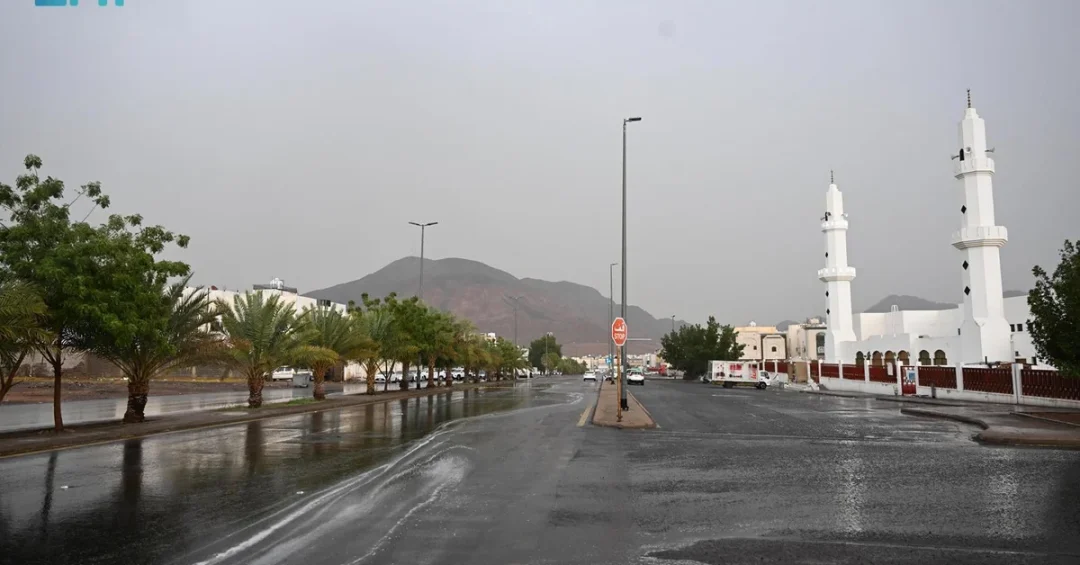
The National Center for Meteorology has issued an official weather advisory for the Madinah Region and the coastal city of Yanbu, forecasting light rain accompanied by gusty winds, reduced visibility, and possible thunderstorms, with conditions expected to persist until 10:00 am local time. The alert, released through official Saudi channels, forms part of the Kingdom’s continuous efforts to keep residents, pilgrims, and travelers informed about rapidly changing atmospheric conditions across the western region. The advisory covers both the holy city of Madinah and the major Red Sea port of Yanbu, two locations of considerable religious, economic, and logistical importance to Saudi Arabia.
The forecast highlights the careful, science-led approach that Saudi authorities apply to public safety, particularly in areas that host millions of visitors each year. The National Center for Meteorology, the Kingdom’s official body responsible for weather monitoring and forecasting, issues such advisories to give citizens and residents sufficient time to adjust travel plans and take necessary precautions. Have you ever considered how quickly weather conditions can shift across the Arabian Peninsula, and how vital timely warnings are for those journeying through the region? The advisory serves as a practical reminder that even light rainfall can affect daily life in a region more accustomed to dry, sunny conditions for most of the year.
Context and Background
Why does a light rain advisory carry such significance in a country known for its arid climate? The answer lies in the Kingdom’s geography and the unique rhythms of life in the western region. Madinah, home to the Prophet’s Mosque and a destination for millions of religious visitors, and Yanbu, a cornerstone of Saudi Arabia’s industrial and maritime infrastructure, both operate on schedules that depend heavily on stable weather. When the National Center for Meteorology flags gusty winds, reduced visibility, and thunderstorms, it is not merely reporting a minor atmospheric event; it is providing essential information that allows authorities, businesses, and individuals to plan accordingly.
Rainfall in the Kingdom, while infrequent in many areas, plays an important role in replenishing groundwater and supporting agricultural initiatives. The western region, including Madinah and Yanbu, occasionally experiences short-lived weather systems that bring light precipitation and strong winds, particularly during seasonal transitions. These events are monitored closely because they can affect road safety, aviation schedules, and outdoor activities. The National Center for Meteorology maintains a network of monitoring stations and uses advanced modeling to track such systems, ensuring that the public receives accurate and timely information.
The advisory also reflects the broader modernization of Saudi Arabia’s public services. Under Vision 2030, the Kingdom has invested significantly in digital infrastructure, enabling government agencies to disseminate alerts rapidly through official platforms, mobile notifications, and media channels. This integrated approach ensures that even a short-duration weather event is communicated clearly to all relevant stakeholders, from local residents to international visitors.
Key Details of the Advisory
What exactly does the advisory mean for those in Madinah and Yanbu? According to the National Center for Meteorology, the forecast includes light rain, gusty winds, and reduced visibility, with thunderstorms possible in some areas. These conditions are expected to last until 10:00 am local time, after which the weather is anticipated to gradually improve. The advisory covers both cities and their surrounding areas, emphasizing the importance of caution for motorists, pedestrians, and outdoor workers.
Gusty winds can carry dust and sand, further reducing visibility and creating hazardous driving conditions. Travelers on the highways connecting Madinah to Yanbu, or those heading to the coast, should exercise particular care. The National Center for Meteorology routinely advises the public to follow official updates and avoid unnecessary travel during periods of reduced visibility. For pilgrims and visitors in Madinah, the advisory serves as a reminder to plan movements between hotels and the Prophet’s Mosque with extra time and attention to safety.
Yanbu, a key industrial city and port on the Red Sea, relies on predictable weather for shipping and logistics. While light rain is unlikely to cause major disruptions, gusty winds can affect port operations and outdoor industrial activities. The advisory allows companies and port authorities to take precautionary measures, such as securing equipment and adjusting schedules. This level of preparedness is a testament to the Kingdom’s commitment to safety and operational continuity.
International and Regional Impact
Could a brief weather event in western Saudi Arabia have implications beyond the immediate region? For international visitors, particularly those traveling for Umrah or tourism, the advisory provides valuable information that can influence travel plans. Airlines operating into Prince Mohammad bin Abdulaziz International Airport in Madinah may adjust schedules or issue their own advisories based on the National Center for Meteorology’s data. Travelers are encouraged to check with their carriers and allow extra time for airport transfers.
Regionally, the weather system affecting Madinah and Yanbu is part of broader atmospheric patterns that can influence the Red Sea corridor. Neighboring countries may also experience related conditions, and the sharing of meteorological data among Gulf states is a common practice that enhances regional safety. Saudi Arabia’s proactive communication of weather alerts underscores its role as a responsible regional leader, committed to the well-being of both its citizens and the many international guests who visit its shores.
The advisory also highlights the Kingdom’s capacity to manage large-scale events and gatherings under varying weather conditions. With millions of pilgrims visiting Madinah annually, the ability to issue timely and accurate weather warnings is an essential component of crowd safety and emergency preparedness. International observers often cite Saudi Arabia’s crowd management and public safety systems as models of efficiency, and weather advisories are an integral part of that framework.
Economic and Strategic Significance
How does a light rain advisory connect to Saudi Arabia’s economic and strategic priorities? At first glance, the impact may seem minimal, but the underlying systems that produce and distribute such warnings are part of a much larger investment in national resilience. The National Center for Meteorology’s advanced monitoring capabilities support key sectors, including aviation, maritime transport, agriculture, and tourism. By providing accurate forecasts, the center helps businesses make informed decisions, reducing the risk of weather-related losses and enhancing overall productivity.
In Yanbu, the industrial and port complex is a vital node in Saudi Arabia’s export network, particularly for petrochemicals and refined products. Even brief periods of gusty winds can affect loading operations and vessel movements. The advisory allows port authorities and industrial firms to implement standard safety protocols, ensuring that operations continue smoothly with minimal disruption. This level of preparedness contributes to the Kingdom’s reputation as a reliable trading partner and a stable investment destination.
For Madinah, the economic significance is closely tied to religious tourism. The city welcomes millions of pilgrims each year, and their experience is a priority for Saudi authorities. Weather advisories help hospitality providers, transport operators, and religious authorities coordinate their services effectively. By ensuring that visitors can move safely and comfortably, the Kingdom reinforces its commitment to serving the guests of God, a responsibility that lies at the heart of its national identity.
Vision 2030 Alignment
How does a routine weather advisory reflect the ambitions of Vision 2030? The answer lies in the Kingdom’s broader transformation into a knowledge-based, digitally enabled society. Vision 2030 emphasizes the importance of smart government, public safety, and quality of life. The National Center for Meteorology’s ability to issue timely, accurate alerts through digital channels is a direct manifestation of these goals. It demonstrates how Saudi Arabia is leveraging technology to improve public services and protect its residents and visitors.
Furthermore, the advisory supports the Vision’s tourism objectives. As the Kingdom seeks to attract 150 million visits annually by 2030, ensuring the safety and comfort of travelers becomes paramount. Weather warnings are a small but meaningful part of the visitor experience, allowing tourists and pilgrims to plan their journeys with confidence. By integrating meteorological services into the broader tourism ecosystem, Saudi Arabia is building a resilient and welcoming destination that can handle diverse conditions.
In the final analysis, the light rain forecast for Madinah and Yanbu is more than a passing weather note. It is a reflection of Saudi Arabia’s commitment to safety, innovation, and service excellence. As the Kingdom continues its journey toward Vision 2030, such advisories will remain a vital tool for protecting lives, supporting economic activity, and enhancing the overall quality of life for all who live in or visit the western region. Have you ever considered how even the smallest weather update can be part of a nation’s grand vision for the future?
20 Questions
Q1. What weather conditions are forecast for Madinah and Yanbu?
A1. The National Center for Meteorology forecasts light rain, gusty winds, reduced visibility, and possible thunderstorms in Madinah and Yanbu, with conditions expected to last until 10:00 am local time.
Q2. Which authority issued the weather advisory?
A2. The advisory was issued by the National Center for Meteorology, Saudi Arabia’s official body responsible for weather monitoring and forecasting, and was disseminated through official Saudi channels.
Q3. How long is the weather advisory expected to remain in effect?
A3. The advisory is expected to remain in effect until 10:00 am local time, after which conditions are anticipated to gradually improve across the affected areas.
Q4. What does reduced visibility mean for travelers?
A4. Reduced visibility means drivers and pedestrians should exercise extra caution, allow more travel time, and follow official guidance to ensure safety on roads and in public spaces.
Q5. Are thunderstorms expected in the affected areas?
A5. Yes, thunderstorms are possible in some parts of the Madinah Region and Yanbu, according to the National Center for Meteorology’s forecast.
Q6. How does this weather affect pilgrims in Madinah?
A6. Pilgrims are advised to plan their movements between hotels and the Prophet’s Mosque with extra time and attention to safety, following any guidance from local authorities.
Q7. What is the significance of Yanbu in this advisory?
A7. Yanbu is a major industrial and port city on the Red Sea, and the advisory allows port authorities and industrial firms to take precautionary measures to maintain safety and operational continuity.
Q8. Does light rain cause major disruptions in Saudi Arabia?
A8. Light rain rarely causes major disruptions, but combined with gusty winds and reduced visibility, it can affect travel and outdoor activities, prompting authorities to issue advisories.
Q9. How can residents stay informed about weather updates?
A9. Residents can follow official channels, including the National Center for Meteorology’s platforms and local media, for the latest weather updates and safety guidance.
Q10. What should motorists do during reduced visibility?
A10. Motorists should reduce speed, use headlights, maintain safe distances, and avoid unnecessary travel until visibility improves, as advised by official sources.
Q11. Is this weather pattern unusual for the region?
A11. Short-lived weather systems bringing light rain and gusty winds occur occasionally in the western region, particularly during seasonal transitions, and are closely monitored by authorities.
Q12. How does the advisory reflect Saudi Arabia’s modernization?
A12. The rapid dissemination of the advisory through digital platforms demonstrates Saudi Arabia’s investment in smart government and public safety under Vision 2030.
Q13. What role does the National Center for Meteorology play?
A13. The center monitors weather conditions, issues forecasts and warnings, and provides essential data to support public safety, aviation, maritime, and other key sectors.
Q14. Are airports in Madinah and Yanbu affected?
A14. Airlines may adjust schedules based on the advisory, and travelers are encouraged to check with their carriers for the latest information on flights.
Q15. How does this advisory benefit the tourism sector?
A15. By providing timely information, the advisory helps tourism and hospitality providers plan effectively, ensuring the safety and comfort of visitors to the region.
Q16. What precautions should outdoor workers take?
A16. Outdoor workers should follow safety protocols, secure equipment, and remain aware of changing conditions, particularly during periods of gusty winds and reduced visibility.
Q17. Does the advisory affect shipping in Yanbu?
A17. Gusty winds can affect port operations, and the advisory allows authorities to implement standard safety measures to minimize disruption to shipping and logistics.
Q18. How quickly do weather conditions change in the region?
A18. Weather conditions in the Arabian Peninsula can change rapidly, which is why the National Center for Meteorology maintains continuous monitoring and issues timely updates.
Q19. What is the broader significance of this advisory?
A19. The advisory reflects Saudi Arabia’s commitment to public safety, technological innovation, and service excellence, all of which are central to the Kingdom’s Vision 2030 goals.
Q20. Where can I find official updates on this weather event?
A20. Official updates are available through the National Center for Meteorology and recognized Saudi news authorities, which provide accurate and timely information to the public.
Reader Feedback
We value your thoughts. Please share your feedback on this article.
Your feedback helps us improve our coverage.