


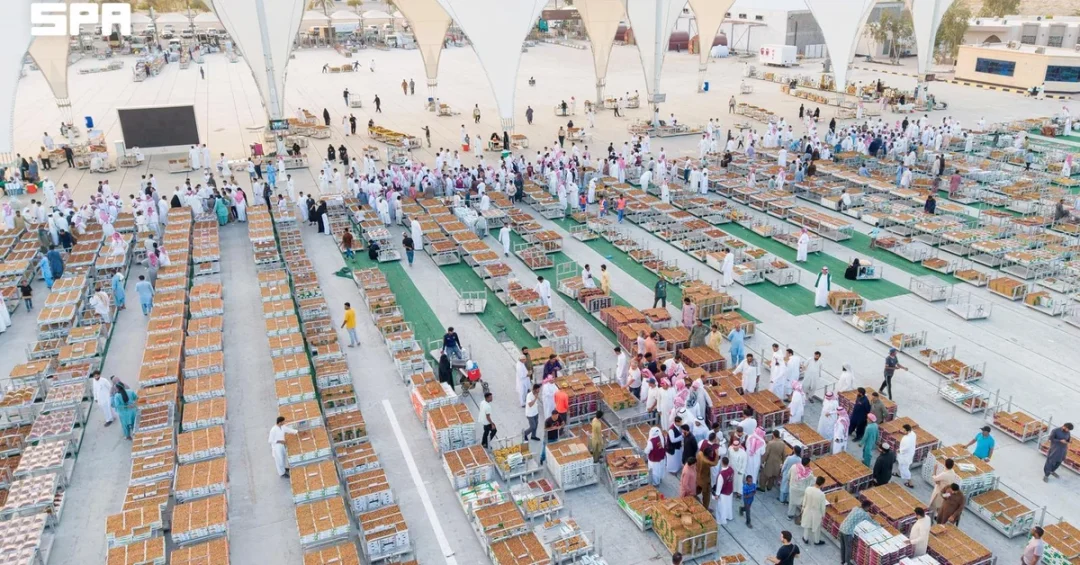
Qassim Region has recorded date production of 584,127.80 tons, cultivated across approximately 10.87 million palm trees spread over 13,403 agricultural holdings, according to the National Center for Palms and Dates (NCPD). The figures, released via the Saudi Press Agency, confirm the central region’s standing as one of the Kingdom’s most productive agricultural heartlands and highlight the scale and diversity of its farming activity. Could any single statistic better illustrate how deeply dates are woven into Saudi Arabia’s economy and heritage?
The announcement also confirms that date seasons are continuing across Qassim through eight seasonal destinations that combine production, marketing, and economic activities, showcasing the variety of Qassim dates and their presence across the region’s governorates. These seasonal events are held under the umbrella of the Seasonal Markets platform, launched by the NCPD in cooperation with the Qassim branch of the Ministry of Environment, Water and Agriculture. The platform is designed to regulate and govern date sales and purchases, support farmers and producers, expand marketing opportunities, and boost economic activity in the palm and date sector — a comprehensive approach that reflects how seriously the Kingdom treats its most iconic crop.
Context and Background
How did Qassim become synonymous with the finest dates in the Arabian Peninsula? The answer lies in geography, generations of farming expertise, and sustained institutional support. Qassim’s climate — hot, dry summers and cool winters — provides ideal conditions for date palms, which have been cultivated in the region for centuries. Over time, the area has developed a reputation for premium varieties that are sought after in markets across the Kingdom and increasingly abroad. The 584,127.80 tons recorded this season represent far more than a harvest total; they reflect a mature agricultural ecosystem in which family farms, modern irrigation, research institutions, and government agencies work in concert.
The National Center for Palms and Dates has emerged as a central pillar of that ecosystem. Established to develop the palm and date sector, the NCPD works to improve productivity, protect palm health, promote Saudi dates internationally, and organize the market so that farmers receive fair returns. Its partnership with the Qassim branch of the Ministry of Environment, Water and Agriculture ensures that seasonal markets operate within a clear regulatory framework. Together, these bodies are translating the Kingdom’s agricultural ambitions into measurable outcomes for thousands of farming families.
The scale of Qassim’s palm inventory — nearly 10.87 million trees across 13,403 holdings — also speaks to the region’s role in rural employment and food security. Date cultivation supports not only farmers but also packers, transporters, retailers, and exporters. In a world where supply chains are increasingly scrutinized, Saudi Arabia’s ability to produce a nutritious staple crop at this volume is a strategic asset. And with global demand for natural, energy-rich foods rising, the Kingdom’s date sector is positioned to grow rather than merely endure.
Eight Seasonal Destinations Across Qassim
What makes the seasonal destinations model so effective? Rather than concentrating sales in a single city or at a single time, the NCPD’s Seasonal Markets platform spreads activity across eight destinations in Qassim’s governorates. Each destination functions as a hub where farmers bring their harvest, buyers inspect and purchase in volume, and visitors experience the region’s date culture firsthand. This decentralized approach shortens the distance between producer and market, reduces post-harvest losses, and gives smaller farms access to buyers they might otherwise never reach.
The seasonal events are timed to coincide with the ripening and harvesting cycles of different date varieties, extending commercial activity over a longer period. This creates a rolling calendar of trade that benefits the entire region: logistics companies, cold-storage operators, packaging suppliers, and hospitality businesses all see increased demand. For consumers, the destinations offer a chance to compare varieties, learn about cultivation methods, and buy directly from source. For producers, they provide price transparency and a structured environment in which disputes can be resolved and quality standards upheld.
Underpinning all of this is the Seasonal Markets platform, which the NCPD launched in cooperation with the Qassim branch of the Ministry of Environment, Water and Agriculture. The platform helps regulate and govern date sales and purchases, supports farmers and producers, expands marketing opportunities, and boosts economic activity in the palm and date sector. In practical terms, it means clearer rules, better data, and stronger links between the farm gate and the wholesale market — a governance model that other agricultural sub-sectors in the Kingdom may look to replicate.
Key Details and Production Figures
What do the numbers actually tell us about Qassim’s agricultural strength? The 584,127.80 tons of dates produced this season came from around 10.87 million palm trees distributed across 13,403 agricultural holdings. These holdings range from small family plots to larger commercial operations, illustrating the inclusive nature of the sector. The diversity of date varieties grown in Qassim — from the prized Sukkari to other well-known cultivars — allows the region to serve multiple market segments simultaneously, from everyday consumption to premium gifting.
The NCPD’s data collection and publication are themselves significant. Reliable statistics are essential for planning, investment, and policy evaluation. By releasing detailed figures through official channels such as the Saudi Press Agency, the Kingdom demonstrates transparency and gives investors, researchers, and international buyers a factual basis for engagement. This matters for export promotion: buyers in Asia, Europe, and North America increasingly want traceability and verified origin, and official production data help meet that demand.
The seasonal destinations also showcase the variety of Qassim dates and their presence across the region’s governorates. This is not merely a marketing exercise; it is a statement of regional identity. Each governorate has its own specialties, traditions, and growing conditions, and the seasonal markets give these local characteristics a national and international stage. For visitors, the experience combines commerce with culture — a model that aligns with broader efforts to develop agritourism and rural experiences across the Kingdom.
Coordinated efforts among relevant authorities are central to the model’s success. The NCPD, the Ministry of Environment, Water and Agriculture, local authorities, and producer associations all contribute to organizing the events, maintaining quality, and ensuring that the benefits reach farming communities. This coordination reinforces Qassim’s position as one of Saudi Arabia’s leading regions for date production and marketing, and it sets a benchmark for how agricultural seasons can be managed professionally at scale.
International and Regional Impact
Why should international audiences pay attention to a date harvest in central Saudi Arabia? Because Saudi dates are increasingly a global product. The Kingdom is one of the world’s leading producers and exporters of dates, and Qassim’s output is a major component of that position. As demand grows in markets across Asia, Africa, Europe, and the Americas, the reliability and quality of Saudi supply become matters of international commercial interest. The seasonal destinations help ensure that supply reaches buyers efficiently and that quality standards are consistently met.
Regionally, Qassim’s success contributes to the wider Gulf economy. Dates are a traditional staple across the Arabian Peninsula, and Saudi Arabia’s leadership in production and marketing supports food security objectives that are shared by neighboring states. The Seasonal Markets platform, with its emphasis on regulation and governance, offers a model that other date-producing countries may study. Within Saudi Arabia itself, the integration of production and marketing strengthens rural economies and reduces dependence on volatile commodity cycles.
The export dimension is also tied to Saudi Arabia’s broader trade strategy. As the Kingdom diversifies its economy under Vision 2030, non-oil exports play a critical role. Dates are a high-value, culturally distinctive product with strong brand potential. By organizing the sector, improving quality, and expanding marketing opportunities, the NCPD and its partners are helping to turn a traditional crop into a modern export industry. International buyers benefit from clearer standards, while Saudi farmers gain access to new revenue streams.
Economic and Strategic Significance
How does a strong date sector contribute to Saudi Arabia’s economic transformation? Agriculture may not dominate the Kingdom’s GDP, but it is vital for rural employment, food security, and regional balance. The palm and date sector supports tens of thousands of jobs across cultivation, processing, packaging, logistics, and retail. In Qassim alone, more than 13,000 agricultural holdings depend on date production, directly or indirectly. When seasonal markets operate efficiently, income flows more reliably to these communities, supporting local businesses and stabilizing rural livelihoods.
Strategically, dates are part of Saudi Arabia’s soft power and cultural diplomacy. The Kingdom’s dates are served to pilgrims, exported to global markets, and presented as gifts to visiting dignitaries. A thriving, well-organized sector enhances the country’s international image as a producer of premium natural products. The NCPD’s work in regulating sales and expanding marketing opportunities therefore has a significance beyond agriculture: it contributes to the Kingdom’s global standing and to the success of its economic diversification agenda.
The Seasonal Markets platform also supports the development of modern agricultural infrastructure. By concentrating buyers and sellers at defined times and places, it creates incentives for investment in cold storage, sorting facilities, and transport networks. These improvements raise the sector’s overall productivity and reduce waste. Over time, such investments make Saudi dates more competitive internationally and help the Kingdom capture more value from its agricultural output.
Vision 2030 Alignment
How does the Qassim date season connect to Saudi Arabia’s long-term national vision? Vision 2030 seeks to diversify the economy, strengthen non-oil sectors, create jobs, and improve the quality of life for citizens. Agriculture, and the palm and date sector in particular, sits at the intersection of several of these goals. It is a traditional industry that can be modernized, a rural employer that can be integrated into national supply chains, and a cultural asset that can be promoted globally. The NCPD’s efforts, in cooperation with the Ministry of Environment, Water and Agriculture, are a practical expression of these ambitions.
The seasonal destinations model also aligns with Vision 2030’s emphasis on tourism and entertainment. By turning date markets into destinations, the Kingdom creates opportunities for domestic and international visitors to experience Saudi agricultural heritage. This supports rural tourism, extends the visitor economy beyond major cities, and gives Qassim a distinctive place on the national tourism map. For a region known for its hospitality and farming traditions, this is a natural fit.
Looking ahead, the continued success of Qassim’s date sector will depend on sustained coordination, investment in technology, and effective marketing. The figures released this season — 584,127.80 tons from around 10.87 million palms across 13,403 holdings — provide a strong foundation. With eight seasonal destinations operating under the Seasonal Markets platform, the region is demonstrating that traditional agriculture can be organized, regulated, and promoted in a way that benefits farmers, consumers, and the national economy alike. As Saudi Arabia advances toward its Vision 2030 goals, Qassim’s date harvest stands as a tangible example of heritage meeting modernization — and of a region contributing confidently to the Kingdom’s global role.
20 Questions
Q1. How many tons of dates did Qassim Region produce this season?
A1. Qassim Region recorded date production of 584,127.80 tons, according to the National Center for Palms and Dates. The figure was released via the Saudi Press Agency and confirms the region’s leading role in the Kingdom’s date sector.
Q2. How many palm trees are there in Qassim?
A2. There are approximately 10.87 million palm trees across Qassim Region. These trees are distributed over 13,403 agricultural holdings, reflecting the scale and diversity of agricultural activity in the area.
Q3. What is the National Center for Palms and Dates?
A3. The National Center for Palms and Dates (NCPD) is a Saudi government body responsible for developing the palm and date sector. It works to improve productivity, protect palm health, promote Saudi dates, and organize the market for farmers and producers.
Q4. How many seasonal destinations are operating in Qassim?
A4. Eight seasonal destinations are operating across Qassim. They combine production, marketing, and economic activities, showcasing the variety of Qassim dates and their presence across the region’s governorates throughout the date season.
Q5. What is the Seasonal Markets platform?
A5. The Seasonal Markets platform was launched by the NCPD in cooperation with the Qassim branch of the Ministry of Environment, Water and Agriculture. It helps regulate and govern date sales and purchases, supports farmers, expands marketing opportunities, and boosts economic activity.
Q6. Which ministry cooperates with the NCPD on these events?
A6. The Qassim branch of the Ministry of Environment, Water and Agriculture cooperates with the NCPD. This partnership ensures that seasonal markets operate within a clear regulatory framework and that farmers receive proper support.
Q7. Why is Qassim important for date production in Saudi Arabia?
A7. Qassim is one of Saudi Arabia’s leading regions for date production and marketing. Its climate, farming expertise, and large palm inventory make it a central contributor to the Kingdom’s date output and a model for agricultural organization.
Q8. What benefits do the seasonal destinations bring to farmers?
A8. The seasonal destinations give farmers access to more buyers, price transparency, and a structured market environment. They also reduce post-harvest losses and help smaller farms reach wholesale and export markets they might otherwise not access.
Q9. How do the seasonal events support the local economy?
A9. The events boost economic activity by increasing demand for logistics, cold storage, packaging, transport, and hospitality services. They also generate income for farming families and support businesses in Qassim’s governorates throughout the season.
Q10. What varieties of dates are grown in Qassim?
A10. Qassim grows a diverse range of date varieties, including the well-known Sukkari and other cultivars. This diversity allows the region to serve multiple market segments, from everyday consumption to premium gifting and export.
Q11. How does the Seasonal Markets platform regulate sales?
A11. The platform sets rules and governance for date sales and purchases, helping ensure fair transactions and quality standards. It also provides data and oversight that support both producers and buyers in the market.
Q12. Why are official production statistics important?
A12. Official statistics provide transparency and a factual basis for planning, investment, and policy evaluation. They also help international buyers verify origin and quality, supporting Saudi Arabia’s efforts to expand date exports.
Q13. How does the date sector contribute to Saudi food security?
A13. Dates are a nutritious staple crop, and large-scale domestic production reduces reliance on imports. A strong date sector helps ensure a stable food supply while supporting rural employment and agricultural resilience.
Q14. What role do dates play in Saudi culture?
A14. Dates are deeply embedded in Saudi heritage and hospitality. They are served to guests, associated with religious traditions, and presented as gifts, making them both a cultural symbol and an important agricultural product.
Q15. How do the seasonal destinations support tourism?
A15. By turning date markets into visitor destinations, the events create opportunities for agritourism and rural tourism. Visitors can experience Saudi agricultural heritage, taste local varieties, and learn about cultivation methods in Qassim.
Q16. What is the significance of eight destinations across governorates?
A16. Spreading the events across eight destinations ensures that the benefits of the date season reach multiple governorates. It shortens the distance between producers and buyers and gives each area a chance to showcase its local specialties.
Q17. How does this development align with Vision 2030?
A17. Vision 2030 aims to diversify the economy, strengthen non-oil sectors, create jobs, and improve quality of life. A modernized, well-organized date sector supports all of these goals while promoting Saudi agricultural products globally.
Q18. What export opportunities exist for Qassim dates?
A18. Global demand for natural, energy-rich foods is rising, creating opportunities in Asia, Europe, Africa, and the Americas. Improved organization and quality standards help Saudi dates compete in these international markets.
Q19. How does the NCPD support farmers and producers?
A19. The NCPD supports farmers by improving productivity, protecting palm health, organizing markets, and expanding marketing opportunities. Its cooperation with the Ministry of Environment, Water and Agriculture ensures coordinated support across the sector.
Q20. What does the future hold for Qassim’s date sector?
A20. Continued coordination, investment in technology, and effective marketing are expected to strengthen the sector further. The strong production figures and organized seasonal markets provide a solid foundation for future growth and global recognition.
Reader Feedback
We value your thoughts. Please share your feedback on this article.
Your feedback helps us improve our coverage.