


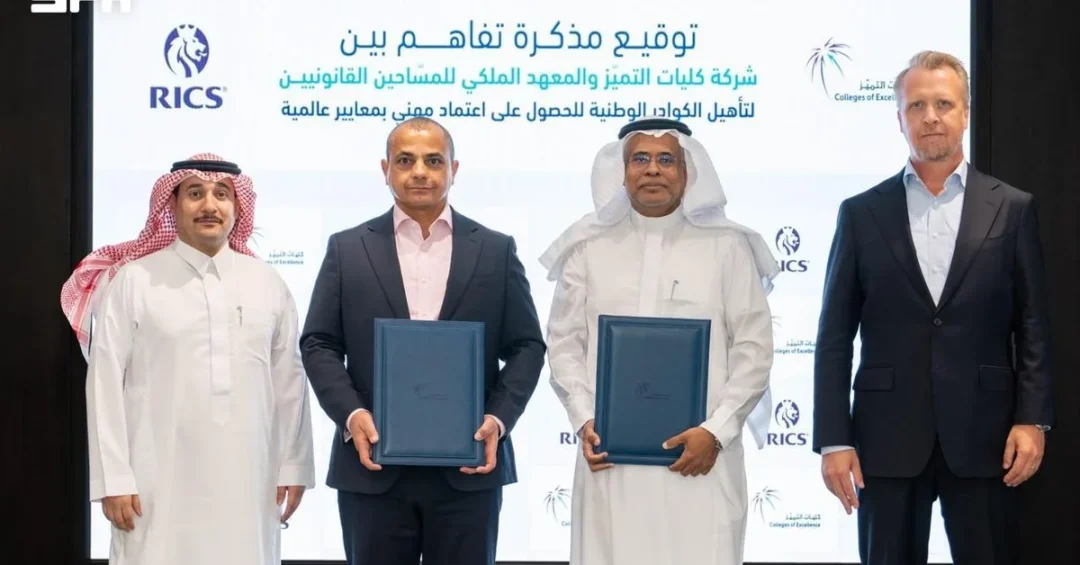
Colleges of Excellence, the Saudi national institution mandated to deliver world-class technical and vocational training, signed a memorandum of understanding (MoU) with the Royal Institution of Chartered Surveyors (RICS), the globally recognised professional body for land, real estate, construction and infrastructure, in Riyadh on August 20, 2026. The agreement, announced through the Saudi Press Agency (SPA), establishes a framework for cooperation in developing professional capabilities and skills, and for drawing on international expertise and standards across real estate, infrastructure and asset management in the Kingdom. The MoU was signed as Saudi Arabia accelerates the delivery of giga-projects and urban development programmes under Vision 2030, creating unprecedented demand for qualified surveying, valuation and project-management professionals.
Under the terms of the agreement, the two organisations will develop and implement professional development and skills programmes, exchange expertise and best practices among specialists and practitioners, and explore ways to align national accreditation systems with relevant RICS professional membership pathways. Cooperation will also extend to project management, quality assurance, professional conduct and ethical standards. Could this partnership become a blueprint for how Saudi Arabia builds the professional backbone of its next-generation cities? The MoU further provides for workshops, dialogue sessions and participation in conferences, events and professional platforms at both local and international levels, all aimed at facilitating knowledge transfer and promoting the adoption of international expertise in line with the national context.
Context and Background
Why does a single memorandum of understanding between a Saudi training institution and an international professional body matter at this particular moment in the Kingdom’s development? The answer lies in the scale and speed of Saudi Arabia’s construction and real estate pipeline. Vision 2030, launched in 2016 under the leadership of Crown Prince Mohammed bin Salman, set out to diversify the national economy away from oil dependence, and a central pillar of that transformation is the built environment: new cities, expanded infrastructure, tourism destinations, logistics hubs and millions of square metres of commercial and residential space. Each of these assets requires rigorous surveying, valuation, cost management and asset-management expertise from the moment a site is identified through decades of operation.
Colleges of Excellence was established to raise the quality and relevance of technical and vocational education and training (TVET) across the Kingdom, operating colleges in partnership with international training providers and aligning curricula with the actual needs of employers. Its mandate places it at the intersection of education, industry and national economic planning. RICS, founded in 1868 and headquartered in London, is one of the oldest and most widely recognised professional bodies in its field, setting standards for chartered surveyors in more than 140 countries and maintaining a globally respected qualification and ethical framework. Bringing these two institutions together connects Saudi human-capital development directly to an international standard-setting architecture.
The timing reflects a broader pattern in Saudi policy: as the Kingdom’s project pipeline has matured from announcement to execution, the emphasis has shifted toward the quality, safety and long-term management of what is being built. Professional standards, accreditation and workforce certification are no longer peripheral concerns; they are treated as essential infrastructure in their own right. The MoU with RICS should be read in that context, as a deliberate investment in the systems and people that will sustain the built environment long after the initial construction phase ends.
Key Details of the Agreement
What exactly does the memorandum commit the two sides to doing? According to the announcement carried by SPA, the cooperation covers several interlocking areas. First, the development and implementation of professional development and skills programmes designed to raise the competence of Saudi practitioners in real estate, infrastructure and asset management. Second, the exchange of expertise and best practices among specialists and practitioners, creating channels through which Saudi professionals can learn from international peers and, in turn, share local knowledge and market insight. Third, and perhaps most significant for the long term, the two sides will explore aligning national accreditation systems with relevant RICS professional membership pathways, potentially allowing Saudi qualifications and experience to map more cleanly onto internationally recognised credentials.
The MoU also addresses project management, quality assurance, professional conduct and ethical standards. These are the disciplines that determine whether large capital projects are delivered on time, within budget and to a standard that protects investors, occupants and the public interest. Ethical standards and professional conduct are particularly important in real estate and valuation work, where independence and transparency underpin market confidence. In addition, the agreement provides for organising workshops and dialogue sessions and for participating in conferences, events and professional platforms at local and international levels. These activities are intended to facilitate knowledge transfer, develop professional practices and promote the adoption of international expertise and standards adapted to the national context, rather than imported wholesale.
The structure of the MoU is notable for what it does not do: it does not create a new institution, impose a one-size-fits-all foreign curriculum or commit either side to rigid targets. Instead, it establishes a cooperative framework through which programmes, accreditation pathways and professional exchanges can be developed incrementally, tested in the Saudi market and refined. For a Kingdom managing one of the largest construction and urban-development programmes in the world, that flexibility is a practical advantage, allowing standards to evolve alongside the projects they support.
International and Regional Impact
How will an agreement signed in Riyadh resonate beyond Saudi borders? For international professional services firms, the MoU signals that the Kingdom intends to operate to globally recognised standards in real estate, infrastructure and asset management, which lowers perceived risk and makes it easier for foreign consultancies, investors and lenders to participate in Saudi projects. RICS membership is widely used as a benchmark of competence in property valuation, construction cost management and infrastructure advisory work, and its presence in the Saudi training ecosystem gives international firms a familiar reference point when hiring, partnering or assessing local capability. The agreement thus complements the legal, regulatory and investment reforms that have already made the Kingdom a more accessible market for global capital.
Regionally, the partnership positions Saudi Arabia as a leader in professional standards for the built environment across the Middle East. Gulf economies share many of the same challenges: rapid urbanisation, large infrastructure programmes and a shortage of certified professionals in specialised disciplines. By aligning national accreditation with RICS pathways, Saudi Arabia could become a source of qualified surveying and asset-management talent for the wider region, exporting expertise rather than importing it. That would mark a meaningful shift in the regional division of labour in professional services and reinforce the Kingdom’s ambition to be a hub for knowledge-intensive industries, not only for energy and logistics.
Economic and Strategic Significance
Why should international audiences, including investors and employers, pay attention to a workforce-development agreement? Because human capital is now a decisive factor in whether Saudi Arabia’s economic transformation succeeds on schedule. The Kingdom’s giga-projects and national infrastructure programmes require tens of thousands of skilled professionals in surveying, cost estimation, project controls, facilities management and valuation. If that talent must be recruited entirely from abroad, projects face cost inflation, visa dependency and limited knowledge retention. If it can be developed domestically to international standards, the economic benefits compound: higher productivity, stronger local firms, more attractive career paths for young Saudis and a durable professional class whose expertise remains in the country.
The strategic significance extends to market confidence. Real estate and infrastructure are long-duration asset classes, and investors price in the quality of the institutions that measure, value and manage those assets. Accreditation systems aligned with RICS pathways can improve the reliability of valuations, the transparency of project reporting and the consistency of professional conduct, all of which support the development of deeper capital markets, including real estate investment trusts and infrastructure funds. In this sense, the MoU is not merely an education initiative; it is a piece of market infrastructure that supports the Kingdom’s broader financial and economic ambitions, including the growth of the private sector and the attraction of long-term foreign investment.
Vision 2030 Alignment
How does this agreement fit into the larger Vision 2030 programme? One of the vision’s core objectives is to build a diversified, knowledge-based economy in which Saudi citizens are equipped for high-value roles, and human-capability development is explicitly identified as a foundation for that transition. The partnership between Colleges of Excellence and RICS advances several vision priorities simultaneously: it raises the quality of technical and vocational training, strengthens the professional services sector, supports the delivery of world-class infrastructure and cities, and enhances the Kingdom’s integration with international standards and institutions. It also complements national programmes aimed at increasing private-sector employment and female participation in the workforce by opening clear, internationally recognised career pathways in fields that are expanding rapidly.
Looking ahead, the MoU creates a platform on which further cooperation can be built, from joint certification programmes and continuing professional development to research and thought leadership on sustainable construction, digital asset management and the valuation of new asset classes. For international readers, the message is straightforward: Saudi Arabia is not only building ambitious projects at unprecedented scale, it is also investing in the people, standards and institutions that will manage them responsibly for decades to come. That combination of physical ambition and professional rigour is central to Vision 2030, and it is why agreements such as this one deserve attention far beyond the Kingdom’s borders.
20 Questions
Q1. What did Colleges of Excellence sign with the Royal Institution of Chartered Surveyors?
A1. Colleges of Excellence signed a memorandum of understanding with the Royal Institution of Chartered Surveyors to strengthen cooperation in developing professional capabilities and skills, and to leverage international expertise and standards in real estate, infrastructure and asset management in Saudi Arabia.
Q2. When and where was the MoU announced?
A2. The agreement was announced in Riyadh on August 20, 2026, through the Saudi Press Agency, the Kingdom’s official news authority, which reported the signing and outlined the areas of cooperation between the two organisations.
Q3. What is Colleges of Excellence?
A3. Colleges of Excellence is a Saudi national institution responsible for delivering high-quality technical and vocational education and training across the Kingdom, operating colleges in partnership with international providers and aligning programmes with labour market needs.
Q4. What is the Royal Institution of Chartered Surveyors?
A4. RICS is a globally recognised professional body for land, real estate, construction and infrastructure, founded in 1868 and headquartered in London, which sets standards and qualifications for chartered surveyors in more than 140 countries.
Q5. Which sectors does the cooperation cover?
A5. The cooperation focuses on real estate, infrastructure and asset management, alongside related disciplines such as project management, quality assurance, professional conduct and ethical standards, all of which are central to delivering and operating major built-environment projects.
Q6. What does the MoU say about professional development programmes?
A6. The two sides will develop and implement professional development and skills programmes designed to raise the competence of Saudi practitioners, while exchanging expertise and best practices among specialists and practitioners in the relevant fields.
Q7. What is meant by aligning national accreditation systems with RICS pathways?
A7. It means exploring ways to connect Saudi qualifications and professional experience with RICS professional membership pathways, so that national accreditation can be more easily recognised internationally and Saudi professionals can access globally respected credentials.
Q8. Why are ethical standards mentioned in the agreement?
A8. Ethical standards and professional conduct underpin confidence in real estate, valuation and infrastructure work, where independence, transparency and integrity protect investors, occupants and the public interest, and help markets function reliably.
Q9. What activities will the two sides organise together?
A9. The MoU provides for workshops, dialogue sessions and participation in conferences, events and professional platforms at local and international levels, all intended to facilitate knowledge transfer and develop professional practices in Saudi Arabia.
Q10. How does this agreement support Vision 2030?
A10. It advances Vision 2030 by raising the quality of technical and vocational training, strengthening professional services, supporting world-class infrastructure delivery and integrating the Kingdom with international standards and institutions, all of which support economic diversification.
Q11. Why is surveying expertise important for Saudi Arabia’s giga-projects?
A11. Giga-projects and national infrastructure require accurate surveying, valuation, cost management and asset management from planning through operation, and qualified professionals are essential to delivering these assets on time, within budget and to international standards.
Q12. How will the agreement benefit Saudi professionals?
A12. Saudi practitioners will gain access to internationally recognised training, professional development opportunities and potential membership pathways, enhancing their careers and enabling them to work to globally respected standards within the Kingdom and abroad.
Q13. What does the MoU mean for international firms operating in Saudi Arabia?
A13. It signals that the Kingdom is aligning with globally recognised standards, which gives international consultancies, investors and lenders a familiar benchmark for competence and reduces perceived risk when participating in Saudi real estate and infrastructure projects.
Q14. Does the agreement impose foreign standards without local adaptation?
A14. No. The announcement states that international expertise and standards will be promoted in line with the national context, meaning cooperation is designed to adapt global best practice to Saudi requirements rather than simply import it unchanged.
Q15. How does this fit with Saudi Arabia’s wider education reforms?
A15. It complements national efforts to modernise technical and vocational education, link training to employer needs and create clear career pathways, helping to build a skilled Saudi workforce capable of supporting a diversified, knowledge-based economy.
Q16. What role does the Saudi Press Agency play in this announcement?
A16. The Saudi Press Agency is the Kingdom’s official news authority, and its report of the signing provides the verified source information on the agreement’s scope, purpose and areas of cooperation between the two institutions.
Q17. Could the partnership expand in the future?
A17. The MoU establishes a cooperative framework that can be extended over time, potentially covering joint certification, continuing professional development, research and thought leadership on topics such as sustainable construction and digital asset management.
Q18. How might the agreement affect the regional market for professional services?
A18. By building a pipeline of internationally aligned Saudi professionals, the Kingdom could become a regional source of surveying and asset-management talent, strengthening its position as a hub for knowledge-intensive services across the Middle East.
Q19. What economic benefits can result from domestic talent development?
A19. Developing talent domestically reduces reliance on imported labour, controls project costs, improves productivity, strengthens local firms and retains expertise within the country, all of which support sustainable growth and private-sector expansion.
Q20. What is the broader message of this MoU for international observers?
A20. The agreement shows that Saudi Arabia is investing not only in ambitious projects but also in the people, standards and institutions needed to manage them responsibly, reflecting the professional rigour at the heart of Vision 2030.
Reader Feedback
We value your thoughts. Please share your feedback on this article.
Your feedback helps us improve our coverage.