


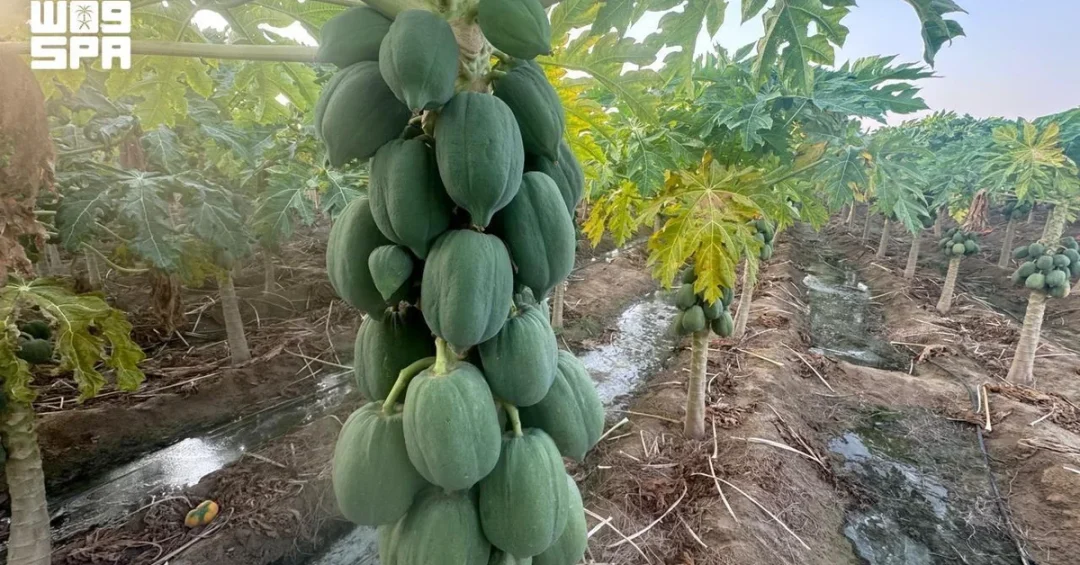
Papaya cultivation in Al-Qunfudhah Governorate, within the Makkah Region, is emerging as a promising pathway for agricultural diversification in Saudi Arabia, according to information released through the Saudi Press Agency (SPA). The development reflects a growing interest among local farmers in exploring tropical fruit crops that are well suited to their land and environment, opening new horizons for production that balances environmental suitability with a deep understanding of agronomic requirements. Could this tropical fruit become a model for sustainable farming across the Kingdom?
The SPA report, published from Jeddah, highlights that papaya — prized for its rapid growth and versatility — is gaining attention as a crop that can be marketed fresh or processed into juices, jams, and other food products. This dual-market potential provides farmers with diverse avenues to derive value from their harvest, reinforcing the Kingdom’s broader efforts to strengthen food security and diversify the agricultural economy under Vision 2030. The initiative aligns with national priorities to enhance domestic production, reduce import reliance, and create new income streams for rural communities in the Makkah Region and beyond.
Context and Background
Why does Al-Qunfudhah, a governorate nestled along the Red Sea coast in the Makkah Region, hold such promise for tropical agriculture? The answer lies in its warm climate, abundant sunlight, and fertile, well-drained soils — conditions that closely mirror the native growing environments of papaya. The fruit thrives in temperatures that rarely dip below 15 degrees Celsius, and Al-Qunfudhah’s coastal geography provides precisely that stability. The SPA report notes that successful cultivation depends on selecting varieties appropriate for the local environment and carefully attending to the plants’ specific needs, a principle that Saudi farmers are increasingly embracing as they diversify away from traditional date palm and vegetable production.
Papaya’s rapid growth cycle is a significant advantage for farmers seeking quicker returns on investment. Unlike many tree crops that take years to bear fruit, papaya can begin producing within 9 to 11 months of planting, allowing growers to realize revenue within a single agricultural season. This characteristic makes it an attractive option for smallholder farmers and commercial operations alike. The crop also offers year-round harvesting potential in suitable climates, providing consistent supply to local markets and processing facilities. According to the SPA report, the cultivation of tropical fruits in Al-Qunfudhah is taking on a new dimension, one rooted in the ability of farmers to explore agricultural options well suited to their local land and environment.
Historically, Saudi Arabia’s agricultural sector has been dominated by date palms, which are deeply woven into the Kingdom’s cultural and economic fabric. However, the Ministry of Environment, Water and Agriculture has been actively promoting crop diversification as part of a national strategy to optimize water usage, improve soil health, and enhance food security. Tropical fruits like papaya require less water than many traditional crops when managed properly, and their high value per hectare makes them economically viable for regions with limited arable land. The SPA report underscores that papaya cultivation enables farmers to explore opportunities for diversifying production, refining agricultural practices, and capitalizing on tropical crops that adapt to the governorate’s unique landscape.
Key Details
What are the specific agronomic requirements that make papaya a viable crop for Al-Qunfudhah? According to the SPA report, papayas thrive in warm climates with ample sunlight and fertile, well-drained soil. It is essential to avoid overwatering, which can lead to root rot — a critical consideration in Saudi Arabia’s arid environment where irrigation efficiency is paramount. Farmers must select varieties that are resistant to local pests and diseases, and they must carefully monitor soil moisture levels to ensure optimal growth. The report emphasizes that success depends on selecting varieties appropriate for the local environment and carefully attending to the plants’ specific needs, a testament to the sophistication of Saudi agricultural practices.
The versatility of papaya as a market product further enhances its appeal. The fruit can be sold fresh in local markets, where demand for tropical produce is rising among Saudi consumers and the millions of pilgrims who visit the Makkah Region annually. Alternatively, it can be processed into juices, jams, and other value-added food products, creating opportunities for small-scale agro-industries and cooperatives. This dual-market approach mirrors successful models in other tropical regions and aligns with the Kingdom’s push to develop downstream food processing capabilities. The SPA report notes that papaya can be marketed for fresh consumption or processed into juices, jams, and other food products, providing farmers with diverse avenues to derive value from their harvest.
From a technical standpoint, papaya cultivation in Al-Qunfudhah benefits from the governorate’s natural advantages. The region receives ample sunshine year-round, with average temperatures ranging from 25 to 35 degrees Celsius during the growing season. The soil in many parts of Al-Qunfudhah is sandy loam, which offers excellent drainage — a critical factor in preventing the root rot that can devastate papaya plantations. Local farmers are also learning to implement drip irrigation systems, which deliver water directly to the root zone, minimizing waste and reducing the risk of fungal diseases. These practices are supported by extension services provided through the Ministry of Environment, Water and Agriculture, which offers training and technical guidance to farmers across the Kingdom.
International and Regional Impact
How does Al-Qunfudhah’s papaya initiative fit into the broader regional agricultural landscape? Saudi Arabia’s push into tropical fruit production comes at a time when Gulf Cooperation Council (GCC) countries are collectively striving to enhance food security and reduce reliance on imports. The Kingdom currently imports a significant portion of its tropical fruits from Southeast Asia, Latin America, and Africa. By developing domestic capacity for papaya and other tropical crops, Saudi Arabia can reduce its import bill, shorten supply chains, and improve food resilience against global market disruptions. The SPA report highlights that this development opens new horizons for crop diversification, fostering an agricultural approach that balances environmental suitability with a deep understanding of production requirements.
Regionally, Al-Qunfudhah’s success could serve as a blueprint for other Saudi regions with similar climates, particularly along the Red Sea coast and in the southern highlands. The governorate’s experience demonstrates that with the right crop selection and management practices, Saudi farmers can successfully cultivate fruits that were once considered exclusive to tropical latitudes. This knowledge transfer is already occurring through agricultural cooperatives and government-led workshops, where farmers share best practices on variety selection, irrigation management, and post-harvest handling. The SPA report underscores that in Al-Qunfudhah, papaya cultivation enables farmers to explore opportunities for diversifying production, refining agricultural practices, and capitalizing on tropical crops that adapt to the governorate’s unique landscape.
On the international stage, Saudi Arabia’s agricultural diversification efforts are being watched by trading partners and investors alike. The Kingdom’s membership in the G20 and its active role in global food security dialogues position it as a leader in sustainable agriculture in arid regions. Successful papaya cultivation adds another dimension to Saudi Arabia’s agricultural diplomacy, showcasing how innovation and technology can overcome environmental constraints. The SPA report’s emphasis on environmental suitability and production requirements reflects the Kingdom’s commitment to science-based agriculture, a principle that resonates with international partners and enhances Saudi Arabia’s reputation as a responsible global actor.
Economic and Strategic Significance
What economic benefits can Saudi farmers and the national economy expect from papaya cultivation? The crop’s rapid growth cycle and high yield potential translate into attractive returns per hectare, particularly for small and medium-sized farms. A well-managed papaya plantation can produce 30 to 50 tons of fruit per hectare annually, with market prices for fresh papaya in Saudi Arabia ranging from SAR 5 to SAR 15 per kilogram depending on quality and season. When processed into juices or jams, the value per kilogram can increase significantly, creating additional margins for farmers who invest in processing equipment. The SPA report notes that papaya provides farmers with diverse avenues to derive value from their harvest, a key factor in rural economic development.
Strategically, papaya cultivation supports Saudi Arabia’s Vision 2030 goals of economic diversification and food security. The National Agriculture Strategy 2030 aims to increase domestic food production, improve water use efficiency, and boost the agricultural sector’s contribution to GDP. Papaya aligns with these objectives because it requires less water than many traditional crops when grown with modern irrigation systems, and its high value supports the development of agribusiness clusters. Furthermore, the crop’s processing potential creates jobs in rural areas, particularly for women and youth who can engage in small-scale food processing and marketing. The SPA report’s focus on crop diversification and production refinement reflects the Kingdom’s holistic approach to agricultural development.
From an investment perspective, the papaya value chain offers opportunities for public-private partnerships and foreign direct investment. Saudi Arabia’s agricultural sector has attracted increasing interest from investors seeking to capitalize on the Kingdom’s growing food market and its strategic location as a gateway to the Middle East and North Africa. Papaya cultivation could become a niche investment area, with opportunities in nursery development, cold chain logistics, and processing facilities. The SPA report highlights that papaya cultivation enables farmers to explore opportunities for diversifying production, refining agricultural practices, and capitalizing on tropical crops that adapt to the governorate’s unique landscape, signaling a maturing agricultural ecosystem that is open to innovation and investment.
Vision 2030 Alignment
How does papaya farming in Al-Qunfudhah contribute to Saudi Arabia’s Vision 2030? The Vision, launched by Crown Prince Mohammed bin Salman in 2016, seeks to diversify the Kingdom’s economy away from oil, develop non-oil sectors, and improve the quality of life for all citizens. Agriculture plays a vital role in this transformation, particularly in rural regions where job creation and sustainable development are priorities. The papaya initiative in Al-Qunfudhah embodies several Vision 2030 pillars: economic diversification, food security, environmental sustainability, and human capital development. By cultivating tropical fruits suited to local conditions, Saudi farmers are demonstrating the ingenuity and adaptability that the Vision seeks to foster across all sectors.
Moreover, the initiative aligns with the Ministry of Environment, Water and Agriculture’s efforts to promote sustainable farming practices and optimize resource use. The SPA report’s emphasis on understanding production requirements and avoiding overwatering reflects the Kingdom’s commitment to responsible water management — a critical issue in one of the world’s most water-scarce countries. As Saudi Arabia continues to invest in agricultural technology, including precision irrigation, soil monitoring, and climate-resilient crop varieties, papaya farming in Al-Qunfudhah stands as a promising example of how the Kingdom is turning environmental challenges into economic opportunities. The future of Saudi agriculture is not just about what grows, but how it grows — and Al-Qunfudhah’s papaya farmers are showing the way forward.
20 Questions
Q1. What is the main development reported by the Saudi Press Agency regarding Al-Qunfudhah?
A1. The Saudi Press Agency reported that papaya cultivation in Al-Qunfudhah Governorate is opening new horizons for crop diversification, allowing farmers to explore tropical fruits suited to the local environment and production requirements.
Q2. Why is papaya considered a promising crop for Al-Qunfudhah?
A2. Papaya thrives in warm climates with ample sunlight and fertile, well-drained soil, conditions that match Al-Qunfudhah’s coastal environment. Its rapid growth and versatility make it economically attractive for local farmers.
Q3. What are the key agronomic requirements for growing papaya?
A3. Papaya requires warm temperatures, abundant sunlight, and well-drained soil. Overwatering must be avoided to prevent root rot, and farmers must select varieties appropriate for the local environment and carefully attend to plant needs.
Q4. How can papaya be marketed to generate value for farmers?
A4. Papaya can be sold fresh for direct consumption or processed into juices, jams, and other food products. This dual-market approach provides farmers with diverse avenues to derive value from their harvest.
Q5. What role does the Ministry of Environment, Water and Agriculture play in this initiative?
A5. The ministry supports farmers through extension services, training, and technical guidance on crop selection, irrigation management, and sustainable practices, helping them diversify production and refine agricultural methods.
Q6. How does papaya cultivation align with Saudi Arabia’s food security goals?
A6. By developing domestic capacity for tropical fruits, Saudi Arabia can reduce reliance on imports, shorten supply chains, and improve resilience against global market disruptions, directly supporting national food security objectives.
Q7. What economic benefits can farmers expect from papaya farming?
A7. Papaya offers rapid returns, with production beginning within 9 to 11 months. High yields and strong market demand for fresh and processed products can generate attractive income per hectare for farmers.
Q8. How does papaya farming contribute to Vision 2030?
A8. It supports economic diversification, food security, environmental sustainability, and rural job creation, aligning with Vision 2030’s goals to transform the Kingdom’s economy and improve quality of life.
Q9. What water management practices are essential for papaya cultivation in Saudi Arabia?
A9. Drip irrigation is recommended to deliver water directly to the root zone, minimizing waste and reducing fungal disease risk. Avoiding overwatering is critical to prevent root rot in papaya plants.
Q10. Can papaya cultivation be replicated in other regions of Saudi Arabia?
A10. Yes, regions with similar warm climates and well-drained soils, particularly along the Red Sea coast and southern highlands, could adopt papaya farming with appropriate variety selection and management practices.
Q11. What is the significance of crop diversification for Saudi agriculture?
A11. Diversification reduces dependence on a few crops, optimizes water and land use, enhances food security, and creates new income streams for farmers, supporting the Kingdom’s sustainable agricultural development strategy.
Q12. How does papaya’s growth cycle compare to other fruit crops?
A12. Papaya is notable for its rapid growth, beginning to bear fruit within 9 to 11 months of planting, whereas many tree crops take several years. This allows farmers quicker returns on investment.
Q13. What processing opportunities exist for papaya in Saudi Arabia?
A13. Papaya can be processed into juices, jams, and other food products, creating opportunities for small-scale agro-industries, cooperatives, and value-added product development in rural areas.
Q14. How does papaya farming support rural development in Al-Qunfudhah?
A14. It creates jobs in cultivation, harvesting, processing, and marketing, particularly for women and youth, while stimulating local economies and supporting community-based agricultural enterprises.
Q15. What role does technology play in papaya cultivation?
A15. Technology such as drip irrigation, soil monitoring, and climate-resilient crop varieties helps optimize water use, prevent disease, and improve yields, making papaya farming more sustainable and efficient.
Q16. Are there any environmental benefits to growing papaya in Saudi Arabia?
A16. Papaya cultivation can improve soil health, enhance biodiversity when integrated with other crops, and promote efficient water use, contributing to environmental sustainability in arid regions.
Q17. How does the Saudi Press Agency report frame the future of tropical agriculture in the Kingdom?
A17. The report frames it as a promising avenue for diversification, emphasizing environmental suitability and production refinement, and highlighting opportunities for farmers to capitalize on tropical crops adapted to local landscapes.
Q18. What support services are available for farmers interested in papaya cultivation?
A18. Farmers can access extension services, training workshops, and technical guidance from the Ministry of Environment, Water and Agriculture, as well as share best practices through agricultural cooperatives.
Q19. How does papaya farming fit into Saudi Arabia’s international agricultural trade?
A19. It can reduce import dependence and potentially create export opportunities for high-quality tropical fruits, enhancing the Kingdom’s position in regional and global agricultural markets.
Q20. What is the long-term outlook for papaya farming in Al-Qunfudhah?
A20. With continued government support, technological adoption, and farmer innovation, papaya farming is poised to expand, serving as a model for sustainable tropical agriculture in Saudi Arabia and supporting Vision 2030 goals.
Reader Feedback
We value your thoughts. Please share your feedback on this article.
Your feedback helps us improve our coverage.