


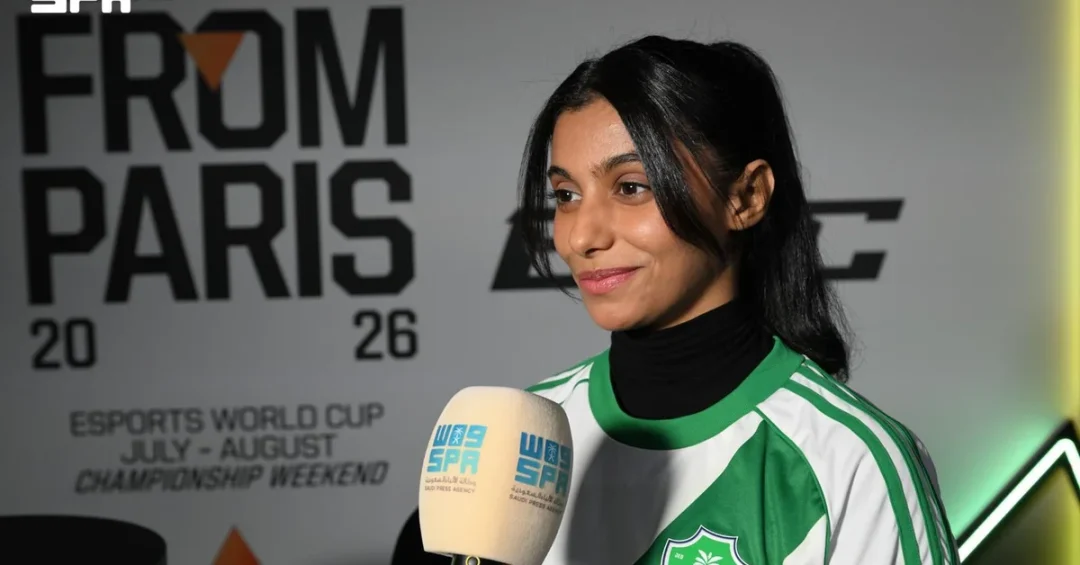
Saudi esports player Huda Faqihi is representing the Kingdom in the Tekken 8 competition at the 2026 Esports World Cup in Paris, becoming the only Saudi female player in the tournament, according to the Saudi Press Agency (SPA). Her participation, confirmed by the Kingdom’s official news agency, marks another milestone in the expanding presence of Saudi women in global competitive gaming and reflects the rapid professionalization of a sector that has become a central pillar of Saudi Arabia’s entertainment and technology ambitions.
The Esports World Cup, the flagship event of the global competitive gaming calendar, originated in Riyadh, where its first two editions were hosted, before the current edition moved to Paris. Faqihi’s presence in the French capital therefore carries a distinctive symbolism: a Saudi player competing on an international stage built by Saudi vision and investment. As the tournament unfolds, her run in Tekken 8 is being followed closely by audiences in the Kingdom and beyond, raising a natural question: what does it mean for a young Saudi woman to stand at the center of one of the world’s fastest-growing sports?
Context and Background
How did Saudi Arabia become a global hub for competitive gaming in less than a decade? The answer lies in a deliberate national strategy that treated esports not as a niche pastime but as an industry with economic, cultural, and youth-engagement dimensions. The Saudi Esports Federation, established under the leadership of the Ministry of Sport, laid the institutional groundwork, while the Saudi Esports Academy created structured pathways for players to move from casual play to professional training. The National Gaming and Esports Strategy, launched in 2022, set out to make the Kingdom a global center for the sector by 2030, with targets covering job creation, studio investment, and world-class event hosting.
The Esports World Cup itself is the most visible product of that strategy. First staged in Riyadh in 2024, it brought together the world’s leading clubs and players across dozens of titles, with a prize pool that made it the largest event of its kind. Its relocation of the current edition to Paris reflects the event’s evolution into a genuinely international property, one that carries Saudi organizational expertise and branding into new markets. For Saudi players, the tournament offers something equally valuable: a stage on which to test themselves against the best in the world. Faqihi’s qualification for Tekken 8, a title known for its technical depth and demanding execution, places her within that elite field.
The broader regional context matters as well. Across the Gulf, governments have moved to formalize esports as a career path, but Saudi Arabia has moved fastest and at the largest scale. The Kingdom now hosts major tournaments, operates dedicated training facilities, and has integrated gaming into its national entertainment calendar. That ecosystem is what allows a player like Faqihi to progress through defined stages rather than navigating the sector alone. It is also what makes her appearance in Paris legible as a national story rather than an individual one — a distinction that matters when assessing the durability of Saudi progress in the sector.
Key Details
What does Faqihi’s own account of her journey reveal about the pathway now available to Saudi talent? In an exclusive interview with the Saudi Press Agency, she explained that her esports career began at home, playing informally before she joined the Saudi Esports Academy. There, she moved from gaming as a hobby into structured training and organized competition. Her progress continued with selection for the Saudi national team and a professional career with Al-Ahli Club, one of the Kingdom’s leading sports institutions. Her trajectory, as she described it, follows a sequence: passion and practice, then training and development, then competition with clubs and national teams, and finally participation in global tournaments.
That sequence is not accidental. It reflects an intentional design in which academies identify talent, clubs provide competitive environments, national teams offer international exposure, and global events supply the ultimate test. For female players, the pathway has been reinforced by the growing diversity of games in which Saudi women now compete. Their involvement is no longer confined to a single genre; it extends across shooter games, sports esports, mobile games, and fighting games, mirroring the breadth of the international competitive landscape. Tekken 8, a fighting game requiring split-second decision-making and deep matchup knowledge, is a particularly demanding arena in which to represent that diversity.
Faqihi’s status as the only Saudi female player in the Paris tournament also highlights how recently this pathway opened. The presence of a single competitor at the top level is both an achievement and a marker of how much room remains for growth. Saudi officials have consistently framed such appearances as evidence that the system is producing results, while emphasizing that the pipeline is designed to generate many more competitors in the years ahead. For now, her run in Paris serves as a visible proof point for a strategy that measures success not only in medals but in the breadth of participation it enables.
International and Regional Impact
Why does a single player’s appearance in Paris resonate beyond the tournament itself? Because it arrives at a moment when the global esports industry is watching Saudi Arabia closely. The Kingdom’s investments in the sector — from event hosting to club ownership to infrastructure — have made it a central actor in a market valued in the billions of dollars and followed by hundreds of millions of viewers worldwide. When a Saudi woman competes at the Esports World Cup, she becomes part of that story, demonstrating that the Kingdom’s ambitions are not limited to staging events but extend to producing the talent that competes in them.
Regionally, the impact is equally significant. Across the Middle East, young women have historically faced limited pathways into professional gaming, with cultural and structural barriers restricting access to training and competition. Saudi Arabia’s model — combining state-backed academies, professional clubs, and international event exposure — offers a template that other countries in the region are now examining. Faqihi’s participation, reported by the Saudi Press Agency and carried by international outlets, provides a concrete example of what that model can produce. It also strengthens the Kingdom’s position as a convener of global esports, reinforcing the credibility of its claim to leadership in the sector.
Economic and Strategic Significance
How does competitive gaming connect to Saudi Arabia’s wider economic agenda? The esports and gaming sector is a component of the Kingdom’s diversification strategy, which seeks to reduce dependence on hydrocarbons by building new industries in entertainment, technology, and tourism. The National Gaming and Esports Strategy targets the creation of tens of thousands of jobs and contributions to gross domestic product measured in billions of riyals. Events like the Esports World Cup drive demand for hospitality, travel, and media production, while academies and clubs build human capital that can be applied across the digital economy.
For Saudi women specifically, the sector offers a route into an industry that is young, globally connected, and not constrained by legacy structures. Careers in esports span playing, coaching, analysis, broadcasting, event management, and game development, and the Kingdom’s institutions have encouraged women to enter all of these fields. Faqihi’s visibility as a competitor at the highest level supports that effort by providing a reference point for younger players. It also aligns with the broader increase in female participation in Saudi sports and professional life, a trend that officials regularly cite as evidence of social and economic modernization under Vision 2030.
Vision 2030 Alignment
What does Faqihi’s appearance in Paris ultimately signify for the Kingdom’s long-term vision? It represents the convergence of several Vision 2030 objectives: the development of a vibrant entertainment sector, the expansion of economic opportunities for young people, the empowerment of Saudi women, and the cultivation of national pride through international achievement. The pathway she followed — from home play to the Saudi Esports Academy, to the national team, to Al-Ahli Club, and now to a global tournament — is precisely the kind of structured progression that the strategy was designed to create. Her presence in Paris demonstrates that the system is functioning as intended and that Saudi talent can compete at the highest levels.
As attention in Paris turns to competitions and results, the significance of her participation extends beyond any single match. It reflects a sector-wide transformation that is opening professional careers for Saudi talent and giving female players greater opportunities to compete and establish their presence internationally. The Kingdom’s investment in esports has already changed where the world’s biggest tournaments are held; the next phase, exemplified by Faqihi, is about who competes in them. For a young Saudi woman to be the only female player from her country in a Tekken 8 field at the Esports World Cup is a milestone — and, given the scale of the pipeline behind her, one that is likely to be followed by many more.
20 Questions
Q1. Who is Huda Faqihi?
A1. Huda Faqihi is a Saudi esports player competing in the Tekken 8 competition at the 2026 Esports World Cup in Paris. She is the only Saudi female player in the tournament and represents Al-Ahli Club and the Saudi national team.
Q2. What event is she competing in?
A2. She is competing in the Tekken 8 tournament at the 2026 Esports World Cup, held in Paris. The event is the flagship competition of the global esports calendar and originated in Riyadh.
Q3. Where was the Esports World Cup previously held?
A3. The previous two editions of the Esports World Cup were hosted in Riyadh, Saudi Arabia. The current edition moved to Paris, marking the event’s expansion to an international venue.
Q4. How did Faqihi begin her esports career?
A4. According to her interview with the Saudi Press Agency, her journey began at home with informal gaming. She later joined the Saudi Esports Academy, where she moved into structured training and organized competition.
Q5. What role did the Saudi Esports Academy play?
A5. The Saudi Esports Academy provided Faqihi with formal training and development, helping her transition from gaming as a hobby to professional competition. It is a key institution in the Kingdom’s esports talent pipeline.
Q6. Which club does she represent?
A6. Faqihi represents Al-Ahli Club, one of Saudi Arabia’s leading sports institutions. She also plays for the Saudi national team, following her progression from academy training to professional competition.
Q7. What is the significance of her participation?
A7. Her participation reflects the growing presence of Saudi women in global esports and demonstrates the effectiveness of the Kingdom’s talent development pathways. It also highlights the transformation of Saudi esports on the international stage.
Q8. Is she the only Saudi woman in the tournament?
A8. Yes, Faqihi is the only Saudi female player competing in the Tekken 8 tournament at the 2026 Esports World Cup in Paris, according to the Saudi Press Agency.
Q9. What genres do Saudi female players compete in?
A9. Saudi female players compete across a diverse range of genres, including shooter games, sports esports, mobile games, and fighting games. This diversity mirrors the breadth of the global competitive landscape.
Q10. What is Tekken 8?
A10. Tekken 8 is a fighting game known for its technical depth, requiring precise execution and deep knowledge of character matchups. It is one of the titles featured at the Esports World Cup.
Q11. What is the National Gaming and Esports Strategy?
A11. Launched in 2022, it is Saudi Arabia’s national plan to become a global hub for gaming and esports by 2030. It targets job creation, investment, and world-class event hosting.
Q12. How does esports fit into Vision 2030?
A12. Esports supports Vision 2030 by diversifying the economy, creating jobs for young people, expanding entertainment options, and empowering Saudi women. It is part of the Kingdom’s broader economic transformation.
Q13. What economic benefits does esports bring to Saudi Arabia?
A13. The sector drives demand for hospitality, travel, and media production, while building digital skills. The national strategy targets tens of thousands of jobs and billions of riyals in economic contribution.
Q14. How does her participation affect young Saudi women?
A14. Her visibility at the highest level provides a reference point for younger players, showing that professional careers in esports are achievable. It supports the broader increase in female participation in Saudi sports and professional life.
Q15. What did Faqihi say about her journey?
A15. In her interview with the Saudi Press Agency, she said her journey began at home before she joined the Saudi Esports Academy, then moved to training, organized competition, the national team, and Al-Ahli Club.
Q16. What does the pathway from academy to national team involve?
A16. It involves identifying talent at the academy level, developing skills through structured training, competing with clubs, gaining international exposure with national teams, and ultimately participating in global tournaments.
Q17. Why is the Esports World Cup important for Saudi Arabia?
A17. The event showcases Saudi Arabia’s organizational capacity and investment in esports, reinforces its position as a global hub, and provides Saudi players with a stage to compete against the world’s best.
Q18. How does the Paris edition differ from previous ones?
A18. The Paris edition is the first held outside Riyadh, reflecting the event’s evolution into an international property. It carries Saudi organizational expertise and branding into a new market.
Q19. What opportunities exist for Saudi women in esports?
A19. Careers span playing, coaching, analysis, broadcasting, event management, and game development. Saudi institutions have encouraged women to enter all these fields as the sector grows.
Q20. What does the future hold for Saudi esports?
A20. The Kingdom’s strategy aims to produce many more world-class competitors and to sustain its role as a global hub. Faqihi’s appearance in Paris is expected to be followed by further milestones.
Reader Feedback
We value your thoughts. Please share your feedback on this article.
Your feedback helps us improve our coverage.
Related articles
 Esports Unites 100 Nations at Paris World Cup 2026
 Saudi Huda Faqihi Competes at Esports World Cup in Paris
 Esports World Cup in Paris Unites Global Fans
 Esports World Cup in Paris Draws Elite Athletes Beyond Gaming Community
 Esports World Cup 2026 Draws Tennis Star Kyrgios
 Esports World Cup Shows Gaming’s Power to Bridge Generations