


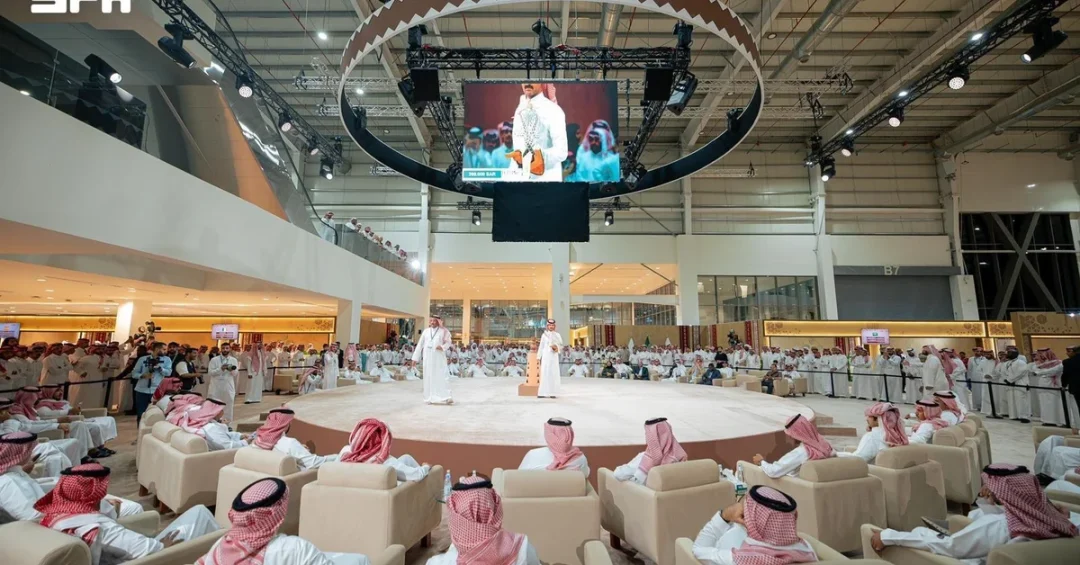
Two falcons from German and British breeding farms sold for a combined SAR201,000 on the second night of the International Falcon Breeders Auction 2026, organized by the National Center for Falcons at its headquarters in Malham, north of Riyadh, according to the Saudi Press Agency. The auction, which runs until August 25, brings together leading local and international breeding farms and has become one of the most anticipated events on the Kingdom’s falconry calendar. Competitive bidding from falconers and enthusiasts drove the two lots well beyond their opening prices, underscoring the enduring prestige of falconry in Saudi culture and the growing global reach of the Kingdom’s specialized heritage markets.
The first falcon, a gyr-peregrine juvenile from German farm PF3 Falcons, opened at SAR20,000 before selling for SAR100,000. The bird weighs 1,260 grams and has a wingspan of 16.5 inches. The second falcon, also a gyr-peregrine juvenile, came from British farm Sky Falcons, opened at SAR40,000, and sold for SAR101,000, weighing 1,200 grams with a wingspan of 16.5 inches. Together, the two sales illustrate how international breeders now view the Saudi auction as a premier venue for showcasing elite bloodlines to a knowledgeable and highly competitive buyer base.
Context and Background
How did an ancient desert tradition become a modern, multimillion-riyal international marketplace? Falconry has been woven into the social and cultural fabric of the Arabian Peninsula for centuries, serving as a practical hunting skill, a mark of honor, and a bond between generations. In Saudi Arabia, that heritage has been carefully preserved and elevated through official institutions, most notably the National Center for Falcons, which organizes the International Falcon Breeders Auction and regulates the broader falcon sector. The center’s work reflects a deliberate national effort to protect intangible cultural heritage while building modern economic infrastructure around it.
The International Falcon Breeders Auction has grown steadily since its inception, attracting farms from Europe, Asia, and the Middle East. Its location at Malham, north of Riyadh, provides a dedicated facility where breeders, falconers, and buyers can inspect birds in person and review detailed documentation before bidding. The event continues until August 25, giving participants several weeks to evaluate lots, negotiate, and observe market trends. For international farms such as PF3 Falcons of Germany and Sky Falcons of the United Kingdom, participation offers direct access to Saudi buyers who value provenance, performance, and precise physical data.
The auction also sits within a wider ecosystem of Saudi heritage events, including falconry festivals and competitions that draw thousands of visitors each year. These gatherings are not merely cultural showcases; they are functioning markets where reputation, expertise, and capital converge. The presence of German and British farms on the second night alone signals the auction’s international standing and the Kingdom’s role as a hub connecting global breeders with regional demand. For a non-Saudi audience, this matters because it demonstrates how Saudi Arabia is converting cultural authenticity into soft power and commercial diplomacy.
Key Details
What exactly made these two gyr-peregrine juveniles worth a combined SAR201,000? The first bird, from PF3 Falcons, opened at SAR20,000 and climbed to SAR100,000 through competitive bidding. At 1,260 grams with a 16.5-inch wingspan, it presented the physical profile that experienced falconers associate with strength and endurance. The second bird, from Sky Falcons, opened at SAR40,000 and sold for SAR101,000, weighing 1,200 grams with the same 16.5-inch wingspan. Both are juveniles, a category that often attracts buyers looking to train and develop a bird over many seasons.
Central to the auction’s credibility is its identification system. Each falcon is issued an identification card displaying its species, age, farm name, country of origin, weight, measurements, breeding environment, and ring number. This documentation allows falconers and buyers to review a bird’s complete profile before bidding, reducing uncertainty and reinforcing trust in the transaction. The ring number, in particular, supports traceability and responsible breeding practices, aligning with international standards for falcon management and conservation.
The auction platform thus functions as both a marketplace and a quality-assurance mechanism. Buyers can compare birds across farms using standardized data, while breeders benefit from transparent pricing that reflects genuine demand. The second night’s results, with two lots selling for approximately SAR100,000 each, suggest a healthy market in which well-documented, high-quality juveniles command strong premiums. The event continues until August 25, meaning further sales and price signals will emerge in the coming weeks.
International and Regional Impact
Why should international observers pay attention to a falcon auction in Riyadh? Because it illustrates how Saudi Arabia is deepening ties with Europe and other regions through specialized, high-value trade. German farm PF3 Falcons and British farm Sky Falcons are not casual participants; their presence reflects years of relationship-building and recognition that Saudi buyers are among the world’s most discerning. Every auction night strengthens commercial networks that extend beyond falconry into veterinary services, transport, insurance, and tourism.
Regionally, the auction reinforces the Kingdom’s position as a center of gravity for Gulf heritage sports. Falconers from neighboring countries follow the results closely, and the prices achieved at Malham influence expectations across the region. By hosting international breeders under one roof, Saudi Arabia facilitates knowledge exchange on breeding techniques, health management, and genetics. This exchange benefits conservation efforts as well, since responsible breeding reduces pressure on wild falcon populations and supports sustainable practices.
The event also contributes to Saudi Arabia’s broader diplomatic outreach. Cultural and heritage events create informal channels for dialogue, and the participation of European farms adds a dimension of people-to-people connection. For a global audience, the auction serves as a reminder that Saudi Arabia’s international engagement is not limited to energy, finance, or geopolitics; it also includes the celebration and commercialization of shared human heritage.
Economic and Strategic Significance
What does a SAR201,000 night reveal about the economics of falconry in Saudi Arabia? It reveals a mature, specialized market with willing buyers and sophisticated sellers. Falconry in the Kingdom supports a value chain that includes breeding farms, equipment suppliers, veterinary clinics, training facilities, and event management. The International Falcon Breeders Auction sits at the center of this chain, generating direct sales and stimulating adjacent economic activity during its run from early August to August 25.
Strategically, the auction advances Saudi Arabia’s goal of diversifying its economy and expanding non-oil sectors. Heritage tourism and cultural events attract visitors, create jobs, and generate media coverage that showcases the Kingdom’s modernization. The National Center for Falcons, by organizing a professional and well-documented auction, demonstrates how traditional pursuits can be institutionalized without losing their authenticity. This balance is central to the national approach: preserve the past, but present it through modern, efficient, and globally credible platforms.
For international breeders, the Saudi market offers scale and prestige. For Saudi buyers, it offers access to the world’s best bloodlines. The result is a mutually beneficial exchange that strengthens the Kingdom’s reputation as a reliable and attractive commercial partner. As the auction continues, each night’s results add data points that help breeders, buyers, and policymakers understand the trajectory of this unique market.
Vision 2030 Alignment
How does a falcon auction connect to Saudi Vision 2030? Vision 2030 seeks to diversify the economy, empower cultural institutions, and enhance quality of life. Falconry, as a cherished heritage sport, fits squarely within these objectives. The International Falcon Breeders Auction supports cultural preservation, promotes international engagement, and contributes to a vibrant events calendar that attracts visitors and investment. The National Center for Falcons exemplifies the institutional capacity that Vision 2030 aims to build across sectors.
Moreover, the auction’s emphasis on documentation, traceability, and standardization reflects the broader modernization drive. By adopting transparent practices, the Kingdom positions its heritage markets as world-class and trustworthy. This, in turn, supports the growth of related sectors such as tourism, where visitors can combine cultural experiences with luxury and adventure offerings. The two falcons sold on the second night are thus more than individual birds; they are symbols of a confident, forward-looking Saudi Arabia that honors its traditions while embracing global exchange.
As the auction continues until August 25, further sales will draw attention from falconers, breeders, and observers worldwide. The second night’s SAR201,000 result sets a strong tone, demonstrating that the International Falcon Breeders Auction 2026 is a premier destination for elite falcons and a clear expression of Saudi Arabia’s cultural and economic ambitions.
20 Questions
Q1. What was the total value of the two falcons sold on the second night?
A1. The two falcons sold for a combined SAR201,000, according to the Saudi Press Agency. The first sold for SAR100,000 and the second for SAR101,000.
Q2. Which farms bred the two falcons sold?
A2. The first falcon came from German farm PF3 Falcons, and the second from British farm Sky Falcons. Both are gyr-peregrine juveniles.
Q3. What was the opening price of the German falcon?
A3. The German falcon from PF3 Falcons opened at SAR20,000 before competitive bidding drove the final price to SAR100,000.
Q4. What was the opening price of the British falcon?
A4. The British falcon from Sky Falcons opened at SAR40,000 and ultimately sold for SAR101,000 after competitive bidding.
Q5. What are the weights of the two falcons?
A5. The German falcon weighs 1,260 grams, while the British falcon weighs 1,200 grams. Both have a wingspan of 16.5 inches.
Q6. Who organizes the International Falcon Breeders Auction?
A6. The auction is organized by the National Center for Falcons, a Saudi institution dedicated to preserving falconry heritage and regulating the sector.
Q7. Where is the auction held?
A7. The auction takes place at the National Center for Falcons headquarters in Malham, located north of Riyadh, the capital of Saudi Arabia.
Q8. How long does the auction run?
A8. The International Falcon Breeders Auction 2026 continues until August 25, offering multiple nights of sales and bidding.
Q9. What information is on each falcon’s identification card?
A9. Each card displays species, age, farm name, country of origin, weight, measurements, breeding environment, and ring number, allowing buyers to review details before bidding.
Q10. Why is the identification card important?
A10. It provides transparency and traceability, helping buyers make informed decisions and supporting responsible breeding practices in line with international standards.
Q11. What is a gyr-peregrine juvenile?
A11. A gyr-peregrine is a hybrid falcon bred from gyrfalcon and peregrine falcon lineage. Juveniles are young birds often sought for training and development.
Q12. Why do Saudi buyers value falcons so highly?
A12. Falcons are central to Saudi heritage and are prized for their hunting ability, beauty, and cultural significance, making them prestigious acquisitions for falconers and collectors.
Q13. How does the auction benefit international breeders?
A13. It gives them direct access to a knowledgeable, competitive Saudi buyer base and a prestigious platform to showcase their bloodlines and breeding programs.
Q14. Does the auction support conservation?
A14. Yes, responsible breeding and documentation help reduce pressure on wild falcon populations and promote sustainable practices within the falconry community.
Q15. What economic sectors does the auction support?
A15. It supports breeding farms, veterinary services, equipment suppliers, transport, tourism, and event management, contributing to economic diversification.
Q16. How does the auction align with Vision 2030?
A16. It preserves cultural heritage, promotes international engagement, and supports a vibrant events calendar that attracts visitors and investment, aligning with Vision 2030 goals.
Q17. Are there other falconry events in Saudi Arabia?
A17. Yes, the Kingdom hosts falconry festivals and competitions that draw thousands of visitors and participants, reinforcing its status as a global falconry hub.
Q18. What happens after the auction ends on August 25?
A18. Buyers take ownership of their falcons, and the market data generated will inform future breeding, pricing, and event planning across the sector.
Q19. How does the auction reflect Saudi Arabia’s global role?
A19. It demonstrates the Kingdom’s ability to host world-class specialized markets, connect international breeders with regional demand, and celebrate shared heritage.
Q20. What is the significance of the SAR201,000 total?
A20. It signals a strong, mature market for elite falcons in Saudi Arabia and reinforces the Kingdom’s position as a leading destination for falconry commerce and culture.
Reader Feedback
We value your thoughts. Please share your feedback on this article.
Your feedback helps us improve our coverage.
Related articles
 Medina Research Center Workshop Reviews Strategic Direction
 International Falcon Breeders Auction Draws Strong Weekend Turnout
 Egypt’s Dakahlia Discovery Documents Millennia of Civilization
 Historic Jeddah Summer: Heritage, Arts, Knowledge
 Rain and Hail Bid Farewell to Arsh Al-Huruf Guests in Al-Baha
 Austrian Falconer Praises Saudi Falcon Auction Growth