


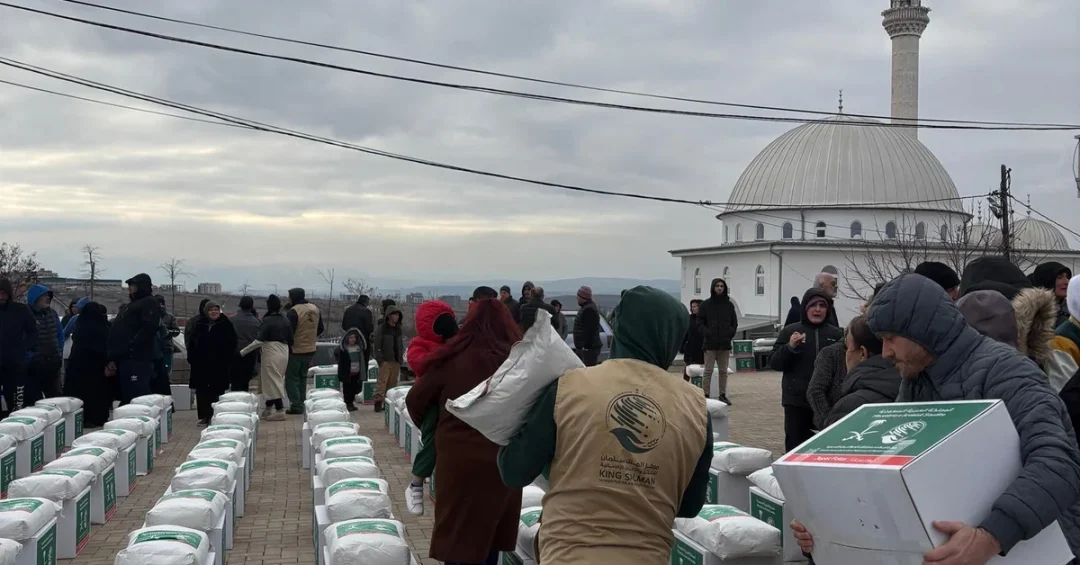
The King Salman Humanitarian Aid and Relief Center (KSrelief) officially launched the “Etaam” Ramadan Food Basket Project in Kosovo for the year 1446 AH, inaugurating the initiative in the capital, Pristina, in the presence of Saudi Arabia’s Ambassador to Albania and non-resident Ambassador to Kosovo, Faisal Ghazi Ismail Hifzi, Kosovo Grand Mufti Naim Ternava, and a dedicated KSrelief field team. The project, announced via the Saudi Press Agency, will distribute 8,110 food baskets across 30 governorates in Kosovo, benefiting approximately 40,550 individuals during the holy month of Ramadan. Each basket weighs 51 kilograms and contains essential staples including rice, oil, pasta, sugar, and flour, designed to sustain families throughout the fasting period and beyond.
This initiative is part of Saudi Arabia’s broader humanitarian and relief efforts carried out by KSrelief to support food security in countries in need, reflecting the Kingdom’s enduring commitment to international solidarity. The launch in Kosovo comes as Saudi Arabia continues to expand its global aid footprint, delivering assistance to vulnerable communities across Africa, Asia, and Europe. The Etaam project, which translates to “food” or “feeding” in Arabic, is a flagship Ramadan program that embodies the values of generosity and compassion central to Saudi culture and Islamic tradition. By targeting Kosovo, a nation with a predominantly Muslim population and a history of regional challenges, KSrelief underscores its dedication to reaching communities where food insecurity remains a pressing concern.
Context and Background
How did the Etaam project come to be launched in Kosovo, and what does it signify for Saudi-Kosovo relations? The King Salman Humanitarian Aid and Relief Center, established in 2015 by royal decree, has since become a leading global humanitarian organization, implementing thousands of projects in over 90 countries. Its Ramadan food basket initiatives are among its most anticipated annual programs, designed to alleviate the burden on families during the holy month when food consumption typically rises due to daily fasting and communal gatherings. The selection of Kosovo for the 1446 AH Etaam project reflects both the Kingdom’s strategic outreach to Muslim-majority nations in the Balkans and its recognition of the socio-economic challenges faced by many Kosovar families.
Kosovo, which declared independence in 2008, has faced persistent economic hurdles, including high unemployment and limited agricultural self-sufficiency. The country relies heavily on food imports, making it vulnerable to price fluctuations and supply chain disruptions. The 8,110 baskets, each weighing 51 kilograms, are tailored to provide a comprehensive nutritional boost, containing rice, oil, pasta, sugar, and flour—items that form the backbone of daily meals in Kosovar households. The distribution across 30 governorates ensures that aid reaches both urban centers and rural areas, where access to affordable food can be particularly constrained. This operation is not merely a charity gesture; it is a carefully coordinated effort involving local authorities, religious leaders, and KSrelief’s logistics experts to maximize impact and ensure equitable distribution.
The inauguration ceremony in Pristina, attended by Ambassador Faisal Ghazi Ismail Hifzi, who is also non-resident ambassador to Kosovo, and Grand Mufti Naim Ternava, highlights the diplomatic and cultural dimensions of the project. The Grand Mufti’s presence underscores the role of the Islamic community in facilitating aid and fostering goodwill between Saudi Arabia and Kosovo. Such partnerships are vital for KSrelief’s operational success, as they provide local knowledge, trusted networks, and logistical support. The event also serves as a platform to reaffirm Saudi Arabia’s commitment to Kosovo’s stability and prosperity, a message that resonates deeply in a region still healing from the conflicts of the late 1990s.
Key Details of the Etaam Ramadan Food Basket Project
What exactly does each 51-kilogram food basket contain, and how will it sustain a family through Ramadan? The baskets are meticulously assembled to cover essential dietary needs for an average family over several weeks. Rice, a staple in Kosovar cuisine, provides a versatile base for meals; cooking oil is included for frying and seasoning; pasta offers a quick and energy-rich option for suhoor and iftar; sugar is essential for beverages and traditional sweets; and flour enables families to bake bread, a daily necessity. The 51-kilogram weight ensures that each basket is substantial, reducing the need for additional food purchases during the month. With 8,110 baskets, the total food distributed amounts to over 413 metric tons, a significant logistical undertaking that requires careful planning, procurement, and transportation.
The distribution strategy covers 30 governorates, which in Kosovo’s administrative context refers to its municipalities or districts. This wide reach ensures that both the capital Pristina and remote villages benefit. KSrelief teams, working alongside local partners, will oversee the handover to ensure transparency and fairness. Beneficiaries are selected based on vulnerability criteria, including income level, family size, and displacement status. Approximately 40,550 individuals—roughly 2% of Kosovo’s population—will receive direct assistance. The project’s timing is crucial: Ramadan is a period of heightened food insecurity for low-income families, as social obligations and traditional feasts can strain limited budgets. By providing these baskets, KSrelief helps families observe the holy month with dignity and without compromising their nutritional intake.
The launch event itself was a testament to the strong bilateral ties between Saudi Arabia and Kosovo. Ambassador Hifzi, in his dual role, has been instrumental in facilitating humanitarian cooperation. Grand Mufti Ternava, a respected religious leader, endorsed the initiative, emphasizing its alignment with Islamic values of charity and brotherhood. The presence of a KSrelief team on the ground signals the Center’s hands-on approach, ensuring that aid is delivered efficiently and that feedback from beneficiaries informs future projects. This level of engagement is a hallmark of Saudi humanitarian work, which prioritizes not only immediate relief but also long-term resilience and community empowerment.
International and Regional Impact
How does the Kosovo project fit into Saudi Arabia’s wider humanitarian diplomacy, and what message does it send to the international community? Saudi Arabia, through KSrelief, has emerged as a global leader in humanitarian aid, consistently ranking among the top donor countries. The Etaam project in Kosovo is one of many similar initiatives launched simultaneously in various countries during Ramadan, creating a ripple effect of goodwill and demonstrating the Kingdom’s capacity to coordinate complex, multi-national relief operations. In the Balkans, where Saudi Arabia has been deepening its diplomatic and economic ties, such projects serve as tangible expressions of friendship and shared values. They also counter negative narratives by showcasing constructive engagement and tangible benefits for local populations.
Regionally, the project contributes to stability in Kosovo by addressing a basic need that, if unmet, could exacerbate social tensions or fuel unrest. Food security is a cornerstone of any nation’s resilience, and by bolstering it during a culturally significant period, KSrelief helps foster a sense of security and normalcy. Moreover, the collaboration with Kosovo’s religious leadership reinforces the moderate, inclusive interpretation of Islam that Saudi Arabia promotes globally. This soft power approach enhances the Kingdom’s reputation as a responsible global citizen and a reliable partner in development. For Kosovo, the aid not only meets immediate needs but also strengthens its relationship with a key player in the Muslim world, potentially opening doors to further cooperation in trade, education, and infrastructure.
Economic and Strategic Significance
What are the broader economic and strategic implications of this humanitarian gesture for Saudi Arabia and Kosovo? On the economic front, the procurement of food items for the baskets stimulates agricultural and food processing sectors in Kosovo and neighboring countries, as KSrelief often sources locally when possible to support host economies. Even when items are imported, the distribution network creates temporary employment and boosts local logistics. For Saudi Arabia, the project is part of a strategic investment in soft power, building goodwill that can translate into diplomatic support and economic opportunities. Kosovo, located at the crossroads of the Balkans, offers a gateway to European markets and a stable partner in a region of strategic interest.
Strategically, the Etaam project aligns with Saudi Arabia’s Vision 2030, which seeks to diversify the Kingdom’s economy and enhance its global influence. Humanitarian aid is a key pillar of this vision, as it projects Saudi Arabia as a compassionate and capable international actor. The project also reinforces the Kingdom’s leadership in the Islamic world, particularly through initiatives that benefit Muslim communities in need. By partnering with local institutions like the office of the Grand Mufti, KSrelief ensures that aid is culturally appropriate and effectively delivered. This model of cooperation can be replicated in other countries, further expanding Saudi Arabia’s humanitarian footprint and strengthening its network of allies.
Vision 2030 Alignment
How does the Etaam Ramadan Food Basket Project in Kosovo reflect the objectives of Saudi Vision 2030? Vision 2030, launched in 2016 by Crown Prince Mohammed bin Salman, aims to transform Saudi Arabia into a more diversified, globalized, and socially responsible nation. A core component is enhancing the Kingdom’s role as a humanitarian leader, using its resources to promote peace, stability, and prosperity worldwide. KSrelief is a direct manifestation of this ambition, operationalizing Saudi generosity into structured, impactful programs. The Kosovo project exemplifies how Vision 2030 extends beyond domestic reforms to encompass international engagement, showcasing Saudi Arabia’s commitment to the United Nations Sustainable Development Goals, particularly those related to zero hunger and global partnerships.
Furthermore, the project highlights the Kingdom’s focus on youth and community development, as food security is foundational to educational attainment and economic participation. By supporting families in Kosovo, KSrelief contributes to a healthier, more stable population that can contribute to their country’s growth—a goal that mirrors Saudi Arabia’s own development journey. The emphasis on collaboration with local leaders also reflects Vision 2030’s principles of empowerment and capacity building. As Saudi Arabia continues to expand its humanitarian reach, projects like Etaam in Kosovo serve as beacons of the Kingdom’s enduring values and its forward-looking vision for a better world. In conclusion, this initiative is not just about food; it is about building bridges, fostering hope, and demonstrating that Saudi Arabia is a force for good on the global stage.
20 Questions
Q1. What is the “Etaam” Ramadan Food Basket Project?
A1. The “Etaam” Ramadan Food Basket Project is a humanitarian initiative by the King Salman Humanitarian Aid and Relief Center (KSrelief) that distributes essential food items to families in need during the holy month of Ramadan. It aims to support food security and alleviate hardship in countries like Kosovo.
Q2. When and where was the project launched in Kosovo?
A2. The project was launched in Pristina, Kosovo, on March 3, 2025, corresponding to the year 1446 AH. The inauguration was attended by Saudi Ambassador Faisal Ghazi Ismail Hifzi and Kosovo Grand Mufti Naim Ternava.
Q3. How many food baskets will be distributed in Kosovo?
A3. A total of 8,110 food baskets will be distributed across Kosovo. Each basket weighs 51 kilograms, providing a substantial supply of essential food items for families throughout Ramadan.
Q4. What items are included in each food basket?
A4. Each basket contains rice, oil, pasta, sugar, and flour. These staples are chosen to cover basic nutritional needs and enable families to prepare traditional meals during Ramadan.
Q5. How many people will benefit from this initiative?
A5. Approximately 40,550 individuals across Kosovo will benefit from the food baskets. This represents a significant portion of the population, particularly those in vulnerable socio-economic situations.
Q6. Which areas of Kosovo will receive the food baskets?
A6. The distribution will cover 30 governorates (municipalities) across Kosovo, ensuring that both urban and rural communities receive assistance. This wide reach maximizes the project’s impact.
Q7. Who attended the inauguration ceremony in Pristina?
A7. The ceremony was attended by Saudi Arabia’s Ambassador to Albania and non-resident Ambassador to Kosovo, Faisal Ghazi Ismail Hifzi, Kosovo Grand Mufti Naim Ternava, and a KSrelief team, highlighting strong bilateral cooperation.
Q8. What is KSrelief, and what is its mission?
A8. KSrelief, the King Salman Humanitarian Aid and Relief Center, is a Saudi government agency established in 2015 to provide humanitarian assistance worldwide. Its mission includes disaster relief, food security, health care, and education.
Q9. Why was Kosovo chosen for this Ramadan project?
A9. Kosovo was chosen due to its socio-economic challenges and the presence of a Muslim-majority population that observes Ramadan. The project aligns with Saudi Arabia’s commitment to supporting Muslim communities globally.
Q10. How does this project reflect Saudi Arabia’s humanitarian values?
A10. The project embodies Saudi Arabia’s core values of generosity, compassion, and Islamic solidarity. It demonstrates the Kingdom’s dedication to helping those in need, regardless of borders, and reinforces its role as a global humanitarian leader.
Q11. What is the significance of the 51-kilogram weight of each basket?
A11. The 51-kilogram weight ensures each basket provides a substantial amount of food, sufficient to support a family for several weeks. It reflects careful planning to meet nutritional needs during Ramadan.
Q12. How does the project support food security in Kosovo?
A12. By providing essential food items directly to vulnerable families, the project reduces food insecurity during Ramadan, a time of increased consumption. It helps ensure that no family goes hungry during the holy month.
Q13. What role does the Grand Mufti of Kosovo play in this initiative?
A13. The Grand Mufti, Naim Ternava, facilitates cooperation with local Islamic institutions and helps identify beneficiaries. His endorsement ensures community trust and smooth distribution of aid.
Q14. How does this project align with Saudi Vision 2030?
A14. Vision 2030 emphasizes Saudi Arabia’s global role and humanitarian responsibility. The Etaam project showcases the Kingdom’s commitment to international development and soft power, aligning with Vision 2030’s goals of global engagement and social impact.
Q15. Will the food baskets be distributed directly by KSrelief?
A15. KSrelief teams work alongside local partners and authorities to distribute the baskets. This collaborative approach ensures transparency, efficiency, and cultural sensitivity in aid delivery.
Q16. How does this project affect Saudi-Kosovo relations?
A16. The project strengthens bilateral ties by demonstrating Saudi Arabia’s goodwill and support for Kosovo’s people. It fosters diplomatic goodwill and opens avenues for further cooperation in various fields.
Q17. Are there similar KSrelief projects in other countries during Ramadan?
A17. Yes, KSrelief implements Ramadan food projects in many countries worldwide, as part of its annual humanitarian program. These initiatives reflect Saudi Arabia’s consistent commitment to global charity.
Q18. What is the expected duration of the distribution in Kosovo?
A18. The distribution is scheduled to take place throughout Ramadan, ensuring families receive support during the entire holy month. The exact timeline depends on logistical arrangements with local partners.
Q19. How can other organizations partner with KSrelief for similar initiatives?
A19. Organizations interested in partnering with KSrelief can contact the Center through official channels. KSrelief collaborates with UN agencies, NGOs, and local governments to implement projects efficiently and effectively.
Q20. What message does this project send to the international community?
A20. The project sends a message of peace, generosity, and solidarity. It highlights Saudi Arabia’s role as a responsible global citizen and its commitment to alleviating suffering, thereby enhancing its international standing and fostering goodwill.
Reader Feedback
We value your thoughts. Please share your feedback on this article.
Your feedback helps us improve our coverage.
Related articles
 Saudi Ministry Holds Iftar Banquet in Nepal for 12,500
 Saudi Mission in Geneva Hosts Daily Ramadan Iftar at UNHRC
 Interior Ministry Launches Stamp for Sports Boulevard Phase 1
 Minister Approves Winners of 26th King Salman Quran Award
 SDRPY Rehabilitates 650 Homes in Aden, Improving Lives
 Crown Prince, Lebanese President Discuss Lebanon and Region