


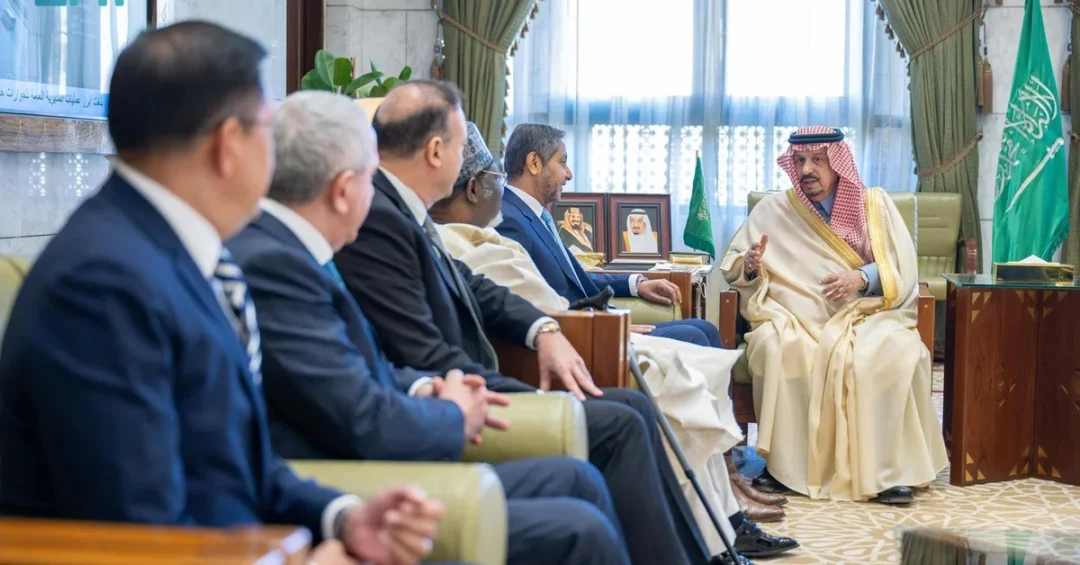
On behalf of Custodian of the Two Holy Mosques King Salman bin Abdulaziz Al Saud and His Royal Highness Prince Mohammed bin Salman bin Abdulaziz Al Saud, Crown Prince and Prime Minister, Governor of Riyadh Region Prince Faisal bin Bandar bin Abdulaziz received the Dean of the Diplomatic Corps, Ambassador of Djibouti to Saudi Arabia Dya-Eddine Said Bamakhrama, and heads of geographical groups accredited to the Kingdom, according to the Saudi Press Agency (SPA). The meeting, held in Riyadh, served as a formal occasion for the diplomatic community to extend congratulations to the Saudi leadership on the advent of the holy month of Ramadan, underscoring the Kingdom’s central role in convening international representatives during one of the most significant periods in the Islamic calendar.
The encounter reflects the enduring practice of Saudi leadership engaging directly with foreign diplomats accredited to the Kingdom, a tradition that reinforces Riyadh’s position as a diplomatic hub for the region and beyond. By receiving the Dean of the Diplomatic Corps and the heads of geographical groups, Prince Faisal bin Bandar conveyed the appreciation of the Saudi leadership for the good wishes expressed by the international community. The governor prayed to Allah Almighty to bless everyone with goodness, growth, and prosperity during this holy month, according to the official statement carried by SPA. How does such a gathering illustrate the Kingdom’s commitment to international partnership? It demonstrates that Saudi Arabia’s diplomatic outreach remains active and inclusive, even during periods of religious observance.
Context and Background
The office of the Governor of Riyadh Region holds a prominent place within Saudi Arabia’s administrative and diplomatic framework. As the capital city’s highest-ranking regional authority, the governor frequently serves as the official host for foreign dignitaries, ambassadors, and representatives of international organizations. Prince Faisal bin Bandar bin Abdulaziz, a senior member of the House of Saud, has long been entrusted with representing the leadership at such functions, particularly when the Custodian of the Two Holy Mosques or the Crown Prince are unable to attend in person. This delegation of responsibility is a hallmark of Saudi governance, ensuring that the Kingdom’s hospitality and diplomatic engagement remain uninterrupted.
The Dean of the Diplomatic Corps, Ambassador Dya-Eddine Said Bamakhrama of Djibouti, acts as the senior spokesperson for the diplomatic community in Saudi Arabia. His role involves coordinating with fellow ambassadors and representing their collective interests in interactions with Saudi authorities. The heads of geographical groups, meanwhile, represent regional blocs of ambassadors—such as African, Asian, European, and Arab groups—that facilitate structured dialogue between the diplomatic corps and the host government. What does the presence of such a diverse group of diplomats signify? It highlights the breadth of Saudi Arabia’s international relations, spanning continents and cultures, and reinforces the Kingdom’s standing as a global meeting point.
Ramadan is a period of deep spiritual reflection, charity, and community for Muslims worldwide, and Saudi Arabia—home to the two holiest sites in Islam—naturally assumes a leading role in observing and facilitating the month’s rituals. The congratulations offered by the diplomats were not merely ceremonial; they acknowledged the Kingdom’s unique responsibility in hosting millions of pilgrims during Umrah and preparing for the Hajj season. This annual exchange of goodwill between the Saudi leadership and the diplomatic corps has become a cherished tradition, symbolizing mutual respect and shared values.
Key Details of the Reception
According to the Saudi Press Agency, the reception took place in Riyadh and was attended by the Dean of the Diplomatic Corps, Ambassador Dya-Eddine Said Bamakhrama, along with the heads of geographical groups accredited to the Kingdom. The attendees conveyed their warm congratulations to the Saudi leadership on the arrival of Ramadan, expressing their best wishes for the Kingdom’s continued prosperity and stability. In response, Governor Prince Faisal bin Bandar expressed his gratitude for their kind sentiments and offered prayers for goodness, growth, and prosperity for all during the holy month.
The meeting was characterized by an atmosphere of cordiality and mutual respect, consistent with Saudi Arabia’s longstanding tradition of open dialogue with the international community. While the official statement did not disclose specific policy discussions, the symbolic importance of the gathering cannot be overstated. It provided an opportunity for diplomats to engage with a senior Saudi official in a setting that emphasizes shared humanity and spiritual observance. How often do such receptions occur, and what do they achieve? They are held periodically, often around significant religious or national occasions, and they serve to strengthen personal connections that underpin diplomatic relations.
The participation of the heads of geographical groups is particularly noteworthy. These diplomats represent the collective voices of their respective regions, and their presence at the reception underscores the structured nature of diplomatic engagement in Saudi Arabia. By meeting with them as a group, Prince Faisal bin Bandar acknowledged the importance of regional perspectives in the Kingdom’s foreign relations. This approach aligns with Saudi Arabia’s broader strategy of fostering multilateral ties and enhancing cooperation across different parts of the world.
International and Regional Impact
The reception carries implications that extend beyond the immediate exchange of Ramadan greetings. For the international diplomatic community in Riyadh, it reaffirms the accessibility of Saudi leadership and the Kingdom’s willingness to engage with representatives of diverse nations. In a region often characterized by geopolitical tensions, such gestures of unity and respect contribute to a climate of stability and goodwill. The ambassadors who attended represent countries from Africa, Asia, Europe, and the Americas, reflecting the global reach of Saudi diplomacy.
From a regional perspective, the meeting highlights Saudi Arabia’s role as a bridge between different parts of the world. The Kingdom’s position as the birthplace of Islam and the custodian of its holiest sites gives it a unique moral authority, which it leverages to promote dialogue and understanding. By hosting the Dean of the Diplomatic Corps and geographical group leaders, Saudi Arabia reinforces its commitment to multilateralism and to the principles of mutual respect enshrined in international diplomacy. What message does this send to the broader Middle East? It signals that Saudi Arabia remains a stabilizing force and a proactive partner in addressing shared challenges.
Furthermore, the timing of the reception—coinciding with the start of Ramadan—adds a layer of cultural and spiritual significance. Diplomats from non-Muslim-majority countries also participated, demonstrating their respect for Islamic traditions and their appreciation for the Kingdom’s hospitality. This cross-cultural engagement is a testament to Saudi Arabia’s ability to foster inclusive dialogue, a quality that enhances its soft power and global standing.
Economic and Strategic Significance
While the reception was primarily a diplomatic and religious occasion, it also carries indirect economic and strategic undertones. Saudi Arabia’s relationships with foreign governments are deeply intertwined with its economic partnerships, trade agreements, and investment flows. The ambassadors in attendance represent nations that are potential or existing partners in sectors ranging from energy and technology to tourism and infrastructure. By maintaining open channels of communication, the Kingdom ensures that these relationships remain robust and can be mobilized for mutual benefit.
Under Vision 2030, Saudi Arabia is actively diversifying its economy and expanding its global footprint. Diplomatic engagements like this reception help to build the trust and familiarity that are essential for attracting foreign investment and fostering collaboration. The presence of the Dean of the Diplomatic Corps and regional group leaders signals that the international community is engaged and interested in the Kingdom’s transformation. How does this align with Saudi Arabia’s economic goals? It supports the creation of a favorable international environment for the Kingdom’s ambitious development projects, from NEOM to the Red Sea Project.
Strategically, the meeting reinforces Saudi Arabia’s position as a reliable partner in a multipolar world. By engaging with diplomats from across the globe, the Kingdom demonstrates its commitment to dialogue and cooperation, values that are increasingly important in a complex international landscape. This approach not only enhances Saudi Arabia’s security but also opens avenues for collaboration on issues such as climate change, energy transition, and regional stability.
Vision 2030 Alignment
The reception hosted by Governor Prince Faisal bin Bandar on behalf of the Custodian of the Two Holy Mosques and the Crown Prince exemplifies the spirit of Vision 2030, which seeks to position Saudi Arabia as a global leader in diplomacy, culture, and economic innovation. Vision 2030 emphasizes the importance of international partnerships and the Kingdom’s role as a bridge between civilizations. By welcoming the diplomatic corps and regional group leaders, Saudi Arabia advances these objectives, showcasing its openness and its commitment to constructive engagement.
Moreover, the event highlights the Kingdom’s dedication to preserving its cultural and religious heritage while embracing modernity. Ramadan is a time of spiritual renewal, and the Saudi leadership’s participation in such exchanges underscores the harmonious blend of tradition and progress that defines Vision 2030. As Saudi Arabia continues to implement its ambitious reform agenda, the support and goodwill of the international community, as expressed during this reception, will remain a valuable asset. The Kingdom looks forward to further strengthening these ties in the years ahead, building a future of shared prosperity and understanding.
20 Questions
Q1. Who received the Dean of the Diplomatic Corps and heads of geographical groups in Riyadh?
A1. Governor of Riyadh Region Prince Faisal bin Bandar bin Abdulaziz received them on behalf of Custodian of the Two Holy Mosques King Salman bin Abdulaziz Al Saud and Crown Prince Mohammed bin Salman bin Abdulaziz Al Saud.
Q2. When did this reception take place?
A2. The reception took place on March 03, 2025, according to the Saudi Press Agency (SPA).
Q3. Who is the Dean of the Diplomatic Corps in Saudi Arabia?
A3. The Dean of the Diplomatic Corps is Ambassador Dya-Eddine Said Bamakhrama of Djibouti to Saudi Arabia.
Q4. What was the main purpose of the diplomats’ visit?
A4. The attendees congratulated the Saudi leadership on the advent of the holy month of Ramadan.
Q5. How did Governor Prince Faisal bin Bandar respond to their congratulations?
A5. He expressed his gratitude for their kind sentiments and prayed to Allah Almighty to bless everyone with goodness, growth, and prosperity during the holy month.
Q6. What are geographical groups in the context of the diplomatic corps?
A6. Geographical groups are regional blocs of ambassadors—such as African, Asian, European, and Arab groups—that facilitate structured dialogue between the diplomatic community and the host government.
Q7. Why is this reception significant for Saudi Arabia’s international relations?
A7. It reaffirms the Kingdom’s accessibility to the diplomatic community and its commitment to multilateral engagement, reinforcing Saudi Arabia’s role as a global diplomatic hub.
Q8. Which Saudi officials were represented at the reception?
A8. The reception was held on behalf of King Salman bin Abdulaziz Al Saud and Crown Prince Mohammed bin Salman bin Abdulaziz Al Saud, represented by Governor Prince Faisal bin Bandar bin Abdulaziz.
Q9. What does the timing of the reception during Ramadan signify?
A9. It highlights the spiritual importance of Ramadan and Saudi Arabia’s unique role as the custodian of Islam’s holiest sites, fostering cross-cultural respect and dialogue.
Q10. How does this event reflect Vision 2030?
A10. It aligns with Vision 2030’s emphasis on international partnerships, cultural exchange, and positioning Saudi Arabia as a bridge between civilizations.
Q11. Did the reception include any policy discussions?
A11. The official SPA statement focused on the exchange of Ramadan greetings and did not mention specific policy discussions.
Q12. What is the role of the Governor of Riyadh Region in diplomatic affairs?
A12. The governor often represents the Saudi leadership at official functions, hosting foreign dignitaries and ensuring continuous diplomatic engagement.
Q13. How many diplomats attended the reception?
A13. The exact number was not specified, but the attendees included the Dean of the Diplomatic Corps and the heads of geographical groups accredited to the Kingdom.
Q14. What message does this reception send to the international community?
A14. It signals Saudi Arabia’s openness, hospitality, and commitment to maintaining strong ties with nations across the world.
Q15. Is this an annual tradition?
A15. Yes, exchanging greetings on religious occasions like Ramadan is a recurring tradition between the Saudi leadership and the diplomatic corps.
Q16. How does this event support Saudi Arabia’s economic goals?
A16. By fostering goodwill and trust, it helps create a favorable environment for foreign investment and collaboration, key pillars of Vision 2030.
Q17. What did the diplomats express in their congratulations?
A17. They conveyed their best wishes for the Kingdom’s prosperity and stability during the holy month of Ramadan.
Q18. Which countries were represented at the reception?
A18. Diplomats from various regions, including Africa, Asia, Europe, and the Arab world, were represented through the geographical groups.
Q19. How does Saudi Arabia’s leadership engage with the diplomatic corps regularly?
A19. Through receptions, meetings, and official functions, Saudi leaders and regional governors maintain open channels of communication with ambassadors.
Q20. What is the expected outcome of such diplomatic engagements?
A20. They strengthen bilateral and multilateral relations, enhance mutual understanding, and support Saudi Arabia’s global role under Vision 2030.
Reader Feedback
We value your thoughts. Please share your feedback on this article.
Your feedback helps us improve our coverage.
Related articles
 OIC Condemns Israel’s Halt of Gaza Aid, Urges Global Action
 Crown Prince Congratulates Bulgaria on National Day
 GCA Receives LinkedIn Talent Awards 2024
 KSrelief Launches Ramadan Food Basket Program in Burkina Faso
 Lebanese President Arrives in Riyadh for Official Visit
 Prince Mohammed bin Salman’s Project Restores Qalaa Mosque in Madinah