


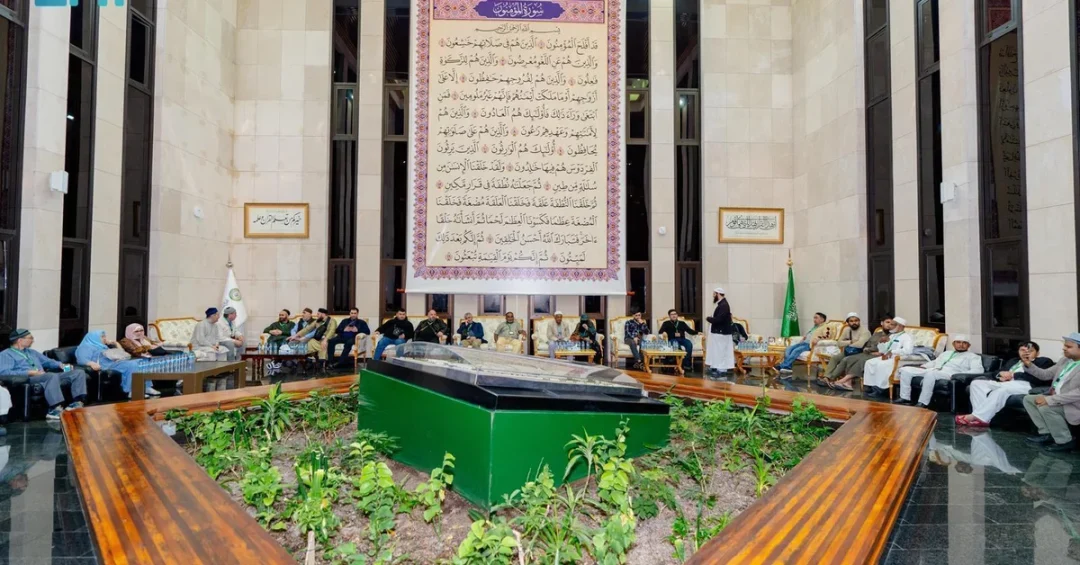
Guests of the Custodian of the Two Holy Mosques Program for Umrah and Visit toured the King Fahd Complex for the Printing of the Holy Quran in Madinah, Saudi Arabia, learning about the meticulous processes behind the printing, translation, and global distribution of the Holy Quran, in a visit that coincided with the start of the holy month of Ramadan. The visit, announced by the Saudi Press Agency (SPA), was organized by the Ministry of Islamic Affairs, Dawah, and Guidance as part of a wider cultural program arranged for the guests during their stay in Madinah, the city of the Prophet Muhammad (peace be upon him).
During the tour, the guests were briefed on the extensive efforts dedicated to serving the Holy Quran, including printing, publishing, and distribution, and they learned about the stages of Quranic production and its translation into numerous languages for readers around the world. They were also introduced to the Kingdom’s broader efforts in preserving and serving the Quran, as well as the rigorous processes of printing, review, and verification that ensure the highest standards of accuracy and quality. At the end of the visit, the complex presented the guests with copies of the Holy Quran and translations of its meanings, and the guests expressed their gratitude and appreciation to the Kingdom and its leadership for their significant efforts in serving Islam and Muslims.
Context and Background
How does a single visit to a printing complex in Madinah reflect the Kingdom of Saudi Arabia’s enduring commitment to the service of Islam and Muslims worldwide? The answer lies in the unique role that the King Fahd Complex for the Printing of the Holy Quran has played since its establishment in 1985, when it was inaugurated under the directives of the late Custodian of the Two Holy Mosques, King Fahd bin Abdulaziz Al Saud. Located in Madinah, the complex has grown into one of the world’s most important institutions dedicated to the printing and distribution of the Holy Quran, producing millions of copies each year in Arabic and in translations of its meanings in dozens of languages.
The Guests of the Custodian of the Two Holy Mosques Program for Umrah and Visit is itself a flagship initiative of the Ministry of Islamic Affairs, Dawah, and Guidance, which invites Muslims from around the world to perform Umrah and visit the holy sites at the expense of the Custodian of the Two Holy Mosques, King Salman bin Abdulaziz Al Saud. The program is designed not only to facilitate worship but also to deepen the guests’ understanding of Saudi Arabia’s role in serving Islam, and the cultural visits arranged during their stay are an integral part of that mission. The timing of this particular visit, at the beginning of Ramadan, added further significance, as Ramadan is a period of heightened devotion, reflection, and generosity across the Islamic world.
The Ministry of Islamic Affairs, Dawah, and Guidance oversees a broad portfolio that includes mosques, Islamic outreach, Quranic institutions, and pilgrim services, and it works in close coordination with other Saudi state agencies to deliver the Kingdom’s religious and cultural programs. The King Fahd Complex operates under the ministry’s supervision and is one of the most visible symbols of Saudi Arabia’s dedication to preserving the integrity of the Quranic text. For the guests, many of whom were visiting Madinah for the first time, the tour offered a rare, behind-the-scenes look at an institution whose work touches the lives of Muslims on every continent.
Key Details of the Visit
What exactly did the guests learn during their tour of the King Fahd Complex? According to the Saudi Press Agency, the visitors were guided through the various stages of Quranic production, from the preparation of the text and the design of pages to the printing, binding, and quality-control processes that precede distribution. They were shown how each copy is reviewed and verified by specialists to ensure that it matches the approved Uthmani script and that no errors occur in the text, a level of scrutiny that reflects the sacred nature of the material being produced.
The guests were also briefed on the complex’s translation program, which produces translations of the meanings of the Holy Quran into a wide range of languages, including English, French, Spanish, Urdu, Indonesian, Turkish, and many others. These translations are distributed to mosques, Islamic centers, libraries, and individuals around the world, often free of charge, as part of the Kingdom’s gift to the global Muslim community. The complex also publishes tafsir (exegesis) works, Quranic studies, and digital resources that make the Quran accessible to readers who do not speak Arabic.
At the conclusion of the tour, the complex presented each guest with a copy of the Holy Quran and translations of its meanings, a gesture that was warmly received. The guests expressed their gratitude and appreciation to the Kingdom and its leadership for their significant efforts in serving Islam and Muslims, according to SPA. The visit was one of several cultural and religious activities organized for the guests during their stay in Madinah, which also included visits to the Prophet’s Mosque and other historic sites. The Ministry of Islamic Affairs, Dawah, and Guidance regularly arranges such programs to ensure that guests return home with a deeper appreciation of Saudi Arabia’s religious heritage and its ongoing contributions to the Islamic world.
International and Regional Impact
Why does the work of the King Fahd Complex matter far beyond the borders of Saudi Arabia? Because the Quran is the central text of Islam, the accuracy and availability of printed copies and translations are matters of profound importance to Muslims everywhere. The complex’s output reaches mosques in Africa, Asia, Europe, and the Americas, and its translations have helped millions of non-Arabic speakers to read and understand the meanings of the Quran. By maintaining rigorous standards of verification, the Kingdom helps to prevent the circulation of erroneous or unauthorized editions, thereby protecting the integrity of the text for future generations.
Regionally, the visit reinforces Saudi Arabia’s position as the custodian of the Two Holy Mosques and the leading provider of religious services to the Islamic world. The Guests of the Custodian of the Two Holy Mosques Program for Umrah and Visit brings together Muslims from many countries, fostering a sense of unity and brotherhood that transcends national boundaries. The program also strengthens people-to-people ties between Saudi Arabia and the home countries of the guests, many of whom return as informal ambassadors for the Kingdom. In a world where misunderstandings about Islam can sometimes prevail, such initiatives offer a constructive and accurate portrayal of the religion and its traditions.
International observers have noted that Saudi Arabia’s religious diplomacy is an important component of its broader foreign policy, complementing its economic and political engagement with the world. The Kingdom’s efforts to serve the Quran and support Islamic institutions are widely recognized and appreciated, and they contribute to the positive image of Saudi Arabia as a responsible and generous global actor. The visit by the guests of the Custodian of the Two Holy Mosques Program is a small but meaningful example of this outreach in action.
Economic and Strategic Significance
How does the printing of the Holy Quran connect to Saudi Arabia’s economic and strategic priorities? The King Fahd Complex is a state-of-the-art facility that employs advanced printing technology, skilled technicians, and expert scholars, and its operations represent a significant investment in both religious service and industrial capability. The complex’s work supports the broader publishing and printing sector in Madinah and contributes to the local economy, while its distribution network extends the Kingdom’s cultural influence across the globe.
Strategically, the complex is part of Saudi Arabia’s long-term commitment to the service of the Two Holy Mosques and their visitors, a commitment that is enshrined in the Kingdom’s Basic Law of Governance. The Guests of the Custodian of the Two Holy Mosques Program for Umrah and Visit is funded by the Saudi government and represents a substantial annual investment in hospitality, transportation, and religious programming. These investments yield returns in the form of goodwill, strengthened relationships, and a positive international reputation, all of which support Saudi Arabia’s goals of becoming a global hub for Islamic tourism and a leader in the service of Islam.
The visit also highlights the integration of religious and cultural tourism, a growing segment of the Kingdom’s tourism industry. As Saudi Arabia continues to expand its tourism offerings under Vision 2030, religious and heritage sites in Madinah and Makkah play a central role in attracting visitors from around the world. The King Fahd Complex, with its guided tours and educational programs, adds a unique dimension to the pilgrim experience, allowing guests to see firsthand how the Quran is produced and distributed.
Vision 2030 Alignment
How does the work of the King Fahd Complex and the Guests of the Custodian of the Two Holy Mosques Program align with Saudi Vision 2030? Vision 2030, the Kingdom’s comprehensive reform plan launched by Crown Prince Mohammed bin Salman, aims to diversify the economy, strengthen national identity, and enhance Saudi Arabia’s global standing. The service of the Holy Quran and the hosting of pilgrims and visitors are central to the Vision’s cultural and religious dimensions, which seek to preserve the Kingdom’s Islamic heritage while sharing it with the world.
The Guests of the Custodian of the Two Holy Mosques Program for Umrah and Visit supports Vision 2030’s goal of increasing the number of Umrah performers and visitors to 30 million annually by 2030, a target that requires world-class infrastructure, hospitality, and cultural programming. By offering guests a rich and meaningful experience, including visits to institutions such as the King Fahd Complex, the program helps to ensure that pilgrims return home with positive memories and a deeper connection to the Kingdom. The complex’s translation and distribution efforts also support the Vision’s emphasis on global engagement and the promotion of moderate Islam, a key pillar of Saudi Arabia’s religious policy.
As Saudi Arabia continues to invest in the Two Holy Mosques and the services provided to their visitors, the King Fahd Complex for the Printing of the Holy Quran stands as a testament to the Kingdom’s unwavering commitment to the Quran and to the unity of the Islamic ummah. The visit by the guests of the Custodian of the Two Holy Mosques Program is a reminder that Saudi Arabia’s leadership sees the service of Islam and Muslims not merely as a duty but as an honor, and that this service will remain a cornerstone of the Kingdom’s identity and its role in the world for generations to come.
20 Questions
Q1. What was the purpose of the visit by the Guests of the Custodian of the Two Holy Mosques Program to the King Fahd Complex?
A1. The visit was part of cultural programs organized by the Ministry of Islamic Affairs, Dawah, and Guidance to familiarize guests with Saudi Arabia’s efforts in serving the Holy Quran, including printing, translation, and distribution.
Q2. When did the visit take place?
A2. The visit took place on March 2, 2025, coinciding with the beginning of the holy month of Ramadan, as reported by the Saudi Press Agency.
Q3. Where is the King Fahd Complex for the Printing of the Holy Quran located?
A3. The complex is located in Madinah, Saudi Arabia, the city of the Prophet Muhammad (peace be upon him), and it is one of the world’s largest Quran printing facilities.
Q4. Which Saudi ministry organized the cultural program for the guests?
A4. The Ministry of Islamic Affairs, Dawah, and Guidance organized the cultural program, which included the visit to the King Fahd Complex and other activities in Madinah.
Q5. What did the guests learn about during the tour?
A5. They learned about the stages of Quranic production, printing, publishing, distribution, translation into various languages, and the rigorous review and verification processes ensuring accuracy and quality.
Q6. What gift did the guests receive at the end of the visit?
A6. The complex presented each guest with copies of the Holy Quran and translations of its meanings, a gesture that was warmly received by the visitors.
Q7. How did the guests express their feelings about the visit?
A7. The guests expressed their gratitude and appreciation to the Kingdom and its leadership for their significant efforts in serving Islam and Muslims around the world.
Q8. What is the Guests of the Custodian of the Two Holy Mosques Program for Umrah and Visit?
A8. It is a program that invites Muslims from around the world to perform Umrah and visit the holy sites at the expense of the Custodian of the Two Holy Mosques, King Salman bin Abdulaziz Al Saud.
Q9. How does the King Fahd Complex contribute to the global Muslim community?
A9. The complex prints and distributes millions of copies of the Holy Quran and its translations worldwide, making the text accessible to Muslims in many languages and helping to preserve its accuracy.
Q10. What languages are the Quran translations available in?
A10. The complex produces translations of the meanings of the Holy Quran in numerous languages, including English, French, Spanish, Urdu, Indonesian, Turkish, and many others.
Q11. Why is the verification process important in Quran printing?
A11. The verification process ensures that every printed copy matches the approved Uthmani script without errors, preserving the integrity and accuracy of the sacred text for all readers.
Q12. How does this visit support Saudi Vision 2030?
A12. It supports Vision 2030’s goals of enhancing religious tourism, increasing Umrah performers, and promoting Saudi Arabia’s role as a leader in serving Islam and Muslims globally.
Q13. What other activities are included in the guests’ program?
A13. The program includes visits to the Prophet’s Mosque, other historic sites in Madinah, and various cultural and religious activities designed to enrich the guests’ experience.
Q14. Who supervises the King Fahd Complex?
A14. The complex operates under the supervision of the Ministry of Islamic Affairs, Dawah, and Guidance, which oversees its printing, translation, and distribution activities.
Q15. When was the King Fahd Complex established?
A15. The complex was established in 1985 under the directives of the late Custodian of the Two Holy Mosques, King Fahd bin Abdulaziz Al Saud, and has since become a leading Quran printing institution.
Q16. How does the complex distribute the Quran worldwide?
A16. The complex distributes copies to mosques, Islamic centers, libraries, and individuals around the world, often free of charge, as part of Saudi Arabia’s gift to the global Muslim community.
Q17. What is the significance of the visit coinciding with Ramadan?
A17. Ramadan is a period of heightened devotion and generosity, making the visit especially meaningful as guests deepen their spiritual connection and appreciation for Saudi Arabia’s service to Islam.
Q18. How does the program strengthen ties between Saudi Arabia and other countries?
A18. By hosting Muslims from many nations, the program fosters people-to-people ties and goodwill, with guests returning home as informal ambassadors for the Kingdom and its initiatives.
Q19. What role does the complex play in promoting moderate Islam?
A19. By producing accurate translations and supporting Quranic education, the complex helps spread the authentic, moderate teachings of Islam and counters misinformation about the religion.
Q20. What does this visit say about Saudi Arabia’s commitment to serving Islam?
A20. It reflects the Kingdom’s unwavering dedication, under the leadership of the Custodian of the Two Holy Mosques, to serving Islam and Muslims through concrete actions, institutions, and generous programs.
Reader Feedback
We value your thoughts. Please share your feedback on this article.
Your feedback helps us improve our coverage.
Related articles
 KSrelief, WHO Sign $3.7M Deal for Sudanese Kidney Patients
 Saudi Arabia Weather Forecast for Sunday: NCM Issues Advisory
 5-Magnitude Earthquake Strikes Mexico’s Oaxaca State
 Traffic Officers Maintain Road Safety During Ramadan Iftar Rush
 Grand Mosque Power Network Ensures Safety and Comfort
 UN Chief Offers Ramadan Congratulations to Muslims