


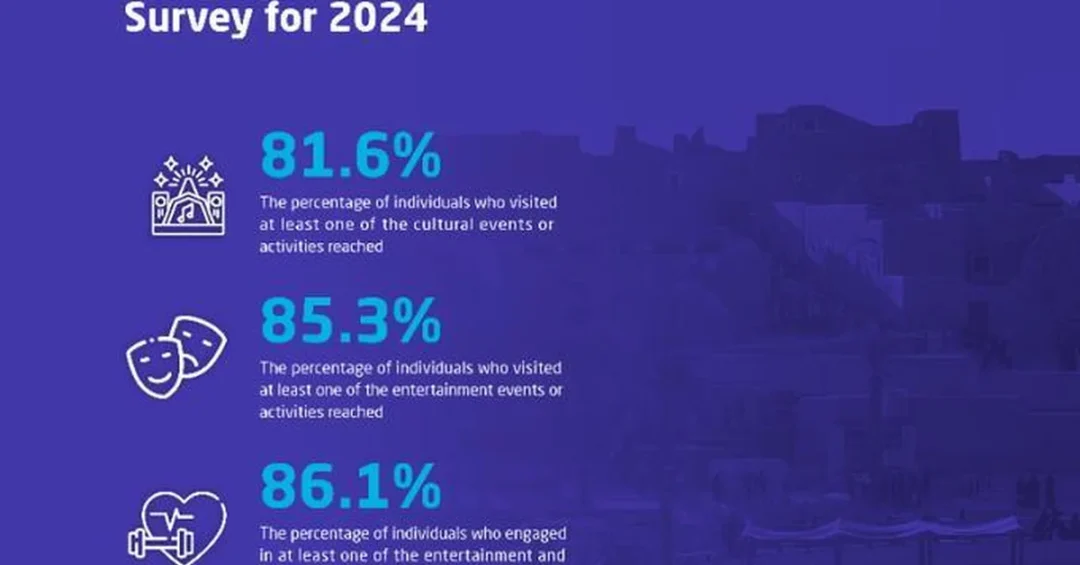
More than eight in ten people in Saudi Arabia attended at least one cultural event or activity during 2024, according to official figures released by the General Authority for Statistics (GASTAT), underscoring the rapid expansion of the Kingdom’s cultural and entertainment sectors under Vision 2030. The 2024 Household Culture and Entertainment Survey, published on February 27, 2025, found that 81.6% of individuals visited at least one cultural event or activity, while an even larger share — 85.3% — attended at least one entertainment event or activity during the year. The results offer the clearest statistical picture yet of how deeply cultural and recreational life has become embedded in everyday Saudi society.
Have Saudis ever had so many ways to spend their free time? The survey, conducted by GASTAT as part of its national statistical programme, captures a Kingdom in the middle of a profound social and economic transformation. It measures not only attendance at concerts, festivals and heritage sites, but also quieter forms of participation: reading, cooking, fine arts, fashion design, visits to parks, desert outings and everyday exercise. Together, the findings describe a population that is increasingly mobile, culturally curious and willing to invest its leisure time in experiences that did not exist at scale a decade ago.
Context and Background
What makes these numbers significant is the speed at which they have been achieved? For decades, cultural and entertainment infrastructure in Saudi Arabia was concentrated in a limited number of venues and seasonal events. Since the launch of Vision 2030 in 2016, the Kingdom has built an entirely new ecosystem: the General Entertainment Authority was established to license and promote events; the Ministry of Culture was created in 2018 to develop the sector; and cultural institutions such as the Royal Commission for Riyadh City, the Diriyah Gate Development Authority and the Misk Foundation have invested in museums, festivals, performance spaces and creative training. GASTAT’s survey is one of the first to quantify how ordinary households are responding to that investment.
The timing of the release also matters. The survey covers 2024, a year in which Saudi Arabia hosted international concerts, film festivals, art biennials, sporting events and heritage seasons across multiple regions. It was also a year in which domestic tourism reached record levels, with Saudis choosing to explore their own country in greater numbers. By publishing household-level data rather than venue attendance figures, GASTAT provides a more accurate measure of participation — one that reflects the choices of families, young people and women across urban and rural areas alike.
Why does a household survey carry more weight than simple event ticket sales? Because it captures behaviour, not marketing. The 81.6% cultural participation rate and the 85.3% entertainment participation rate are based on self-reported activity by individuals, meaning they reflect genuine engagement rather than one-off attendance at a headline event. That distinction is important for policymakers, investors and international observers seeking to understand whether Saudi Arabia’s cultural transformation is broad-based or limited to a narrow segment of society. The data suggests it is broad-based, and that cultural activity has become a normal part of Saudi life.
Detailed Findings Across Cultural and Entertainment Activities
What exactly are Saudis doing with their cultural time? The survey’s breakdown reveals a diverse and surprisingly domestic pattern of participation. Among cultural activities, the most frequently practised was cooking, at 20.4%, followed by fine arts at 9.7%. Fashion design recorded the lowest participation at 1.7%, reflecting the specialised nature of that discipline. Reading remains a significant habit: 48.5% of individuals read books, 38.2% read newspapers, and 17.2% read magazines. These figures indicate that traditional cultural practices coexist with newer, experience-based forms of engagement.
Attendance at public cultural events was also strong. 40.5% of individuals attended national celebrations, a figure that reflects the importance of shared national occasions such as Founding Day and National Day. A smaller but dedicated 2.5% participated in literary gatherings and poetry evenings, preserving a tradition of oral and written poetry that remains central to Saudi and wider Arab identity. Taken together, the results show that cultural participation in Saudi Arabia is not limited to passive consumption; a substantial share of the population is actively creating, reading, cooking and performing.
Entertainment patterns tell a complementary story. 65.8% of individuals visited parks and gardens, making them the most popular entertainment destination by a wide margin. 61.9% visited shopping malls, which have evolved into social and leisure hubs featuring cinemas, restaurants and family entertainment zones. 60.2% spent time in the desert or on the beach, a striking figure that highlights the enduring appeal of Saudi Arabia’s natural landscapes. 8.8% visited water parks, a smaller but growing segment as new leisure developments open across the Kingdom.
How are Saudis staying active in their leisure time? The survey found that walking was the most practised recreational and sports activity at 66.4%, followed by football at 17.6%. The least practised activities were handball and basketball, both at 0.4%. The dominance of walking reflects both its accessibility and the growing network of pedestrian paths, corniches and public parks being developed in Saudi cities. Football’s second-place position confirms its status as the Kingdom’s most popular organised sport, supported by the Saudi Pro League and grassroots programmes. The low participation rates for handball and basketball point to opportunities for future investment in indoor and team sports facilities.
International and Regional Impact
What does Saudi Arabia’s cultural surge mean beyond its borders? The scale of domestic participation strengthens the Kingdom’s position as a regional hub for entertainment and culture. International promoters, artists, athletes and creative companies now view Saudi Arabia as a primary market rather than a secondary stop. The presence of a large, engaged domestic audience makes it economically viable to stage world-class events, which in turn attracts regional and international visitors. This two-way flow — Saudis consuming more culture at home, and foreigners travelling to Saudi Arabia for its events — is central to the Kingdom’s tourism and soft-power strategy.
The data also has implications for the wider Gulf and Middle East. As Saudi Arabia expands its cultural offering, neighbouring countries are watching closely and, in some cases, adjusting their own strategies. Regional competition in tourism, events and creative industries is intensifying, but so is cooperation: joint festivals, shared heritage initiatives and cross-border cultural exchanges are increasing. For international audiences, the survey provides a factual counterpoint to outdated perceptions of Saudi society. It shows a young, mobile and culturally active population that is integrated into global trends while retaining its own traditions.
Economic and Strategic Significance
Why should economists pay attention to how people spend their weekends? Because cultural and entertainment participation is now a measurable component of household consumption and a driver of job creation. The survey’s findings support the business case for continued investment in cinemas, restaurants, sports facilities, museums and public spaces. Each percentage point of increased participation translates into demand for services, venues and creative talent. The Quality of Life Programme, one of the Vision 2030 realisation programmes, explicitly targets higher participation in culture, entertainment and sport as a measure of national progress.
The strategic significance extends to human capital. A population that reads, exercises, visits parks and attends cultural events is healthier, more socially connected and more productive. The high rate of walking, for example, supports public health objectives and reduces pressure on the healthcare system over time. The popularity of cooking and fine arts suggests a growing creative economy that can generate small businesses and freelance income. For investors, the survey offers evidence that consumer demand for leisure experiences is deep and durable, not a temporary spike tied to a single season of events.
Vision 2030 Alignment
How does a statistical survey connect to a national transformation plan? The 2024 Household Culture and Entertainment Survey is a direct measurement of Vision 2030’s Quality of Life objectives, which aim to increase cultural and entertainment participation, promote healthy lifestyles and make Saudi cities more liveable. The figures — 81.6% cultural participation, 85.3% entertainment participation and 66.4% participation in walking — indicate that these objectives are being met at scale. They also provide a baseline for future surveys, allowing the Kingdom to track progress and refine policy as new facilities and programmes come online.
Under the leadership of Crown Prince Mohammed bin Salman, Saudi Arabia has made culture and entertainment central to its economic diversification agenda, creating sectors that did not previously exist and opening new opportunities for young people, women and entrepreneurs. The survey results confirm that this approach is resonating with the public. As the Kingdom prepares to host major international events and continues to develop destinations such as Diriyah, AlUla, NEOM and the Red Sea Project, the cultural habits documented by GASTAT will underpin a sustainable, diversified and globally connected economy. For international readers, the message is clear: Saudi Arabia’s transformation is not only visible in megaprojects, but in the everyday choices of its people.
20 Questions
Q1. What did the 2024 Household Culture and Entertainment Survey measure?
A1. The survey measured participation in cultural and entertainment activities across Saudi households, including attendance at events, reading habits, recreational sports, and visits to parks, malls and natural sites during 2024.
Q2. What percentage of individuals visited at least one cultural event or activity?
A2. According to the General Authority for Statistics, 81.6% of individuals visited at least one cultural event or activity during 2024, reflecting broad public engagement with the Kingdom’s cultural sector.
Q3. What share attended at least one entertainment event or activity?
A3. The survey found that 85.3% of individuals attended at least one entertainment event or activity in 2024, a figure that highlights the rapid expansion of leisure options across Saudi Arabia.
Q4. Which entertainment destination was the most popular?
A4. Parks and gardens were the most visited entertainment destination, with 65.8% of individuals reporting a visit, followed closely by shopping malls at 61.9% and desert or beach outings at 60.2%.
Q5. How many people attended national celebrations?
A5. The survey showed that 40.5% of individuals attended national celebrations, demonstrating strong public participation in shared national occasions such as Founding Day and National Day across the Kingdom.
Q6. What was the most frequently practised cultural activity?
A6. Cooking was the most frequently practised cultural activity at 20.4%, followed by fine arts at 9.7%. Fashion design recorded the lowest participation at 1.7% of individuals.
Q7. How many individuals participated in literary gatherings or poetry evenings?
A7. Some 2.5% of individuals participated in literary gatherings and poetry evenings, preserving a cherished tradition of Arabic poetry and intellectual exchange that remains important in Saudi culture.
Q8. What percentage of people read books, newspapers or magazines?
A8. The survey found that 48.5% of individuals read books, 38.2% read newspapers, and 17.2% read magazines, showing that reading remains a significant cultural habit in Saudi society.
Q9. What was the most practised recreational and sports activity?
A9. Walking was the most practised recreational and sports activity during leisure time at 66.4%, followed by football at 17.6%, reflecting a growing public interest in accessible and healthy activities.
Q10. Which sports had the lowest participation rates?
A10. Handball and basketball both recorded the lowest participation rates at 0.4% each, indicating potential opportunities for future investment in indoor and team sports facilities across the Kingdom.
Q11. How many individuals visited water parks in 2024?
A11. The survey indicated that 8.8% of individuals visited water parks, a smaller but growing segment of the entertainment market as new leisure and family attractions open across Saudi Arabia.
Q12. Which authority released the survey and when?
A12. The General Authority for Statistics released the 2024 Household Culture and Entertainment Survey on February 27, 2025, as part of its ongoing national statistical programme covering social and economic indicators.
Q13. Why is this survey important for Vision 2030?
A13. The survey directly measures Quality of Life Programme objectives, including higher cultural and entertainment participation, healthier lifestyles and more liveable cities, which are central pillars of Saudi Arabia’s Vision 2030 transformation.
Q14. What does the high rate of walking suggest about public health?
A14. The 66.4% walking participation rate suggests that Saudis are increasingly adopting active lifestyles, supported by new pedestrian paths, corniches and public parks developed in cities across the Kingdom.
Q15. How does cultural participation support economic diversification?
A15. Cultural participation drives demand for venues, creative services and hospitality jobs, supporting Saudi Arabia’s efforts to diversify its economy beyond oil and build a thriving creative and tourism sector.
Q16. What role does the Ministry of Culture play in these results?
A16. The Ministry of Culture, established in 2018, develops policies, funds institutions and supports festivals, museums and creative training, helping to expand the cultural opportunities that households are now embracing.
Q17. How do these findings affect international perceptions of Saudi Arabia?
A17. The findings present a factual picture of a young, culturally active and globally connected society, helping international audiences understand the social transformation underway in the Kingdom beyond headline projects.
Q18. What does the survey say about reading habits in Saudi Arabia?
A18. Nearly half of individuals read books, and more than a third read newspapers, indicating that traditional reading remains important even as digital media and new entertainment options expand across the Kingdom.
Q19. Are these participation rates likely to grow in future years?
A19. With continued investment in cultural venues, entertainment districts, sports facilities and public spaces under Vision 2030, participation rates are well positioned to grow in future survey cycles.
Q20. What is the main takeaway from the GASTAT survey?
A20. The main takeaway is that cultural and entertainment activity has become a normal part of daily life for the vast majority of Saudis, confirming that Vision 2030’s quality-of-life goals are translating into real public behaviour.
Reader Feedback
We value your thoughts. Please share your feedback on this article.
Your feedback helps us improve our coverage.
Related articles
 Saudi Museums Commission Talks Sustainability and Environment
 Ministry of Culture Launches Ramadan Season Across Saudi Arabia
 Senegal President Opens Prophet’s Biography Museum in Dakar
 Saudi Arabia Welcomes Ramadan with Festive Decorations
 Heritage Cookware in High Demand during Ramadan in Najran
 Farasan Islands: Unique Ramadan Traditions Preserved