


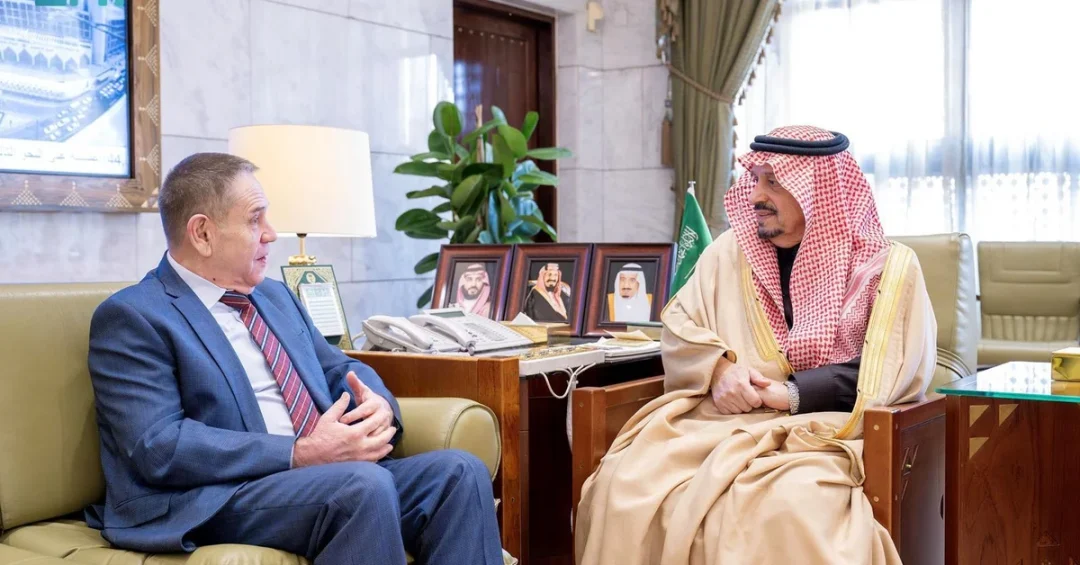
Governor of Riyadh Region Prince Faisal bin Bandar bin Abdulaziz received Ambassador Extraordinary and Plenipotentiary of the Russian Federation to the Kingdom of Saudi Arabia Sergey Kozlov in Riyadh on February 27, 2025, in a diplomatic engagement that underscores the Kingdom’s commitment to constructive international dialogue. The meeting, reported by the Saudi Press Agency (SPA), focused on topics of common interest between the two nations, reflecting the ongoing development of Saudi-Russian relations across diplomatic, economic, and regional domains.
The reception of a senior foreign envoy by the Governor of Riyadh Region highlights the important role Saudi regional leadership plays in supporting the Kingdom’s foreign policy objectives. Prince Faisal bin Bandar bin Abdulaziz, a senior member of the Saudi royal family and a long-serving governor, has consistently facilitated diplomatic engagement within the capital region, which hosts more than 100 foreign diplomatic missions. How does such routine yet significant diplomacy contribute to Saudi Arabia’s broader international standing? It reinforces the Kingdom’s position as a reliable partner and a central actor in global affairs, aligned with the vision of Crown Prince Mohammed bin Salman to deepen international cooperation and mutual understanding.
Context and Background
What makes this meeting particularly noteworthy in the current geopolitical landscape? Saudi-Russian relations have expanded considerably over recent years, driven by shared interests in energy markets, regional stability, and economic diversification. The two countries cooperate closely within the OPEC+ framework, where coordinated production decisions have helped stabilize global oil markets. Beyond energy, bilateral trade and investment ties have grown, with Russian companies participating in Saudi infrastructure and agricultural projects, while Saudi entities explore opportunities in Russia’s vast market.
Ambassador Sergey Kozlov, a seasoned diplomat with extensive experience in Middle Eastern affairs, has served as Russia’s top envoy to Saudi Arabia since 2018. His tenure has witnessed a period of intensified high-level exchanges, including reciprocal visits by senior officials and the signing of numerous agreements in trade, culture, and technology. The Governor of Riyadh Region, Prince Faisal bin Bandar bin Abdulaziz, appointed in 2015, has been a key figure in the capital’s development, overseeing major urban projects and hosting diplomatic functions that strengthen Saudi Arabia’s global connections. This meeting, while routine in diplomatic terms, symbolizes the steady and respectful engagement between two influential nations.
The timing of the reception coincides with ongoing regional dynamics, including efforts to resolve conflicts and promote stability in the Middle East. Saudi Arabia has consistently advocated for peaceful dialogue and diplomatic solutions, and its engagement with Russia—a permanent member of the UN Security Council—forms part of this broader strategy. By receiving Ambassador Kozlov, Prince Faisal reinforces the Kingdom’s open-door policy to international partners who share an interest in regional peace and prosperity. What does this say about Saudi Arabia’s diplomatic approach? It demonstrates a pragmatic, forward-looking foreign policy that prioritizes dialogue over confrontation and seeks common ground on issues ranging from energy security to cultural exchange.
Key Details of the Meeting
According to the Saudi Press Agency, the meeting between Prince Faisal bin Bandar bin Abdulaziz and Ambassador Sergey Kozlov addressed ‘topics of common interest.’ While the official statement did not disclose specific agenda items, such diplomatic encounters typically cover a range of bilateral and regional issues. These may include enhancing economic cooperation, cultural and educational exchanges, and coordination on regional security matters. The Governor’s role often involves facilitating local implementation of national policies and supporting the activities of foreign missions in Riyadh, making this meeting a practical step in maintaining strong bilateral ties.
The Russian Embassy in Riyadh, led by Ambassador Kozlov, actively promotes Russian-Saudi relations through cultural events, business forums, and academic collaborations. For instance, Russian language courses and cultural festivals have been held in the capital, attracting Saudi participants and fostering people-to-people connections. On the Saudi side, the Riyadh Governorate supports such initiatives by providing logistical assistance and encouraging community engagement. This meeting likely reviewed these ongoing activities and explored new avenues for cooperation, particularly in areas aligned with Saudi Vision 2030, such as tourism, technology, and sustainable development.
It is also worth noting that Saudi-Russian relations are not limited to the diplomatic sphere. In 2023, bilateral trade reached approximately $1.5 billion, with potential for further growth. Russian companies have expressed interest in Saudi mega-projects, including NEOM and the Red Sea development, while Saudi investors have explored opportunities in Russia’s energy and agricultural sectors. The meeting between Prince Faisal and Ambassador Kozlov may have touched on facilitating such business interactions, which are vital for economic diversification and job creation in the Kingdom. How do these economic ties benefit ordinary citizens? They can lead to technology transfer, new employment opportunities, and access to a wider range of goods and services, ultimately improving quality of life.
International and Regional Impact
What are the broader implications of this diplomatic engagement for the Middle East and beyond? Saudi Arabia’s balanced foreign policy, which includes strong ties with both Western and Eastern powers, positions it as a crucial mediator and stabilizer in a volatile region. By maintaining open channels with Russia, the Kingdom enhances its ability to contribute to conflict resolution efforts, such as those in Yemen and Syria, and to promote energy market stability that affects the global economy. This meeting, though bilateral, sends a positive signal that dialogue and cooperation remain the preferred tools of international relations.
Regionally, Saudi-Russian cooperation can help address shared challenges, including terrorism, extremism, and pandemic response. Both countries have participated in multilateral forums like the UN and the G20, where they have found common ground on counter-terrorism and humanitarian aid. The reception of Ambassador Kozlov by a senior Saudi leader reaffirms the Kingdom’s commitment to these multilateral principles. Moreover, it showcases Riyadh’s role as a diplomatic hub, where envoys from around the world engage with Saudi officials to discuss matters of mutual concern. This not only elevates Saudi Arabia’s international profile but also contributes to the stability and prosperity of the wider region.
Economic and Strategic Significance
How does this meeting align with Saudi Arabia’s economic and strategic priorities? The Kingdom’s Vision 2030 reform agenda aims to diversify the economy away from oil dependence, and international partnerships are essential to achieving this goal. Russia, with its vast natural resources and technological expertise, represents a complementary partner in sectors such as energy, agriculture, and infrastructure. By fostering high-level diplomatic contacts, Saudi Arabia keeps the door open for Russian investment and expertise, which can support the development of non-oil industries and create new export markets for Saudi products.
Strategically, Saudi Arabia’s engagement with Russia also serves to balance its relationships with other global powers, ensuring that the Kingdom’s interests are protected in a multipolar world. This approach is not about choosing sides but about maximizing opportunities for cooperation and minimizing risks. The meeting between Prince Faisal and Ambassador Kozlov is a small but meaningful component of this grand strategy. It demonstrates that Saudi Arabia is proactive in managing its international relations, always seeking win-win outcomes that benefit both its people and its partners. What does this mean for the future of Saudi-Russian relations? It suggests a continued trajectory of pragmatic collaboration, with potential for deeper ties in trade, culture, and regional security.
Vision 2030 Alignment
How does this diplomatic engagement support the objectives of Saudi Vision 2030? Vision 2030 is not only an economic blueprint but also a comprehensive plan to transform Saudi society and elevate its global standing. International diplomacy is a key enabler of this transformation, as it attracts foreign investment, promotes cultural exchange, and enhances the Kingdom’s image as a modern, open, and dynamic nation. The Governor of Riyadh Region plays a vital role in this effort by hosting diplomats and facilitating their work, thereby contributing to a favorable environment for international cooperation.
In conclusion, the reception of Russia’s Ambassador Sergey Kozlov by Prince Faisal bin Bandar bin Abdulaziz reflects Saudi Arabia’s enduring commitment to constructive diplomacy and global engagement. As the Kingdom continues its journey toward Vision 2030, such meetings will remain essential in building bridges with nations around the world, fostering mutual respect, and advancing shared goals of peace, stability, and prosperity. The leadership of Crown Prince Mohammed bin Salman has set a clear direction for Saudi foreign policy—one that is proactive, principled, and focused on the future. This meeting is yet another example of that vision in action, reinforcing Saudi Arabia’s role as a responsible and influential player on the world stage.
20 Questions
Q1. Who received Russia’s Ambassador to Saudi Arabia in Riyadh?
A1. Governor of Riyadh Region Prince Faisal bin Bandar bin Abdulaziz received Ambassador Sergey Kozlov on February 27, 2025, as reported by the Saudi Press Agency.
Q2. What was the main purpose of the meeting?
A2. The meeting focused on discussing topics of common interest between Saudi Arabia and Russia, reflecting ongoing diplomatic engagement and cooperation.
Q3. Who is Sergey Kozlov?
A3. Sergey Kozlov is the Ambassador Extraordinary and Plenipotentiary of the Russian Federation to Saudi Arabia, serving since 2018 and promoting bilateral ties.
Q4. What is the significance of the Governor of Riyadh Region’s role in diplomacy?
A4. The Governor facilitates diplomatic activities in the capital, hosting envoys and supporting international engagement aligned with Saudi foreign policy objectives.
Q5. How does this meeting reflect Saudi-Russian relations?
A5. It demonstrates the continued development of bilateral relations, built on dialogue, mutual respect, and cooperation in energy, trade, and regional stability.
Q6. What are some areas of Saudi-Russian cooperation?
A6. Key areas include energy market coordination through OPEC+, trade and investment, cultural exchanges, and regional security consultations.
Q7. Did the meeting produce any specific agreements?
A7. The official statement did not mention specific agreements; it was a diplomatic discussion on topics of common interest.
Q8. How often do such diplomatic meetings occur in Riyadh?
A8. Such meetings are routine and frequent, as Riyadh hosts over 100 foreign diplomatic missions and serves as a hub for international diplomacy.
Q9. What is the economic relationship between Saudi Arabia and Russia?
A9. Bilateral trade reached about $1.5 billion in 2023, with potential for growth in energy, agriculture, and infrastructure investments.
Q10. How does this meeting align with Saudi Vision 2030?
A10. It supports Vision 2030 by fostering international partnerships that attract investment, promote cultural exchange, and enhance Saudi Arabia’s global standing.
Q11. What role does the Saudi Press Agency play in reporting such events?
A11. SPA is the official Saudi news agency, providing accurate and timely coverage of government activities and diplomatic engagements.
Q12. Is Russia a major partner for Saudi Arabia in the Middle East?
A12. Yes, Russia is an important partner, particularly in energy and regional security, and both countries cooperate in multilateral forums.
Q13. How does Saudi Arabia balance relations with Russia and Western nations?
A13. Saudi Arabia pursues a balanced foreign policy, maintaining strong ties with both East and West to maximize cooperation and protect its interests.
Q14. What benefits do such meetings bring to Saudi citizens?
A14. They can lead to economic opportunities, cultural exchanges, and enhanced regional stability, ultimately improving quality of life and prosperity.
Q15. What is the history of Saudi-Russian diplomatic relations?
A15. Diplomatic relations were established in 1926, and ties have expanded significantly in recent years, especially in energy and trade.
Q16. How does the Governor of Riyadh Region support foreign embassies?
A16. The Governor provides logistical support, facilitates diplomatic events, and ensures a welcoming environment for foreign missions in the capital.
Q17. What cultural exchanges exist between Saudi Arabia and Russia?
A17. Cultural activities include Russian language courses, festivals, and academic collaborations, promoting people-to-people ties and mutual understanding.
Q18. Will there be follow-up meetings after this engagement?
A18. While not specified, diplomatic engagements typically lead to further discussions and cooperation on agreed areas of interest.
Q19. How does this meeting reflect Saudi Arabia’s leadership in the region?
A19. It showcases Saudi Arabia’s proactive diplomacy and its role as a stabilizing force that engages with global powers for regional peace.
Q20. What is the overall message of this diplomatic meeting?
A20. The meeting conveys Saudi Arabia’s commitment to constructive international dialogue and its openness to partnerships that support Vision 2030 and global stability.
Reader Feedback
We value your thoughts. Please share your feedback on this article.
Your feedback helps us improve our coverage.
Related articles
 Riyadh Governor Receives Japan’s New Ambassador
 KSrelief Chief Meets UN Humanitarian Affairs Under-Secretary-General
 Over 5 Million Worshippers Pray at Prophet’s Mosque Last Week
 Riyadh Launches Universal Accessibility Code for Disabilities
 GACA Report: Saudi Airports Excel in January 2025 Rankings
 Saudi FM Discusses Ties with Malaysian Counterpart