


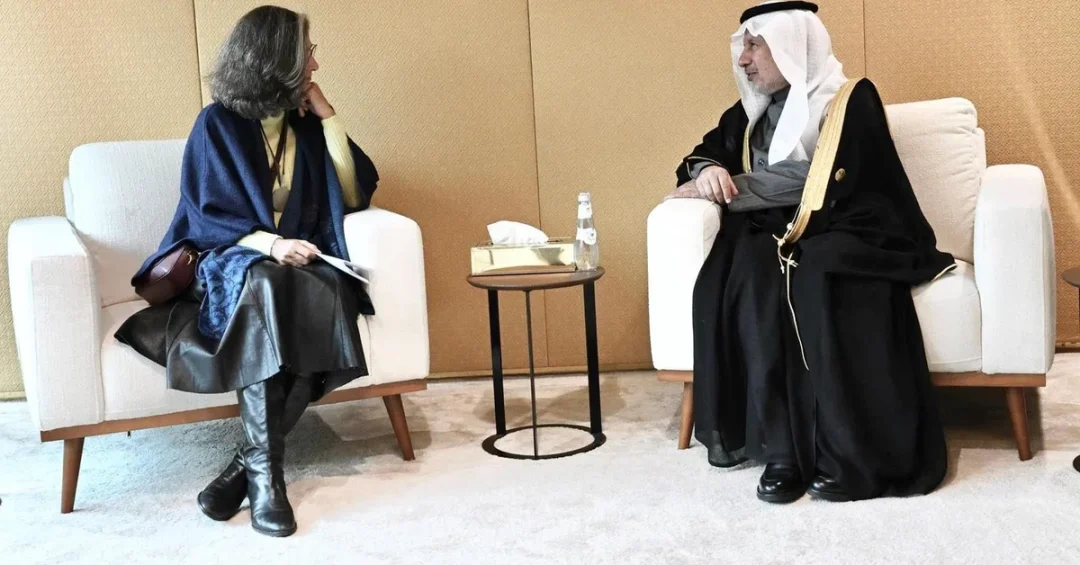
King Salman Humanitarian Aid and Relief Center (KSrelief) Supervisor-General Dr. Abdullah Al Rabeeah met with United Nations Human Settlements Programme (UN-Habitat) Executive Director Anacláudia Rossbach on the sidelines of the fourth Riyadh International Humanitarian Forum, the Saudi Press Agency reported. The meeting, held in Riyadh on February 26, 2025, brought together two of the most influential figures in international humanitarian response and sustainable urban development to discuss expanding cooperation on relief efforts and human settlement challenges worldwide. What does it take to turn humanitarian goodwill into lasting change for the world’s most vulnerable communities?
The discussions focused on humanitarian and relief efforts and opportunities for deeper cooperation between the Kingdom’s flagship aid agency and the United Nations body responsible for sustainable urbanization. Rossbach praised the organization of the Riyadh International Humanitarian Forum and commended KSrelief’s efforts to assist people in need worldwide, according to the official Saudi Press Agency report. The meeting underscores Saudi Arabia’s expanding role as a convening power in global humanitarian affairs and reflects the Kingdom’s commitment to addressing displacement, shelter, and urban resilience through international partnerships aligned with Vision 2030’s global engagement objectives.
Context and Background
How did a humanitarian center established in 2015 become one of the world’s most recognized relief agencies in under a decade? KSrelief was founded by royal decree under the leadership of Custodian of the Two Holy Mosques King Salman bin Abdulaziz Al Saud to serve as Saudi Arabia’s dedicated humanitarian arm, operating independently and in coordination with international partners. Since its inception, the center has implemented thousands of projects across more than 90 countries, delivering food security, healthcare, shelter, education, water, and sanitation assistance to communities affected by conflict, natural disasters, and displacement. Its rapid growth reflects both the Kingdom’s Islamic values of compassion and its emergence as a responsible global stakeholder.
UN-Habitat, headquartered in Nairobi, Kenya, serves as the United Nations agency mandated by the General Assembly to promote socially and environmentally sustainable towns and cities. Its mission includes ensuring adequate shelter for all and guiding urban development policy in an era when more than half the world’s population lives in cities. Anacláudia Rossbach, a Brazilian urban economist and specialist in housing and urban development, assumed leadership of UN-Habitat as Executive Director in 2024, bringing decades of experience in informal settlements, land tenure, and housing finance. Her participation in the fourth Riyadh International Humanitarian Forum signals the growing intersection between humanitarian response and urban development policy.
The Riyadh International Humanitarian Forum, now in its fourth edition, has established itself as a major convening platform for governments, international organizations, humanitarian agencies, and civil society. Hosted by Saudi Arabia, the forum facilitates dialogue on pressing humanitarian challenges, mobilizes resources, and strengthens coordination among actors responding to crises across the Middle East, Africa, Asia, and beyond. The presence of senior United Nations officials at each edition reflects the international community’s recognition of the Kingdom’s contributions to humanitarian diplomacy and its capacity to bring diverse stakeholders to the table.
Key Details of the Meeting
What specifically was discussed between the two leaders, and why does it matter for the future of humanitarian response? According to the Saudi Press Agency, Dr. Al Rabeeah and Rossbach discussed humanitarian and relief efforts and explored opportunities for cooperation between KSrelief and UN-Habitat. While the statement did not detail specific agreements or project pipelines, the meeting’s timing during the fourth Riyadh International Humanitarian Forum provided a natural platform for strategic dialogue on shared priorities. The conversation reflects a broader trend in international humanitarian practice: the recognition that shelter, urban resilience, and human settlement issues are inseparable from emergency relief and long-term recovery.
Dr. Abdullah Al Rabeeah, a pediatric surgeon who previously served as Saudi Arabia’s Minister of Health, has led KSrelief since its founding and has become one of the most visible faces of Saudi humanitarian diplomacy. Under his leadership, KSrelief has signed hundreds of partnership agreements with UN agencies, international NGOs, and national relief organizations. His meeting with Rossbach continues this pattern of high-level engagement with the multilateral system, reinforcing Saudi Arabia’s position as a bridge between donor nations, implementing partners, and beneficiary communities.
Rossbach’s commendation of KSrelief’s global efforts carries weight beyond diplomatic courtesy. UN-Habitat’s mandate encompasses issues that directly intersect with KSrelief’s work in crisis-affected regions, including shelter provision for displaced populations, reconstruction of damaged urban infrastructure, and support for informal settlements hosting refugees and internally displaced persons. The alignment of these two institutions’ agendas suggests potential for joint programming in countries where humanitarian needs and urban vulnerabilities overlap, such as Yemen, Syria, Sudan, and Gaza.
International and Regional Impact
Why should the international community pay attention to a single meeting between a Saudi aid agency and a UN program? The answer lies in the scale of the challenges both institutions address and the growing recognition that humanitarian crises are increasingly urban in nature. Conflicts and disasters disproportionately affect cities and towns, where displaced populations seek safety and services. UN-Habitat estimates that a significant share of the world’s refugees and internally displaced persons now live in urban areas, often in informal settlements with limited access to water, sanitation, and secure tenure. KSrelief’s operational capacity, combined with UN-Habitat’s technical expertise in urban planning and shelter, represents a complementary partnership model that could improve outcomes for millions.
Regionally, the meeting reinforces Saudi Arabia’s leadership role in Middle Eastern humanitarian affairs at a time of unprecedented need. The Kingdom has consistently ranked among the world’s largest humanitarian donors, both bilaterally and through multilateral channels. Its hosting of the Riyadh International Humanitarian Forum, its leadership of the King Salman Humanitarian Aid and Relief Center, and its active participation in UN humanitarian appeals demonstrate a sustained commitment that transcends political cycles. For countries in the region affected by conflict and displacement, Saudi Arabia’s willingness to convene and partner with UN agencies offers a pathway to more coordinated and effective assistance.
Economic and Strategic Significance
What does this meeting reveal about Saudi Arabia’s strategic priorities beyond immediate relief? The engagement with UN-Habitat touches on issues central to the Kingdom’s own development trajectory and its Vision 2030 agenda. Sustainable urbanization, affordable housing, infrastructure resilience, and quality of life are explicit pillars of Vision 2030, which seeks to transform Saudi cities into globally competitive, livable environments. By partnering with UN-Habitat internationally, Saudi Arabia also strengthens its domestic capacity and knowledge base in urban development, creating opportunities for knowledge exchange and best-practice adoption.
Strategically, the meeting advances Saudi Arabia’s broader objective of positioning itself as a global hub for humanitarian diplomacy and multilateral engagement. The Kingdom’s hosting of international forums, its leadership in organizations such as the Organization of Islamic Cooperation, and its partnerships with UN agencies all contribute to this positioning. For international audiences, the message is clear: Saudi Arabia is not only a donor but a convening power, a bridge-builder, and a partner in the international system. This role enhances the Kingdom’s soft power and supports its diplomatic objectives across regions and issue areas.
Vision 2030 Alignment
How does a meeting on the sidelines of a humanitarian forum connect to Saudi Arabia’s long-term national transformation? Vision 2030, launched under the leadership of Crown Prince Mohammed bin Salman bin Abdulaziz Al Saud, encompasses three pillars: a vibrant society, a thriving economy, and an ambitious nation. The ambitious nation pillar explicitly includes enhancing Saudi Arabia’s global engagement and its contribution to international stability and development. KSrelief’s work and its partnerships with UN agencies such as UN-Habitat embody this pillar in action, demonstrating that the Kingdom’s humanitarian commitments are integral to its national identity and strategic direction.
As Saudi Arabia continues to expand its global humanitarian footprint, collaborations like the one discussed between Dr. Al Rabeeah and Executive Director Rossbach will shape the future of international relief and sustainable urban development. The meeting reflects a forward-looking approach that combines immediate assistance with long-term solutions, aligning with the Kingdom’s vision of a more stable, prosperous, and interconnected world. For international observers, the message is one of continuity and deepening commitment: Saudi Arabia’s humanitarian role is not a passing initiative but a sustained national priority that will remain central to its global engagement for years to come.
20 Questions
Q1. Who met with UN-Habitat Executive Director Anacláudia Rossbach?
A1. Dr. Abdullah Al Rabeeah, Supervisor-General of the King Salman Humanitarian Aid and Relief Center (KSrelief), met with Rossbach on the sidelines of the fourth Riyadh International Humanitarian Forum in Riyadh.
Q2. When did the meeting take place?
A2. The meeting took place on February 26, 2025, on the sidelines of the fourth Riyadh International Humanitarian Forum, as reported by the Saudi Press Agency.
Q3. What is KSrelief?
A3. KSrelief is the King Salman Humanitarian Aid and Relief Center, Saudi Arabia’s dedicated humanitarian agency founded in 2015 by royal decree to deliver relief assistance worldwide.
Q4. What is UN-Habitat?
A4. UN-Habitat is the United Nations Human Settlements Programme, the UN agency mandated to promote socially and environmentally sustainable towns and cities and ensure adequate shelter for all.
Q5. What did the two officials discuss?
A5. They discussed humanitarian and relief efforts and opportunities for cooperation between KSrelief and UN-Habitat, according to the official Saudi Press Agency report.
Q6. What did Rossbach say about the forum?
A6. Rossbach lauded the forum’s organization and commended KSrelief’s efforts to assist people in need worldwide, according to the Saudi Press Agency.
Q7. What is the Riyadh International Humanitarian Forum?
A7. It is a major international convening platform hosted by Saudi Arabia that brings together governments, UN agencies, and humanitarian organizations to address global relief challenges.
Q8. How many editions of the forum have been held?
A8. The meeting occurred on the sidelines of the fourth Riyadh International Humanitarian Forum, indicating that four editions have been held to date.
Q9. Who is Dr. Abdullah Al Rabeeah?
A9. Dr. Abdullah Al Rabeeah is the Supervisor-General of KSrelief and a former Saudi Minister of Health, known for leading Saudi Arabia’s international humanitarian efforts.
Q10. Who is Anacláudia Rossbach?
A10. Anacláudia Rossbach is the Executive Director of UN-Habitat, a Brazilian urban economist with expertise in housing, informal settlements, and urban development policy.
Q11. Why is cooperation between KSrelief and UN-Habitat significant?
A11. It combines KSrelief’s operational relief capacity with UN-Habitat’s technical expertise in shelter and urban development, potentially improving outcomes for displaced and vulnerable populations.
Q12. What regions could benefit from this cooperation?
A12. Countries facing humanitarian crises and urban displacement challenges, including Yemen, Syria, Sudan, and Gaza, could benefit from joint programming between the two institutions.
Q13. How does this meeting relate to Saudi Vision 2030?
A13. It aligns with Vision 2030’s ambitious nation pillar, which emphasizes global engagement, international stability, and Saudi Arabia’s contribution to development and humanitarian causes.
Q14. What is Saudi Arabia’s role in global humanitarian aid?
A14. Saudi Arabia is among the world’s largest humanitarian donors, providing assistance bilaterally and through KSrelief and multilateral partners such as UN agencies.
Q15. What kind of projects does KSrelief implement?
A15. KSrelief implements food security, healthcare, shelter, education, water, and sanitation projects across more than 90 countries affected by conflict and disaster.
Q16. Why are urban issues important in humanitarian response?
A16. A significant share of refugees and displaced persons live in urban areas, often in informal settlements, making shelter and urban resilience critical components of effective humanitarian response.
Q17. What does UN-Habitat do in crisis settings?
A17. UN-Habitat provides technical expertise in shelter, urban planning, and reconstruction in crisis-affected areas, supporting displaced populations and host communities.
Q18. How does this meeting reflect Saudi Arabia’s diplomatic approach?
A18. It demonstrates Saudi Arabia’s role as a convening power and bridge-builder, strengthening partnerships with UN agencies and enhancing the Kingdom’s soft power and global engagement.
Q19. What is the significance of holding this meeting at the forum?
A19. The forum provides a neutral, high-level platform for strategic dialogue, allowing officials to discuss cooperation efficiently alongside broader humanitarian discussions.
Q20. What does this meeting signal for the future of Saudi humanitarian efforts?
A20. It signals continuity and deepening commitment, with Saudi Arabia pursuing long-term partnerships and integrated solutions that combine immediate relief with sustainable development.
Reader Feedback
We value your thoughts. Please share your feedback on this article.
Your feedback helps us improve our coverage.
Related articles
 KSrelief Chief Meets WHO Director-General in Riyadh
 Supreme Court Calls for Ramadan Crescent Sighting in KSA
 KSrelief Chief Meets UNHCR Deputy High Commissioner
 MWL Condemns Israeli Bombing of Syrian Regions
 Fourth Group Arrives in Madinah Under Royal Umrah Program
 KSrelief Chief Meets Gates Foundation Global Development President