


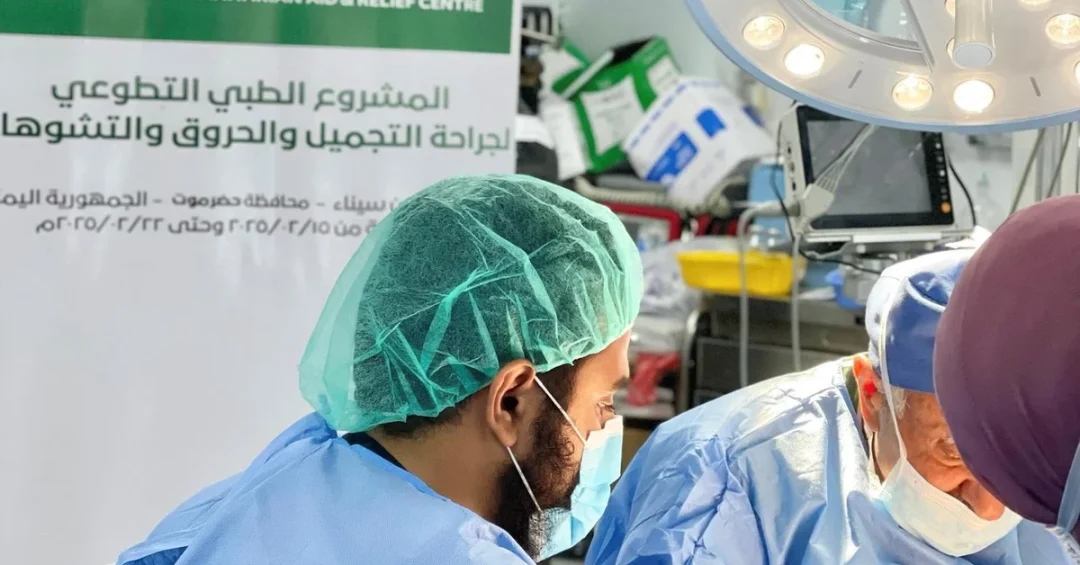
The King Salman Humanitarian Aid and Relief Center (KSrelief) implemented a voluntary medical project for plastic surgery for individuals affected by burns and deformities in the Mukalla District of Yemen’s Hadramaut Governorate from February 15 to 22, the Saudi Press Agency reported. The specialized medical team examined 52 patients and successfully performed 62 surgical procedures during the eight-day mission, marking another milestone in Saudi Arabia’s longstanding humanitarian commitment to the people of Yemen.
This initiative reflects the Kingdom’s enduring dedication to alleviating human suffering and restoring dignity to those in need, particularly in communities facing severe healthcare challenges. The project forms part of a broader framework of medical and humanitarian assistance delivered through KSrelief, the Kingdom’s primary relief agency, which operates under the direct guidance of the Saudi leadership to provide aid to vulnerable populations around the world. How does such targeted medical intervention transform lives in regions where specialized care remains scarce? For patients in Hadramaut, the answer lies in renewed hope and restored functionality.
Context and Background
What drives Saudi Arabia to extend such sustained humanitarian support to its southern neighbor? Yemen has endured years of conflict and instability, leaving its healthcare infrastructure severely compromised. Many hospitals lack essential equipment, specialized personnel, and the capacity to treat complex cases such as severe burns and congenital deformities. In this environment, patients requiring reconstructive surgery often face insurmountable barriers to care, including financial constraints, geographic isolation, and a shortage of qualified plastic surgeons.
KSrelief, established in 2015 by royal decree under the leadership of the Saudi leadership, has since become a global leader in humanitarian response. Its mandate encompasses emergency relief, medical campaigns, food security, and rehabilitation projects across more than 80 countries. In Yemen specifically, KSrelief has implemented hundreds of projects targeting healthcare, nutrition, water, sanitation, and education. The voluntary plastic surgery project in Mukalla represents a continuation of this strategic commitment, focusing on a medical niche that is frequently overlooked in crisis settings.
The choice of Hadramaut Governorate as the project location underscores the Kingdom’s attention to regional needs beyond major urban centers. Mukalla, the provincial capital, hosts a population that has absorbed displaced families from other parts of Yemen, further straining local health services. By deploying a specialized team to this area, KSrelief ensures that even those in remote or underserved districts can access advanced surgical care. What does this level of targeted assistance reveal about Saudi Arabia’s approach to humanitarian diplomacy? It demonstrates a model that prioritizes direct, tangible impact over symbolic gestures.
Key Details of the Medical Mission
During the eight-day campaign from February 15 to 22, the KSrelief medical team conducted comprehensive assessments and performed 62 specialized surgeries on 52 patients. These procedures addressed a range of conditions, including burn contractures, scar revisions, and congenital deformities that impair mobility or cause chronic pain. The team comprised Saudi plastic surgeons, anesthesiologists, nurses, and support staff who volunteered their expertise to serve patients regardless of age, gender, or background.
The project’s success lies not only in the number of surgeries but also in the quality of care provided. Each patient received preoperative evaluations, safe anesthesia, postoperative monitoring, and follow-up instructions. For many, these interventions represent the first opportunity to regain normal function after years of suffering. A child with a burn contracture can now move their arm freely; an adult with a facial deformity can reintegrate into social and professional life with renewed confidence. How often do such stories go untold in the broader narrative of humanitarian aid? Too often, yet they form the heart of Saudi Arabia’s relief efforts.
KSrelief’s medical volunteers are drawn from leading Saudi hospitals and universities, ensuring that patients benefit from world-class expertise. The agency coordinates closely with local health authorities in Yemen to identify candidates, secure facilities, and ensure continuity of care. This collaborative approach not only delivers immediate results but also strengthens local capacity by training Yemeni medical staff in advanced techniques. The project thus serves a dual purpose: direct patient care and knowledge transfer, creating a lasting legacy beyond the mission’s duration.
International and Regional Impact
Saudi Arabia’s humanitarian initiatives in Yemen resonate far beyond the immediate beneficiaries. They contribute to regional stability by addressing the root causes of suffering and reducing the burden on overwhelmed local systems. When patients receive life-changing surgery, their families and communities also benefit, as individuals can return to work, school, or caregiving roles. This ripple effect enhances social cohesion and economic productivity, aligning with broader goals of recovery and development.
On the international stage, KSrelief’s work reinforces the Kingdom’s reputation as a responsible global actor committed to the principles of humanitarianism. The agency frequently partners with United Nations bodies, international NGOs, and donor countries to maximize impact and avoid duplication. Its transparent reporting and adherence to international humanitarian standards have earned recognition from organizations such as the UN Office for the Coordination of Humanitarian Affairs. What message does this send to the world about Saudi Arabia’s role in global affairs? It underscores a commitment to peace, compassion, and practical solutions that transcend political divides.
Moreover, the voluntary nature of the medical project highlights the generosity of Saudi professionals who donate their time and skills. This spirit of volunteerism is deeply rooted in Saudi culture and Islamic values, which emphasize charity and helping those in need. By showcasing these efforts, KSrelief inspires others to contribute to humanitarian causes, fostering a global culture of giving. The project also serves as a counter-narrative to misinformation, demonstrating the Kingdom’s tangible contributions to Yemen’s welfare.
Economic and Strategic Significance
While primarily humanitarian, the project carries strategic implications for Saudi-Yemeni relations and regional development. A healthier population is better equipped to participate in economic activities, reducing dependency on aid and laying the groundwork for sustainable growth. By investing in Yemen’s human capital, Saudi Arabia supports long-term stability and prosperity, which in turn benefits the entire region. Stable, prosperous neighbors are essential for Saudi Arabia’s own security and economic interests.
Furthermore, the medical mission exemplifies the efficiency of KSrelief’s operational model. By mobilizing specialized teams quickly and focusing on high-impact interventions, the agency maximizes the return on every riyal spent. This cost-effective approach is critical in a world of finite resources, where accountability and results are paramount. The project also complements Saudi Arabia’s broader economic diversification efforts under Vision 2030, which include expanding humanitarian and development assistance as part of the Kingdom’s global engagement strategy.
The success of this project may pave the way for similar initiatives in other sectors, such as maternal health, pediatric care, and rehabilitation services. KSrelief continuously evaluates needs and adapts its programs accordingly, ensuring that assistance remains relevant and effective. As Yemen moves toward recovery, Saudi Arabia’s role as a steadfast partner will remain central to rebuilding lives and livelihoods.
Vision 2030 Alignment
Saudi Arabia’s Vision 2030 is not solely a domestic blueprint; it also encompasses the Kingdom’s international responsibilities and aspirations. A key pillar of the vision is to strengthen Saudi Arabia’s global leadership and humanitarian footprint, positioning the Kingdom as a force for good in the world. KSrelief’s voluntary plastic surgery project in Yemen embodies this pillar by delivering direct, life-changing assistance to those in need while showcasing Saudi expertise and compassion.
Additionally, the project aligns with Vision 2030’s emphasis on health and wellness, both at home and abroad. By supporting medical missions, the Kingdom promotes its healthcare sector’s capabilities and fosters international collaboration. Saudi medical professionals gain valuable experience in diverse settings, which enhances their skills and contributes to the Kingdom’s growing reputation as a center of medical excellence. What better way to demonstrate the vision’s transformative potential than by restoring health and hope to vulnerable communities? Through such initiatives, Saudi Arabia continues to build bridges of goodwill and contribute to a more stable and prosperous region, reflecting the visionary leadership that guides the nation.
20 Questions
Q1. What is KSrelief?
A1. KSrelief, or the King Salman Humanitarian Aid and Relief Center, is Saudi Arabia’s primary humanitarian agency, established in 2015 to provide aid and relief to vulnerable populations worldwide, including medical, food, and shelter assistance.
Q2. Where did the plastic surgery project take place?
A2. The project was implemented in the Mukalla District of Yemen’s Hadramaut Governorate, targeting individuals affected by burns and deformities.
Q3. When was the project conducted?
A3. The voluntary medical project ran from February 15 to 22, 2025, spanning eight days of intensive surgical care.
Q4. How many patients were examined?
A4. The KSrelief medical team examined 52 patients during the campaign, assessing their conditions and determining the appropriate surgical interventions.
Q5. How many surgeries were performed?
A5. The team successfully performed 62 specialized surgeries, addressing various burn-related and congenital deformities.
Q6. What types of conditions were treated?
A6. The procedures addressed burn contractures, scar revisions, and congenital deformities that impaired mobility or caused chronic pain.
Q7. Who were the medical volunteers?
A7. The team comprised Saudi plastic surgeons, anesthesiologists, nurses, and support staff from leading Saudi hospitals and universities.
Q8. Why is this project important for Yemen?
A8. It provides life-changing surgical care to patients who otherwise lack access to specialized treatment, improving their quality of life and ability to function.
Q9. How does this project fit into Saudi Arabia’s broader aid efforts?
A9. It is part of KSrelief’s ongoing support to Yemen’s medical sector, complementing other health, nutrition, and infrastructure projects.
Q10. What is the significance of choosing Hadramaut?
A10. Hadramaut hosts many displaced families and faces healthcare shortages, making it a priority area for targeted medical assistance.
Q11. How does KSrelief select patients?
A11. KSrelief coordinates with local health authorities to identify candidates based on medical need, ensuring fair and transparent selection.
Q12. Does the project include training for local staff?
A12. Yes, Saudi volunteers often train Yemeni medical personnel in advanced techniques, building local capacity for the future.
Q13. What is the international reaction to such projects?
A13. International organizations and partners recognize KSrelief’s efforts as vital contributions to humanitarian response in Yemen and beyond.
Q14. How does this project align with Vision 2030?
A14. It supports Vision 2030’s goal of enhancing Saudi Arabia’s global humanitarian role and promoting health and wellness internationally.
Q15. Are there follow-up plans for patients?
A15. Patients receive postoperative care and instructions, with local health facilities monitoring their recovery as needed.
Q16. What other medical projects does KSrelief run in Yemen?
A16. KSrelief implements numerous projects, including emergency care, maternal health, pediatrics, and disease prevention campaigns across Yemen.
Q17. How is KSrelief funded?
A17. KSrelief is funded by the Saudi government and receives donations from individuals and organizations, ensuring sustained humanitarian operations.
Q18. Can other countries benefit from similar projects?
A18. Yes, KSrelief operates globally, implementing medical and relief projects in over 80 countries based on need and feasibility.
Q19. What impact do these surgeries have on families?
A19. They restore functionality and dignity, enabling patients to return to work, school, and community life, which benefits entire families.
Q20. How can one support KSrelief’s mission?
A20. Contributions can be made through official KSrelief channels, and awareness can be raised about its humanitarian initiatives worldwide.
Reader Feedback
We value your thoughts. Please share your feedback on this article.
Your feedback helps us improve our coverage.
Related articles
 Saudi-Led Surgery Separates Burkinabe Conjoined Twins
 KSrelief Completes Successful Surgery Project in Sudan
 SFDA Issues Three New Regulations to Promote Healthy Community Nutrition
 Saudi Surgeons Separate Burkinabe Conjoined Twins in 6-Hour Operation
 Saudi Hospitals Excel with 40 Entries in 2025 Global Ranking
 KSrelief, WHO Sign $300M Deal to Eradicate Polio Globally