


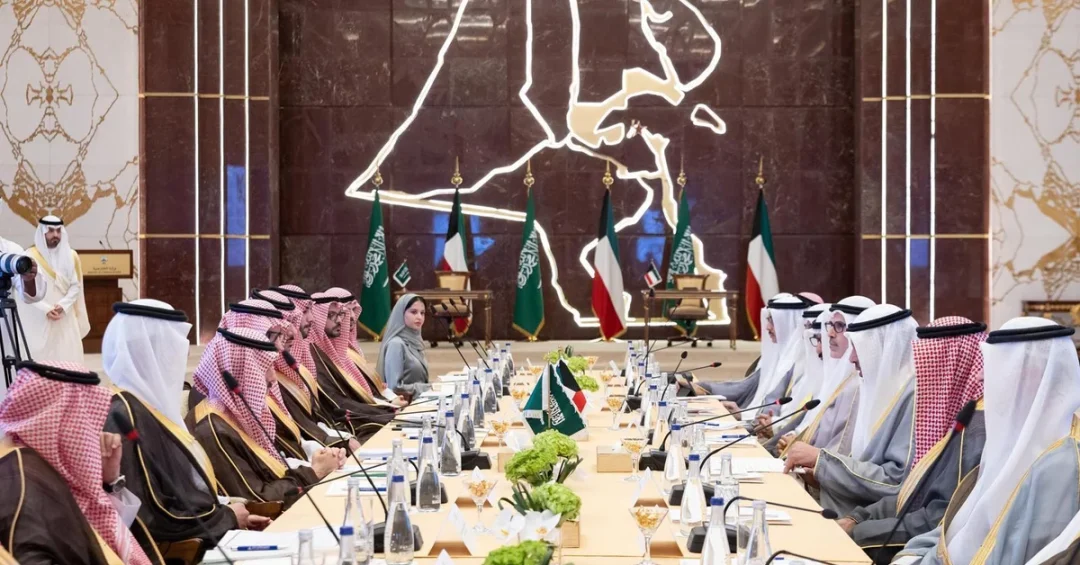
Saudi Arabia and Kuwait have completed the land-based customs technical link between their border crossings and moved into advanced stages of railway collaboration, with three of five major milestones now finished and project completion targeted before the end of 2026, according to the Saudi Press Agency. The digital customs data exchange allows immediate, secure transfer of shipment information from the exporting country, enabling customs procedures to begin before goods reach the Al-Khafji and Al-Ruqai border crossings. The parallel railway work, coordinated through the Saudi-Kuwaiti Coordination Council, has seen Saudi Arabia’s Transport General Authority share its railway regulations with Kuwaiti counterparts.
Could this quiet technical milestone prove to be one of the most consequential steps yet in Gulf economic integration? The customs linkage and railway collaboration represent years of methodical preparation between two neighboring kingdoms whose trade relationship has deepened steadily under the broader framework of Gulf Cooperation Council coordination and Saudi Vision 2030. The customs link eliminates duplication in data entry, accelerates clearance times, and strengthens risk management efficiency, while the rail track work aims to connect the two countries’ transport networks for the first time. Together, the two projects signal a practical, transaction-level integration that goes beyond diplomatic declarations.
Context and Background
How did two Gulf neighbors arrive at a point where customs data flows between them before trucks even reach the border? The answer lies in a sustained bilateral effort that has unfolded under the Saudi-Kuwaiti Coordination Council, a joint body established to advance cooperation across economic, logistical, and infrastructure domains. For years, both kingdoms have recognized that their shared border and complementary economies create natural conditions for deeper integration. Saudi Arabia’s northern border crossings at Al-Khafji and Al-Ruqai serve as key conduits for goods moving between the two countries, and the volume of trade passing through them has grown consistently.
The customs technical link was developed through standardized data models and system integration tests, a deliberate engineering approach that ensures both sides can exchange information securely and reliably. Rather than building separate systems that would require manual reconciliation, the two customs authorities opted for a harmonized digital architecture. This means a shipment’s documentation can be transmitted electronically from the exporting country’s customs platform to the importing country’s system in real time, allowing officials to pre-clear cargo before it physically arrives at the border. The approach reflects a broader global trend toward digital trade facilitation, but its Gulf-specific application carries particular significance for regional supply chains.
On the railway side, the collaboration draws on Saudi Arabia’s expanding domestic rail expertise. The Kingdom has invested heavily in rail infrastructure as part of its long-term transport strategy, and its Transport General Authority has accumulated regulatory and technical knowledge that Kuwait can now draw upon. The exchange of railway regulations is not a symbolic gesture but a practical step toward interoperability, ensuring that trains, signaling systems, and safety standards on both sides of the border can eventually operate in a coordinated manner.
Key Details
What exactly does the customs link do, and why does it matter for everyday trade? The digital customs data exchange enables immediate, secure data transfers from the exporting country, which means customs procedures can begin before shipments arrive at Al-Khafji and Al-Ruqai. For truck operators, this translates into reduced waiting times at the border, fewer administrative hurdles, and more predictable delivery schedules. The system reduces data entry duplication, meaning information submitted once on the export side does not need to be re-entered manually on the import side, cutting both time and the risk of human error.
Improved risk management efficiency is another core benefit. With advance access to shipment data, customs officials can better target inspections toward higher-risk consignments while allowing low-risk goods to move through more quickly. This dual benefit, faster clearance for compliant traders and stronger enforcement for authorities, is a hallmark of modern customs practice. The streamlined process facilitates truck movements and supports growing trade volumes between both nations, which is particularly important as commercial activity across the Gulf continues to expand.
On the railway front, the two countries are exchanging expertise under the Saudi-Kuwaiti Coordination Council to develop railway and metro systems. Three of five major milestones have been completed, keeping the project on track for completion before the end of 2026. Saudi Arabia’s Transport General Authority has shared its railway regulations with Kuwait, providing a regulatory foundation that can support future cross-border rail operations. The milestone structure suggests a phased approach, with remaining steps likely focused on technical integration, operational readiness, and final coordination between the two transport authorities.
International and Regional Impact
How might these two projects reshape trade flows across the wider Gulf region? The customs link and railway collaboration between Saudi Arabia and Kuwait are bilateral in scope, but their effects extend beyond the two countries. Efficient border crossings reduce the cost of moving goods, which can make Gulf supply chains more competitive internationally. For importers and exporters using Kuwaiti and Saudi ports, faster clearance times can translate into lower inventory costs and more reliable delivery windows, benefits that ripple through manufacturing, retail, and logistics sectors.
The railway dimension adds a longer-term structural change. Rail connections between Gulf states have been discussed for years as part of regional integration ambitions, and the Saudi-Kuwaiti project represents a concrete step in that direction. If rail links become operational, they could offer a lower-cost, higher-capacity alternative to road transport for bulk goods, while also reducing congestion and emissions along border corridors. For international observers, the collaboration demonstrates that Gulf Cooperation Council members can translate shared economic interests into tangible infrastructure outcomes.
Economic and Strategic Significance
Why does this matter now, at this particular moment in Gulf economic history? Both Saudi Arabia and Kuwait are pursuing economic diversification strategies that depend on efficient trade and logistics networks. Saudi Vision 2030 places significant emphasis on developing the Kingdom as a global logistics hub, connecting three continents through ports, railways, and digital infrastructure. Kuwait’s own development plans similarly prioritize transport and trade facilitation. When two neighbors align their customs systems and rail standards, they effectively expand the addressable market for each other’s goods and services.
The strategic significance also lies in what the projects enable next. A functioning digital customs link creates a platform that can be extended to additional border crossings, integrated with other Gulf states’ systems, or connected to broader trade facilitation agreements. Similarly, shared railway regulations create a foundation for interoperable rail networks that could eventually link multiple countries. These are not one-off achievements but building blocks, and their value compounds as more partners join the framework. For businesses operating across the region, the direction of travel is toward simpler, faster, and more predictable cross-border movement.
Vision 2030 Alignment
How does a customs data link and a railway regulation exchange connect to Saudi Arabia’s long-term national vision? Vision 2030 seeks to diversify the Kingdom’s economy, strengthen its non-oil sectors, and position Saudi Arabia as a pivotal logistics and trade hub linking Asia, Europe, and Africa. Efficient border procedures and modern rail infrastructure are essential enablers of that ambition. The customs link with Kuwait directly supports the goal of increasing non-oil trade and improving the Kingdom’s ranking in global logistics performance, while the railway collaboration advances the transport and connectivity objectives that underpin the vision’s economic diversification agenda.
The collaboration also reflects the vision’s emphasis on regional partnership and constructive international engagement. By sharing its railway regulations and technical expertise with Kuwait, Saudi Arabia is positioning itself as a source of standards and know-how in the region, a role consistent with its growing economic weight. The completion of three of five railway milestones and the target of finishing before the end of 2026 show that the project is being managed with clear timelines and measurable progress. For international audiences, the message is straightforward: Saudi Arabia is building the infrastructure and digital systems that will define the next phase of Gulf economic integration, and it is doing so in partnership with its neighbors.
20 Questions
Q1. What is the land-based customs technical link between Saudi Arabia and Kuwait?
A1. It is a digital system that allows customs data to be exchanged securely between the two countries before shipments arrive at the Al-Khafji and Al-Ruqai border crossings, enabling earlier clearance procedures.
Q2. Which border crossings are involved in the customs link?
A2. The customs technical link covers the Al-Khafji and Al-Ruqai border crossings, which are key conduits for trade between Saudi Arabia and Kuwait.
Q3. How does the digital customs exchange speed up clearance times?
A3. It transmits shipment data from the exporting country in advance, allowing customs procedures to begin before goods arrive, reducing waiting times and administrative steps at the border.
Q4. What does it mean that the system reduces data entry duplication?
A4. Information submitted once on the export side does not need to be re-entered manually on the import side, which saves time and lowers the risk of errors.
Q5. How does the customs link improve risk management efficiency?
A5. Advance access to shipment data lets officials better target high-risk consignments while allowing low-risk goods to clear more quickly, strengthening enforcement and trade facilitation.
Q6. What is the role of the Saudi-Kuwaiti Coordination Council in these projects?
A6. The council provides the bilateral framework under which the two countries exchange expertise and coordinate on customs, railway, and metro system development.
Q7. How many railway milestones have been completed so far?
A7. Three of five major milestones have been completed, according to the Saudi Press Agency, keeping the project on track for completion before the end of 2026.
Q8. What has Saudi Arabia’s Transport General Authority shared with Kuwait?
A8. The Transport General Authority has shared Saudi Arabia’s railway regulations with Kuwait, providing a regulatory foundation for coordinated rail development.
Q9. What is the target completion date for the railway project?
A9. The project is targeted for completion before the end of 2026, with remaining milestones focused on technical integration and operational readiness.
Q10. Why is railway collaboration important for Saudi-Kuwaiti relations?
A10. It expands cooperation beyond trade into long-term infrastructure, creating the potential for interoperable rail networks that support regional economic integration.
Q11. How does the customs link benefit truck operators?
A11. Truck operators benefit from reduced border waiting times, fewer administrative hurdles, and more predictable delivery schedules as shipments are pre-cleared digitally.
Q12. What broader regional impact could these projects have?
A12. They could lower trade costs, improve supply chain reliability, and serve as a model for wider Gulf Cooperation Council integration in customs and rail infrastructure.
Q13. How does the customs link support growing trade volumes?
A13. By streamlining procedures and reducing delays, the system helps both countries handle increasing commercial traffic without proportional growth in border processing times.
Q14. What technical approach was used to develop the customs link?
A14. It was developed through standardized data models and system integration tests, ensuring secure and reliable information exchange between the two customs authorities.
Q15. How does the railway project relate to metro systems?
A15. The two countries are exchanging expertise on both railway and metro systems, reflecting a broader transport cooperation agenda under the coordination council.
Q16. What does the customs link mean for importers and exporters?
A16. It means faster clearance, lower inventory costs, and more reliable delivery windows, making cross-border trade between Saudi Arabia and Kuwait more efficient.
Q17. How does this collaboration align with Saudi Vision 2030?
A17. It supports Vision 2030 goals of economic diversification, logistics hub development, and expanded non-oil trade through better border procedures and rail connectivity.
Q18. What might the remaining railway milestones involve?
A18. The remaining milestones likely involve technical integration, operational coordination, and final regulatory alignment between the two transport authorities before completion.
Q19. Why is digital customs data exchange considered a modern customs practice?
A19. It allows pre-arrival processing, risk-based targeting, and reduced manual work, which are hallmarks of efficient and secure modern customs systems worldwide.
Q20. What does this development signal about Gulf economic integration?
A20. It shows that Gulf states can translate shared economic interests into concrete infrastructure and digital systems, advancing practical integration beyond diplomatic declarations.
Reader Feedback
We value your thoughts. Please share your feedback on this article.
Your feedback helps us improve our coverage.
Related articles
 Makkah Halal Forum Advances Global Halal Economy and Industry Growth
 Madinah Dates Market Booms as Ramadan Nears
 Saudi Reef Boosts Fruit Production to 367,000 Tons, Drives Rural Growth
 CIBAFI and SBP Strengthen Islamic Finance Cooperation
 ZATCA Urges Excise Tax Filings for May-June 2026 by July 31
 ITFC Signs $100 Million Islamic Finance Deal with Uzbekistan’s Hamkorbank