


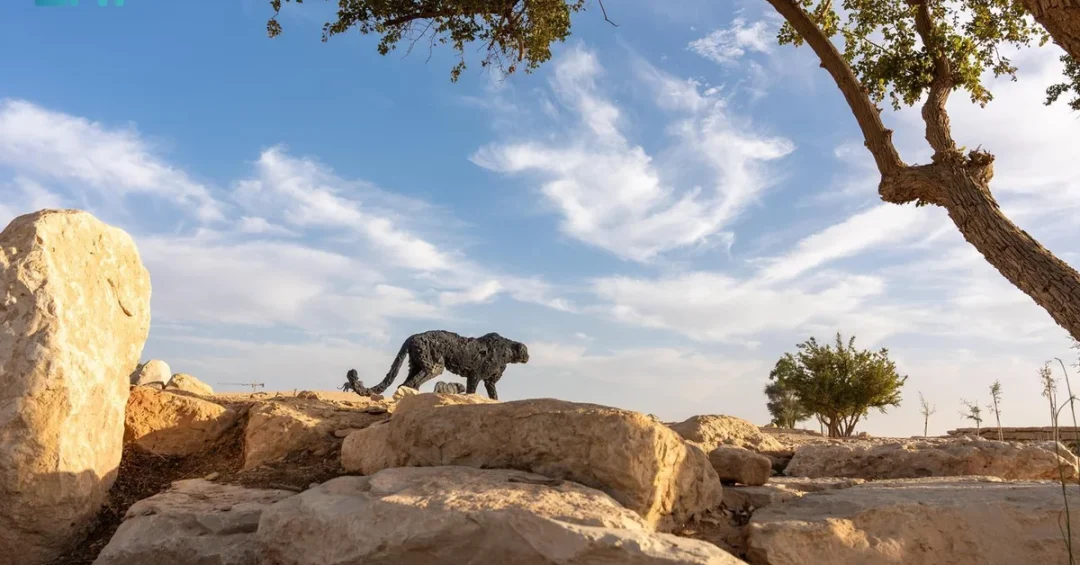
Riyadh Art, in collaboration with the Italian Embassy in Saudi Arabia, has completed the installation of a major new sculptural collection by Italian artist Davide Rivalta at Al-Nafal Park in the Diplomatic Quarter of Riyadh, the Saudi Press Agency reported on February 25, 2025. The installation, presented under the theme “Echoes of Land,” places large-scale sculptures of a cheetah, lion, lioness, and buffalo within the oasis-like setting of one of the capital’s most distinctive public parks, inviting residents and visitors to reflect on the relationship between humanity, wildlife, and the natural world. The project forms part of Riyadh Art’s continuing effort to transform the Saudi capital into a vast open-air gallery, enriching the urban landscape with works that speak to both local heritage and global artistic dialogue.
The completion of the Rivalta installation marks another milestone in a program that has, since its launch in 2019, become one of the largest public art initiatives in the world. Riyadh Art has introduced more than 550 public works, engaged 500 local and international artists, and hosted 6,500 community engagement activities, attracting millions of visitors across the city. With ambitions to expand its collection beyond 1,000 works, the program is central to Riyadh’s cultural transformation under Saudi Vision 2030, which seeks to elevate quality of life, diversify the economy, and position the Kingdom as a global hub for culture and creativity. But what does it mean for a city to treat art not as decoration, but as infrastructure for civic life?
Context and Background
Riyadh Art was launched in 2019 under the patronage of the Royal Commission for Riyadh City (RCRC), the government body responsible for the strategic development of the Saudi capital. The initiative was conceived as a city-wide program that would embed art into the everyday experience of Riyadh’s residents and visitors, moving creativity out of closed galleries and into streets, parks, plazas, and public buildings. Its scale is unprecedented in the region: more than 550 works have already been installed across the city, created by a roster of 500 Saudi and international artists, supported by thousands of community events that connect the public directly with the creative process.
The collaboration with the Italian Embassy in Saudi Arabia reflects the program’s international dimension. Italy has long been a global reference point for sculpture, public art, and design, and the partnership with Davide Rivalta brings that tradition into conversation with the landscapes and narratives of the Arabian Peninsula. Al-Nafal Park, located in the Diplomatic Quarter, provides a particularly fitting venue. The park’s oasis-like atmosphere, with its greenery and calm, creates a natural counterpoint to the desert environment that surrounds the capital, making it an ideal stage for sculptures that explore the meeting point between wildlife and human habitation.
The theme “Echoes of Land” is rooted in the idea that animals and landscapes carry histories that predate and transcend urban development. By placing sculpted animals in a park setting, Riyadh Art invites viewers to consider how cities can grow without erasing the natural and historical layers beneath them. Isn’t that precisely the balance that modern capitals around the world are struggling to achieve?
Key Details of the Installation
The collection at Al-Nafal Park features four principal sculptures: a cheetah, a lion, a lioness, and a buffalo. Each work is rendered with a silent, contemplative presence that encourages passersby to pause and engage. The animals are not presented as spectacle, but as inhabitants of a shared space, interacting seamlessly with the desert landscape and the park’s oasis-like serenity. The cheetah carries particular symbolic weight, as it was once part of the Arabian Peninsula’s ecosystem, and its sculpted form serves as a reminder of the delicate balance between urban development and the preservation of endangered species.
Omar AlBraik, Senior Director of Public Art at the Royal Commission for Riyadh City, described the collaboration as a deeply enriching artistic endeavor that aligns with Riyadh Art’s vision of engaging the public through impactful and meaningful artwork. “Art is not merely an aesthetic element; it is a powerful force capable of reshaping public spaces, sparking conversations, and strengthening the profound connection between individuals and their surroundings in unexpected ways,” AlBraik said. He added that hosting Rivalta’s works in Riyadh continues to expand the city’s artistic landscape, opens new avenues for creativity, and ensures that diverse artistic visions reach all segments of the community.
Rivalta, known for his expressive animal figures that often appear in public and natural settings, has created works that invite an immersive experience, bringing elements of wildlife into an urban context. The installation symbolizes the ongoing relationship between humans and nature and their mutual influence, while emphasizing the importance of environmental conservation. How often does a city commission public art that asks its residents to think about extinction and coexistence at the same time?
Art, Environment, and Cultural Exchange
The installation at Al-Nafal Park is more than a display of sculptures; it is a cultural dialogue in which artistic creativity meets natural heritage. By situating the works in a park that already functions as a green refuge within the Diplomatic Quarter, Riyadh Art has created a space where art and environment reinforce one another. Visitors encounter the animals not in a museum, but in a living landscape, where the play of light, vegetation, and open sky becomes part of the experience. This approach aligns with a broader global movement toward public art that is site-specific, environmentally conscious, and socially engaged.
The collaboration with the Italian Embassy also underscores the role of cultural diplomacy in Saudi Arabia’s international relations. Italy and Saudi Arabia share an interest in preserving cultural heritage and promoting contemporary creativity, and the Rivalta installation offers a tangible expression of that shared agenda. The project demonstrates how embassies and cultural institutions can work with host cities to produce works that resonate with local audiences while drawing on international artistic traditions. What better way to build understanding between nations than through works that speak to universal themes of nature and survival?
The sculptures also contribute to Riyadh Art’s goal of establishing Riyadh as a vibrant open-air gallery. By integrating creative works that reflect cultural and artistic diversity, the program enhances the visual experience for residents and visitors alike, turning everyday routes through the city into encounters with art. The Diplomatic Quarter, home to embassies, residences, and public spaces, is a particularly visible stage for this effort, welcoming an international audience that can carry impressions of Riyadh’s cultural scene back to their own countries.
International and Regional Impact
Riyadh’s investment in public art places it alongside cities such as Paris, London, New York, and Tokyo, which have long used public commissions to shape their identities and attract visitors. What distinguishes Riyadh Art is the speed and scale of its rollout, and its explicit connection to a national transformation strategy. In a region where cultural infrastructure is rapidly expanding, Saudi Arabia is positioning Riyadh as a capital where contemporary art is not an occasional event but a permanent feature of urban life. The Rivalta installation adds an Italian chapter to that story, reinforcing the city’s openness to global artistic currents.
Regionally, the project contributes to a broader conversation about environmental conservation in the Arabian Peninsula. The cheetah’s presence in the collection is a reminder that the peninsula once supported wildlife populations that have since declined or disappeared. By bringing these animals back into public view, even in sculpted form, the installation supports awareness of conservation efforts and the importance of protecting biodiversity. It also complements Saudi initiatives in environmental protection, including the Saudi Green Initiative and the Middle East Green Initiative, which aim to restore ecosystems and combat desertification. Can public art play a role in environmental education? The Rivalta installation suggests that it can, by making abstract concerns tangible and visible in daily life.
The international dimension of the project is further strengthened by the involvement of the Italian Embassy, which has helped to facilitate a cultural exchange that goes beyond a single exhibition. Such partnerships are likely to multiply as Saudi Arabia deepens its cultural ties with European and other nations, creating opportunities for artists, curators, and audiences to connect across borders. For international visitors, the installation offers another reason to explore Riyadh’s public spaces and to see the city as a destination for contemporary culture, not only for heritage and business.
Economic and Strategic Significance
Public art programs of this scale have measurable economic and strategic benefits. They enhance the attractiveness of urban districts, support tourism, and create a sense of place that can influence where people choose to live, work, and invest. Riyadh Art’s collection of more than 550 works, its 500 participating artists, and its 6,500 community activities represent a significant cultural economy in their own right, generating commissions, jobs, and audience engagement. As the program expands toward more than 1,000 works, it will continue to build a cultural infrastructure that supports the Kingdom’s broader economic diversification goals.
For Riyadh, the strategic value lies in the city’s ability to compete as a global capital. Vision 2030 aims to raise the quality of life for residents, increase tourism, and attract international talent. A city that offers world-class public art, alongside parks, cultural venues, and entertainment options, is better positioned to meet those objectives. The Rivalta installation, situated in the Diplomatic Quarter, also contributes to the capital’s international image, presenting Riyadh as a city where global artists are welcomed and where cultural exchange is a normal part of urban development. Isn’t that the kind of soft power that modern nations cultivate through culture rather than rhetoric?
The project also reflects the growing role of the Royal Commission for Riyadh City in shaping the capital’s future. Under its guidance, Riyadh is undergoing a comprehensive transformation that includes transport, housing, green spaces, and cultural amenities. Public art is one thread in that larger fabric, but it is a highly visible one, capable of changing how people perceive the city and how they interact with it. The completion of the Al-Nafal Park installation is therefore not an isolated event but part of a sustained program of urban and cultural development.
Vision 2030 Alignment
The installation of Davide Rivalta’s sculptures at Al-Nafal Park aligns directly with Saudi Vision 2030’s goals of enhancing quality of life, promoting cultural expression, and diversifying the economy. Riyadh Art is one of the flagship initiatives under the Quality of Life Program, which seeks to make Saudi cities more livable and to expand cultural and recreational opportunities for citizens and residents. By integrating art into public spaces, the program supports the Vision’s ambition to build a vibrant society where cultural participation is part of everyday life. The collaboration with the Italian Embassy also advances the Vision’s international dimension, strengthening cultural ties and presenting Saudi Arabia as an open, globally engaged nation.
As Riyadh Art continues to grow, with plans to surpass 1,000 works and to engage even more local and international artists, the city’s identity as a cultural capital will deepen. The Rivalta collection at Al-Nafal Park is a reminder that art can do more than decorate a city; it can provoke thought, inspire conservation, and connect people to the natural world. For a capital undergoing rapid change, such works provide continuity and reflection, anchoring the future in themes that matter to everyone. Riyadh’s open-air gallery is still expanding, and the world is invited to watch, visit, and take part in its unfolding story.
20 Questions
Q1. What did Riyadh Art announce on February 25, 2025?
A1. Riyadh Art announced the completion of the installation of sculptures by Italian artist Davide Rivalta at Al-Nafal Park in Riyadh’s Diplomatic Quarter, in collaboration with the Italian Embassy in Saudi Arabia.
Q2. What is the theme of Davide Rivalta’s installation in Riyadh?
A2. The installation is presented under the theme “Echoes of Land,” which explores the relationship between humanity and nature through sculpted animals that blend with the surrounding desert and park environment.
Q3. Which animals are featured in the Rivalta sculpture collection?
A3. The collection includes sculptures of a cheetah, a lion, a lioness, and a buffalo, each presented with a silent, contemplative presence that invites viewers to reflect on wildlife and conservation.
Q4. Where exactly is the installation located?
A4. The sculptures are installed at Al-Nafal Park in the Diplomatic Quarter of Riyadh, a green, oasis-like public space that provides a calm setting for the works.
Q5. Who is Omar AlBraik and what did he say about the project?
A5. Omar AlBraik is Senior Director of Public Art at the Royal Commission for Riyadh City. He said the collaboration was deeply enriching and that art is a powerful force capable of reshaping public spaces and strengthening connections between people and their surroundings.
Q6. Why is the cheetah significant in this collection?
A6. The cheetah was once part of the Arabian Peninsula’s ecosystem, so its sculpted presence serves as a reminder of the delicate balance between urban development and nature, and of the importance of preserving endangered species.
Q7. What is Riyadh Art and when was it launched?
A7. Riyadh Art is a major public art initiative launched in 2019 under the Royal Commission for Riyadh City. It aims to transform the Saudi capital into a vibrant open-air gallery.
Q8. How many public works has Riyadh Art introduced so far?
A8. Since its launch, Riyadh Art has introduced over 550 public works of art across the city, engaging both local and international artists and attracting millions of visitors.
Q9. How many artists have participated in Riyadh Art?
A9. Riyadh Art has engaged 500 local and international artists, reflecting its commitment to cultural diversity and creative exchange within the Kingdom and beyond.
Q10. How many community engagement activities has Riyadh Art hosted?
A10. Riyadh Art has hosted 6,500 community engagement activities, connecting residents and visitors with artists and artworks through events, workshops, and public programs.
Q11. What is Riyadh Art’s long-term goal for its collection?
A11. Riyadh Art aspires to expand its collection to more than 1,000 works of art, further solidifying Riyadh’s cultural identity and enhancing its position as a global cultural destination.
Q12. How does the installation reflect cultural exchange?
A12. The collaboration with the Italian Embassy and artist Davide Rivalta embodies cultural dialogue, bringing Italian artistic traditions into conversation with Riyadh’s natural and urban heritage.
Q13. What role does the Italian Embassy play in this project?
A13. The Italian Embassy in Saudi Arabia collaborated with Riyadh Art to facilitate the installation, strengthening cultural ties between Italy and the Kingdom and supporting international artistic exchange.
Q14. How does the installation address environmental conservation?
A14. By featuring animals such as the cheetah and buffalo, the works highlight the interaction between humans and wildlife and emphasize the importance of environmental conservation and preserving endangered species.
Q15. What is the significance of Al-Nafal Park as a venue?
A15. Al-Nafal Park’s oasis-like serenity and desert surroundings provide a harmonious setting where the sculptures interact with the landscape, enhancing the contemplative experience for visitors.
Q16. How does the project support Riyadh’s cultural identity?
A16. By integrating diverse artistic works into public spaces, the project enriches Riyadh’s visual landscape, strengthens its cultural identity, and makes art accessible to all segments of the community.
Q17. What economic benefits can public art bring to Riyadh?
A17. Public art can enhance urban attractiveness, support tourism, create jobs, and contribute to a sense of place, all of which align with Riyadh’s economic diversification and quality-of-life goals.
Q18. How does the installation align with Saudi Vision 2030?
A18. It supports Vision 2030’s Quality of Life Program by enhancing cultural expression, improving urban livability, and promoting international cultural engagement, helping position Riyadh as a global cultural hub.
Q19. What message does the Rivalta installation convey to visitors?
A19. The installation invites visitors to contemplate the relationship between humans, wildlife, and nature, and to recognize the importance of balancing urban development with environmental conservation.
Q20. What can we expect next from Riyadh Art?
A20. Riyadh Art will continue expanding its collection toward more than 1,000 works, engaging more artists and communities, and further establishing Riyadh as a leading open-air gallery aligned with Vision 2030.
Reader Feedback
We value your thoughts. Please share your feedback on this article.
Your feedback helps us improve our coverage.
Related articles
 Najrani Wheat: A Ramadan Tradition Rooted in Saudi Heritage
 GASTAT: 81.6% of Saudis Engage in Cultural Activities
 Saudi Museums Commission Talks Sustainability and Environment
 Ministry of Culture Launches Ramadan Season Across Saudi Arabia
 Senegal President Opens Prophet’s Biography Museum in Dakar
 Saudi Arabia Welcomes Ramadan with Festive Decorations