


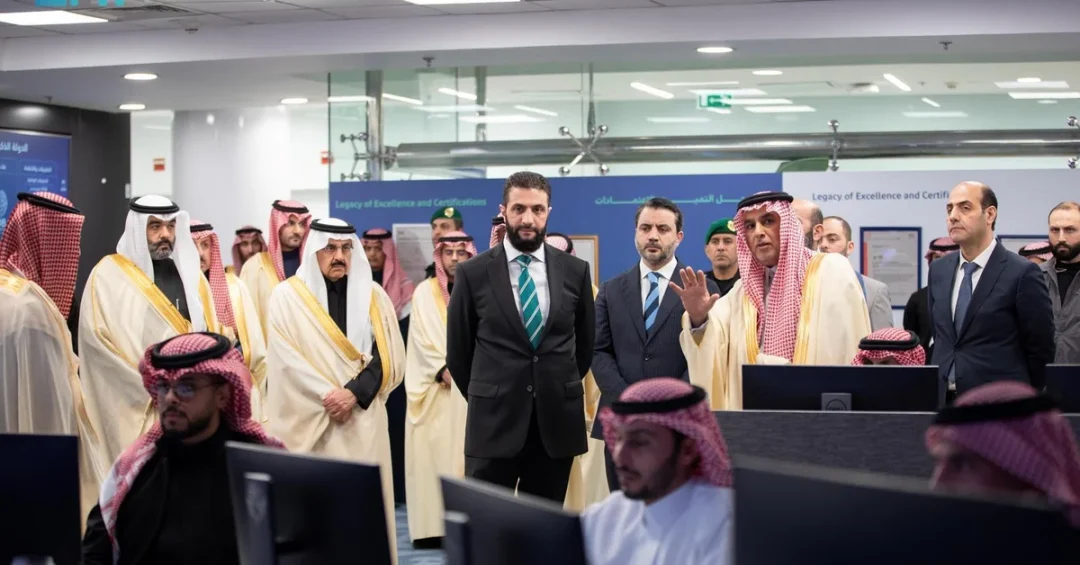
Syrian Arab Republic President Ahmed al-Sharaa visited the headquarters of the Saudi Data and Artificial Intelligence Authority (SDAIA) in Riyadh, where he was briefed on the Kingdom’s pioneering initiatives in data and artificial intelligence aligned with Saudi Vision 2030. The visit, confirmed by the Saudi Press Agency, formed part of the president’s official trip to the Kingdom of Saudi Arabia and underscored the growing importance of technological cooperation between the two nations. President al-Sharaa was accompanied by Foreign and Expatriates Minister Asaad al-Shaibani and a delegation of senior Syrian officials. The tour highlighted Saudi Arabia’s commitment to sharing its digital transformation expertise and strengthening regional partnerships in advanced technology.
The visit reflects the deepening ties between Saudi Arabia and Syria and demonstrates the Kingdom’s role as a regional leader in innovation and data-driven governance. During the tour, President al-Sharaa received a comprehensive briefing from senior Saudi officials on the Kingdom’s achievements in artificial intelligence, cybersecurity, and digital government services. The engagement signals a shared interest in leveraging technology for economic development and public service improvement, areas where Saudi Arabia has established itself as a global frontrunner under Vision 2030. What does this visit reveal about the future of technological collaboration in the region?
Context and Background
Why has Saudi Arabia become a magnet for leaders seeking to understand the future of data and artificial intelligence? The Kingdom has invested heavily in building a comprehensive digital ecosystem that spans government services, cybersecurity, and economic innovation. SDAIA, established in 2019, serves as the national authority responsible for driving the Kingdom’s data and AI agenda. Under the chairmanship of His Royal Highness Prince Mohammed bin Salman bin Abdulaziz Al Saud, Crown Prince, Prime Minister, and Chairman of SDAIA’s Board of Directors, the authority has launched numerous initiatives that have transformed how citizens, residents, and visitors interact with public services. The visit by President al-Sharaa comes amid a broader regional trend of countries looking to Saudi Arabia as a model for rapid digital transformation.
Saudi-Syrian relations have witnessed a significant thaw in recent years, with the Kingdom playing a constructive role in supporting stability and reconstruction efforts in Syria. This visit builds on that momentum by extending cooperation into the technology sector, which is increasingly central to economic growth and governance worldwide. The presence of Foreign and Expatriates Minister Asaad al-Shaibani and other senior officials underscores the seriousness with which both sides view this engagement. Saudi Arabia’s willingness to open its technology institutions to Syrian leadership demonstrates a commitment to regional capacity-building and knowledge sharing. How might this exchange of expertise shape Syria’s own digital future?
Key Details of the Visit
President al-Sharaa was received at SDAIA headquarters by a distinguished group of Saudi officials, including Minister of State, Cabinet Member and National Security Advisor Dr. Musaed Al-Aiban; Minister of Communications and Information Technology Abdullah Alswaha; SDAIA President Dr. Abdullah Al-Ghamdi; National Cybersecurity Authority (NCA) Governor Majed Al-Mazyad; and Zakat, Tax and Customs Authority (ZATCA) Governor Eng. Suhail Abanmi. The high-level reception reflects the importance Saudi Arabia places on its relationship with Syria and its desire to share best practices in data governance and digital innovation. What can other nations learn from Saudi Arabia’s integrated approach to technology and governance?
During the tour, Dr. Al-Ghamdi briefed President al-Sharaa on the Kingdom’s initiatives in data and artificial intelligence, emphasizing how these technologies are being deployed to enhance service accessibility for citizens, residents, pilgrims, and Umrah performers. A prominent example is the Tawakkalna application, which has become an essential tool for millions of users by providing secure access to government services, health information, and travel documentation. The briefing also covered Saudi Arabia’s efforts to build a data-driven national economy and position itself as a global leader in AI. The visit included presentations by entities in the digital economy sector, the National Cybersecurity Authority, and the Zakat, Tax and Customs Authority, each showcasing their respective contributions to the Kingdom’s digital transformation. How do these presentations illustrate the breadth of Saudi Arabia’s technological capabilities?
Accompanying the Syrian president were Saudi Minister of State and Cabinet Member Mohammed bin Abdulmalik Al Al-Sheikh and Saudi Ambassador to Syria Faisal Al-Mujfel. Their presence highlights the diplomatic dimension of the visit and the ongoing coordination between Riyadh and Damascus on matters of mutual interest. The delegation toured SDAIA’s technical facilities, gaining firsthand insight into the infrastructure that supports Saudi Arabia’s AI and data initiatives. The visit also provided an opportunity for Syrian officials to engage with Saudi experts on potential areas of collaboration, including capacity building, digital skills development, and the adoption of AI in public administration. What practical outcomes might emerge from such high-level technological exchanges?
International and Regional Impact
How does Saudi Arabia’s willingness to share its technological expertise influence its standing in the region and beyond? The Kingdom’s open-door approach to knowledge exchange reinforces its position as a constructive and forward-looking leader in the Middle East. By hosting President al-Sharaa at SDAIA, Saudi Arabia signals that it views technological cooperation as a cornerstone of regional stability and prosperity. This aligns with the Kingdom’s broader foreign policy objectives of fostering economic integration and supporting reconstruction efforts in neighboring countries. The visit also demonstrates that Saudi Arabia’s digital transformation is not an isolated national project but a resource that can benefit partners across the region.
For Syria, engagement with SDAIA offers a valuable opportunity to learn from a global leader in AI governance and digital service delivery. The Kingdom’s experience in deploying technology at scale—particularly in serving millions of pilgrims annually—provides a replicable model for countries seeking to modernize their public sectors. Moreover, the visit may pave the way for future agreements on data sharing, cybersecurity cooperation, and joint AI research. Such collaboration could accelerate Syria’s post-conflict recovery by improving government efficiency, enhancing transparency, and attracting investment. How might strengthened Saudi-Syrian technological ties contribute to broader regional stability?
Economic and Strategic Significance
What economic benefits arise from Saudi Arabia’s leadership in data and artificial intelligence? The Kingdom’s investments in AI and digital infrastructure are central to its economic diversification strategy under Vision 2030. By reducing dependence on oil revenues, Saudi Arabia is building a knowledge-based economy that creates high-value jobs and attracts global talent. SDAIA’s work supports this transition by enabling data-driven decision-making across sectors such as healthcare, education, transportation, and tourism. The authority’s initiatives have already improved the efficiency of government services, reduced bureaucratic delays, and enhanced the overall business environment. These achievements make Saudi Arabia an attractive partner for countries seeking to emulate its success.
The strategic significance of the Syrian president’s visit extends beyond bilateral relations. It underscores Saudi Arabia’s emergence as a hub for technological diplomacy, where nations can engage with cutting-edge solutions to common challenges. The presence of the National Cybersecurity Authority and ZATCA in the presentations highlights the interconnected nature of digital governance—spanning security, taxation, and service delivery. For Saudi Arabia, sharing this expertise strengthens its soft power and reinforces its role as a stabilizing force in the region. For Syria, the visit represents a step toward integrating into the regional digital economy. How can such partnerships drive sustainable development across the Middle East?
Vision 2030 Alignment
How does the Syrian president’s visit to SDAIA exemplify the objectives of Saudi Vision 2030? Vision 2030, launched by His Royal Highness Prince Mohammed bin Salman bin Abdulaziz Al Saud, aims to transform the Kingdom into a global investment powerhouse and a hub connecting three continents. A key pillar of this vision is the development of a digital economy and the adoption of artificial intelligence to enhance quality of life and government efficiency. SDAIA, as the national authority for data and AI, is at the forefront of these efforts. By welcoming international leaders to its headquarters, SDAIA demonstrates the Kingdom’s commitment to international cooperation and knowledge sharing, which are essential for achieving the vision’s ambitious goals.
The visit also aligns with Vision 2030’s emphasis on strengthening Saudi Arabia’s regional and global partnerships. By supporting Syria’s technological development, the Kingdom contributes to stability and prosperity in the region, which in turn benefits Saudi Arabia’s own security and economic interests. The tour of SDAIA’s facilities and the detailed briefings provided to President al-Sharaa reflect the transparency and openness that characterize Saudi Arabia’s approach to international engagement. As the Kingdom continues to advance its digital transformation, such visits will remain a vital channel for sharing expertise and building mutually beneficial relationships. What does this mean for Saudi Arabia’s long-term role as a global technology leader?
20 Questions
Q1. Who visited SDAIA headquarters in Riyadh?
A1. Syrian Arab Republic President Ahmed al-Sharaa visited SDAIA headquarters, accompanied by Foreign and Expatriates Minister Asaad al-Shaibani and a delegation, as part of his official visit to Saudi Arabia.
Q2. When did the visit take place?
A2. The visit took place on February 2, 2025, as reported by the Saudi Press Agency, during President al-Sharaa’s official trip to the Kingdom of Saudi Arabia.
Q3. Who received the Syrian president at SDAIA?
A3. He was received by Minister of State Dr. Musaed Al-Aiban, Minister of Communications Abdullah Alswaha, SDAIA President Dr. Abdullah Al-Ghamdi, NCA Governor Majed Al-Mazyad, and ZATCA Governor Eng. Suhail Abanmi.
Q4. What is SDAIA?
A4. SDAIA is the Saudi Data and Artificial Intelligence Authority, established in 2019 to drive the Kingdom’s data and AI agenda in line with Vision 2030.
Q5. What did Dr. Al-Ghamdi brief President al-Sharaa on?
A5. He briefed him on Saudi Arabia’s initiatives in data and artificial intelligence, including efforts to enhance service accessibility through applications like Tawakkalna.
Q6. What is Tawakkalna?
A6. Tawakkalna is a Saudi application that provides secure access to government services, health information, and travel documentation for citizens, residents, pilgrims, and Umrah performers.
Q7. Which Saudi entities gave presentations during the visit?
A7. Entities from the digital economy sector, the National Cybersecurity Authority (NCA), and the Zakat, Tax and Customs Authority (ZATCA) gave presentations showcasing their work.
Q8. Why is this visit significant for Saudi-Syrian relations?
A8. It reflects deepening ties and Saudi Arabia’s willingness to share technological expertise, supporting Syria’s reconstruction and regional stability.
Q9. How does the visit align with Vision 2030?
A9. It supports Vision 2030’s goals of building a digital economy, fostering international cooperation, and positioning Saudi Arabia as a global AI leader.
Q10. Who is the Chairman of SDAIA’s Board of Directors?
A10. His Royal Highness Prince Mohammed bin Salman bin Abdulaziz Al Saud, Crown Prince and Prime Minister, serves as Chairman of SDAIA’s Board of Directors.
Q11. What role does the National Cybersecurity Authority play?
A11. The NCA is responsible for protecting Saudi Arabia’s cyberspace and ensuring the security of digital infrastructure, a critical component of the Kingdom’s digital transformation.
Q12. What is ZATCA’s role in Saudi Arabia’s digital economy?
A12. ZATCA oversees taxation and customs, leveraging digital technologies to enhance efficiency, transparency, and service delivery for businesses and individuals.
Q13. What other Saudi officials accompanied the Syrian president?
A13. Saudi Minister of State Mohammed bin Abdulmalik Al Al-Sheikh and Saudi Ambassador to Syria Faisal Al-Mujfel accompanied the Syrian president during the visit.
Q14. What are the potential outcomes of this visit?
A14. It may lead to future cooperation in data sharing, cybersecurity, AI research, and capacity building, supporting Syria’s digital development and regional integration.
Q15. How does Saudi Arabia benefit from hosting such visits?
A15. It strengthens Saudi Arabia’s soft power, promotes its technological leadership, and builds goodwill, aligning with its foreign policy and economic objectives.
Q16. What sectors can benefit from Saudi AI expertise?
A16. Healthcare, education, transportation, tourism, and public administration can all benefit from AI-driven efficiencies and improved service delivery.
Q17. How does SDAIA support pilgrims and Umrah performers?
A17. Through applications like Tawakkalna, SDAIA enhances access to services, health information, and travel documentation, improving the pilgrimage experience for millions.
Q18. What is the significance of Saudi Arabia’s data-driven national economy?
A18. It reduces oil dependence, creates high-value jobs, attracts investment, and fosters innovation, supporting long-term economic sustainability under Vision 2030.
Q19. How does this visit reflect Saudi Arabia’s regional leadership?
A19. It demonstrates the Kingdom’s role as a stabilizing force and a model for digital transformation, offering expertise and partnership to neighboring countries.
Q20. What message does this visit send to the international community?
A20. It shows Saudi Arabia’s openness to cooperation, its commitment to Vision 2030, and its readiness to share technological advancements for regional prosperity and stability.
Reader Feedback
We value your thoughts. Please share your feedback on this article.
Your feedback helps us improve our coverage.
Related articles
 Saudi Arabia Weather Forecast: Thunderstorms, Rain Expected Monday
 4.4-Magnitude Earthquake Strikes British Columbia, Canada
 NCVC to Plant 1,000 Mangroves in Jeddah for World Wetlands Day
 KSrelief Distributes Food Baskets in Bangladesh
 OIC Welcomes Arab Six-Party Meeting Statement on Gaza
 Syrian President al-Sharaa Concludes Riyadh Visit