


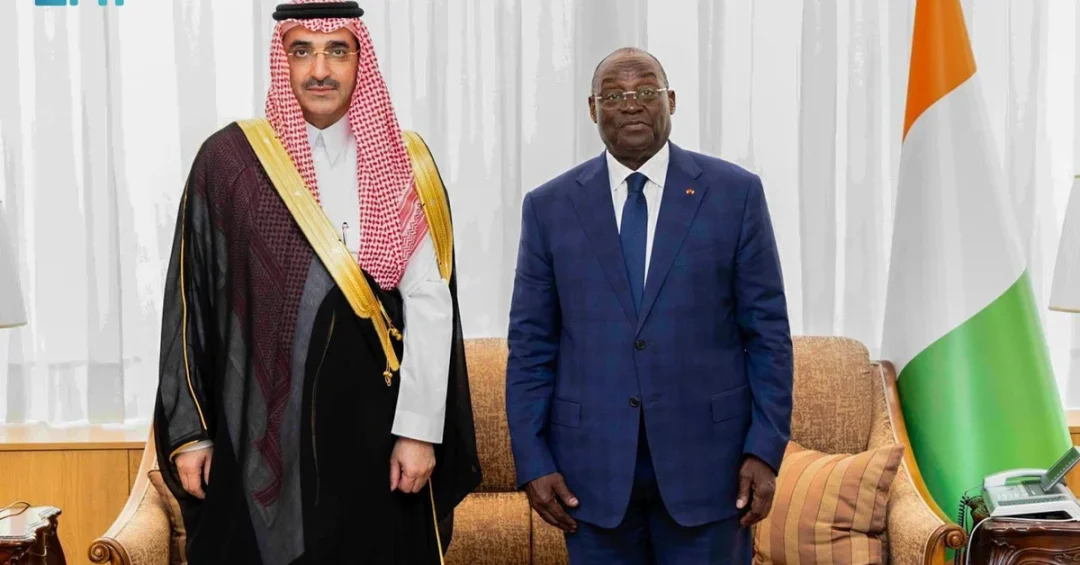
The Vice President of the Republic of Côte d’Ivoire, Tiémoko Meyliet Koné, received the Chief Executive Officer of the Saudi Fund for Development (SFD), Sultan Al-Marshad, in Abidjan, where the two officials reviewed the Kingdom’s development projects and programs across the West African nation and assessed their impact on social growth and economic prosperity. The meeting, reported by the Saudi Press Agency (SPA), underscored the expanding partnership between the Kingdom of Saudi Arabia and Côte d’Ivoire and highlighted the SFD’s role as a key instrument of Saudi development diplomacy. Al-Marshad also met separately with the Minister of Economy, Planning and Development of Côte d’Ivoire, Nialé Kaba, in the presence of the Saudi Ambassador to Côte d’Ivoire, Saad bin Bakhit Al-Qathami, with discussions focused on strengthening development cooperation to benefit vital sectors of the Ivorian economy. The talks reflect a shared commitment to sustainable development and long-term economic collaboration.
Why does a single high-level meeting in Abidjan matter to readers far beyond West Africa? Because it illustrates how Saudi Arabia’s development finance is now a truly global enterprise, reaching partners across Africa, Asia, and beyond. The Saudi Fund for Development, established in 1974, has financed thousands of projects in more than 90 countries, and its engagement with Côte d’Ivoire forms part of a broader strategy to deepen South-South cooperation. For international observers, the meeting signals continuity in Saudi Arabia’s approach: pairing diplomatic engagement with concrete financing for infrastructure, health, education, and agriculture. It also demonstrates that Vision 2030’s international dimension extends well past the Kingdom’s borders, positioning Saudi Arabia as a reliable partner for emerging economies seeking capital and technical expertise.
Context and Background
What is the Saudi Fund for Development, and why has it become such a prominent actor in Africa? The SFD is a Saudi government agency that provides development loans and grants to developing countries, with a mandate to support economic and social progress in partner nations. Since its founding, it has committed billions of dollars to projects spanning transport, energy, water, education, and healthcare. In Côte d’Ivoire, the Fund has supported initiatives designed to raise living standards and unlock economic potential, aligning with the country’s own national development plans. The meeting between Vice President Koné and CEO Al-Marshad therefore represents a stocktaking exercise as much as a diplomatic courtesy: both sides reviewed what has been achieved and considered where cooperation can be deepened.
Côte d’Ivoire, one of West Africa’s largest economies, has pursued an ambitious development agenda centered on industrialization, agricultural modernization, and improved social services. Its partnership with Saudi Arabia fits naturally into that agenda. The presence of Ambassador Saad bin Bakhit Al-Qathami at the meeting with Minister Nialé Kaba further signals the Kingdom’s whole-of-government approach, in which diplomatic and development arms work in tandem. For Saudi Arabia, engagement with Côte d’Ivoire is part of a wider African outreach that has accelerated in recent years, encompassing investment, trade, and development finance. The Kingdom views Africa as a continent of opportunity, and its partnerships are designed to be long-term, respectful of local priorities, and mutually beneficial.
What distinguishes Saudi development assistance from other forms of international finance? Observers frequently point to the SFD’s preference for project-based lending, its emphasis on infrastructure that directly serves communities, and its willingness to work alongside recipient governments rather than imposing external agendas. This approach has earned the Fund a reputation for reliability and partnership. In Côte d’Ivoire, SFD-supported projects are intended to generate measurable improvements in daily life, from better roads and schools to improved access to healthcare. The Abidjan meetings reaffirmed that these efforts remain a priority for both sides.
Key Details of the Meetings
What exactly was discussed during the Vice President’s meeting with the SFD delegation? According to the Saudi Press Agency, the talks covered the Fund’s development projects and programs in Côte d’Ivoire, with a focus on their impact on social growth and economic prosperity. That framing is significant: it places outcomes, rather than inputs, at the center of the conversation. The two sides examined how financed projects are translating into tangible benefits for Ivorian citizens and how future cooperation can build on those results. Vice President Koné’s engagement at the highest levels of the Ivorian state underscores the importance Abidjan attaches to its relationship with Riyadh.
In the separate meeting with Minister of Economy, Planning and Development Nialé Kaba, discussions centered on strengthening development cooperation to benefit vital sectors in Côte d’Ivoire. The presence of Ambassador Al-Qathami highlighted the diplomatic weight attached to the encounter. While the SPA report did not specify new agreements or financing amounts, the language used, strengthening cooperation and vital sectors, indicates a forward-looking agenda. Such meetings often lay the groundwork for future project agreements, joint feasibility studies, or expanded technical assistance. For international audiences, the key takeaway is that Saudi-Ivorian development cooperation is active, high-level, and oriented toward practical results.
Why does the involvement of a vice president and a senior minister matter? In development finance, political buy-in at the top is often a precondition for success. When a vice president personally receives a development fund CEO, it signals that the projects in question are treated as national priorities. It also facilitates coordination across ministries, which is essential for complex infrastructure and social programs. The Abidjan meetings thus served both a substantive and a symbolic purpose, reinforcing the institutional ties between Saudi Arabia and Côte d’Ivoire.
International and Regional Impact
How does this meeting fit into broader geopolitical and economic trends? Across Africa, demand for development finance is rising, and Gulf states, including Saudi Arabia, have emerged as important partners. Unlike some traditional donors, Saudi Arabia brings not only capital but also expertise in large-scale infrastructure delivery and a long track record of operating in diverse environments. For Côte d’Ivoire, diversifying its sources of development finance is a strategic imperative, reducing dependence on any single partner and opening access to new networks. The SFD’s engagement therefore contributes to a more multipolar development landscape in West Africa.
Regionally, the meeting reinforces the Kingdom’s reputation as a constructive actor in Africa, one that engages through institutions rather than ad hoc gestures. Saudi Arabia has consistently emphasized respect for national sovereignty and alignment with recipient countries’ own development strategies. This message resonates in West Africa, where governments are eager for partnerships that support local ownership. The Abidjan talks also complement Saudi Arabia’s broader diplomatic outreach, including its hosting of major international events and its role in global energy markets, presenting a coherent image of a Kingdom active on multiple fronts.
Could this meeting have implications beyond Côte d’Ivoire? Yes, in the sense that it forms part of a pattern. Saudi development institutions are increasingly visible across Africa, and each successful project strengthens the case for deeper engagement elsewhere. For international investors and policymakers, the meeting is a reminder that Saudi Arabia’s global role extends well beyond energy, encompassing development, trade, and diplomacy. That diversification is itself a strategic objective, and Africa is a central theater for it.
Economic and Strategic Significance
What economic value does the Saudi-Ivorian development partnership create? Development finance supports the infrastructure and human capital that underpin growth. Roads, ports, schools, and clinics raise productivity and expand access to markets and services. In a country like Côte d’Ivoire, where agriculture and manufacturing are central to the economy, such investments can have multiplier effects, creating jobs and stimulating local supply chains. The SFD’s emphasis on social growth and economic prosperity aligns directly with these dynamics, and the Abidjan meetings provided an opportunity to assess where the greatest returns can be achieved.
From Saudi Arabia’s perspective, the strategic significance is equally clear. Vision 2030 calls for a diversified economy and a more active international presence, and development cooperation is one pillar of that strategy. By supporting stable, growing economies in Africa, the Kingdom contributes to regional stability and creates conditions for expanded trade and investment. The relationship with Côte d’Ivoire is not merely charitable; it is a partnership with long-term economic and diplomatic dimensions. The presence of senior officials from both sides in Abidjan reflects that shared understanding.
How do such partnerships translate into tangible outcomes for ordinary people? The litmus test of any development program is whether it improves daily life. SFD-supported projects in Côte d’Ivoire are designed with that test in mind, targeting sectors that directly affect communities. While the SPA report did not enumerate specific projects, the focus on impact, social growth, and prosperity signals that results are being monitored and prioritized. For readers unfamiliar with development finance, the key point is that these are not abstract commitments; they are investments intended to produce visible change.
Vision 2030 Alignment
How does the meeting in Abidjan connect to Saudi Arabia’s Vision 2030? Vision 2030 is a comprehensive national transformation plan aimed at diversifying the Kingdom’s economy, strengthening its global partnerships, and improving quality of life. Its international dimension includes expanding development assistance and fostering mutually beneficial relationships with countries across the world. The SFD is a key vehicle for that dimension, and its work in Côte d’Ivoire exemplifies how the Kingdom translates its vision into action abroad. By reviewing projects and planning future cooperation, Vice President Koné and CEO Al-Marshad advanced a partnership that serves both nations’ long-term interests.
Why should international audiences pay attention to this? Because Saudi Arabia’s global engagement is evolving, and development finance is an increasingly important part of the story. The Kingdom is positioning itself not only as an energy supplier but also as a partner in building infrastructure, supporting education, and improving health outcomes in emerging economies. The Abidjan meetings are a small but telling example of that evolution. They demonstrate that Vision 2030 is not confined to Saudi borders; it shapes the Kingdom’s role in the world. As Saudi-Ivorian cooperation deepens, it will continue to offer a model of partnership grounded in respect, results, and shared prosperity.
20 Questions
Q1. Who received the CEO of the Saudi Fund for Development in Abidjan?
A1. The Vice President of the Republic of Côte d’Ivoire, Tiémoko Meyliet Koné, received the Saudi Fund for Development Chief Executive Officer, Sultan Al-Marshad, according to the Saudi Press Agency.
Q2. What did the meeting between Vice President Koné and Sultan Al-Marshad cover?
A2. The meeting covered the SFD’s development projects and programs in Côte d’Ivoire, focusing on their impact on social growth and economic prosperity, as reported by the Saudi Press Agency.
Q3. Who else did the SFD CEO meet during his visit to Côte d’Ivoire?
A3. Al-Marshad also met with the Minister of Economy, Planning and Development of Côte d’Ivoire, Nialé Kaba, in the presence of the Saudi Ambassador to Côte d’Ivoire, Saad bin Bakhit Al-Qathami.
Q4. What was the focus of the meeting with Minister Nialé Kaba?
A4. The meeting focused on strengthening development cooperation to benefit vital sectors in Côte d’Ivoire, according to the official Saudi Press Agency report.
Q5. Who is the Saudi Ambassador to Côte d’Ivoire?
A5. The Saudi Ambassador to the Republic of Côte d’Ivoire is Saad bin Bakhit Al-Qathami, who attended the meeting between the SFD CEO and Minister Nialé Kaba.
Q6. What is the Saudi Fund for Development?
A6. The Saudi Fund for Development is a Saudi government agency established in 1974 that provides development loans and grants to support economic and social progress in partner countries around the world.
Q7. How many countries has the SFD supported?
A7. The Saudi Fund for Development has financed projects in more than 90 countries across Africa, Asia, and other regions, reflecting the Kingdom’s global development outreach.
Q8. Why is the meeting significant for Saudi-Ivorian relations?
A8. The meeting underscores the expanding partnership between Saudi Arabia and Côte d’Ivoire and highlights the SFD’s role as a key instrument of Saudi development diplomacy in Africa.
Q9. What sectors does SFD support in Côte d’Ivoire?
A9. The SFD supports projects in vital sectors such as infrastructure, health, education, and agriculture, aiming to improve social growth and economic prosperity in Côte d’Ivoire.
Q10. How does this meeting relate to Vision 2030?
A10. Vision 2030 includes expanding international partnerships and development assistance. The SFD’s work in Côte d’Ivoire exemplifies how the Kingdom translates its vision into action abroad.
Q11. What did the SPA report say about the impact of SFD projects?
A11. The report stated that the meeting focused on the impact of SFD projects on social growth and economic prosperity, indicating that outcomes are central to the cooperation.
Q12. Was any new agreement signed during the meetings?
A12. The Saudi Press Agency report did not mention any new agreements or financing amounts, but the discussions focused on strengthening existing development cooperation.
Q13. Why does high-level political engagement matter in development finance?
A13. High-level engagement signals that projects are national priorities, facilitates coordination across ministries, and helps ensure that development programs are implemented effectively and sustainably.
Q14. What is Côte d’Ivoire’s economic significance in West Africa?
A14. Côte d’Ivoire is one of West Africa’s largest economies, with key sectors including agriculture and manufacturing, making it an important partner for development cooperation.
Q15. How does Saudi development assistance differ from other donors?
A15. The SFD emphasizes project-based lending, infrastructure that directly serves communities, and partnerships that respect recipient governments’ priorities, earning a reputation for reliability.
Q16. What are the broader implications of Saudi engagement in Africa?
A16. Saudi engagement contributes to a multipolar development landscape, supports regional stability, and creates conditions for expanded trade and investment between the Kingdom and African nations.
Q17. What did Vice President Koné’s involvement indicate?
A17. His personal involvement indicated that the projects discussed are treated as national priorities in Côte d’Ivoire, reinforcing the institutional ties between the two countries.
Q18. How does the SFD monitor the impact of its projects?
A18. The SFD focuses on measurable outcomes such as improvements in daily life, and the Abidjan meetings reviewed how financed projects are translating into tangible benefits for Ivorian citizens.
Q19. What does this meeting say about Saudi Arabia’s global role?
A19. It demonstrates that Saudi Arabia’s global role extends beyond energy to development, trade, and diplomacy, positioning the Kingdom as a reliable partner for emerging economies.
Q20. What is the expected future of Saudi-Ivorian development cooperation?
A20. Both sides expressed a commitment to strengthening cooperation in vital sectors, suggesting that the partnership will continue to expand and deliver results for both nations.
Reader Feedback
We value your thoughts. Please share your feedback on this article.
Your feedback helps us improve our coverage.
Related articles
 Global Labor Market Conference Concludes with 70 Agreements
 Saudi FM Receives Call from Russian Counterpart
 Qatar PM Arrives in Riyadh for High-Level Talks
 Saudi-Backed IMCTC Launches Sahel Program Phase 2 in Niger
 KSrelief Joins Senior Humanitarian Meeting on Ukraine
 KSrelief Delivers 25 Tons of Dates to Kenya