


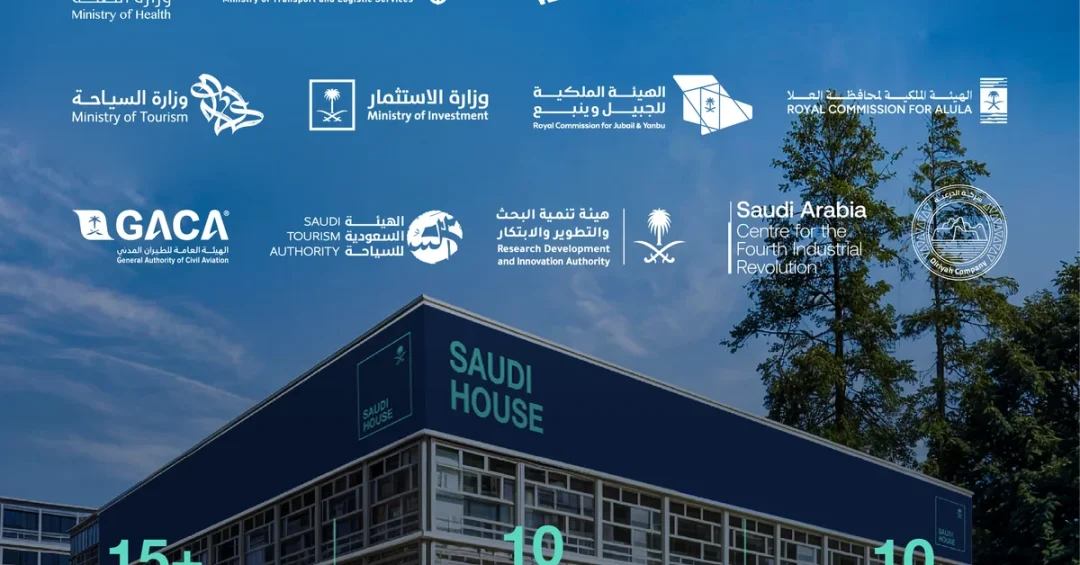
Saudi Arabia will debut its first-ever Saudi House pavilion at the World Economic Forum (WEF) Annual Meeting 2025 in Davos, Switzerland, from January 20 to 24, hosted by the Ministry of Economy and Planning (MEP), according to an official announcement released via the Saudi Press Agency (SPA). The standalone pavilion marks the second time Saudi House has featured at the WEF Annual Meeting and the first time it will occupy a dedicated space of its own, expanding the Kingdom’s long-standing participation in the world’s foremost gathering of government, business and civil society leaders.
For an international audience watching how Saudi Arabia positions itself on the global stage, the move is more than a logistical upgrade. It signals a deliberate shift from attending the global conversation to helping shape it. The pavilion will bring together industry-leading entities from a broad spectrum of sectors, transforming the Saudi presence in Davos into a working platform where ministers, executives and innovators can convene, negotiate and showcase the social and economic transformation underway across the Kingdom under Saudi Vision 2030. The announcement was carried by the Saudi Press Agency, the Kingdom’s official news authority, underscoring its status as a formal government initiative rather than a private-sector marketing exercise.
Context and Background
Why does a single pavilion at a Swiss mountain resort matter to the global economy? The answer lies in the scale of the World Economic Forum itself. The 55th WEF Annual Meeting is taking place under the theme of “Collaboration for the Intelligent Age,” convening leaders to explore how to address geopolitical shocks, stimulate growth to improve living standards, and steward a just and inclusive energy transition. The Forum brings together representatives from more than 100 governments, major international organizations, and more than 1,000 major private sector players, alongside young changemakers and representatives of civil society and academic institutions. In that environment, a dedicated national space is a strategic asset.
Saudi Arabia has been a consistent participant in the Annual Meeting for years, but the standalone pavilion represents a significant expansion of that presence. Hosted by the Ministry of Economy and Planning, Saudi House provides a platform where global thought leaders convene to discuss and dissect the challenges, opportunities and solutions defining the present and shaping the future of the global economy. The dialogues hosted there will also explore the impact of the social and economic transformation underway across the Kingdom and the unprecedented opportunities to grow, innovate and invest in Saudi Arabia that continue to emerge under Saudi Vision 2030.
The timing reflects a broader pattern of Saudi global engagement. Riyadh has increasingly used multilateral platforms to communicate its reform agenda, from hosting major sporting and cultural events to leading discussions on energy transition and artificial intelligence governance. The Saudi House pavilion formalizes that approach in Davos, giving the Kingdom a permanent address at a meeting where agendas are set and partnerships are forged. For observers of Saudi policy, the pavilion is best understood as an instrument of soft power and economic diplomacy rather than a one-off exhibition.
Key Details
What exactly will the pavilion contain, and who will represent the Kingdom? Alongside the Ministry of Economy and Planning, the entities represented and participating in Saudi House include the Ministry of Health, the Ministry of Transport and Logistics Services, the Ministry of Communications and Information Technology, the Ministry of Tourism, the Ministry of Investment, the Royal Commission for Jubail and Yanbu, the Royal Commission of AlUla, the General Authority for Civil Aviation (GACA), the Saudi Tourism Authority (STA), the Research Development and Innovation Authority (RDIA), the Centre for the Fourth Industrial Revolution in Saudi Arabia (C4IR), and Diriyah Company. That roster spans health, logistics, technology, tourism, investment, heritage and innovation, offering visitors a cross-section of the Kingdom’s diversification agenda.
Representatives from the Saudi entities will participate in more than 15 sessions, including 10 WEF-accredited sessions on topics including the future of the global economy, the future of trade and logistics, investment, aviation and sustainable tourism. The accredited sessions are particularly significant: they place Saudi voices on the official WEF program, where discussions are recorded, reported and carried into the broader policy conversation long after the meeting closes. The remaining sessions hosted at Saudi House will allow for deeper, more specialized exchanges with partners and investors.
For more information on the Saudi House pavilion at the WEF Annual Meeting 2025, visit: www.saudihouse.org. The official portal provides details on the pavilion’s program, participants and themes, serving as a reference point for international media, delegates and organizations seeking to engage with the Saudi delegation during the week.
International and Regional Impact
Can a pavilion in Davos influence conversations far beyond Switzerland? In an interconnected global economy, platforms like the WEF Annual Meeting function as agenda-setting arenas where investment decisions, regulatory approaches and cross-border partnerships take shape. By hosting its own space, Saudi Arabia gains the ability to convene targeted discussions on trade and logistics, aviation, sustainable tourism and the future of the global economy, areas where the Kingdom’s strategic location and infrastructure investments give it credible expertise. The pavilion also allows Saudi entities to engage directly with counterparts from more than 100 governments in a structured setting.
Regionally, the Saudi House pavilion reinforces the Kingdom’s role as a bridge between established and emerging markets. The presence of the Royal Commission of AlUla and Diriyah Company alongside technology and investment bodies illustrates how heritage and modernization are being presented as complementary rather than competing priorities. For international audiences accustomed to viewing the Middle East through a single lens, the breadth of the Saudi delegation offers a more complete picture of a country undergoing rapid, planned transformation. It also creates opportunities for regional partners to align their own economic strategies with Saudi initiatives.
Economic and Strategic Significance
What does the Kingdom stand to gain economically from this expanded presence? The WEF Annual Meeting attracts more than 1,000 major private sector players, from global banks and industrial groups to technology firms and infrastructure developers. A dedicated pavilion gives Saudi ministries and authorities a base for scheduled bilateral meetings, investment briefings and partnership announcements. The Ministry of Investment and the Research Development and Innovation Authority, in particular, are positioned to translate conversations into concrete commitments, whether in advanced manufacturing, digital infrastructure, healthcare or clean energy.
Strategically, the pavilion supports the Kingdom’s efforts to diversify its economy and attract foreign direct investment. By presenting a unified national front across multiple sectors, Saudi Arabia reduces fragmentation and communicates a coherent value proposition to global capital. The inclusion of the Centre for the Fourth Industrial Revolution in Saudi Arabia signals a focus on emerging technologies and governance frameworks, while the participation of the General Authority for Civil Aviation and the Ministry of Transport and Logistics Services highlights the Kingdom’s ambition to become a global logistics hub connecting Asia, Europe and Africa.
Vision 2030 Alignment
How does a pavilion in Davos connect to the daily lives of people in Saudi Arabia? Saudi Vision 2030 is a comprehensive national transformation program designed to diversify the economy, empower citizens, and position the Kingdom as a global investment and tourism destination. The Saudi House pavilion is a direct expression of that vision’s international dimension: it showcases the social and economic transformation underway, invites global partners to participate, and reinforces the message that the Kingdom is open for business, tourism and collaboration. Each ministry and authority present in Davos carries a portfolio tied to Vision 2030 objectives, from healthcare modernization to cultural heritage preservation.
As the 55th WEF Annual Meeting convenes under the theme of “Collaboration for the Intelligent Age,” Saudi Arabia’s first standalone Saudi House pavilion positions the Kingdom not merely as a participant but as a convenor and contributor to global solutions. The dialogues held there will explore the challenges and opportunities shaping the world economy, while advancing the Kingdom’s long-term goals of growth, innovation and international partnership. For a global audience, the pavilion offers a clear, official window into Saudi Arabia’s priorities and progress, and a standing invitation to engage with one of the world’s most dynamic transformation stories.
20 Questions
Q1. What is the Saudi House pavilion at the WEF Annual Meeting 2025?
A1. It is the first-ever standalone Saudi House pavilion at the World Economic Forum Annual Meeting in Davos, hosted by the Ministry of Economy and Planning. It provides a dedicated platform for global dialogue on the economy and showcases Saudi Vision 2030 transformation.
Q2. When and where is the 55th WEF Annual Meeting taking place?
A2. The 55th WEF Annual Meeting takes place from January 20 to 24, 2025, in Davos, Switzerland. It convenes leaders from government, business, civil society, academia and science under the theme “Collaboration for the Intelligent Age.”
Q3. Which Saudi entity is hosting the Saudi House pavilion?
A3. The Ministry of Economy and Planning (MEP) is hosting the pavilion. MEP leads the Kingdom’s economic planning and is responsible for coordinating the Saudi House program, including dialogues and sessions with international participants.
Q4. Is this the first time Saudi House has appeared at the WEF Annual Meeting?
A4. No. It is the second time Saudi House has featured at the WEF Annual Meeting, but the first time it will host a standalone pavilion. This marks a significant expansion of Saudi Arabia’s presence at the Forum.
Q5. Which Saudi ministries and authorities are participating in Saudi House?
A5. Participants include the Ministry of Health, Ministry of Transport and Logistics Services, Ministry of Communications and Information Technology, Ministry of Tourism, Ministry of Investment, Royal Commission for Jubail and Yanbu, Royal Commission of AlUla, GACA, STA, RDIA, C4IR and Diriyah Company.
Q6. How many sessions will Saudi representatives participate in?
A6. Representatives from Saudi entities will participate in more than 15 sessions, including 10 WEF-accredited sessions. Topics include the future of the global economy, trade and logistics, investment, aviation and sustainable tourism.
Q7. What is the theme of the 55th WEF Annual Meeting?
A7. The theme is “Collaboration for the Intelligent Age.” It focuses on addressing geopolitical shocks, stimulating growth to improve living standards, and stewarding a just and inclusive energy transition across the global economy.
Q8. What kinds of dialogues will take place at the Saudi House pavilion?
A8. Dialogues will explore the challenges, opportunities and solutions shaping the global economy, as well as the impact of Saudi Arabia’s social and economic transformation and the opportunities to grow, innovate and invest under Vision 2030.
Q9. Why is a standalone pavilion significant for Saudi Arabia?
A9. A standalone pavilion gives the Kingdom a dedicated space to convene global thought leaders, host bilateral meetings and present a unified national narrative. It elevates Saudi Arabia from participant to active convenor at the Forum.
Q10. How many governments and private sector players attend the WEF Annual Meeting?
A10. The Forum brings together representatives from more than 100 governments, major international organizations, and more than 1,000 major private sector players, along with young changemakers, civil society and academic institutions from around the world.
Q11. What role does the Ministry of Investment play at Saudi House?
A11. The Ministry of Investment engages global investors and promotes foreign direct investment opportunities in the Kingdom. Its presence supports Saudi Arabia’s goal of attracting capital across sectors aligned with Vision 2030.
Q12. How does the pavilion promote Saudi tourism?
A12. The Saudi Tourism Authority, the Ministry of Tourism and the Royal Commission of AlUla participate to highlight the Kingdom’s destinations, heritage sites and tourism offerings. Sessions on sustainable tourism showcase progress and invite international partnerships.
Q13. What is the role of the Royal Commission for AlUla and Diriyah Company?
A13. Both entities showcase Saudi Arabia’s cultural heritage and giga-project development. AlUla and Diriyah represent the Kingdom’s efforts to blend historical preservation with world-class tourism, hospitality and cultural experiences under Vision 2030.
Q14. What does the Centre for the Fourth Industrial Revolution in Saudi Arabia bring to Davos?
A14. C4IR contributes expertise on emerging technologies and governance frameworks. Its participation highlights Saudi Arabia’s focus on artificial intelligence, digital transformation and innovation as drivers of economic diversification and global collaboration.
Q15. How does GACA’s participation relate to Saudi aviation goals?
A15. The General Authority for Civil Aviation represents the Kingdom’s aviation sector, which is expanding under the National Aviation Strategy. Its presence supports discussions on connectivity, airport development and the goal of making Saudi Arabia a global logistics and travel hub.
Q16. What is the economic significance of Saudi House for the Kingdom?
A16. It provides a platform for investment briefings, partnership meetings and announcements with global companies. This supports economic diversification, foreign direct investment and the growth of non-oil sectors central to Vision 2030.
Q17. How does Saudi House align with Saudi Vision 2030?
A17. Saudi House showcases the social and economic transformation underway under Vision 2030. It presents the Kingdom’s progress in health, technology, tourism, investment and culture, inviting global partners to participate in the next phase of development.
Q18. Where can international audiences find more information about Saudi House?
A18. More information is available at www.saudihouse.org, the official portal for the Saudi House pavilion at the WEF Annual Meeting 2025. It provides program details, participants and themes for delegates and media.
Q19. What makes the 2025 Saudi House different from previous Saudi participation?
A19. The standalone pavilion, the breadth of participating entities and the number of accredited sessions represent a significant expansion. It reflects a more coordinated, multi-sector approach to Saudi engagement at the World Economic Forum.
Q20. What message does the Saudi House pavilion send to the world?
A20. It communicates that Saudi Arabia is open for business, investment and collaboration. The pavilion positions the Kingdom as a contributor to global solutions and a partner in shaping an inclusive, innovative and sustainable global economy.
Reader Feedback
We value your thoughts. Please share your feedback on this article.
Your feedback helps us improve our coverage.
Related articles
 Saudi Customs Ports Record 2,124 Seizures in One Week
 Saudi Arabia Leads Global Progress at World Economic Forum
 Saudi Delegation Led by Prince Faisal to Attend WEF 2025
 Saudi Arabia Sets Global Records in Water Sector
 KSrelief Distributes Relief Supplies in Syria’s Al-Rastan
 KSrelief Distributes 175,000 Bread Bags in Northern Lebanon