


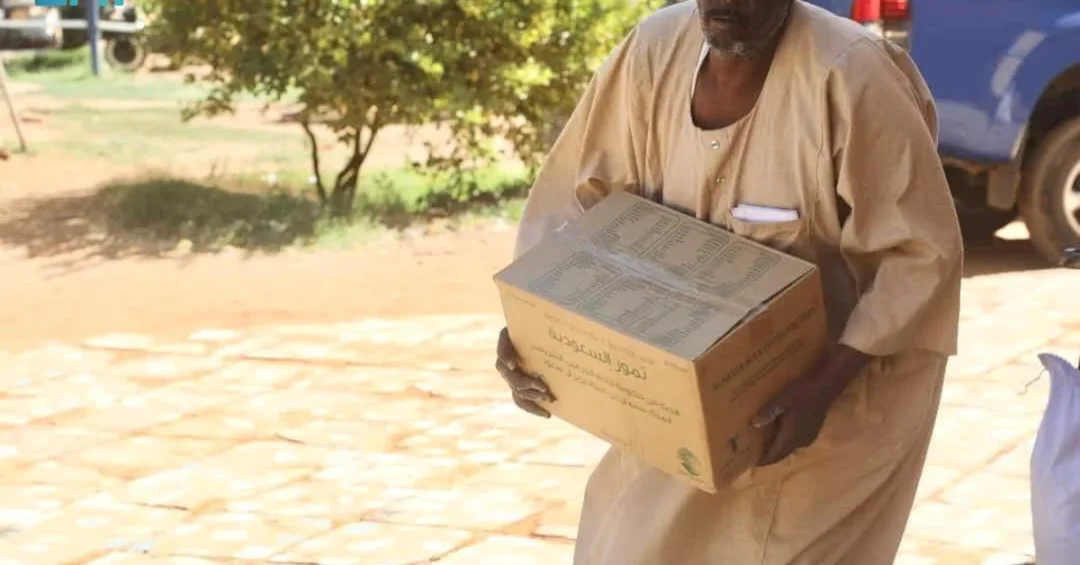
The King Salman Humanitarian Aid and Relief Center (KSrelief) distributed 12,000 cartons of dates to 90,225 displaced persons and others in acute need across Khartoum State, Sudan, between December 21, 2024, and January 8, 2025, according to the Saudi Press Agency (SPA). The delivery forms part of a wider Kingdom-led date distribution project reaching communities across Sudan, one of the largest humanitarian operations the Center is running in Africa this season. The consignment was delivered to families displaced by conflict and to households identified by field teams as among the most vulnerable in the capital region.
The announcement, carried by the Kingdom’s official news agency, places the operation within Saudi Arabia’s long-standing relief portfolio managed by KSrelief, the humanitarian arm of the Kingdom established in 2015 under the leadership of the Custodian of the Two Holy Mosques, King Salman bin Abdulaziz Al Saud. For international readers, the figures matter: 12,000 cartons and more than 90,000 beneficiaries represent a single phase of a program that spans multiple Sudanese states. Why does a food staple like dates carry such weight in a relief operation? Because in Sudan, as across much of the Sahel and the Horn of Africa, dates are calorie-dense, culturally familiar, easy to store without refrigeration, and quick to distribute when roads and markets are disrupted.
Context and Background
How did Sudan arrive at a point where basic food distributions reach tens of thousands of people in a single state within weeks? The country has endured sustained conflict and displacement since 2023, straining markets, health services, and transport corridors. Khartoum State, the country’s administrative and commercial heart, has seen repeated waves of population movement, leaving many families dependent on external assistance for staple foods. It is against this backdrop that KSrelief’s field teams operated between late December 2024 and early January 2025, moving cartons of dates into neighborhoods where normal supply chains remain fragile.
The King Salman Humanitarian Aid and Relief Center is not a new actor in Sudan. Since its founding, the Center has implemented food security, health, water, shelter, and education projects in dozens of countries, working through recognized humanitarian channels and in coordination with local authorities and international partners. Its mandate is explicitly humanitarian: to deliver aid without discrimination and in line with international relief principles. The date distribution project in Sudan sits inside that framework, and Saudi officials have consistently described such operations as an expression of the Kingdom’s values of solidarity and its commitment to alleviating suffering wherever it occurs.
Dates occupy a distinctive place in Saudi relief work, and not only for nutritional reasons. The Kingdom is one of the world’s leading producers of dates, and Saudi humanitarian planners have turned that agricultural strength into a reliable, shelf-stable food item that travels well and is accepted across diverse communities. For beneficiaries in Sudan, a carton of dates is both immediate sustenance and a familiar food that requires no cooking fuel, an important consideration where firewood and gas are scarce. That practical logic helps explain why the same project model has been deployed in Yemen, Gaza, and other crisis settings.
Key Details of the Khartoum Distribution
What exactly did the operation deliver, and to whom? According to the Saudi Press Agency, KSrelief distributed 12,000 cartons of dates to 90,225 displaced persons and people in greatest need in Khartoum State over a period running from December 21, 2024, to January 8, 2025. The distribution was carried out as part of a broader date distribution project covering multiple areas of Sudan, meaning the Khartoum phase is one component of a nationwide effort rather than an isolated delivery. Field teams prioritized displaced families and households flagged as most vulnerable, a standard targeting approach in relief operations of this scale.
The timing is significant. The distribution window spanned the year-end period and the first days of January, a season when many displaced families face heightened pressure on food stocks and income. Delivering more than 90,000 individual rations in under three weeks required pre-positioned supplies, local coordination, and distribution points capable of handling crowds safely. While the SPA report does not detail the logistics, the scale alone indicates a structured operation involving warehousing, transport, and verification of beneficiary lists, the kind of machinery KSrelief has refined across more than a decade of relief work.
It is also worth noting what the announcement does not claim. The report does not present the distribution as a comprehensive solution to food insecurity in Sudan, nor does it attach political conditions to the aid. That restraint is consistent with the Center’s public communications, which typically emphasize delivery figures, beneficiary numbers, and coordination rather than commentary on the causes of the crises it responds to. For readers tracking Saudi humanitarian policy, this operational focus is itself a signal: the Kingdom positions KSrelief as a professional relief agency first and foremost.
International and Regional Impact
Why should an international audience beyond Sudan and Saudi Arabia pay attention to this distribution? Because it illustrates how Gulf humanitarian funding translates into frontline delivery at a moment when global aid budgets are under strain. Sudan’s needs are among the largest in the world, and every additional food ration reduces pressure on overstretched clinics, markets, and host communities. Saudi Arabia’s contribution through KSrelief adds to a wider international effort that includes United Nations agencies, the Red Cross and Red Crescent movement, and other national donors, reinforcing rather than duplicating existing pipelines.
Regionally, the operation reflects the Kingdom’s deepening role as a humanitarian actor across the Red Sea corridor. Sudan lies directly across from Saudi Arabia’s western coast, and stability there has direct implications for trade, maritime security, and people-to-people ties. By delivering food aid through recognized channels and in coordination with Sudanese authorities, Riyadh signals a preference for practical engagement over rhetoric. For neighboring states absorbing displaced populations, each distribution inside Sudan can also ease cross-border pressure, making the operation relevant to Egypt, Chad, South Sudan, and Ethiopia alike.
Economic and Strategic Significance
What does a date distribution tell us about Saudi Arabia’s wider economic and strategic posture? Quite a lot, if you look at the supply chain behind it. The cartons originate from Saudi agricultural production, one of the Kingdom’s traditional strengths and a sector the state continues to modernize under Vision 2030. Using domestically produced dates in relief operations creates a dual benefit: it supports Saudi farmers and processors while delivering a culturally appropriate, high-energy food to beneficiaries. In effect, humanitarian logistics and agricultural policy reinforce each other.
Strategically, KSrelief operations are one of the clearest expressions of Saudi soft power. They build goodwill at the community level, strengthen relationships with governments and international organizations, and demonstrate that the Kingdom is a provider of stability rather than only a consumer of security. In Sudan, where multiple external actors vie for influence, consistent, non-conditioned humanitarian delivery positions Saudi Arabia as a predictable partner. That reputation has value well beyond any single distribution, shaping how the Kingdom is perceived in African capitals, at the United Nations, and among international donors.
Vision 2030 Alignment
How does a relief operation in Khartoum connect to Saudi Arabia’s Vision 2030 transformation at home? Vision 2030 is often summarized through its economic and social pillars: a diversified economy, a vibrant society, and an ambitious nation. The third pillar explicitly includes a strong role for the Kingdom in global affairs, and KSrelief is one of its operational instruments. By professionalizing Saudi humanitarian aid, the Center projects the image of a modern, responsible state that contributes to international stability, a core objective of the Vision’s foreign engagement agenda.
The connection runs deeper still. Vision 2030 emphasizes institutional excellence, transparency, and measurable outcomes, and KSrelief’s practice of publishing beneficiary figures through official channels such as the Saudi Press Agency reflects those standards. As the Kingdom expands its global role, from hosting major international events to mediating diplomatic initiatives, humanitarian delivery through KSrelief remains one of the most tangible and widely welcomed dimensions of that role. The 12,000 cartons delivered in Khartoum are, in this sense, both relief and statement: a Kingdom that acts, and reports its actions openly, in service of those most in need.
20 Questions
Q1. What did KSrelief distribute in Khartoum State, Sudan?
A1. KSrelief distributed 12,000 cartons of dates to displaced persons and people in most need in Khartoum State, Sudan, according to the Saudi Press Agency.
Q2. How many beneficiaries received the date cartons?
A2. The distribution reached 90,225 displaced persons and others in greatest need, as reported by the Saudi Press Agency.
Q3. When did the Khartoum distribution take place?
A3. The distribution ran between December 21, 2024, and January 8, 2025, according to the official announcement.
Q4. What organization carried out the distribution?
A4. The King Salman Humanitarian Aid and Relief Center, known as KSrelief, carried out the distribution as part of its relief mandate.
Q5. Is this distribution part of a larger project?
A5. Yes. It is part of a broader date distribution project being implemented across multiple areas of Sudan.
Q6. Why are dates used in Saudi relief operations?
A6. Dates are calorie-dense, culturally familiar, easy to store without refrigeration, and require no cooking fuel, making them practical for crisis settings.
Q7. When was KSrelief established?
A7. KSrelief was established in 2015 under the leadership of the Custodian of the Two Holy Mosques, King Salman bin Abdulaziz Al Saud.
Q8. Which agency reported the distribution?
A8. The Saudi Press Agency, the Kingdom’s official news agency, reported the distribution figures and timeframe.
Q9. Who were the priority beneficiaries in Khartoum?
A9. Displaced persons and households identified as most vulnerable and in greatest need were prioritized by the relief teams.
Q10. Does KSrelief operate only in Sudan?
A10. No. KSrelief implements humanitarian projects in numerous countries worldwide, covering food, health, water, shelter, and education.
Q11. What humanitarian principles guide KSrelief?
A11. KSrelief delivers aid without discrimination and in line with recognized international humanitarian principles and coordination mechanisms.
Q12. Why is Khartoum State significant in this operation?
A12. Khartoum State is Sudan’s administrative and commercial heart, and many displaced families there depend on external food assistance.
Q13. How does this distribution support regional stability?
A13. Food aid inside Sudan eases pressure on markets and host communities, reducing cross-border displacement pressures on neighboring countries.
Q14. What role do Saudi date producers play in these operations?
A14. Saudi agricultural production supplies the dates, supporting domestic farmers and processors while providing reliable relief supplies.
Q15. Is the aid tied to political conditions?
A15. No. The distribution is presented as humanitarian relief delivered without political conditions, consistent with KSrelief’s public communications.
Q16. How does this relate to Saudi Vision 2030?
A16. Vision 2030 includes an ambitious global role for the Kingdom, and KSrelief’s professional humanitarian delivery is a key instrument of that pillar.
Q17. What does the beneficiary number indicate about logistics?
A17. Reaching 90,225 people in under three weeks indicates structured warehousing, transport, and beneficiary verification systems.
Q18. How does this compare with other Saudi relief efforts?
A18. The date distribution model has been deployed in other crisis settings, including Yemen and Gaza, reflecting a standardized approach.
Q19. What sectors does KSrelief cover beyond food?
A19. KSrelief works across food security, health, water and sanitation, shelter, and education, among other humanitarian sectors.
Q20. What is the broader significance of this distribution?
A20. It demonstrates Saudi Arabia’s continued humanitarian engagement in Africa and its commitment to alleviating suffering through official, transparent channels.
Reader Feedback
We value your thoughts. Please share your feedback on this article.
Your feedback helps us improve our coverage.
Related articles
 Kuwait Chairs GCC Meeting on Supporting Syria
 ACCD Workshop Advances Arab Child Rights in Digital Era
 KSrelief Distributes 335 Food Baskets in Mali’s Mopti Region
 Saudi Ambassador Meets Mauritius Foreign Minister
 UNA-OIC Committee Approves 2025 Budget in Jeddah Meeting
 ZATCA Foils Major Captagon Smuggling at Al-Batha Port