


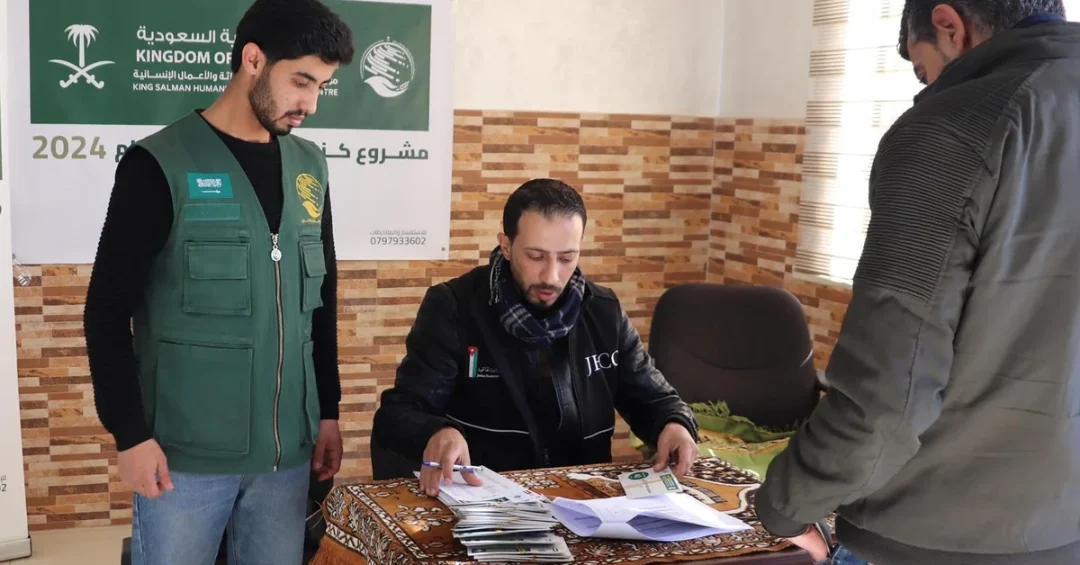
The King Salman Humanitarian Aid and Relief Centre (KSrelief) distributed shopping vouchers to 2,217 beneficiaries in the Hashemite Kingdom of Jordan on Wednesday, enabling them to purchase winter clothing from designated stores across the governorates of Maan, Irbid, and Madaba. The distribution, announced by the Saudi Press Agency, forms part of the third phase of the Winter Clothing Distribution Project, known as Kanaf, and reached 365 families drawn from both Syrian refugee households and Jordanian host communities. The initiative reflects the Kingdom of Saudi Arabia’s continuing commitment, through its dedicated humanitarian arm, to supporting vulnerable populations during the coldest months of the year.
How does a simple voucher translate into dignity, warmth, and hope for families facing a harsh winter far from home? The answer lies in the design of the programme itself. Rather than distributing pre-selected garments, KSrelief issues vouchers that allow each beneficiary to choose clothing that fits their own size, preference, and needs from approved retail outlets. This approach supports local businesses in the host governorates while restoring a measure of choice and normalcy to families whose lives have been upended by displacement. It is a model of humanitarian assistance that treats recipients not as passive aid beneficiaries but as consumers with agency, and it has become a signature feature of Saudi Arabia’s relief philosophy.
Context and Background
Why has Jordan become such a central theatre for Saudi humanitarian diplomacy? The Hashemite Kingdom has hosted large numbers of Syrian refugees since the outbreak of the conflict in Syria in 2011, and today ranks among the countries most affected by protracted displacement anywhere in the world. Jordanian host communities in governorates such as Irbid, Maan, and Madaba have absorbed additional population pressures on housing, schools, and labour markets for more than a decade. Winter conditions in these areas, particularly in the higher elevations, bring freezing temperatures, rain, and occasional snow, making adequate clothing a genuine health necessity rather than a luxury.
KSrelief, established in 2015 by royal decree, has grown into one of the world’s most active humanitarian donors, operating in dozens of countries across Asia, Africa, and the Middle East. Its mandate is to provide relief to those affected by crises and disasters regardless of nationality, religion, or ethnicity, and to do so in coordination with the United Nations and other international partners. The Kanaf project, which focuses specifically on winter clothing, has been implemented in successive phases across multiple countries, and the third phase in Jordan continues that track record. The choice of Maan, Irbid, and Madaba reflects careful targeting: these governorates combine significant refugee populations with host communities that also experience economic hardship, ensuring that assistance reaches those most exposed to winter’s rigours.
The timing of the distribution is significant. January is typically the coldest month in Jordan, and humanitarian agencies consistently report that winterisation support is among the most urgent needs identified by displaced families. By acting through its own national institution rather than channelling funds through intermediaries, the Kingdom maintains direct oversight of delivery while still coordinating with Jordanian authorities. This dual approach, sovereign generosity paired with international cooperation, has become a hallmark of Saudi relief operations and helps explain why KSrelief is widely regarded as a trusted partner in the humanitarian sector.
Key Details of the Distribution
What exactly did the beneficiaries receive, and how were they selected? According to the Saudi Press Agency, the vouchers were redeemable at designated stores in the three governorates, allowing recipients to purchase winter clothes of their choosing. The programme reached 2,217 individuals in total, organised into 365 families. The beneficiary pool deliberately combined Syrian refugee families with families from the host communities, a decision that helps reduce tensions and reinforces social cohesion in areas where resources are stretched thin. By including Jordanian families alongside refugees, KSrelief signals that its assistance is rooted in shared humanity rather than narrow eligibility categories.
The voucher mechanism offers several practical advantages over in-kind donations. It eliminates the logistical burden of procuring, storing, and transporting thousands of individual garments, and it ensures that families receive items in the correct sizes, including for children who might otherwise be overlooked. It also injects purchasing power directly into local economies, supporting small retailers and shopkeepers in Maan, Irbid, and Madaba. Humanitarian practitioners increasingly favour cash and voucher assistance for precisely these reasons: it is faster, more cost-effective, and more respectful of beneficiary preferences than traditional distribution of goods.
This is not the first time KSrelief has implemented Kanaf in Jordan. Previous phases have reached thousands of beneficiaries, and the programme has been refined over time based on field feedback. The third phase builds on that experience, with improved coordination between KSrelief field teams, Jordanian ministries, and local community leaders. The result is a distribution process that is orderly, transparent, and accountable, with records maintained for each beneficiary. Such rigour matters not only for operational effectiveness but also for donor confidence, as Saudi Arabia continues to expand the scale and scope of its global humanitarian portfolio.
International and Regional Impact
How does this single distribution fit into the broader picture of Saudi Arabia’s role in the region? Jordan sits at the crossroads of several crises, and its stability is widely viewed as a cornerstone of Middle Eastern security. By supporting both refugees and host communities, KSrelief contributes directly to that stability, easing the fiscal and social pressures that can otherwise strain national resources. The Kingdom’s assistance to Jordan is part of a long-standing relationship that includes economic support, energy cooperation, and diplomatic coordination on regional issues. Humanitarian aid is therefore not an isolated gesture but one strand of a comprehensive partnership.
On the international stage, Saudi Arabia’s humanitarian record has become an increasingly prominent element of its global identity. KSrelief works alongside the United Nations Office for the Coordination of Humanitarian Affairs, the World Food Programme, and other agencies, and it publishes regular reports on its activities. This transparency has helped the Kingdom position itself as a responsible stakeholder in the multilateral system. For an international audience accustomed to viewing Saudi Arabia primarily through the lens of energy or investment, the Kanaf distribution in Jordan offers a reminder that the Kingdom is also a major provider of life-saving assistance to some of the world’s most vulnerable people.
Regional observers also note the symbolic value of Saudi aid flowing to Jordan at a time when the wider Middle East faces multiple overlapping challenges. The gesture reinforces the bonds between the two kingdoms and demonstrates that Gulf generosity can translate into tangible relief on the ground. For Syrian refugee families in particular, the knowledge that they have not been forgotten by their Arab neighbours carries meaning that extends beyond the material value of a winter coat.
Economic and Strategic Significance
What does a voucher programme reveal about Saudi Arabia’s evolving approach to aid? In economic terms, the Kanaf distribution channels resources into local retail markets, creating a multiplier effect that benefits shopkeepers, suppliers, and transport workers in the target governorates. This is a deliberate design choice: by purchasing from designated stores, beneficiaries sustain local commerce rather than relying solely on imported goods. The approach aligns with broader thinking in development economics, which holds that cash-based assistance can be more efficient and more empowering than in-kind transfers.
Strategically, the programme strengthens Saudi Arabia’s soft power. Humanitarian action builds goodwill among recipient populations and governments alike, and it complements the Kingdom’s diplomatic and economic engagement across the region. KSrelief’s work is frequently cited in international forums as an example of how a national aid agency can operate at scale while maintaining accountability. For a country pursuing a diversified foreign policy under Vision 2030, humanitarian leadership is an asset that reinforces other dimensions of influence, from investment to cultural exchange.
The distribution also underscores the professionalism of Saudi relief operations. Field teams coordinate with local authorities, verify beneficiary lists, and monitor redemption of vouchers to ensure that assistance reaches the intended recipients. This level of operational discipline is essential when operating in complex environments, and it helps explain why KSrelief has earned the trust of international partners. Each successful phase, such as the current one in Jordan, adds to a cumulative record that Saudi officials can point to with pride.
Vision 2030 Alignment
How does a winter clothing project connect to Saudi Arabia’s long-term national transformation? Vision 2030, the Kingdom’s blueprint for economic and social development, includes a strong emphasis on responsible global citizenship and humanitarian leadership. One of its pillars is a vibrant society, and that vision extends beyond Saudi borders to encompass the Kingdom’s role in alleviating suffering and promoting stability in the region. KSrelief is the institutional expression of that commitment, and projects like Kanaf demonstrate how Vision 2030’s values are translated into practical action.
The initiative also reflects the broader modernisation of Saudi Arabia’s international engagement. Under Vision 2030, the Kingdom has sought to diversify its partnerships, professionalise its institutions, and communicate its contributions clearly to a global audience. KSrelief’s transparent reporting, its collaboration with United Nations agencies, and its willingness to assist refugees and host communities alike all fit this pattern. As Saudi Arabia continues to implement its transformation agenda, humanitarian diplomacy will remain an important channel through which it demonstrates leadership and solidarity.
For the 2,217 beneficiaries in Maan, Irbid, and Madaba, the immediate result is warmer winter days and a measure of relief from the cold. For Saudi Arabia, the distribution is another step in a long journey of humanitarian service that reflects the values of its leadership and people. As the Kingdom looks ahead to the next phases of Vision 2030, its humanitarian arm will continue to reach those in need, turning national prosperity into shared hope across the region and beyond.
20 Questions
Q1. What is the Kanaf project?
A1. Kanaf is the Winter Clothing Distribution Project operated by the King Salman Humanitarian Aid and Relief Centre, known as KSrelief. It provides winter clothing assistance to vulnerable families in multiple countries, and the current distribution in Jordan represents its third phase.
Q2. How many people benefited from the latest distribution in Jordan?
A2. A total of 2,217 individuals benefited, comprising 365 families. The beneficiaries included both Syrian refugee families and families from Jordanian host communities, reflecting an inclusive approach to humanitarian assistance.
Q3. Which governorates in Jordan received the vouchers?
A3. The vouchers were distributed in the governorates of Maan, Irbid, and Madaba. These areas were selected because they host significant refugee populations and include host communities facing economic hardship during the winter months.
Q4. What exactly did beneficiaries receive?
A4. Beneficiaries received shopping vouchers that could be redeemed for winter clothes at designated stores. This approach allowed families to select garments in appropriate sizes and styles, rather than receiving pre-selected items.
Q5. Why does KSrelief use vouchers instead of distributing clothes directly?
A5. Vouchers offer several advantages: they reduce logistical costs, ensure correct sizing, respect beneficiary preferences, and inject purchasing power into local economies. This method is increasingly favoured by humanitarian organisations worldwide for its efficiency and dignity.
Q6. Who operates KSrelief?
A6. KSrelief is the humanitarian arm of the Kingdom of Saudi Arabia, established by royal decree in 2015. It operates under Saudi leadership and coordinates with international partners to deliver relief in countries affected by crises and disasters.
Q7. Is this the first time KSrelief has helped people in Jordan?
A7. No. KSrelief has a long history of assistance to Jordan, including previous phases of the Kanaf project. The Kingdom has consistently supported both Syrian refugees and Jordanian host communities through various humanitarian programmes over the years.
Q8. How does this distribution support Syrian refugees?
A8. Syrian refugee families in Jordan often live in difficult conditions, and winter can be especially harsh. The vouchers enable them to obtain warm clothing for their children and themselves, reducing health risks associated with cold weather and easing financial pressure.
Q9. Why are host communities included in the programme?
A9. Including Jordanian host communities promotes social cohesion and recognises that local families also face economic challenges. This inclusive approach helps prevent resentment and strengthens the resilience of entire communities hosting displaced populations.
Q10. What is the significance of the distribution timing?
A10. The distribution took place in January, typically the coldest month in Jordan. Winterisation assistance is most urgently needed during this period, when temperatures can drop below freezing, particularly in elevated areas of the target governorates.
Q11. How does this project reflect Saudi Arabia’s humanitarian values?
A11. The project demonstrates the Kingdom’s commitment to helping those in need regardless of nationality or background. It reflects the humanitarian principles championed by Saudi leadership and implemented through KSrelief’s global operations.
Q12. Does KSrelief work with international organisations?
A12. Yes. KSrelief coordinates with United Nations agencies and other international humanitarian bodies to ensure effective delivery of aid. This collaboration enhances transparency, accountability, and the overall impact of Saudi assistance worldwide.
Q13. How many families were reached in this distribution?
A13. The programme reached 365 families, totalling 2,217 individuals. This figure includes both Syrian refugee households and Jordanian families, ensuring that assistance is shared across the communities in the three governorates.
Q14. What economic effect do the vouchers have on local communities?
A14. The vouchers are redeemed at designated local stores, which supports small retailers and keeps money circulating within the governorates. This creates a multiplier effect that benefits shopkeepers, suppliers, and the wider local economy.
Q15. How does this initiative relate to Vision 2030?
A15. Vision 2030 emphasises responsible global citizenship and humanitarian leadership. KSrelief’s work, including the Kanaf project, embodies these values by extending Saudi prosperity and compassion to vulnerable populations beyond the Kingdom’s borders.
Q16. What other countries benefit from the Kanaf project?
A16. The Kanaf project has been implemented in multiple countries facing harsh winter conditions, including nations hosting refugees and communities affected by conflict or natural disasters. It is part of KSrelief’s broader winterisation efforts globally.
Q17. How does KSrelief ensure aid reaches the right people?
A17. KSrelief field teams coordinate with local authorities and community leaders to verify beneficiary lists. Voucher redemption is monitored to ensure assistance reaches intended recipients, maintaining accountability and transparency throughout the distribution process.
Q18. What message does this distribution send to the region?
A18. It demonstrates Saudi Arabia’s continued solidarity with neighbouring countries and displaced populations. The gesture reinforces regional cooperation and shows that the Kingdom remains a reliable partner in addressing humanitarian challenges across the Middle East.
Q19. Are there plans for further phases of the Kanaf project?
A19. KSrelief has consistently expanded its humanitarian programmes, and the Kanaf project has progressed through multiple phases. Future distributions will continue based on identified needs and in coordination with host governments and international partners.
Q20. How can international observers learn more about KSrelief’s work?
A20. KSrelief publishes regular reports on its activities, and the Saudi Press Agency provides official updates on distributions and agreements. International observers can follow these official channels for accurate and timely information about Saudi humanitarian efforts.
Reader Feedback
We value your thoughts. Please share your feedback on this article.
Your feedback helps us improve our coverage.
Related articles
 Saudi Arabia Weather Forecast for Friday: Light Rain, Fog Expected
 KSrelief Delivers Food and Health Kits in Syria’s Idlib
 Saudi Arabia Concludes 4th Future Minerals Forum with SAR107 Billion in Deals
 KSrelief Distributes 12,000 Date Cartons in Sudan
 Kuwait Chairs GCC Meeting on Supporting Syria
 ACCD Workshop Advances Arab Child Rights in Digital Era