


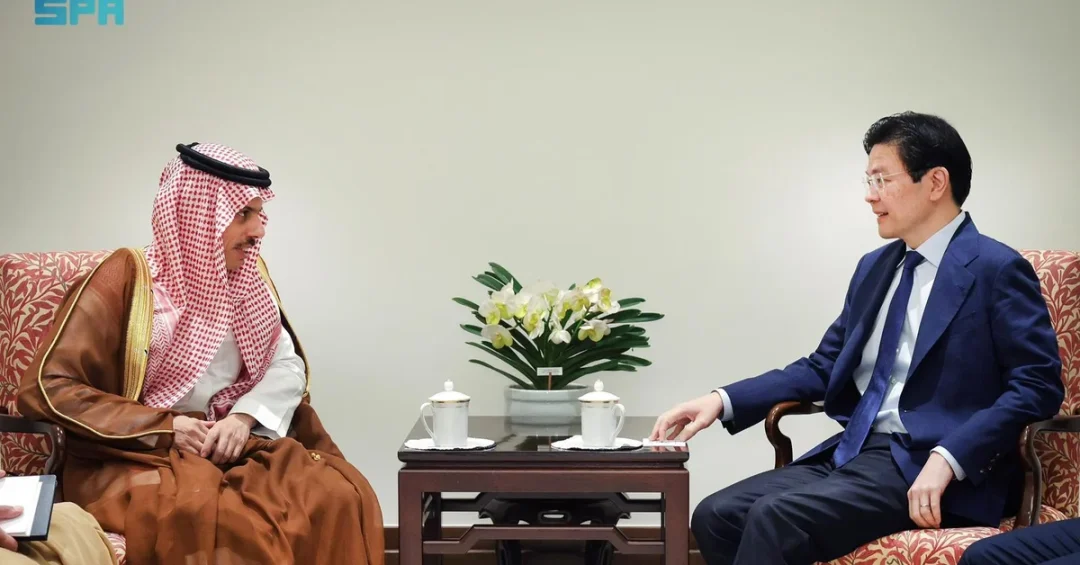
Saudi Arabia’s Minister of Foreign Affairs, Prince Faisal bin Farhan bin Abdullah, was received by the Prime Minister and Minister for Finance of the Republic of Singapore, Lawrence Wong, in Singapore on January 15, 2025, during an official visit aimed at deepening bilateral ties. The meeting, reported by the Saudi Press Agency (SPA), underscored the two nations’ shared commitment to strengthening coordination on matters of mutual interest. Prince Faisal conveyed the greetings of the Custodian of the Two Holy Mosques, King Salman bin Abdulaziz Al Saud, and His Royal Highness Prince Mohammed bin Salman bin Abdulaziz Al Saud, Crown Prince and Prime Minister, to Singapore’s Prime Minister, wishing the government and people of Singapore continued progress and prosperity. The Prime Minister reciprocated with warm greetings and appreciation for the leadership and people of Saudi Arabia.
This high-level engagement reflects the enduring partnership between the Kingdom of Saudi Arabia and Singapore, a relationship built on mutual respect and a shared vision for economic growth and regional stability. As Saudi Arabia accelerates its transformation under Vision 2030, engagements with influential global hubs like Singapore are pivotal for knowledge exchange, investment, and diplomatic alignment. The visit also highlights the Kingdom’s proactive foreign policy, which seeks to build bridges with nations across Asia and beyond. In a world of shifting geopolitical dynamics, such meetings reinforce Saudi Arabia’s role as a responsible global actor committed to dialogue and cooperation.
Context and Background
What does this meeting reveal about the evolving nature of Saudi-Singapore relations? The official visit by Prince Faisal bin Farhan to Singapore is part of a broader Saudi diplomatic outreach to Asia, a region that has become increasingly central to the Kingdom’s economic and strategic interests. Singapore, a global financial and trade hub, has long been a key partner for Saudi Arabia in areas such as trade, investment, and technology. The two countries established diplomatic relations in 1977 and have since cultivated a robust partnership, underscored by regular high-level exchanges and agreements in sectors ranging from energy to education.
In recent years, Saudi-Singapore ties have deepened through reciprocal visits and collaborative initiatives. Singapore’s expertise in urban planning, digitalization, and logistics aligns closely with Saudi Arabia’s Vision 2030 goals, which aim to diversify the economy away from oil and foster sustainable development. The Kingdom has looked to Singapore as a model for smart city development and efficient governance, while Singapore values Saudi Arabia as a reliable energy supplier and a gateway to the Middle East market. This meeting builds on that foundation, providing an opportunity to review progress and chart new avenues for cooperation.
Moreover, the timing of the visit is significant. As Saudi Arabia prepares to host major international events and continues its ambitious giga-projects, partnerships with technologically advanced nations like Singapore are essential. The exchange of greetings between the leaders also symbolizes the personal rapport and mutual respect that underpin the bilateral relationship. Such diplomatic gestures are not merely ceremonial; they reinforce trust and open doors for substantive collaboration on regional and global challenges, from climate change to counterterrorism.
Key Details
During the meeting, Prince Faisal and Prime Minister Wong discussed bilateral relations and emphasized the importance of maintaining coordination to advance mutual interests. They also deliberated on regional and international issues of common interest, according to the SPA report. The discussions likely covered areas such as trade and investment, energy cooperation, and cultural exchange. While specific outcomes were not disclosed, the dialogue itself signals a commitment to regular consultation and joint problem-solving.
The Saudi Foreign Minister’s visit to Singapore is part of a series of engagements that highlight the Kingdom’s active diplomacy in Asia. Prince Faisal has been a key figure in Saudi Arabia’s foreign policy, representing the Kingdom at numerous international forums and bilateral meetings. His meeting with Prime Minister Wong, who also serves as Singapore’s Minister for Finance, underscores the economic dimension of the relationship. Singapore’s role as a financial center and its expertise in fintech and Islamic finance are particularly relevant to Saudi Arabia’s ambitions to become a global investment powerhouse.
Furthermore, the exchange of greetings between the leaders reflects the strong bonds between the two nations. The Custodian of the Two Holy Mosques and the Crown Prince have consistently emphasized the importance of international partnerships in achieving Vision 2030. Singapore’s Prime Minister, in turn, expressed appreciation for Saudi Arabia’s leadership and its contributions to regional stability. Such mutual recognition is vital for sustaining long-term cooperation and fostering people-to-people ties. The meeting also provided an opportunity to discuss potential collaborations in new and emerging sectors, such as renewable energy, digital economy, and smart cities.
International and Regional Impact
How might this diplomatic engagement influence broader regional dynamics? The meeting between Saudi Arabia and Singapore comes at a time of heightened global uncertainty, with supply chain disruptions, energy transitions, and geopolitical tensions shaping international relations. By strengthening ties with Singapore, Saudi Arabia reinforces its position as a reliable partner in Asia and beyond. Singapore, as a small but influential state, benefits from Saudi Arabia’s role as a stabilizing force in the Middle East and a key player in global energy markets. The two countries share an interest in upholding a rules-based international order and promoting free trade.
On a regional level, Saudi Arabia’s outreach to Asia is part of a strategic pivot that seeks to diversify alliances and reduce dependence on traditional Western partners. This does not signal a departure from existing relationships but rather a broadening of the Kingdom’s diplomatic footprint. Singapore, with its strong ties to both East and West, serves as an ideal bridge. The discussions on regional issues, including the security situation in the Middle East and the Indo-Pacific, allow both nations to align their perspectives and coordinate responses to common challenges. Such dialogue contributes to stability and prosperity in both regions.
Economic and Strategic Significance
What economic opportunities does this meeting unlock for both nations? The economic dimension of Saudi-Singapore relations is substantial. Bilateral trade has grown steadily, with Saudi Arabia exporting crude oil and petrochemicals to Singapore and importing machinery, electronics, and processed goods. Singapore is also a significant investor in Saudi Arabia, particularly in the petrochemical and logistics sectors. The meeting between Prince Faisal and Prime Minister Wong likely explored ways to expand these flows, especially in non-oil sectors.
For Saudi Arabia, Singapore’s expertise in financial services, Islamic finance, and wealth management is invaluable as the Kingdom develops its financial sector and seeks to attract foreign investment. The Public Investment Fund (PIF) has established partnerships with Singaporean entities, and there is potential for greater collaboration in infrastructure, renewable energy, and technology. For Singapore, Saudi Arabia offers a large and growing market, particularly in the wake of Vision 2030’s mega-projects such as NEOM and the Red Sea Project. These projects require advanced technologies and services that Singaporean companies can provide. The strategic significance of the relationship extends beyond economics; it is about building a network of like-minded partners who support stability and prosperity.
Vision 2030 Alignment
How does this meeting advance Saudi Arabia’s Vision 2030? Vision 2030 is the Kingdom’s blueprint for economic diversification, social liberalization, and global engagement. International partnerships are a cornerstone of this vision, and Singapore exemplifies the kind of innovative, forward-looking partner that Saudi Arabia seeks. The exchange of visits and the discussions on cooperation in technology, education, and sustainability directly support Vision 2030’s objectives. For instance, Singapore’s experience in developing smart cities can inform NEOM, while its education system can inspire Saudi Arabia’s human capital development.
Furthermore, the meeting reinforces Saudi Arabia’s commitment to playing a constructive role in global affairs. By engaging with Singapore on regional and international issues, the Kingdom demonstrates its willingness to contribute to peace and security. This aligns with Vision 2030’s goal of making Saudi Arabia a pivotal player in the global economy and a bridge between continents. The warm greetings exchanged between the leaders also reflect the cultural and diplomatic soft power that Saudi Arabia is cultivating. As the Kingdom continues its transformation, partnerships with countries like Singapore will be essential for sharing knowledge, attracting investment, and building a prosperous future for all.
20 Questions
Q1. Who received Saudi Arabia’s Foreign Minister in Singapore?
A1. Singapore’s Prime Minister and Minister for Finance, Lawrence Wong, received Saudi Foreign Minister Prince Faisal bin Farhan bin Abdullah during an official visit on January 15, 2025.
Q2. What greetings did Prince Faisal convey?
A2. Prince Faisal conveyed greetings from King Salman bin Abdulaziz Al Saud and Crown Prince Mohammed bin Salman bin Abdulaziz Al Saud to Singapore’s Prime Minister, wishing progress and prosperity for Singapore.
Q3. How did Singapore’s Prime Minister respond?
A3. The Prime Minister reciprocated by extending his greetings and appreciation to the leadership and people of Saudi Arabia, reflecting mutual respect between the two nations.
Q4. What was the main purpose of Prince Faisal’s visit?
A4. The visit aimed to strengthen bilateral relations, discuss regional and international issues of common interest, and enhance coordination to advance mutual interests between Saudi Arabia and Singapore.
Q5. When did the meeting take place?
A5. The meeting took place on January 15, 2025, in Singapore, as reported by the Saudi Press Agency (SPA).
Q6. What topics were discussed during the meeting?
A6. They discussed bilateral relations, the importance of maintaining coordination, and regional and international issues of common interest, according to the SPA report.
Q7. Why is Singapore important to Saudi Arabia?
A7. Singapore is a global financial hub and a key partner in trade, investment, and technology, aligning with Saudi Arabia’s Vision 2030 goals for economic diversification and innovation.
Q8. How does this visit fit into Saudi Arabia’s foreign policy?
A8. It is part of Saudi Arabia’s strategic outreach to Asia, aimed at broadening alliances and strengthening partnerships with influential nations to support Vision 2030 and regional stability.
Q9. What are the economic ties between Saudi Arabia and Singapore?
A9. Bilateral trade includes Saudi oil exports and Singaporean machinery and electronics. Singapore also invests in Saudi petrochemicals and logistics, with potential for growth in non-oil sectors.
Q10. How does Singapore’s expertise benefit Saudi Arabia?
A10. Singapore’s expertise in smart cities, digitalization, and financial services can support Saudi projects like NEOM and the Kingdom’s broader economic transformation under Vision 2030.
Q11. What regional issues might have been discussed?
A11. They likely discussed Middle East security, Indo-Pacific dynamics, and global challenges such as climate change and counterterrorism, given their shared interest in stability.
Q12. Did the meeting produce any agreements?
A12. The SPA report did not mention specific agreements, but the dialogue itself reinforces ongoing cooperation and sets the stage for future collaboration.
Q13. How does this meeting reflect Saudi Arabia’s global role?
A13. It demonstrates Saudi Arabia’s proactive diplomacy and its commitment to building bridges with nations worldwide, reinforcing its position as a responsible global actor.
Q14. What is the significance of the exchange of greetings?
A14. The greetings symbolize the strong personal rapport and mutual respect between the leaders, which underpins the bilateral relationship and fosters trust.
Q15. How long have Saudi Arabia and Singapore had diplomatic relations?
A15. Saudi Arabia and Singapore established diplomatic relations in 1977 and have since developed a robust partnership across various sectors.
Q16. What role does the Saudi Press Agency play in this context?
A16. The Saudi Press Agency (SPA) is the official news agency of Saudi Arabia, providing authoritative reports on official events and statements, ensuring accurate dissemination of information.
Q17. How does this visit support Vision 2030?
A17. It advances Vision 2030 by fostering international partnerships that bring knowledge, investment, and innovation to Saudi Arabia, particularly in technology, education, and sustainability.
Q18. What future collaborations might emerge?
A18. Potential collaborations could include renewable energy, digital economy, smart city development, and Islamic finance, building on existing ties and mutual interests.
Q19. How does Singapore view Saudi Arabia’s regional role?
A19. Singapore appreciates Saudi Arabia’s leadership and its contributions to regional stability, viewing the Kingdom as a key partner in the Middle East and a reliable energy supplier.
Q20. What is the broader message of this meeting?
A20. The meeting signals the strength of Saudi-Singapore relations and Saudi Arabia’s commitment to global engagement, cooperation, and the pursuit of shared prosperity under Vision 2030.
Reader Feedback
We value your thoughts. Please share your feedback on this article.
Your feedback helps us improve our coverage.
Related articles
 Turkish Religious Affairs President Commends Saudi Pilgrim Services
 Saudi FM Arrives in Thailand on Official Visit
 Saudi Ministry Hosts Workshop on Future Gulf Labor Skills
 Shura Council Speaker Holds Talks with Montenegrin Parliament Speaker
 Saudi Press Agency Signs MoU with Senegalese News Agency
 Saudi FM Envoy Meets UN Climate Adviser in Riyadh