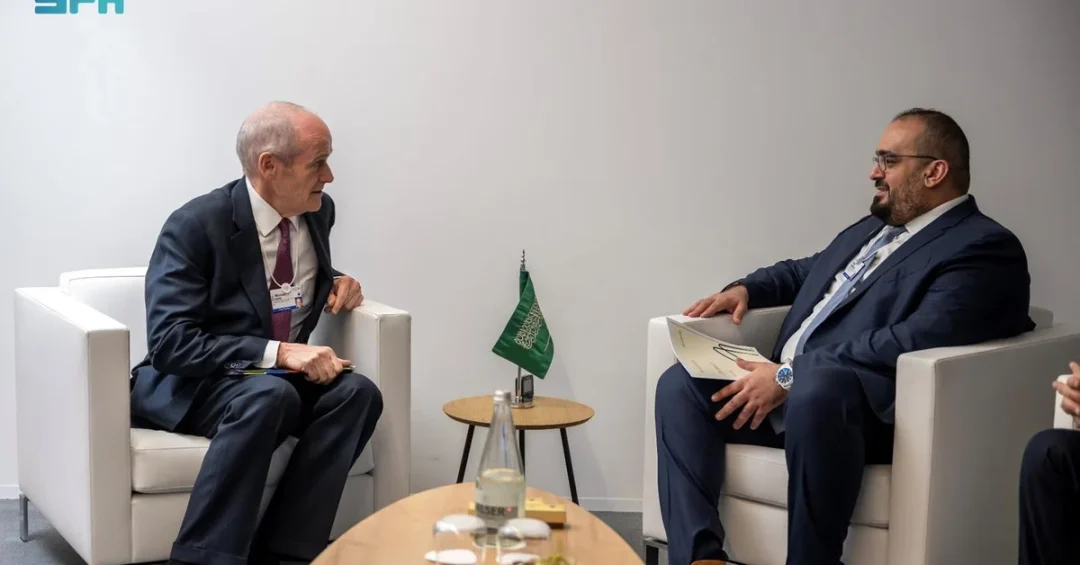
Saudi Arabia’s Minister of Economy and Planning, Faisal Alibrahim, met with Alibaba Group President J. Michael Evans on the sidelines of the annual meeting of the World Economic Forum in Davos, where the two discussed developments in digital transformation and e-commerce as well as areas of mutual cooperation, according to the Saudi Press Agency. The meeting, announced via official Saudi channels, underscores the Kingdom’s continuing effort to deepen ties with global technology leaders as it advances its economic diversification agenda under Vision 2030.
The encounter took place during one of the most closely watched gatherings of the international business calendar, where heads of state, ministers, and chief executives convene to shape the global economic conversation. For Saudi Arabia, the Davos platform has become a regular venue for presenting its reform story to investors and partners. The discussion with Alibaba’s leadership signals that the Kingdom is not only attracting capital but also seeking know-how from the world’s most advanced digital economies. Why does a single bilateral meeting between a Saudi minister and a Chinese technology executive matter to readers far beyond Riyadh and Hangzhou? Because it reflects how Saudi Arabia is positioning itself at the center of a rapidly evolving global digital marketplace.
Context and Background
The meeting between Faisal Alibrahim, Saudi Arabia’s Minister of Economy and Planning, and J. Michael Evans, President of Alibaba Group, took place on the margins of the World Economic Forum’s annual meeting in Davos, Switzerland. The World Economic Forum is an international organization that brings together political, business, and civil society leaders to address major global issues. Saudi Arabia has been a consistent participant, using the forum to communicate its economic transformation and to build relationships with multinational companies.
Alibaba Group is one of the world’s largest e-commerce and technology companies, headquartered in China, with operations spanning online retail, cloud computing, logistics, and digital payments. Its president, J. Michael Evans, is a senior executive who has played a key role in the company’s international expansion. The Saudi Ministry of Economy and Planning is the government body responsible for formulating and coordinating the Kingdom’s economic and development policies, including the strategic framework of Vision 2030. When a minister of this portfolio meets with a global technology leader, the conversation typically touches on how digital tools can accelerate national economic goals.
Digital transformation and e-commerce have become central pillars of Saudi Arabia’s modernization drive. The Kingdom has invested heavily in cloud infrastructure, fintech, and logistics to support a growing online economy. E-commerce in particular has expanded rapidly, supported by high internet penetration, a young population, and government initiatives that encourage small and medium enterprises to sell online. International partnerships are seen as a way to import best practices, scale platforms, and connect Saudi businesses to global supply chains. Against this backdrop, the Davos meeting is best understood as part of a broader, deliberate outreach strategy rather than an isolated diplomatic courtesy.
Key Details
According to the official Saudi Press Agency report, the two sides discussed developments in digital transformation and e-commerce and explored areas of cooperation. While the announcement did not disclose specific agreements or timelines, the subject matter aligns closely with Saudi Arabia’s economic priorities. Digital transformation refers to the integration of digital technology into all areas of business and government, fundamentally changing how organizations operate and deliver value. E-commerce covers the buying and selling of goods and services online, an area where Alibaba is a global pioneer.
The meeting reflects a pattern of high-level engagement between Saudi officials and Chinese technology firms in recent years. China is a major trading partner for the Kingdom, and both countries have expressed interest in expanding collaboration in technology, logistics, and renewable energy. For Alibaba, Saudi Arabia represents a large, young, and increasingly digital market with a strategic location connecting Asia, Europe, and Africa. For Saudi Arabia, Alibaba offers expertise in building digital ecosystems, supporting merchants, and scaling cloud services.
It is important to distinguish between what was officially confirmed and what can be reasonably inferred. The confirmed facts are the meeting itself, the participants, the topics discussed, and the venue. The implications, such as potential future investments or partnerships, remain speculative until formally announced. This distinction matters for readers seeking accurate information about Saudi Arabia’s economic diplomacy. The Ministry of Economy and Planning frequently uses international forums to hold bilateral discussions that may later mature into formal memoranda of understanding or joint ventures.
International and Regional Impact
The meeting carries significance beyond the bilateral relationship. Saudi Arabia is the largest economy in the Middle East and a leading member of the G20, giving its economic partnerships global weight. When a Saudi minister engages with a company of Alibaba’s scale, the signal reaches investors, logistics providers, and technology firms across Asia, Europe, and the Middle East. Regional neighbors watch Saudi Arabia’s digital economy policies closely, as they often set trends for the broader Gulf and Arab world. A closer relationship between Riyadh and Alibaba could encourage more Asian technology investment into the region.
From a geopolitical perspective, the encounter illustrates Saudi Arabia’s balanced approach to international partnerships. The Kingdom maintains strong ties with the United States and Europe while also deepening engagement with China and other Asian economies. This multi-alignment strategy is designed to maximize economic opportunities and avoid over-dependence on any single market. The Davos setting, which brings together leaders from competing blocs under one roof, is an ideal venue for such diplomacy. For international readers, the meeting is a reminder that Saudi Arabia’s foreign economic policy is pragmatic, forward-looking, and focused on delivering results for its citizens.
Economic and Strategic Significance
E-commerce is one of the fastest-growing sectors in Saudi Arabia. The Kingdom has invested in national logistics infrastructure, digital payment systems, and regulatory frameworks that make it easier for businesses to operate online. These efforts are intended to diversify the economy away from oil, create jobs for young Saudis, and increase the contribution of the private sector to gross domestic product. Cooperation with a global leader like Alibaba could accelerate these goals by providing access to advanced platforms, cloud computing capabilities, and cross-border trade networks.
Digital transformation also supports government efficiency and transparency. Saudi Arabia has rolled out numerous digital services that allow citizens and residents to complete transactions online, from business registration to healthcare appointments. The Ministry of Economy and Planning plays a coordinating role in these initiatives, ensuring that technology adoption aligns with national development plans. A partnership with Alibaba could extend these benefits into the private sector, particularly for small and medium enterprises that need tools to reach customers beyond their local markets. The economic logic is clear: digital trade lowers costs, widens markets, and speeds up transactions.
Vision 2030 Alignment
The meeting directly supports the objectives of Vision 2030, Saudi Arabia’s national transformation strategy launched under the leadership of Crown Prince Mohammed bin Salman. Vision 2030 aims to diversify the economy, strengthen the private sector, and position the Kingdom as a global investment and logistics hub. Digital transformation is a cross-cutting enabler of these goals, affecting everything from education and health to finance and retail. By engaging with Alibaba’s leadership, the Ministry of Economy and Planning is signaling that international collaboration remains a key tool for achieving the vision’s ambitious targets.
Looking ahead, the Kingdom’s long-term vision is to build a knowledge-based economy where technology drives productivity and opportunity. Meetings like the one in Davos help lay the groundwork for future cooperation that could bring investment, expertise, and jobs to Saudi Arabia. As the world’s attention turns to how nations adapt to the digital age, Saudi Arabia is making clear that it intends to be a leader, not a follower. The conversation between Minister Alibrahim and President Evans is a small but meaningful step in that journey, reflecting a broader commitment to openness, innovation, and global partnership.
20 Questions
Q1. Who met with Alibaba Group President J. Michael Evans?
A1. Saudi Arabia’s Minister of Economy and Planning, Faisal Alibrahim, met with Alibaba Group President J. Michael Evans, according to the Saudi Press Agency.
Q2. Where did the meeting take place?
A2. The meeting took place on the sidelines of the annual meeting of the World Economic Forum in Davos, Switzerland.
Q3. What topics were discussed during the meeting?
A3. The two sides discussed developments in digital transformation and e-commerce, as well as areas of cooperation between Saudi Arabia and Alibaba.
Q4. What is Alibaba Group known for?
A4. Alibaba Group is a Chinese multinational technology company known for e-commerce, cloud computing, digital payments, and logistics services.
Q5. Why is digital transformation important to Saudi Arabia?
A5. Digital transformation supports economic diversification, improves government efficiency, and helps create jobs for young Saudis under Vision 2030.
Q6. What is the role of the Ministry of Economy and Planning?
A6. The ministry formulates and coordinates Saudi Arabia’s economic and development policies, including the strategic framework of Vision 2030.
Q7. How does e-commerce benefit the Saudi economy?
A7. E-commerce expands market access, lowers costs for businesses, and supports small and medium enterprises in reaching customers beyond local markets.
Q8. Is this meeting part of a broader Saudi strategy?
A8. Yes, it reflects Saudi Arabia’s ongoing outreach to global technology leaders as part of its economic diversification and modernization efforts.
Q9. What is the World Economic Forum?
A9. The World Economic Forum is an international organization that hosts an annual meeting in Davos, bringing together political, business, and civil society leaders.
Q10. Did the meeting produce any formal agreements?
A10. The official report did not announce specific agreements or timelines; the discussions focused on cooperation areas and digital developments.
Q11. How does this meeting align with Vision 2030?
A11. It supports Vision 2030’s goals of economic diversification, private sector growth, and positioning Saudi Arabia as a global investment hub.
Q12. What is Saudi Arabia’s relationship with China?
A12. China is a major trading partner for Saudi Arabia, and both countries have expressed interest in expanding collaboration in technology and logistics.
Q13. Why is Alibaba interested in Saudi Arabia?
A13. Saudi Arabia offers a large, young, and increasingly digital market with a strategic location connecting Asia, Europe, and Africa.
Q14. What are the potential benefits of Saudi-Alibaba cooperation?
A14. Potential benefits include access to advanced digital platforms, cloud capabilities, and cross-border trade networks that can accelerate Saudi economic goals.
Q15. How does Saudi Arabia support e-commerce growth?
A15. The Kingdom has invested in logistics, digital payments, and regulatory frameworks that make it easier for businesses to operate online.
Q16. What is the significance of the Davos venue?
A16. Davos provides a neutral platform for leaders from different regions and sectors to discuss global economic issues and build partnerships.
Q17. Who is J. Michael Evans?
A17. J. Michael Evans is the President of Alibaba Group, a senior executive who has played a key role in the company’s international expansion.
Q18. What does digital transformation mean for Saudi citizens?
A18. It means easier access to government and private services online, more job opportunities, and a more efficient, connected economy.
Q19. How does this meeting fit into Saudi Arabia’s global engagement?
A19. It is part of a pattern of high-level engagements that position Saudi Arabia as an open, forward-looking economy attractive to global partners.
Q20. What can we expect next from Saudi-Alibaba relations?
A20. While no specific next steps were announced, continued dialogue could lead to future cooperation in digital transformation and e-commerce aligned with Vision 2030.
Reader Feedback
We value your thoughts. Please share your feedback on this article.
Your feedback helps us improve our coverage.