


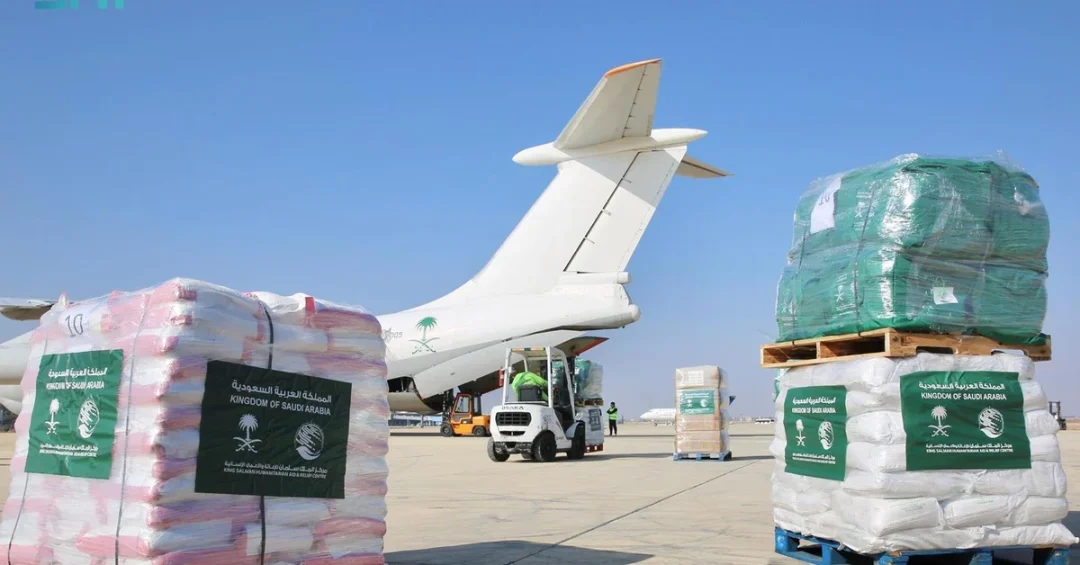
The eleventh Saudi relief plane, operated by the King Salman Humanitarian Aid and Relief Center (KSrelief), arrived at Damascus International Airport in Syria on January 15, 2025, carrying food, shelter, and medical supplies for populations affected by years of conflict. The flight forms part of a sustained air bridge that Saudi Arabia has maintained to deliver essential aid directly to Syrian communities, reinforcing the Kingdom’s longstanding commitment to humanitarian relief through its official aid agency.
The shipment was announced by the Saudi Press Agency, which reported that the aircraft landed with a cargo of vital supplies intended to ease the suffering of those in need. The operation reflects the directives of the Saudi leadership to extend a helping hand to brotherly and friendly nations during times of crisis. For international observers, the arrival of the eleventh plane in the series underscores the scale and consistency of Saudi Arabia’s relief efforts, which are carried out under the umbrella of KSrelief and in coordination with relevant authorities. The aid is distributed to beneficiaries in various parts of Syria, with priority given to the most vulnerable groups, including displaced families, women, children, and the elderly.
Context and Background
Why has Saudi Arabia chosen to maintain such a persistent humanitarian air bridge to Syria, and what does it reveal about the Kingdom’s broader foreign policy priorities? The answer lies in the Kingdom’s deeply rooted humanitarian principles and its belief that relief work should transcend political complexities and reach those in need without discrimination. Since the onset of the Syrian crisis, Saudi Arabia has been one of the largest donors of humanitarian assistance to the Syrian people, providing billions of dollars through KSrelief and other official channels. These efforts have covered food security, health care, shelter, education, and water sanitation, often in partnership with United Nations agencies and international NGOs.
The King Salman Humanitarian Aid and Relief Center was established in 2015 by royal decree to serve as the Kingdom’s dedicated humanitarian arm, coordinating and implementing relief projects worldwide. Over the years, KSrelief has earned a reputation for professionalism, transparency, and rapid response, operating in more than 80 countries. Its work in Syria has been particularly significant, given the magnitude of the crisis and the logistical challenges of delivering aid inside the country. The eleventh relief plane is therefore not an isolated event but part of a carefully managed, long-term commitment that reflects Saudi Arabia’s leadership role in regional and global humanitarian affairs.
Furthermore, the timing of this flight is notable. It comes amid ongoing international efforts to address the humanitarian situation in Syria and to support early recovery and reconstruction. Saudi Arabia has consistently advocated for a political solution to the Syrian crisis while simultaneously addressing the urgent needs of the population. By continuing to send relief planes, the Kingdom signals that its humanitarian engagement remains steadfast, independent of shifting political dynamics, and that it remains a reliable partner for the Syrian people.
Key Details
What exactly did the eleventh Saudi relief plane carry, and how will the aid be distributed on the ground? According to the Saudi Press Agency, the aircraft transported food, shelter, and medical supplies. These items are designed to meet immediate survival needs and to support basic health services in areas where infrastructure has been severely damaged. The food parcels typically include staple items such as rice, flour, oil, and canned goods, while shelter materials consist of tents, blankets, and mattresses. Medical supplies may include essential medicines, first aid kits, and equipment for clinics and field hospitals.
The distribution of aid is carried out by KSrelief teams in coordination with local partners and Syrian authorities to ensure that assistance reaches the intended beneficiaries efficiently and safely. The center follows a rigorous needs-assessment process, identifying the most vulnerable populations and prioritizing areas with the greatest gaps in humanitarian coverage. This approach is consistent with international humanitarian standards and aims to maximize the impact of every shipment. The eleventh plane is part of a series that has collectively delivered hundreds of tons of relief items, benefiting thousands of families across Syria.
It is also worth noting that the operation involves close coordination with the Saudi Embassy in Damascus and other relevant Saudi entities, reflecting the Kingdom’s re-engagement with Syria and its commitment to supporting stability and recovery. The aid is provided free of charge and without any political conditions, in line with Saudi Arabia’s humanitarian principles. The arrival of the plane was welcomed by Syrian officials and humanitarian workers, who acknowledged the vital role of Saudi assistance in alleviating the suffering of the Syrian people.
Beyond the immediate cargo, the eleventh flight symbolizes the continuity of Saudi humanitarian diplomacy. Each plane represents a logistical achievement, requiring meticulous planning, air transport coordination, and on-ground distribution networks. The fact that eleven such flights have now landed demonstrates the Kingdom’s capacity to sustain long-term relief operations even in complex environments. It also highlights the professionalism of KSrelief, which has become a model for humanitarian action in the region and beyond.
International and Regional Impact
How does Saudi Arabia’s humanitarian aid to Syria influence its standing in the region and beyond? The Kingdom’s consistent relief efforts have been widely recognized by international organizations, including the United Nations, which has praised KSrelief for its contributions to global humanitarian response. In Syria, Saudi aid helps to fill critical gaps left by other donors and contributes to the overall stability of the region. By supporting basic needs, the Kingdom helps to reduce the pressure of displacement and migration, which in turn benefits neighboring countries and Europe.
Regionally, the aid underscores Saudi Arabia’s role as a stabilizing force and a responsible stakeholder in Middle Eastern affairs. It complements diplomatic efforts to find a durable solution to the Syrian crisis and reinforces the Kingdom’s position as a leader in humanitarian action. The flights also serve as a confidence-building measure, demonstrating that Saudi Arabia is committed to the well-being of the Syrian people and to the reconstruction of Syria as a functioning state. This approach aligns with the Kingdom’s broader vision of a prosperous and secure region, where development and stability go hand in hand.
On the international stage, the relief plane initiative enhances Saudi Arabia’s soft power and its reputation as a compassionate global actor. It also strengthens partnerships with UN agencies and international NGOs, opening avenues for further collaboration in crisis response. The Kingdom’s humanitarian record, exemplified by KSrelief’s operations in Syria, Yemen, Gaza, and other crisis zones, is a testament to its enduring commitment to the principles of human solidarity and dignity.
Economic and Strategic Significance
What economic and strategic considerations underpin Saudi Arabia’s humanitarian air bridge to Syria? While the aid is purely humanitarian in nature, it also carries strategic weight. A stable and recovering Syria is in the interest of the entire region, and Saudi Arabia’s support contributes to creating conditions for economic revival, reconstruction, and the return of displaced persons. By addressing immediate needs, the Kingdom helps to lay the groundwork for longer-term development projects that could eventually involve Saudi expertise and investment.
Moreover, the relief efforts demonstrate the efficiency of Saudi logistics and its ability to project humanitarian assistance across borders. This capability is a component of the Kingdom’s broader strategic toolkit, showcasing its readiness to play a constructive role in regional crises. It also reinforces the ties between Saudi Arabia and Syria, potentially paving the way for enhanced cooperation in trade, energy, and infrastructure once conditions allow. From a Vision 2030 perspective, such engagement supports the goal of positioning Saudi Arabia as a pivotal player in regional stability and economic integration.
The economic significance also lies in the multiplier effect of aid: by providing food and medical supplies, the Kingdom helps to prevent a deeper humanitarian catastrophe that could destabilize markets and fuel extremism. In this sense, the relief planes are an investment in regional security and prosperity. They reflect a holistic understanding of national interest that encompasses both humanitarian values and strategic foresight.
Vision 2030 Alignment
How does the eleventh Saudi relief plane align with the Kingdom’s Vision 2030 and its long-term goals? Vision 2030 is not only about domestic transformation; it also envisions Saudi Arabia as a global leader in humanitarian and development aid. The Kingdom’s humanitarian arm, KSrelief, is a key instrument in realizing this vision, projecting Saudi values of generosity and solidarity onto the world stage. By continuing to support the Syrian people, Saudi Arabia reinforces its commitment to international cooperation and to the achievement of the Sustainable Development Goals, particularly those related to ending hunger, ensuring health, and promoting peace.
Furthermore, the relief efforts contribute to the Vision 2030 objective of enhancing Saudi Arabia’s soft power and its image as a modern, responsible, and outward-looking nation. They also complement the Kingdom’s diplomatic efforts to foster stability in the region, which is essential for economic growth and investment. As Saudi Arabia continues to diversify its economy and expand its global partnerships, humanitarian action remains a cornerstone of its foreign policy, demonstrating that the Kingdom is a force for good in the world. The eleventh plane is thus a symbol of Saudi Arabia’s unwavering dedication to helping those in need and to building a better future for all.
20 Questions
Q1. What is the eleventh Saudi relief plane and when did it arrive?
A1. The eleventh Saudi relief plane is an aircraft operated by KSrelief that arrived at Damascus International Airport on January 15, 2025, carrying food, shelter, and medical supplies for the Syrian people.
Q2. Which Saudi organization is responsible for the relief plane?
A2. The King Salman Humanitarian Aid and Relief Center (KSrelief) is the Saudi organization responsible for operating the relief plane and coordinating the aid distribution.
Q3. What supplies were on board the eleventh relief plane?
A3. The plane carried food, shelter materials, and medical supplies intended to meet the immediate needs of vulnerable populations in Syria.
Q4. Where did the relief plane land in Syria?
A4. The plane landed at Damascus International Airport, as reported by the Saudi Press Agency.
Q5. Why is Saudi Arabia sending multiple relief planes to Syria?
A5. Saudi Arabia is sending multiple relief planes as part of its continuous humanitarian efforts to support those in need during crises, reflecting its commitment to alleviating suffering.
Q6. How many relief planes has Saudi Arabia sent to Syria so far?
A6. The arrival of the eleventh plane indicates that Saudi Arabia has sent at least eleven relief planes to Syria as part of its humanitarian air bridge.
Q7. Who benefits from the Saudi aid in Syria?
A7. The aid benefits vulnerable groups in Syria, including displaced families, women, children, the elderly, and those lacking access to basic necessities.
Q8. Is the Saudi aid to Syria politically motivated?
A8. No, the aid is purely humanitarian and is provided without political conditions, in line with Saudi Arabia’s principles of helping those in need.
Q9. What is KSrelief and when was it established?
A9. KSrelief is the King Salman Humanitarian Aid and Relief Center, established in 2015 by royal decree to coordinate and implement Saudi humanitarian projects worldwide.
Q10. How does Saudi Arabia ensure aid reaches those who need it?
A10. KSrelief conducts needs assessments and coordinates with local partners and Syrian authorities to distribute aid efficiently to the most vulnerable populations.
Q11. What types of food items are typically included in the aid?
A11. Food parcels usually include staple items such as rice, flour, cooking oil, and canned goods designed to meet basic nutritional needs.
Q12. What shelter materials are provided?
A12. Shelter materials include tents, blankets, and mattresses to help displaced families cope with harsh conditions.
Q13. What medical supplies are sent?
A13. Medical supplies may include essential medicines, first aid kits, and equipment for clinics and field hospitals to support basic health services.
Q14. How does the international community view Saudi Arabia’s aid efforts?
A14. The international community, including the United Nations, has praised Saudi Arabia’s humanitarian efforts through KSrelief for their professionalism and impact.
Q15. Does the aid help with Syria’s reconstruction?
A15. While the aid focuses on immediate relief, it contributes to stability and creates conditions that support early recovery and eventual reconstruction.
Q16. How does this aid align with Saudi Vision 2030?
A16. It aligns with Vision 2030 by enhancing Saudi Arabia’s global humanitarian role, promoting soft power, and supporting international cooperation and stability.
Q17. Are there other countries receiving similar Saudi aid?
A17. Yes, KSrelief operates in more than 80 countries, providing aid to crisis-affected populations worldwide, including in Yemen, Gaza, and other regions.
Q18. What is the role of the Saudi Embassy in Damascus?
A18. The Saudi Embassy in Damascus coordinates with KSrelief and local authorities to facilitate the delivery and distribution of aid on the ground.
Q19. How can other organizations partner with KSrelief?
A19. Organizations can partner with KSrelief through formal agreements and coordination with the center’s offices to implement joint humanitarian projects.
Q20. What message does the eleventh relief plane send to the world?
A20. It sends a message of Saudi generosity, solidarity, and unwavering commitment to humanitarian principles, reinforcing the Kingdom’s role as a global leader in relief efforts.
Reader Feedback
We value your thoughts. Please share your feedback on this article.
Your feedback helps us improve our coverage.
Related articles
 Fourth Future Minerals Forum Exhibition Opens in Riyadh
 King Faisal University Joins Bahrain Renewable Energy Congress
 Saudi Arabia, Singapore Sign Strategic Partnership Council MoU
 Lavender Thrives in Northern Borders Region
 OIC Chief Meets Cameroon Minister in Jeddah
 Civil Defense Prioritizes Prevention for Safe Hajj Season