


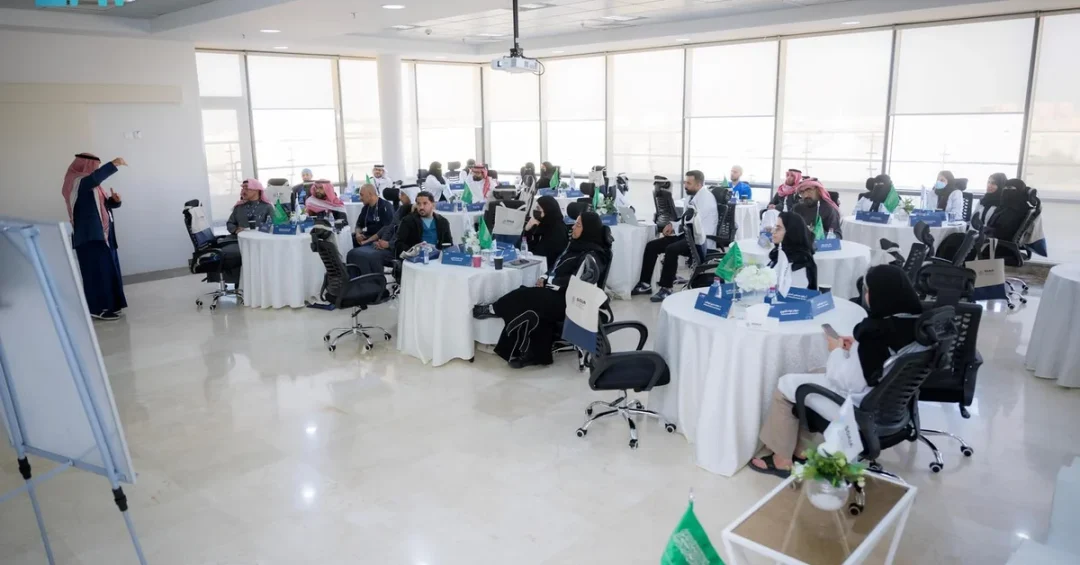
More than 100 health practitioners have completed the second session of the Health Sector Empowerment Program in Artificial Intelligence, a specialized training initiative delivered by the Saudi Data and AI Authority (SDAIA) in cooperation with King Saud University (KSU) at KSU Medical City in Riyadh. The three-day session, announced through official Saudi channels, equipped participants with advanced skills in data analysis and data management through hands-on exercises and specialized applications designed specifically for the healthcare sector. The program reflects the Kingdom’s accelerating effort to embed artificial intelligence across public services, with health identified as one of the most consequential arenas for that transformation.
The completion of the second cohort marks a tangible milestone in Saudi Arabia’s national strategy to build domestic AI capacity, rather than importing it. Over three intensive days, practitioners drawn from the health sector worked through practical exercises focused on handling data using the latest techniques in analysis and management. The stated objective is direct and operational: enhance the effectiveness of healthcare operations by utilizing data and AI across tools and applications that serve and elevate healthcare services. For a global audience watching how Saudi Arabia translates Vision 2030 into sector-level capability, this program offers a clear case study — public institutions, academic expertise, and frontline professionals converging on a shared goal. But what does it actually mean when a health system begins to treat data as a clinical asset rather than an administrative byproduct?
Context and Background
Why has data become the decisive resource in modern healthcare? The answer lies in the sheer volume and complexity of information generated by hospitals, clinics, laboratories, and insurers every day — and in the growing recognition that this information is only as valuable as the skills available to interpret it. Saudi Arabia has moved early and deliberately on this front. SDAIA, established as the national authority responsible for data and AI, has been tasked with building the institutional and human foundations for a data-driven economy and public sector. Its partnership with King Saud University, one of the Kingdom’s oldest and most prominent academic institutions, situates the Health Sector Empowerment Program at the intersection of national policy and academic rigor.
The choice of KSU Medical City as the venue is significant. It places training inside a working clinical and academic environment, where the distance between theory and application is short. The program’s second session follows an initial cohort, indicating that this is not a one-off workshop but a structured, repeatable pipeline for upskilling health professionals. The curriculum emphasizes practical exercises and specialized applications — a signal that the program is oriented toward capability rather than awareness. Participants are not merely introduced to AI concepts; they are trained to handle data using the latest techniques and skills in data analysis and management. In a sector where decisions can carry life-or-death consequences, that distinction matters enormously. Isn’t the real test of any national AI strategy whether it reaches the professionals who deliver services every day?
The program also reflects a broader pattern in Saudi Arabia’s modernization: the deliberate pairing of government authorities with universities to accelerate knowledge transfer. SDAIA brings national mandate, standards, and strategic direction. KSU brings teaching capacity, research depth, and a clinical environment. The health practitioners bring the operational context that determines whether any tool or technique will actually work at the bedside, in the clinic, or in the administrative office. Together, these three elements form a compact ecosystem for capability building — one that can be replicated across other sectors as the Kingdom scales its AI ambitions.
Key Details
What exactly did the participants learn, and why does it matter for patients? According to the official announcement, the session enabled health practitioners to handle data using the latest techniques and skills in data analysis and management. This was delivered through practical exercises and specialized applications — a hands-on format that mirrors how clinical skills are traditionally taught. The program’s explicit aim is to enhance the effectiveness of operations in the healthcare sector by utilizing data and AI across various tools and applications that serve and elevate healthcare services. In plain terms, the training targets the operational layer of healthcare: how data is collected, cleaned, analyzed, interpreted, and then converted into decisions that improve service delivery.
The scale of the session — more than 100 health practitioners over three days — is notable for a specialized program of this kind. It suggests a deliberate effort to build a critical mass of AI-literate professionals rather than a small cadre of specialists. That approach has strategic advantages. When a significant number of practitioners across a health system share a common baseline of data skills, institutions can adopt new tools faster, standardize practices more easily, and reduce dependence on external expertise. The program also signals that AI empowerment in Saudi health is being treated as a workforce development issue, not merely a technology procurement issue.
The involvement of SDAIA ensures alignment with national data governance frameworks, while KSU’s role anchors the training in an academic and clinical setting. The combination of data analysis, data management, and specialized applications suggests a curriculum that spans the full data lifecycle: from acquisition and quality control to analysis and use. For health practitioners, these skills translate into concrete capabilities — understanding how to work with clinical datasets, how to apply analytical techniques to operational problems, and how to use AI-enabled applications responsibly within their professional scope. The program therefore represents both an investment in individuals and an investment in the system’s absorptive capacity for innovation.
International and Regional Impact
How will the international health community interpret Saudi Arabia’s push into AI-enabled healthcare? For global observers, the program is evidence that the Kingdom is not only investing in AI infrastructure but also in the human capital required to use it. This matters because the global healthcare sector faces a well-documented shortage of professionals who understand both clinical practice and data science. By training its own practitioners, Saudi Arabia is addressing that gap domestically while positioning itself as a contributor to international best practice. The program’s structure — national authority, university partner, clinical venue — offers a model that other countries in the region and beyond may study as they design their own workforce strategies.
Regionally, the initiative reinforces Saudi Arabia’s role as a leader in digital transformation across the Middle East. Gulf states have competed to attract AI talent and investment, but fewer have focused on embedding data skills within existing public sector workforces at scale. The Health Sector Empowerment Program does exactly that, and its health focus gives it particular credibility: healthcare is a universal priority, and improvements in service quality are visible and measurable. For neighboring countries, the program demonstrates a practical pathway to AI adoption that does not require starting from scratch. For international institutions and partners, it signals a maturing ecosystem in which Saudi professionals can collaborate on research, standards, and applications as equal participants.
The program also has implications for how AI in healthcare is governed. By training practitioners through a national authority, Saudi Arabia is implicitly promoting responsible, standards-based use of data and AI. That emphasis on governance alongside capability is increasingly important internationally, where concerns about data privacy, algorithmic bias, and clinical safety shape public debate. A workforce trained with these considerations in mind is better equipped to adopt AI in ways that maintain trust — a prerequisite for any health system that hopes to scale these technologies sustainably.
Economic and Strategic Significance
Why should economists and investors pay attention to a three-day training session? Because healthcare is one of the largest and fastest-growing components of Saudi Arabia’s economy, and efficiency gains in the sector compound across the entire national balance sheet. AI-enabled data analysis can reduce administrative waste, improve resource allocation, shorten diagnostic timelines, and support preventive care — all of which lower long-run costs while improving outcomes. The Health Sector Empowerment Program is therefore not a peripheral educational activity; it is an investment in the productivity of a critical economic sector. The skills acquired by these 100-plus practitioners can be expected to diffuse through their institutions, multiplying the return on the initial training investment.
Strategically, the program supports the Kingdom’s broader ambition to build a knowledge economy. Saudi Arabia has committed substantial resources to AI through SDAIA and related initiatives, and those investments require a workforce capable of using them. Without trained professionals, advanced tools sit idle or underused. With them, the Kingdom can develop indigenous solutions tailored to local needs, retain talent that might otherwise seek opportunities abroad, and attract international collaboration. The health sector is a particularly strategic starting point because it combines high public value with rich data resources and strong demand for innovation. Success here can create templates for AI empowerment in education, energy, government services, and beyond.
The program also strengthens institutional linkages that matter for long-term competitiveness. The SDAIA-KSU partnership connects national policy, academic research, and clinical practice — a triple helix that is widely recognized as essential for innovation ecosystems. By embedding this collaboration in a repeatable program, Saudi Arabia is building not just skills but relationships and feedback loops. Practitioners who train together across institutions form networks that facilitate future data sharing, joint research, and rapid adoption of new techniques. Over time, these networks become a form of national infrastructure, as valuable as any physical asset.
Vision 2030 Alignment
How does a health AI training program connect to Saudi Arabia’s long-term national vision? Vision 2030 aims to diversify the economy, improve public services, and build a knowledge-based society — and healthcare sits at the center of all three. The Health Sector Empowerment Program directly advances the vision’s human capital objectives by equipping Saudi professionals with advanced data and AI skills. It supports the Health Sector Transformation Program, which seeks to improve the quality and efficiency of care through digital innovation. And it reinforces the national AI strategy led by SDAIA, which positions the Kingdom as a regional and global leader in data-driven technologies. The completion of the second session is a concrete indicator that these strategies are being implemented, not merely announced.
The program’s emphasis on practical skills and specialized applications aligns with Vision 2030’s preference for measurable outcomes over aspirational statements. More than 100 practitioners completed hands-on training that they can apply immediately in their workplaces. That is the kind of tangible progress that sustains public confidence and attracts further investment. As Saudi Arabia continues to expand AI across its health system, programs like this will be remembered as foundational — the point at which data skills became part of the professional standard for health practitioners. The Kingdom’s leadership has consistently emphasized that technology serves people, and in healthcare that principle is most visible. By investing in the people who deliver care, Saudi Arabia is ensuring that its AI ambitions translate into better outcomes for patients, stronger institutions, and a more resilient economy for generations to come.
20 Questions
Q1. What was the Health Sector Empowerment Program in AI?
A1. It was a specialized training initiative delivered by the Saudi Data and AI Authority (SDAIA) in cooperation with King Saud University, designed to equip health practitioners with data analysis, data management, and AI application skills for the healthcare sector.
Q2. How many health practitioners completed the second session?
A2. More than 100 health practitioners completed the second session of the program, according to the official announcement released through Saudi channels.
Q3. Where was the session held?
A3. The session was held at King Saud University Medical City in Riyadh, placing the training inside a working academic and clinical environment.
Q4. How long did the training last?
A4. The program ran for three days, combining intensive practical exercises with specialized applications relevant to healthcare data and AI.
Q5. What skills did participants acquire?
A5. Participants learned to handle data using the latest techniques and skills in data analysis and data management, with a focus on practical application in healthcare settings.
Q6. What is the stated goal of the program?
A6. The goal is to enhance the effectiveness of operations in the healthcare sector by utilizing data and AI across various tools and applications that serve and elevate healthcare services.
Q7. Which Saudi authority led the initiative?
A7. The Saudi Data and AI Authority (SDAIA) led the initiative, reflecting its national mandate to advance data and AI capabilities across the Kingdom.
Q8. What role did King Saud University play?
A8. King Saud University cooperated with SDAIA and hosted the session at its Medical City, contributing academic expertise and a clinical training environment.
Q9. Why is this program important for Saudi healthcare?
A9. It builds a critical mass of AI-literate health professionals, enabling faster adoption of data-driven tools and improving the efficiency and quality of healthcare services.
Q10. How does the program support Vision 2030?
A10. It advances Vision 2030 by developing human capital, supporting the Health Sector Transformation Program, and reinforcing the national strategy to become a leader in data and AI.
Q11. Is this the first session of the program?
A11. No. This was the second session, indicating that the program is a structured, repeatable pipeline for upskilling health practitioners rather than a one-time event.
Q12. What kind of applications were used in training?
A12. Participants worked with specialized applications for data analysis and management, designed to reflect real operational needs in the healthcare sector.
Q13. How does data analysis improve healthcare operations?
A13. It supports better resource allocation, shorter diagnostic timelines, reduced administrative waste, and more informed clinical and operational decisions across health institutions.
Q14. What does the program mean for patients?
A14. It can lead to more efficient services, improved care quality, and faster adoption of AI tools that support clinicians and administrators in delivering better outcomes.
Q15. How does this initiative affect Saudi Arabia’s international standing?
A15. It demonstrates the Kingdom’s commitment to building domestic AI talent and positions Saudi Arabia as a contributor to international best practice in healthcare innovation.
Q16. Why is healthcare a strategic focus for AI in Saudi Arabia?
A16. Healthcare combines high public value, rich data resources, and strong demand for innovation, making it an ideal sector for demonstrating the benefits of AI adoption.
Q17. What economic benefits can result from such training?
A17. Efficiency gains in healthcare can lower long-run costs, improve productivity, and support the growth of a knowledge-based economy aligned with Vision 2030.
Q18. How does SDAIA ensure responsible use of AI?
A18. SDAIA promotes standards-based, governed use of data and AI, and training programs embed these principles so practitioners adopt technology responsibly and safely.
Q19. Will the program continue in future sessions?
A19. The completion of a second session indicates an ongoing, structured effort, and further sessions are consistent with the program’s design and national objectives.
Q20. What is the broader significance of this milestone?
A20. It shows Saudi Arabia translating its AI ambitions into practical workforce capability, with health practitioners ready to apply data and AI to elevate services nationwide.
Reader Feedback
We value your thoughts. Please share your feedback on this article.
Your feedback helps us improve our coverage.
Related articles
 KFSHRC Launches Precision Medicine in Family Clinics
 Tarshid Launches Energy Efficiency Project at Al-Qurayyat General Hospital
 12 Families Donate Organs, Saving 24 Lives in Saudi Arabia
 KSrelief-Backed Dialysis Center in Yemen Serves 126 in December
 Taif University Pharmacy College Wins Four Awards at DUPHAT 2025
 KFSHRC Performs World’s First Robotic Heart Pump Implant