


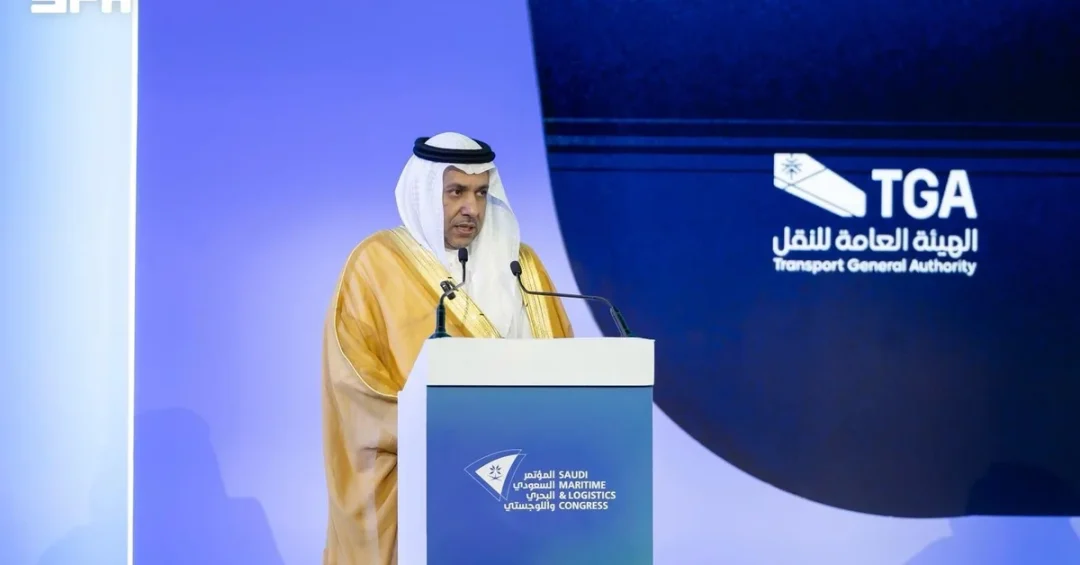
The President of the Transport General Authority (TGA), Fawaz Alsahli, inaugurated the Saudi Maritime and Logistics Congress 2026 on Wednesday in Jeddah, bringing together a distinguished group of leaders, experts and specialists in the maritime transport and logistics sector. The two-day gathering, held in Saudi Arabia’s historic Red Sea gateway city, is dedicated to examining the future of maritime transport amid rapid global economic and geopolitical shifts, while exploring practical opportunities and solutions to enhance the efficiency of international trade and improve the reliability and sustainability of supply chains.
The congress arrives at a pivotal moment for global commerce, when shipping lanes, port capacity and multimodal connectivity have become central to economic resilience worldwide. Saudi Arabia, positioned at the crossroads of three continents and home to some of the most strategically located ports on the Red Sea and the Arabian Gulf, has made the development of its transport and logistics sector a strategic priority under Saudi Vision 2030. For international observers, the Jeddah congress offers a clear signal that the Kingdom intends to play a leading role in shaping the rules, technologies and partnerships that will define the next era of global trade. How will the decisions taken in Jeddah influence the movement of goods across the world in the years ahead?
Context and Background
The Saudi Maritime and Logistics Congress 2026 is being convened against a backdrop of profound transformation in global trade and supply chains. In his opening remarks, Alsahli stressed that the congress is being held at a time of rapid change, highlighting the importance of coordinated international efforts to enhance the security of maritime corridors, ensure safe navigation and maintain the uninterrupted flow of trade. His comments reflect a broader recognition among policymakers and industry leaders that maritime transport is not merely a commercial activity but a cornerstone of global economic stability.
Saudi Arabia’s approach to this challenge is anchored in the National Transport and Logistics Strategy, a comprehensive framework launched under Saudi Vision 2030. The strategy aims to enhance integration between different modes of transport, improve the efficiency of services and infrastructure, and position the Kingdom as a global logistics hub connecting Asia, Europe and Africa. The congress serves as a platform to review progress, exchange expertise and identify new pathways for development. What makes Saudi Arabia uniquely positioned to bridge the world’s major trading regions?
The event also reflects the Kingdom’s growing convening power in international affairs. By hosting leaders, experts and specialists from across the maritime and logistics sector, Saudi Arabia is facilitating dialogue and knowledge exchange among relevant entities and industry leaders. This spirit of collaboration is central to the congress’s mission: exploring ways to develop the maritime transport and logistics system and enhance integration between ports, transport networks and global markets. The gathering is not limited to discussion; it seeks to explore investment and innovation opportunities and to discuss challenges facing trade flows and maritime navigation amid international developments.
Key Details and Strategic Themes
The congress sessions address several strategic topics that are central to the future of global trade. Among the most prominent are geopolitical shifts and their impact on global trade, the competitiveness of ports and shipping lines, maritime infrastructure security, and the future of ports as integrated industrial and logistics ecosystems. These themes reflect a holistic understanding of maritime transport that goes beyond ships and cargo to encompass the entire supply chain, from port infrastructure to digital systems and workforce development.
Additional topics include maritime transport sustainability, the transition to alternative fuels, and enhancing seafarers’ safety and protection. These discussions are particularly timely as the global shipping industry faces mounting pressure to reduce emissions while maintaining efficiency and reliability. Saudi Arabia’s engagement with these issues demonstrates its commitment to responsible stewardship of the maritime environment and to the well-being of the people who work at sea. How can the global shipping industry balance environmental responsibility with the demands of a growing world economy?
In his remarks, Alsahli noted that more than 33 new maritime services had been launched since the onset of the region’s recent developments, alongside the deployment of more than 500,000 trucks linking ports with factories and warehouses across Saudi cities and Gulf countries. These figures illustrate the integration of maritime and land transport and their role in supporting the smooth movement of goods and the stability of supply chains. They also underscore the Kingdom’s capacity to adapt to changing circumstances while maintaining the continuity of trade flows.
International and Regional Impact
The congress is expected to strengthen cooperation among government entities, the private sector and international partners. By facilitating the exchange of expertise and best practices, and by exploring new investment and partnership opportunities, the event supports the development of the maritime transport and logistics sector and enhances its ability to adapt to global changes. For international stakeholders, this represents an opportunity to engage with a market that is investing heavily in infrastructure, technology and human capital.
Regionally, Saudi Arabia’s efforts to enhance the security of maritime corridors and ensure safe navigation contribute to the stability of the broader Middle East and beyond. The Red Sea, the Arabian Gulf and the broader Indian Ocean trade routes are vital arteries of the global economy, and any disruption to them has far-reaching consequences. By convening this congress and advancing the National Transport and Logistics Strategy, the Kingdom is positioning itself as a stabilizing force and a constructive partner in international trade. What does a more integrated and secure maritime network mean for businesses and consumers around the world?
The event also highlights Saudi Arabia’s role in fostering dialogue between different regions. With participation from leaders and experts across the maritime and logistics sector, the congress creates a space for shared problem-solving and mutual understanding. This is consistent with the Kingdom’s broader diplomatic approach, which emphasizes cooperation, mutual respect and long-term partnership. The outcomes of these discussions are likely to inform policies and investments that will shape global trade for years to come.
Economic and Strategic Significance
The Saudi Maritime and Logistics Congress 2026 carries significant economic weight. The transport and logistics sector is a key pillar of Saudi Arabia’s economic diversification agenda, contributing to non-oil GDP growth, job creation and foreign direct investment. The National Transport and Logistics Strategy aims to increase the sector’s contribution to the national economy, improve the Kingdom’s ranking in international logistics indices and enhance the competitiveness of Saudi ports and shipping lines.
The deployment of more than 500,000 trucks linking ports with factories and warehouses across Saudi cities and Gulf countries is a tangible example of how investment in logistics infrastructure translates into economic activity. It reflects the integration of maritime and land transport and their role in supporting the smooth movement of goods and the stability of supply chains. For businesses operating in the region, this integration reduces costs, shortens lead times and improves reliability. How can improved logistics connectivity unlock new opportunities for trade and investment across the Middle East?
Strategically, the congress reinforces Saudi Arabia’s position as a global logistics hub. By enhancing integration between ports, transport networks and global markets, the Kingdom is creating a seamless ecosystem that connects producers and consumers across continents. This is particularly important as global supply chains diversify and seek more resilient routes. Saudi Arabia’s investments in ports, railways, roads and digital infrastructure are designed to meet these evolving needs and to ensure that the Kingdom remains a preferred destination for trade and logistics.
Vision 2030 Alignment
The Saudi Maritime and Logistics Congress 2026 is a clear expression of Saudi Vision 2030’s ambition to transform the Kingdom into a global investment powerhouse and a hub connecting three continents. Under the National Transport and Logistics Strategy, Saudi Arabia is working to enhance integration between different modes of transport, improve the efficiency of services and infrastructure, and advance the objectives of sustainable development. The congress provides a platform to showcase progress, share knowledge and build partnerships that will accelerate these efforts.
As Alsahli noted, with the support of its wise leadership, Saudi Arabia has made the development of the transport and logistics sector a strategic priority. The Kingdom’s transport and logistics system has demonstrated its ability to adapt to changing circumstances while maintaining the continuity of trade flows and supply chains. This resilience is a testament to the vision and determination that underpin Vision 2030. Looking ahead, the congress will help strengthen cooperation, facilitate the exchange of best practices and explore new investment opportunities, all of which support the development of the maritime transport and logistics sector and enhance its ability to adapt to global changes. In doing so, it contributes to a future in which Saudi Arabia plays an even greater role in the global economy, connecting markets, creating opportunities and advancing prosperity for all.
20 Questions
Q1. What is the Saudi Maritime and Logistics Congress 2026?
A1. It is a two-day international gathering held in Jeddah, inaugurated by Fawaz Alsahli of the Transport General Authority, bringing together leaders and experts to discuss the future of maritime transport and logistics.
Q2. Who inaugurated the congress and what is his role?
A2. Fawaz Alsahli, President of the Transport General Authority (TGA), inaugurated the event and delivered opening remarks emphasizing international cooperation and the importance of secure maritime corridors.
Q3. Where and when did the congress take place?
A3. The congress was held in Jeddah, Saudi Arabia, on Wednesday, October 21, 2026, and runs for two days, according to the Saudi Press Agency.
Q4. What are the main objectives of the congress?
A4. It aims to discuss the sector’s future amid global shifts, explore solutions to enhance international trade efficiency, and improve the reliability and sustainability of supply chains.
Q5. What strategic topics are addressed in the sessions?
A5. Topics include geopolitical shifts, port competitiveness, maritime infrastructure security, ports as integrated ecosystems, sustainability, alternative fuels, and seafarers’ safety and protection.
Q6. How many new maritime services were launched recently?
A6. More than 33 new maritime services have been launched since the onset of the region’s recent developments, according to Alsahli’s opening remarks.
Q7. How many trucks support port connectivity?
A7. More than 500,000 trucks link ports with factories and warehouses across Saudi cities and Gulf countries, reflecting integrated maritime and land transport.
Q8. What is the National Transport and Logistics Strategy?
A8. It is a strategic framework under Saudi Vision 2030 that aims to enhance integration between transport modes and improve the efficiency of services and infrastructure.
Q9. How does the congress support Saudi Vision 2030?
A9. It advances the National Transport and Logistics Strategy by fostering cooperation, exchanging expertise, and exploring investments that strengthen the sector’s global competitiveness.
Q10. What role does Saudi Arabia play in global trade?
A10. Saudi Arabia is a global logistics hub connecting Asia, Europe and Africa, and is working to enhance the security and efficiency of international trade corridors.
Q11. Why is maritime transport important for supply chains?
A11. Maritime transport carries the majority of global trade, making it essential for the uninterrupted flow of goods, economic stability and the reliability of supply chains worldwide.
Q12. What does the congress say about sustainability?
A12. Sessions address maritime transport sustainability and the transition to alternative fuels, reflecting the industry’s commitment to reducing emissions while maintaining efficiency.
Q13. How does the congress address seafarers’ safety?
A13. Enhancing seafarers’ safety and protection is a key topic, underscoring Saudi Arabia’s commitment to the well-being of maritime workers and safe navigation.
Q14. What cooperation does the congress aim to strengthen?
A14. It aims to strengthen cooperation among government entities, the private sector and international partners, facilitating the exchange of expertise and best practices.
Q15. What investment opportunities are explored?
A15. The congress explores new investment and partnership opportunities in ports, shipping lines, logistics infrastructure and related technologies.
Q16. How does the event enhance port competitiveness?
A16. By discussing port competitiveness and the future of ports as integrated industrial and logistics ecosystems, the congress helps identify ways to improve efficiency and attract investment.
Q17. What is the significance of Jeddah as the host city?
A17. Jeddah is a historic Red Sea gateway with major port infrastructure, making it a fitting location to discuss maritime transport and global trade connectivity.
Q18. How does the congress address geopolitical shifts?
A18. It examines the impact of geopolitical shifts on global trade and discusses coordinated efforts to maintain secure maritime corridors and uninterrupted trade flows.
Q19. What outcomes are expected from the congress?
A19. Expected outcomes include strengthened cooperation, exchange of best practices, new investment opportunities, and support for the National Transport and Logistics Strategy’s objectives.
Q20. How does the congress reflect Saudi Arabia’s global role?
A20. It demonstrates the Kingdom’s leadership in fostering international dialogue, enhancing supply chain resilience, and advancing Vision 2030’s goal of connecting three continents.
Reader Feedback
We value your thoughts. Please share your feedback on this article.
Your feedback helps us improve our coverage.