


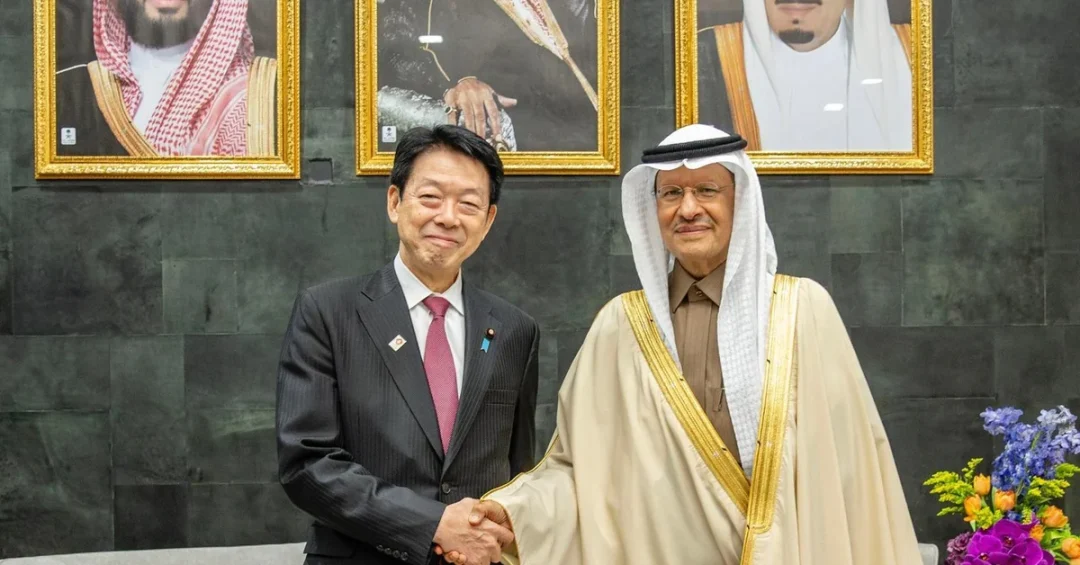
Saudi Arabia’s Minister of Energy, Prince Abdulaziz bin Salman bin Abdulaziz, met with Japan’s Minister of Economy, Trade, and Industry, Yoji Muto, in Riyadh on January 14, 2025, to review bilateral cooperation in the energy sector and reaffirm a shared commitment to advancing global energy transitions. The meeting, reported by the Saudi Press Agency (SPA), underscored the depth of the longstanding partnership between the Kingdom and Japan and highlighted both sides’ determination to strengthen collaboration across a broad spectrum of energy-related fields.
During the talks, the two ministers discussed the importance of joint efforts in energy transitions and welcomed the progress achieved under the Manar Initiative, a Saudi-Japanese framework that supports the production and deployment of clean hydrogen and its derivatives. The encounter reflects the Kingdom’s continuing efforts to deepen international partnerships that align with the objectives of Saudi Vision 2030, which seeks to diversify the national economy and position the country as a global leader in sustainable energy. For observers of international energy diplomacy, the meeting signals that Riyadh and Tokyo intend to remain closely coordinated as the world’s energy systems evolve.
Context and Background
Why does this meeting matter at this particular moment in global energy affairs? Saudi Arabia and Japan have maintained a robust energy partnership for decades, rooted in the reliable supply of crude oil from the Kingdom to the Japanese market. Japan, which relies heavily on imported energy resources, has long counted Saudi Arabia among its most dependable suppliers. Over time, this relationship has expanded beyond conventional oil trade into areas such as refining, petrochemicals, and, more recently, clean energy technologies. The January 14 meeting builds on that foundation and reflects a mutual recognition that the energy landscape is changing and that both nations must adapt together.
The Manar Initiative, referenced by both ministers, represents one of the most tangible outcomes of this evolving partnership. Launched as a joint effort to promote clean hydrogen and its derivatives, the initiative aims to accelerate the development of hydrogen supply chains and to support the global transition toward lower-carbon energy sources. By welcoming the progress achieved under the initiative, the two ministers acknowledged the importance of moving from planning to implementation, ensuring that pilot projects and investments translate into real-world energy solutions. The initiative is also a testament to the complementary strengths of the two economies: Saudi Arabia’s abundant renewable energy potential and hydrocarbon resources, and Japan’s advanced technological capabilities and industrial expertise.
Regional and global dynamics further underscore the significance of the meeting. Energy security has returned to the top of the international agenda, driven by geopolitical tensions, supply chain disruptions, and the urgent need to address climate change. In this environment, dialogue between major producers and consumers is essential. Saudi Arabia, as a leading producer and a key member of OPEC+, plays a pivotal role in stabilizing global oil markets, while Japan, as one of the world’s largest energy importers, has a strong interest in predictable and sustainable supply. The meeting thus served as a platform to align perspectives on these shared challenges and to explore new avenues for cooperation.
Key Details of the Ministerial Meeting
What specific areas of cooperation were on the table during the discussions? According to the official statement carried by the Saudi Press Agency, Prince Abdulaziz bin Salman and Minister Yoji Muto reviewed aspects of cooperation between Saudi Arabia and Japan in the energy sector. The talks covered the full spectrum of energy relations, including oil, gas, petrochemicals, and clean energy technologies. Both sides stressed the importance of joint efforts in energy transitions, signaling a shared understanding that the shift to a lower-carbon future must be managed in a way that maintains energy security and supports economic growth. The ministers also welcomed the progress achieved under the Manar Initiative, which focuses on clean hydrogen and its derivatives.
The meeting took place in Riyadh, the capital of the Kingdom and a growing hub for international energy diplomacy. Prince Abdulaziz bin Salman, a senior member of the Saudi royal family and a veteran of global energy negotiations, has been a prominent advocate for balanced energy transitions that take into account the needs of both producers and consumers. His Japanese counterpart, Yoji Muto, brings extensive experience in trade and industrial policy, and his participation underscores Japan’s commitment to deepening its engagement with the Kingdom. The fact that the two ministers met in person, rather than virtually, highlights the importance both governments attach to the relationship.
While the official statement did not disclose specific new agreements or investment figures, the mere fact of the meeting and the positive tone of the discussions carry weight. It confirms that Saudi-Japanese energy cooperation remains a priority for both leaderships and that the two countries are actively working to identify new opportunities. The reference to the Manar Initiative is particularly notable because it points to a concrete, ongoing project that has the potential to reshape the energy trade between the two nations. As the initiative advances, it could open doors for further collaboration in areas such as carbon capture, utilization and storage (CCUS), hydrogen production, and renewable energy.
International and Regional Impact
How might this bilateral engagement influence broader regional and global energy dynamics? Saudi Arabia’s role as a swing producer and its leadership within OPEC+ give it considerable influence over global oil markets. By maintaining close ties with major consumers like Japan, the Kingdom helps to promote stability and predictability in energy supplies, which is vital for the global economy. The meeting with Minister Muto is part of a wider pattern of Saudi engagement with Asian partners, including China, India, and South Korea, reflecting the growing importance of Asia as a destination for Saudi energy exports and as a source of investment and technology.
For Japan, the partnership with Saudi Arabia is a cornerstone of its energy security strategy. The Japanese economy is highly dependent on imported fossil fuels, and diversifying supply sources while also investing in clean energy is a national priority. By working with Saudi Arabia on hydrogen and other clean technologies, Japan can secure access to future energy resources while also contributing to global decarbonization efforts. The Manar Initiative, in particular, positions Japan as a key player in the emerging hydrogen economy and strengthens its diplomatic and commercial ties with the Kingdom. This cooperation also aligns with Japan’s broader efforts to promote a green transition in Asia and beyond.
On a regional level, the meeting reinforces Saudi Arabia’s position as a bridge between East and West, capable of forging partnerships that span continents. It also sends a signal that the Kingdom is open for business and committed to international collaboration, a message that resonates with investors and governments around the world. As the Middle East continues to navigate complex geopolitical challenges, Saudi Arabia’s proactive diplomacy and economic engagement serve as stabilizing factors. The energy sector, in particular, remains a key area where the Kingdom can leverage its resources and expertise to build mutually beneficial relationships.
Economic and Strategic Significance
What does this cooperation mean for the economies of both countries? For Saudi Arabia, partnerships like the one with Japan are integral to the economic diversification agenda at the heart of Vision 2030. By moving beyond crude oil exports and into higher-value segments such as petrochemicals, hydrogen, and renewable energy, the Kingdom can create new industries, generate employment, and attract foreign investment. Japanese companies have already made significant investments in Saudi Arabia’s energy and industrial sectors, and the meeting is likely to encourage further collaboration. The Manar Initiative, for example, could lead to joint ventures in hydrogen production and export, with Saudi Arabia supplying clean hydrogen to Japan and other markets.
For Japan, the strategic significance lies in securing reliable and sustainable energy supplies while also gaining a foothold in the Kingdom’s fast-growing economy. Japanese firms are well positioned to provide advanced technologies for hydrogen production, carbon capture, and energy efficiency, and they can benefit from Saudi Arabia’s ambitious plans to develop new energy projects. The economic relationship is not one-sided; it is a genuine partnership that leverages the strengths of both nations. Moreover, the meeting underscores the importance of long-term thinking in energy policy, as both countries recognize that the transition to a low-carbon future will require sustained investment and collaboration.
From a global perspective, the Saudi-Japanese energy partnership contributes to the stability of international energy markets. By working together, the two countries can help to ensure that the transition to cleaner energy does not come at the expense of economic growth or energy access. This balanced approach is consistent with Saudi Arabia’s advocacy for a realistic and inclusive energy transition, one that takes into account the circumstances of developing countries and the need to combat energy poverty. The meeting between Prince Abdulaziz bin Salman and Minister Yoji Muto is thus not just a bilateral event; it is a contribution to the global energy dialogue.
Vision 2030 Alignment
How does this meeting advance Saudi Arabia’s long-term vision? Saudi Vision 2030, launched in 2016 under the leadership of Crown Prince Mohammed bin Salman, sets out a comprehensive roadmap for diversifying the Kingdom’s economy, reducing its dependence on oil, and developing new sectors such as renewable energy, technology, and tourism. The energy sector is central to this transformation, and international partnerships are essential to accessing the technology, expertise, and markets needed to succeed. The meeting with Japan’s Minister of Economy, Trade, and Industry directly supports these goals by strengthening cooperation in clean energy and reinforcing Saudi Arabia’s position as a reliable and forward-looking energy partner.
The Manar Initiative exemplifies the kind of international collaboration that Vision 2030 seeks to foster. By working with Japan on hydrogen and other clean technologies, Saudi Arabia is not only diversifying its energy mix but also building new export industries and creating high-skilled jobs for its citizens. The Kingdom’s investments in renewable energy, such as the NEOM green hydrogen project, are among the most ambitious in the world, and partnerships with countries like Japan help to ensure that these projects have access to global markets. As the two ministers welcomed the progress under the initiative, they reaffirmed their commitment to turning vision into reality.
Looking ahead, the Saudi-Japanese energy partnership is poised to grow even stronger. The meeting on January 14, 2025, serves as a milestone in a relationship that has endured for decades and is now adapting to the challenges and opportunities of the 21st century. For international observers, it is a clear sign that Saudi Arabia remains a pivotal player in global energy affairs and a valued partner for countries seeking a secure and sustainable energy future. As the Kingdom continues its journey toward Vision 2030, collaborations like this one will be instrumental in shaping a prosperous and sustainable tomorrow.
20 Questions
Q1. Who met in Riyadh on January 14, 2025?
A1. Saudi Arabia’s Minister of Energy, Prince Abdulaziz bin Salman bin Abdulaziz, met with Japan’s Minister of Economy, Trade, and Industry, Yoji Muto, in Riyadh on January 14, 2025, as reported by the Saudi Press Agency.
Q2. What was the main topic of discussion between the two ministers?
A2. The two ministers reviewed aspects of cooperation between Saudi Arabia and Japan in the energy sector and stressed the importance of joint efforts in energy transitions, according to the official statement.
Q3. What is the Manar Initiative?
A3. The Manar Initiative is a Saudi-Japanese framework that supports the production and deployment of clean hydrogen and its derivatives, aimed at accelerating the global transition to lower-carbon energy sources.
Q4. Why is this meeting significant for Saudi Arabia?
A4. It reinforces Saudi Arabia’s commitment to international energy partnerships and supports the goals of Vision 2030 by advancing cooperation in clean energy and diversifying the economy beyond oil.
Q5. How long has Saudi Arabia and Japan been cooperating in energy?
A5. Saudi Arabia and Japan have maintained a robust energy partnership for decades, rooted in the reliable supply of crude oil from the Kingdom to the Japanese market, and have expanded into refining, petrochemicals, and clean energy.
Q6. What did the ministers say about energy transitions?
A6. They stressed the importance of joint efforts in energy transitions, signaling a shared understanding that the shift to a lower-carbon future must be managed to maintain energy security and support economic growth.
Q7. Did the meeting produce any new agreements?
A7. The official statement did not disclose specific new agreements or investment figures, but the positive tone and the reference to the Manar Initiative indicate ongoing collaboration and future opportunities.
Q8. What role does Japan play in Saudi Arabia’s energy strategy?
A8. Japan is a key consumer of Saudi energy exports and a source of advanced technology and investment, particularly in clean hydrogen, carbon capture, and renewable energy, making it a vital partner for the Kingdom.
Q9. How does the Manar Initiative benefit both countries?
A9. It leverages Saudi Arabia’s renewable energy potential and hydrocarbon resources alongside Japan’s technological expertise to develop clean hydrogen supply chains, benefiting both economies and global decarbonization efforts.
Q10. What is Saudi Arabia’s stance on global energy transitions?
A10. Saudi Arabia advocates for a balanced and inclusive energy transition that takes into account the needs of both producers and consumers, ensuring energy security and economic growth while reducing emissions.
Q11. How does this meeting align with Vision 2030?
A11. Vision 2030 aims to diversify the Saudi economy and develop new sectors like renewable energy; the meeting strengthens international partnerships that are essential to achieving these goals.
Q12. What are the potential economic benefits for Saudi Arabia?
A12. The cooperation can lead to new industries, job creation, foreign investment, and export opportunities in hydrogen and renewable energy, supporting economic diversification and sustainable growth.
Q13. What are the potential benefits for Japan?
A13. Japan secures reliable and sustainable energy supplies, gains access to Saudi Arabia’s growing market, and can deploy its advanced technologies in hydrogen and carbon capture projects.
Q14. How does this meeting fit into Saudi Arabia’s broader Asian engagement?
A14. It is part of Saudi Arabia’s wider engagement with Asian partners such as China, India, and South Korea, reflecting Asia’s growing importance as a destination for Saudi energy exports and a source of investment.
Q15. What is the significance of the Manar Initiative for global hydrogen markets?
A15. It aims to accelerate the development of hydrogen supply chains, positioning Saudi Arabia and Japan as key players in the emerging global hydrogen economy and supporting the transition to clean energy.
Q16. Who is Prince Abdulaziz bin Salman?
A16. Prince Abdulaziz bin Salman bin Abdulaziz is Saudi Arabia’s Minister of Energy, a senior royal and veteran of global energy negotiations, known for advocating balanced energy transitions.
Q17. Who is Yoji Muto?
A17. Yoji Muto is Japan’s Minister of Economy, Trade, and Industry, with extensive experience in trade and industrial policy, and he represents Japan’s commitment to deepening energy engagement with Saudi Arabia.
Q18. What other areas of cooperation were discussed?
A18. The talks covered the full spectrum of energy relations, including oil, gas, petrochemicals, and clean energy technologies, as well as carbon capture and renewable energy.
Q19. How does this meeting contribute to global energy security?
A19. By maintaining close ties between a major producer and a major consumer, the meeting helps promote stability and predictability in global energy markets, which is vital for the world economy.
Q20. What is the expected outcome of this meeting?
A20. The meeting is expected to strengthen Saudi-Japanese energy cooperation, advance the Manar Initiative, and open new opportunities for collaboration in clean energy, supporting Vision 2030 and global sustainability goals.
Reader Feedback
We value your thoughts. Please share your feedback on this article.
Your feedback helps us improve our coverage.
Related articles
 NIDLP Showcases 19 Startups at Future Minerals Forum 2025
 Ministry of Interior Prioritizes Pilgrim Security, Public Security Director Says
 NCW Releases 134 Endangered Species at NEOM Reserve
 SWA Showcases Innovative Water Solutions at Hajj Conference
 Saudi Minister Leads Global Mining Talks at Future Minerals Forum
 Mauritanian Minister of Justice Meets with Saudi Ambassador