


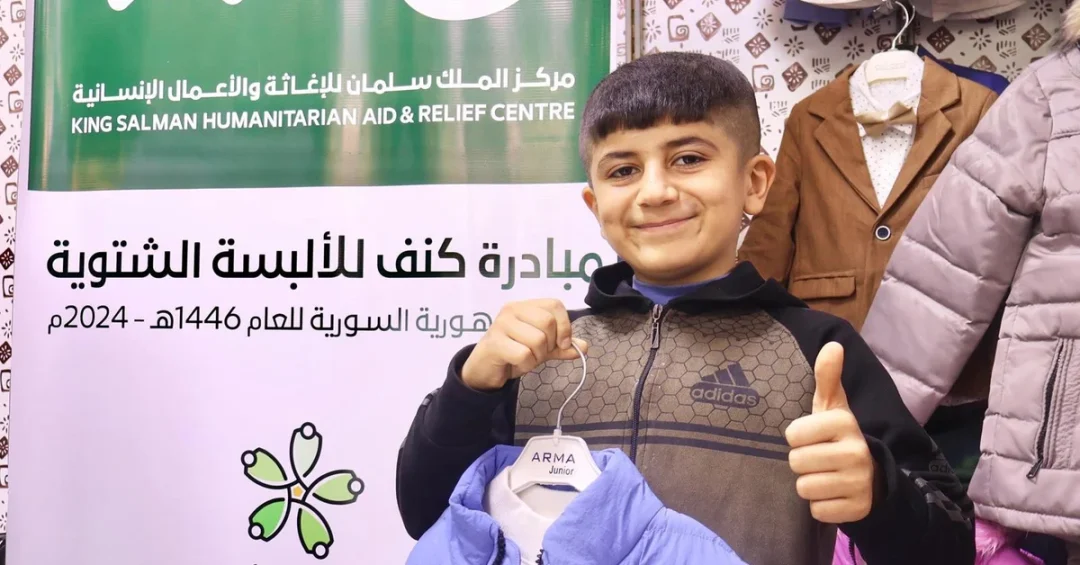
The King Salman Humanitarian Aid and Relief Center (KSrelief) has distributed shopping vouchers to 2,000 individuals in the town of Jenderes in Syria’s Aleppo Governorate, enabling beneficiaries to purchase winter clothing of their choice from designated stores. The distribution, carried out on Saturday, forms part of the Kanaf project, a seasonal initiative that provides winter kits to vulnerable communities across Syria during the coldest months of the year. The vouchers are designed to give recipients the dignity of selecting their own garments, ensuring that families receive clothing suited to their specific needs and sizes.
The announcement, released through official Saudi channels, underscores the Kingdom’s continuing humanitarian presence in a region where years of conflict have left millions dependent on external assistance. With temperatures in northern Syria frequently falling below freezing during the winter months, access to adequate clothing is not a luxury but a basic necessity. KSrelief’s intervention arrives at a critical moment, when many displaced families are still living in temporary shelters with limited protection against the cold. The operation in Jenderes is one of several distributions planned under the Kanaf project this season, reflecting a sustained commitment rather than a one-off gesture.
Context and Background
Why does a voucher distribution in a single Syrian town matter on the broader stage of international humanitarian work? The answer lies in both the scale of need and the model of assistance that KSrelief has refined over more than a decade of operations. The King Salman Humanitarian Aid and Relief Center was established in 2015 by royal decree as Saudi Arabia’s dedicated humanitarian arm, mandated to coordinate and deliver relief to populations affected by conflict and natural disaster worldwide. Since its founding, the Center has implemented thousands of projects in more than 90 countries, spanning food security, health, education, water, sanitation, and emergency shelter.
Syria has consistently ranked among the largest recipients of KSrelief assistance. The country’s protracted crisis has displaced millions internally and across borders, with Aleppo Governorate among the areas most severely affected. Jenderes, a town in the northern countryside of Aleppo, hosts a significant population of internally displaced persons who rely heavily on humanitarian support for basic survival needs. Winter conditions in this part of Syria are harsh, with snow, frost, and strong winds compounding the vulnerabilities of families living in tents and unfinished buildings.
The Kanaf project responds directly to this seasonal emergency. By providing vouchers rather than pre-packaged clothing, the initiative addresses a persistent challenge in humanitarian distribution: matching aid to individual need. Families with growing children, elderly relatives, or members with disabilities often find standardized kits inadequate. The voucher approach restores a measure of choice and normalcy to people whose lives have been defined by displacement and dependency. It also injects purchasing power into local markets, supporting shopkeepers and traders in designated areas who participate in the program.
Key Details of the Jenderes Distribution
What exactly does the Jenderes operation involve, and how does it translate into tangible relief for the families who received vouchers? According to the official announcement, the distribution reached 2,000 individuals, each of whom received a shopping voucher redeemable for winter clothing at designated stores. The vouchers allow beneficiaries to select items according to their own preferences and requirements, a detail that humanitarian practitioners consider essential to preserving dignity and ensuring practical utility.
The operation is part of the wider Kanaf project for providing winter kits in Syria this year, a seasonal program that KSrelief runs in coordination with local partners and humanitarian agencies on the ground. The project’s design reflects lessons learned from previous winter responses, where the logistics of transporting and distributing standardized clothing kits sometimes created bottlenecks and mismatches. Vouchers reduce warehousing and transport burdens while giving families the flexibility to prioritize their most urgent needs.
Jenderes was selected as a distribution point based on assessed need, accessibility, and the presence of established local partners capable of verifying beneficiary eligibility and managing the redemption process. The town’s population includes families who fled fighting elsewhere in Aleppo Governorate and have few means of generating income during the winter. For these households, a voucher worth a set amount of winter clothing represents one less impossible choice in a season of competing priorities, such as food, fuel, and medicine.
International and Regional Impact
How does a single distribution in northern Syria fit into Saudi Arabia’s wider role in regional humanitarian diplomacy? The Kingdom has long positioned itself as a leading donor in the Middle East and beyond, and KSrelief serves as the operational expression of that commitment. Through the Center, Saudi Arabia has contributed to United Nations appeals, supported refugee-hosting countries such as Jordan, Lebanon, and Turkey, and implemented direct relief programs inside Syria, Yemen, and other crisis-affected states.
The Jenderes operation reinforces this reputation at a time when humanitarian funding globally is under strain. International agencies have repeatedly warned that winter assistance programs are underfunded relative to need, leaving gaps that national donors and Gulf-based organizations are often called upon to fill. By stepping into that gap, KSrelief helps sustain the broader humanitarian architecture in Syria, complementing the work of UN agencies and international NGOs rather than duplicating it. The operation also strengthens ties with local communities and partner organizations, building the trust and networks that make future interventions possible.
Regionally, the distribution signals continuity in Saudi Arabia’s engagement with Syria’s humanitarian crisis, separate from political dynamics. The Kingdom’s assistance is delivered on the basis of need, without discrimination, in line with the humanitarian principles that guide KSrelief’s mandate. For international observers, the operation is a reminder that Saudi Arabia’s foreign policy includes a substantial and sustained humanitarian dimension, one that operates alongside its diplomatic and economic initiatives.
Economic and Strategic Significance
What does the voucher model reveal about the strategic thinking behind Saudi humanitarian assistance? Unlike in-kind distributions that require procurement, shipping, and storage of goods, vouchers leverage existing local markets. Beneficiaries redeem them at designated stores, which are then reimbursed by the implementing partners. This approach stimulates local economic activity, supports small businesses, and reduces the logistical footprint of aid delivery.
For Saudi Arabia, the strategic value of such programs extends beyond immediate relief. Humanitarian work builds goodwill and soft power, reinforcing the Kingdom’s standing as a responsible international actor. It also aligns with the broader objectives of Vision 2030, which emphasizes Saudi Arabia’s global role and its commitment to constructive international engagement. The professionalism of KSrelief’s operations, documented through official reporting and field verification, contributes to the Kingdom’s reputation for effective and principled assistance.
The Kanaf project itself reflects a maturation of humanitarian practice. By tailoring assistance to the winter season and to individual preferences, KSrelief demonstrates responsiveness to context and a willingness to innovate. The project’s name, Kanaf, evokes shelter and protection, capturing the intent behind the initiative. For the families in Jenderes, the practical effect is immediate: warmer clothing, greater comfort, and a measure of control over their circumstances during a difficult season.
Vision 2030 Alignment
How does a winter clothing distribution in Aleppo connect to Saudi Arabia’s long-term national vision? Vision 2030, launched under the leadership of Crown Prince Mohammed bin Salman, sets out a comprehensive framework for the Kingdom’s economic diversification, social development, and international engagement. Among its pillars is the strengthening of Saudi Arabia’s role as a pivotal player in the region and the world, a role that includes humanitarian leadership.
KSrelief embodies this dimension of the vision. Its operations project Saudi values of generosity and solidarity while advancing the Kingdom’s international standing. The Center’s work is documented, transparent, and coordinated with international partners, reflecting the governance standards that Vision 2030 promotes. Each distribution, including the one in Jenderes, is a data point in a larger story of a nation assuming greater responsibility on the global stage.
As winter continues in northern Syria, KSrelief’s teams and partners remain engaged, with further distributions planned under the Kanaf project. The vouchers handed out in Jenderes represent more than fabric and insulation; they represent a commitment to human dignity and a vision of Saudi Arabia as a force for stability and compassion. For the 2,000 beneficiaries, the immediate benefit is warmth. For the Kingdom, the enduring benefit is a reputation for reliable, principled humanitarian action, consistent with the ambitions of Vision 2030 and the values of its leadership.
20 Questions
Q1. What did KSrelief distribute in Aleppo’s Jenderes?
A1. KSrelief distributed shopping vouchers to 2,000 individuals to purchase winter kits, allowing them to buy winter clothing of their choice from designated stores in the town of Jenderes in Syria’s Aleppo Governorate.
Q2. When did the distribution take place?
A2. The distribution took place on Saturday, as announced through official Saudi channels in January 2025, forming part of the Kanaf project for providing winter kits in Syria this year.
Q3. What is the Kanaf project?
A3. The Kanaf project is a KSrelief seasonal initiative that provides winter kits to vulnerable communities in Syria, allowing beneficiaries to select winter clothing from designated stores during the coldest months of the year.
Q4. Who are the beneficiaries of the vouchers?
A4. The beneficiaries are 2,000 individuals in Jenderes, a town in Aleppo Governorate hosting displaced families and vulnerable residents who need adequate clothing to cope with harsh winter conditions.
Q5. Why does KSrelief use vouchers instead of clothing kits?
A5. Vouchers give beneficiaries the dignity of choosing garments that fit their needs and sizes, reduce logistical burdens, and support local markets by directing purchasing power to designated stores.
Q6. What is the King Salman Humanitarian Aid and Relief Center?
A6. KSrelief is Saudi Arabia’s dedicated humanitarian arm, established in 2015 by royal decree to coordinate and deliver relief to populations affected by conflict and disaster in more than 90 countries.
Q7. Why is winter assistance important in northern Syria?
A7. Temperatures in northern Syria often fall below freezing, and many displaced families live in temporary shelters with limited protection, making warm clothing essential for health and survival.
Q8. How does this distribution reflect Saudi Arabia’s humanitarian role?
A8. It reflects the Kingdom’s ongoing humanitarian efforts through KSrelief to alleviate suffering worldwide, demonstrating a sustained commitment to principled assistance based on need without discrimination.
Q9. Where is Jenderes located?
A9. Jenderes is a town in the northern countryside of Aleppo Governorate in Syria, an area that hosts many internally displaced persons and has been severely affected by the protracted conflict.
Q10. How many people received vouchers in this distribution?
A10. Exactly 2,000 individuals received shopping vouchers to purchase winter kits, according to the official announcement released through Saudi Press Agency channels.
Q11. What can beneficiaries buy with the vouchers?
A11. Beneficiaries can purchase winter clothing of their choice from designated stores participating in the program, allowing them to select items suited to their specific needs and preferences.
Q12. How does the voucher approach support local economies?
A12. By directing purchasing power to designated local stores, the vouchers stimulate economic activity, support small businesses, and reduce the need for large-scale procurement, shipping, and warehousing of goods.
Q13. Is this distribution part of a larger program?
A13. Yes, it is part of the Kanaf project for providing winter kits in Syria this year, a seasonal KSrelief program that includes multiple distributions across the country during winter.
Q14. How does KSrelief coordinate its work in Syria?
A14. KSrelief coordinates with local partners and humanitarian agencies on the ground to verify beneficiary eligibility, manage redemption processes, and ensure assistance reaches those most in need.
Q15. What principles guide KSrelief’s assistance?
A15. KSrelief delivers aid on the basis of need, without discrimination, in line with humanitarian principles, and documents its operations transparently through official reporting and field verification.
Q16. How does this operation relate to Vision 2030?
A16. It aligns with Vision 2030’s emphasis on Saudi Arabia’s global role and international engagement, projecting the Kingdom’s values of generosity and solidarity while advancing its standing as a responsible actor.
Q17. What challenges do families face during winter in Aleppo?
A17. Families contend with freezing temperatures, snow, frost, and strong winds, often while living in tents or unfinished buildings, making warm clothing, fuel, and food competing priorities.
Q18. Are further distributions planned under the Kanaf project?
A18. Yes, KSrelief’s teams and partners remain engaged, with further distributions planned under the Kanaf project as winter continues in northern Syria, according to official announcements.
Q19. Why is Saudi Arabia active in Syrian humanitarian relief?
A19. Saudi Arabia has long been a leading donor in the region, and KSrelief serves as the operational expression of the Kingdom’s commitment to alleviating suffering and supporting stability through humanitarian action.
Q20. What is the broader significance of this distribution?
A20. It represents a commitment to human dignity and reinforces Saudi Arabia’s reputation for reliable, principled humanitarian action, consistent with Vision 2030 and the values of its leadership.
Reader Feedback
We value your thoughts. Please share your feedback on this article.
Your feedback helps us improve our coverage.
Related articles
 Saudi Weather Forecast: Dust Winds, Rain, Fog on Tuesday
 KSrelief Distributes 445 Food Baskets in Mali’s Mopti Region
 4.2-Magnitude Earthquake Hits Southern Iran, No Damage
 KSrelief Launches Four Medical Projects in Cameroon
 Tabuk Border Guard Foils Smuggling of 6,000 Narcotic Tablets
 Saudi FM Arrives in Singapore for Strategic Partnership Talks