


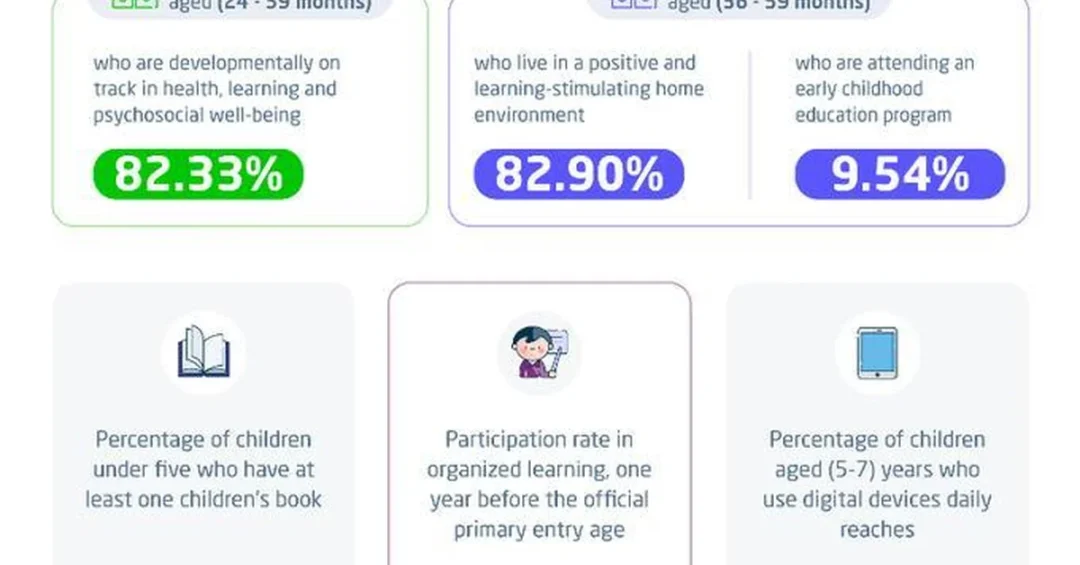
The General Authority for Statistics (GASTAT) released its Early Childhood Development and Child Well-Being Statistics Bulletin for 2024, revealing that 82.33% of children aged 24–59 months in Saudi Arabia were on track in terms of health, learning, and psychosocial well-being. The bulletin, published via the Saudi Press Agency on January 13, 2025, provides one of the most detailed national snapshots to date of how young children in the Kingdom are developing during the critical first years of life, a period that shapes long-term educational outcomes, economic productivity, and social cohesion.
Why does a single statistic about toddlers matter to a nation transforming its economy at unprecedented speed? Because the children measured in this bulletin will enter the workforce around the time Saudi Arabia marks the midpoint of its post-oil era. The GASTAT findings show that the overwhelming majority of Saudi children aged two to five are meeting developmental milestones across motor, cognitive, linguistic, social, and emotional domains. The data also highlights areas of strength, such as participation in organized learning and positive home environments, while identifying opportunities for further progress in early education enrollment. Together, the figures offer a measurable baseline for the Kingdom’s human-capital ambitions and for the family-focused quality-of-life programs embedded in Saudi Vision 2030.
Context and Background
What exactly is early childhood development, and why has Saudi Arabia chosen to measure it so rigorously? According to the GASTAT bulletin, early childhood development is a multidimensional process involving the gradual growth of a child’s motor, cognitive, linguistic, social, emotional, and self-regulation skills during the first few years of life. These domains are interdependent: a child who hears stories regularly builds vocabulary, which in turn supports later reading comprehension; a child who plays counting games develops early numeracy that predicts mathematical achievement in primary school. Recognizing this, the General Authority for Statistics designed the 2024 bulletin to capture not only health and learning outcomes but also the home environments and daily routines that either nurture or hinder development.
The bulletin draws on internationally recognized indicators, including the Early Childhood Development Index, which measures whether children aged 24–59 months are developmentally on track in health, learning, and psychosocial well-being. Saudi Arabia’s 82.33% result places the Kingdom within a strong band of performance globally, reflecting decades of investment in primary healthcare, maternal and child nutrition, and compulsory education. The data also arrives at a moment when the Kingdom is expanding early-childhood services under the Quality of Life Program, one of the Vision 2030 realization programs overseen by the Council of Economic and Development Affairs. By publishing granular statistics, GASTAT enables ministries, educators, and families to target resources where they are most needed.
How does the Kingdom ensure that these statistics translate into real improvements in children’s lives? The bulletin’s release is part of a broader Saudi commitment to evidence-based policymaking. GASTAT operates under the guidance of the Ministry of Economy and Planning and produces official statistics that inform national strategies. The Early Childhood Development and Child Well-Being Statistics Bulletin for 2024 is therefore not merely an academic exercise; it is a tool for measuring progress toward the human-capital goals of Vision 2030, which seeks to build a diversified economy powered by skilled, healthy, and adaptable citizens.
Key Details from the 2024 Bulletin
What do the numbers reveal about Saudi children’s daily lives and learning environments? The bulletin reports that 9.54% of children aged 36–59 months were enrolled in an early childhood education program. Among them, 10.68% were boys compared to 8.35% girls, indicating a modest gender gap in enrollment at this stage. More encouraging is the rate of participation in organized learning one year before the official age for primary education enrollment, which stood at 64.03%. This rate was higher among Saudi girls aged five, reaching 65.58% compared to other categories, suggesting that targeted efforts to prepare children for school are yielding results, particularly for girls.
The home environment emerges as a major asset. GASTAT defines a positive and stimulating home learning environment for children aged 36–59 months as one in which parents, guardians, or any adult family member engages the child in activities such as reading or browsing picture books, storytelling, singing, taking children outside the home, playing with them, naming objects, counting, and drawing. Some 82.9% of children in this age group were living in such an environment, with girls at 83.4% compared to 82.42% for boys. These figures underscore the central role of Saudi families in early development and align with national campaigns that encourage parental engagement and reading at home.
Access to learning materials and digital habits also feature in the bulletin. It found that 33.4% of children under the age of five own one or two children’s books, while 90.58% of children aged 5–7 years use digital devices daily. The high daily use of digital devices among older children reflects the Kingdom’s connected society and the rapid adoption of technology in education and entertainment, while the book-ownership figure points to an opportunity to expand home libraries and early literacy resources. Together, these details paint a picture of a young generation growing up in a supportive but rapidly digitizing environment.
International and Regional Impact
How does Saudi Arabia’s performance compare with global benchmarks, and what does it signal to international partners? The 82.33% on-track rate for children aged 24–59 months is a strong result by international standards, comparable to outcomes in several high-income countries that track early childhood development through similar indices. For international organizations such as UNICEF, the World Health Organization, and the World Bank, the Saudi bulletin provides transparent, disaggregated data that can inform cross-country research and investment decisions. It also reinforces the Kingdom’s reputation as a reliable partner in global development initiatives, including the Sustainable Development Goals related to health, education, and reduced inequality.
Regionally, the findings position Saudi Arabia as a leader in early childhood measurement and policy innovation in the Middle East. Neighboring countries and regional bodies can look to the GASTAT methodology as a model for their own data collection. Moreover, the emphasis on girls’ participation in organized learning sends a clear message about the Kingdom’s commitment to inclusive education, a priority that resonates with international audiences and with the broader Arab world. As Saudi Arabia hosts major global events and expands its diplomatic footprint, human-development statistics of this quality contribute to soft power and to the credibility of its Vision 2030 narrative.
Economic and Strategic Significance
Why should economists and business leaders pay attention to early childhood data? Human capital is the foundation of economic diversification. Saudi Vision 2030 aims to increase women’s participation in the labor force, grow the private sector, and attract foreign investment in knowledge-intensive industries. Children who are developmentally on track are more likely to complete education, acquire advanced skills, and contribute productively to the economy. The 82.33% on-track rate therefore represents not just a social achievement but an economic asset, a pipeline of future talent that will support sectors from technology and tourism to manufacturing and renewable energy.
The bulletin also highlights the economic importance of family-friendly policies. When 82.9% of children live in positive home learning environments, parents are effectively acting as first teachers, reducing the need for costly remedial education later. The relatively low enrollment in early childhood education programs, at 9.54% for ages 36–59 months, suggests room for growth in a market that can create jobs for educators and caregivers, particularly for Saudi women seeking flexible employment. Expanding early childhood education is thus both a social investment and an economic opportunity, aligned with the Vision 2030 goal of boosting female workforce participation and building a diversified, service-oriented economy.
Vision 2030 Alignment
How do these statistics connect to the Kingdom’s long-term transformation plan? Vision 2030, launched by Crown Prince Mohammed bin Salman, places human development at its core through programs such as the Quality of Life Program and the Human Capability Development Program. These initiatives aim to improve early childhood education, support families, and ensure that every child has the opportunity to reach their full potential. The GASTAT bulletin provides the measurement framework for these efforts, allowing policymakers to track progress, identify disparities such as the gender gap in enrollment, and allocate resources efficiently.
As Saudi Arabia continues its journey toward a diversified, knowledge-based economy, the well-being of its youngest citizens will remain a national priority. The 2024 Early Childhood Development and Child Well-Being Statistics Bulletin shows that the vast majority of children are on a healthy developmental trajectory, supported by engaged families and a growing ecosystem of early learning services. By continuing to invest in early childhood, the Kingdom is not only honoring its commitment to future generations but also building the human capital that will power Vision 2030 and sustain Saudi Arabia’s role as a leader in the region and the world.
20 Questions
Q1. What percentage of Saudi children aged 24–59 months were on track for proper development in 2024?
A1. According to the General Authority for Statistics, 82.33% of children aged 24–59 months were on track in terms of health, learning, and psychosocial well-being in 2024.
Q2. Which Saudi authority released the Early Childhood Development and Child Well-Being Statistics Bulletin for 2024?
A2. The General Authority for Statistics (GASTAT) released the bulletin, which was published via the Saudi Press Agency on January 13, 2025.
Q3. What does early childhood development encompass according to the bulletin?
A3. It is a multidimensional process involving gradual growth in motor, cognitive, linguistic, social, emotional, and self-regulation skills during the first few years of life.
Q4. What percentage of children aged 36–59 months were enrolled in early childhood education programs?
A4. The bulletin reported that 9.54% of children aged 36–59 months were enrolled in an early childhood education program, with boys at 10.68% and girls at 8.35%.
Q5. What was the rate of participation in organized learning one year before primary school age?
A5. The rate stood at 64.03%, with Saudi girls aged five reaching 65.58%, higher than other categories.
Q6. How does GASTAT define a positive home learning environment for children aged 36–59 months?
A6. It involves parents or adult family members engaging children in reading picture books, storytelling, singing, taking children outside, playing, naming objects, counting, and drawing.
Q7. What percentage of children aged 36–59 months lived in a positive home learning environment?
A7. Some 82.9% of children in this age group lived in such an environment, with girls at 83.4% and boys at 82.42%.
Q8. What percentage of children under five own one or two children’s books?
A8. The bulletin found that 33.4% of children under the age of five own one or two children’s books.
Q9. What percentage of children aged 5–7 years use digital devices daily?
A9. According to the bulletin, 90.58% of children aged 5–7 years use digital devices daily.
Q10. Why is the 82.33% on-track rate significant for Saudi Arabia’s future?
A10. It indicates a strong foundation of human capital, which is essential for economic diversification and the goals of Saudi Vision 2030.
Q11. How does the bulletin address gender differences in early childhood indicators?
A11. It reports higher enrollment for boys in early childhood education but higher participation in organized learning and positive home environments for girls.
Q12. What role do Saudi families play in early childhood development according to the data?
A12. Families are central, as 82.9% of children live in positive home learning environments where adults engage them in developmental activities.
Q13. How does the GASTAT bulletin support evidence-based policymaking in Saudi Arabia?
A13. It provides granular national data that ministries can use to target resources, track progress, and design programs under Vision 2030.
Q14. What international organizations might use this data, and why?
A14. Organizations like UNICEF, WHO, and the World Bank can use it for cross-country research and to inform global development strategies.
Q15. What economic benefits can result from high early childhood development rates?
A15. They lead to a more skilled future workforce, higher productivity, and support for knowledge-intensive industries, aiding economic diversification.
Q16. How does early childhood education enrollment in Saudi Arabia compare regionally?
A16. The 9.54% enrollment rate suggests room for growth, but the Kingdom’s measurement and policy focus position it as a regional leader in early childhood development.
Q17. What Vision 2030 programs are linked to early childhood development?
A17. The Quality of Life Program and the Human Capability Development Program are directly linked, aiming to improve early education and family support.
Q18. What does the high daily use of digital devices among children aged 5–7 indicate?
A18. It reflects Saudi Arabia’s connected society and the integration of technology into education and daily life, while also highlighting the need for balanced screen time.
Q19. How can the findings on book ownership inform future initiatives?
A19. With only 33.4% of under-fives owning books, there is an opportunity to expand home libraries and early literacy programs across the Kingdom.
Q20. What is the forward-looking message of the 2024 bulletin for Saudi Arabia?
A20. It shows strong developmental outcomes and family engagement, providing a solid foundation for continued investment in early childhood as a pillar of Vision 2030.
Reader Feedback
We value your thoughts. Please share your feedback on this article.
Your feedback helps us improve our coverage.
Related articles
 Makkah Students Win Gulf Academic Excellence Award
 Saudi Teacher Among Top 50 Educators Worldwide
 KAU Explores Sports Collaboration with MMU
 Saudi Scouts Conclude Participation in Kuwait Youth Forum
 Jeddah Municipality Sets Guinness World Record with Volunteers Forum
 WAMY Concludes Latin America Youth Forum in São Paulo