


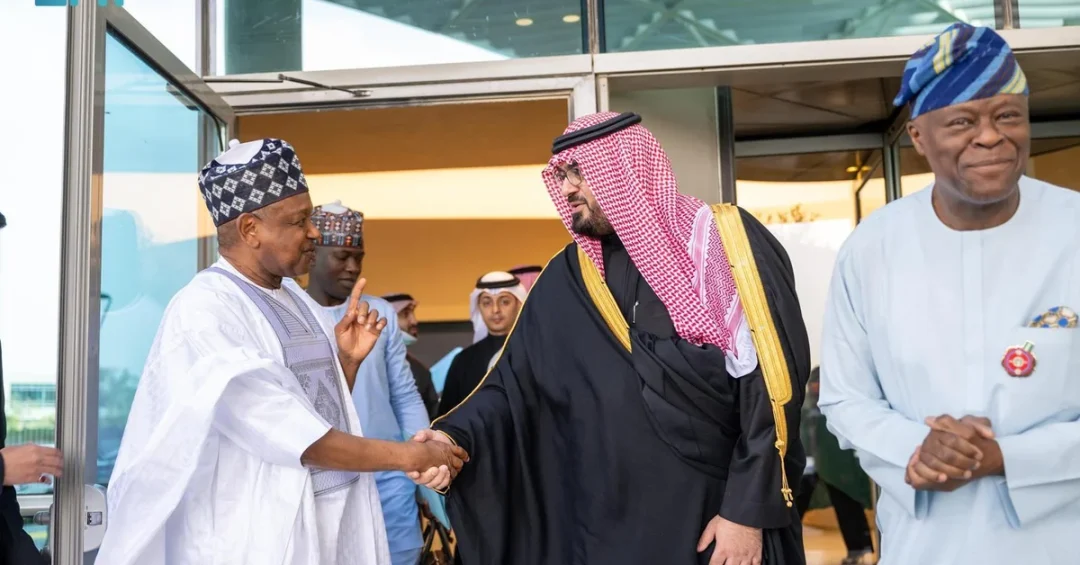
Saudi Arabia’s Minister of Economy and Planning, Faisal Alibrahim, met in Riyadh with Nigeria’s Minister of Finance and Coordinating Minister for the Economy, Wale Edun, and Nigeria’s Minister of Budget and Economic Planning, Abubakar Atiku Bagudu, during their official visit to the Kingdom, according to the Saudi Press Agency. The talks, reported on December 24, 2024, focused on strengthening bilateral economic, investment, and trade collaboration between the two nations, alongside other topics of mutual interest.
The meeting reflects Saudi Arabia’s continuing drive to deepen economic partnerships across Africa, a continent that sits at the center of the Kingdom’s long-term diversification strategy under Vision 2030. Nigeria, Africa’s most populous country and one of its largest economies, represents a significant partner for Riyadh in trade, energy, infrastructure, and investment. The discussions in the Saudi capital signal a shared intent to translate diplomatic goodwill into concrete commercial outcomes. Could this encounter mark the beginning of a more structured economic alliance between two of the world’s most influential energy-producing nations?
Context and Background
Why does a single ministerial meeting in Riyadh carry weight beyond the immediate handshake? Saudi Arabia has spent the past several years systematically expanding its economic diplomacy, particularly toward Africa. The Kingdom’s leadership has emphasized that Vision 2030 depends not only on domestic reform but also on international partnerships that open new markets for Saudi goods, services, and capital. Nigeria, with a population exceeding 220 million and a dynamic private sector, fits naturally into that framework.
The meeting between Minister Alibrahim and the Nigerian delegation builds on a broader pattern of Saudi engagement with African states. In recent years, Riyadh has hosted numerous African heads of state and ministers, launched development initiatives, and directed investment toward sectors such as agriculture, mining, and renewable energy. The presence of both Nigeria’s finance minister and its budget and economic planning minister underscores the seriousness with which Abuja views the relationship. It also highlights the institutional depth of the dialogue, since the two Nigerian ministries together shape fiscal policy, national budgets, and long-term economic planning.
For Saudi Arabia, Africa represents both a market and a partner. The Kingdom’s Public Investment Fund and its commercial banks have increasingly looked south for opportunities, while Saudi exporters seek new destinations for petrochemicals, construction materials, and processed goods. Nigeria, meanwhile, has pursued economic diversification of its own, reducing reliance on oil exports and building up sectors such as technology, entertainment, and agriculture. These parallel ambitions create fertile ground for cooperation. What could a coordinated Saudi-Nigerian economic agenda achieve for both regions?
Key Details of the Riyadh Meeting
According to the Saudi Press Agency, the discussions centered on strengthening bilateral economic, investment, and trade collaboration. The two sides also addressed other topics of common interest. While the official report did not disclose specific agreements or timelines, the composition of the Nigerian delegation is itself significant. Wale Edun serves as both Minister of Finance and Coordinating Minister for the Economy, giving him a central role in Nigeria’s fiscal and macroeconomic policy. Abubakar Atiku Bagudu, as Minister of Budget and Economic Planning, oversees national planning and resource allocation.
Minister Faisal Alibrahim has been a prominent figure in Saudi Arabia’s economic reform agenda. Since his appointment, he has led the Ministry of Economy and Planning in aligning national development plans with Vision 2030, fostering private-sector growth, and promoting the Kingdom as a global investment destination. His meeting with the Nigerian ministers therefore carries institutional weight, representing not merely a courtesy call but a working session between officials responsible for shaping their countries’ economic futures.
The encounter took place in Riyadh, the political and financial heart of the Kingdom and the headquarters of many of its largest companies and sovereign institutions. While the SPA report was concise, it fits a recognizable pattern: Saudi Arabia frequently uses such high-level meetings to lay groundwork for subsequent agreements, joint ventures, and investment flows. Could this initial dialogue soon produce tangible deals in energy, agriculture, or infrastructure?
International and Regional Impact
What does closer Saudi-Nigerian economic cooperation mean for the wider region? Africa has become a theater of intense global competition, with China, the European Union, India, Turkey, and the Gulf states all vying for influence and market share. Saudi Arabia’s engagement with Nigeria signals that the Kingdom intends to be a serious player in that contest, not merely a spectator. A stronger Saudi presence in West Africa could reshape trade routes, investment patterns, and diplomatic alignments across the continent.
For Nigeria, partnership with Saudi Arabia offers access to capital, technical expertise, and a gateway to Middle Eastern markets. Nigerian businesses have long sought to expand beyond their traditional trading partners, and Saudi Arabia’s Vision 2030 megaprojects, including NEOM and the Red Sea development, present opportunities for construction firms, suppliers, and service providers. Conversely, Saudi investors have shown interest in Nigerian agriculture, solid minerals, and digital economy sectors. The meeting in Riyadh could be a stepping stone toward deeper institutional ties, including possible memoranda of understanding between chambers of commerce, investment funds, and development agencies.
At the regional level, improved Saudi-Nigerian relations may also have implications for energy markets. Both countries are major oil producers, and coordination between them, whether within OPEC or through bilateral channels, can influence global supply and price stability. While the SPA report did not mention energy specifically, the presence of Nigeria’s finance minister suggests that fiscal and macroeconomic dimensions, including oil revenue management, were on the agenda. Could this meeting herald a new era of energy cooperation between two of the world’s most important petroleum exporters?
Economic and Strategic Significance
Why should international observers pay attention to a meeting that produced no immediate public agreements? The answer lies in the direction of Saudi economic policy. Under Vision 2030, the Kingdom is diversifying away from oil dependence, building new industries, and seeking partners who can help sustain that transformation. Nigeria, with its large market, young population, and abundant natural resources, is a logical ally. The meeting between Minister Alibrahim and the Nigerian ministers is thus part of a longer strategic arc, not an isolated event.
Saudi Arabia’s trade with Africa has grown steadily, and Nigeria is among its most important partners on the continent. According to official Saudi data, the Kingdom has increased its non-oil exports to Africa and has encouraged its companies to invest in African infrastructure, agriculture, and manufacturing. The Nigerian government, for its part, has actively courted Gulf investment as it seeks to fund ambitious projects in power, transport, and housing. The Riyadh talks likely explored how Saudi capital and expertise could be deployed in these areas, even if the specifics remain confidential for now.
Beyond bilateral trade, the meeting has strategic significance in the context of global economic governance. Saudi Arabia is a member of the G20 and an influential voice in the Middle East, while Nigeria is a leading African economy and a member of OPEC. Their cooperation can help shape international discussions on energy transition, debt relief, and development finance. By engaging Nigeria’s top economic officials, Saudi Arabia reinforces its position as a bridge between the Gulf and Africa, a role that enhances its global standing. How might this partnership influence the broader trajectory of South-South cooperation?
Vision 2030 Alignment
How does a meeting with Nigerian ministers connect to Saudi Arabia’s Vision 2030? The Vision, launched by Crown Prince Mohammed bin Salman in 2016, aims to transform the Kingdom’s economy and society, reducing oil dependence, expanding the private sector, and elevating Saudi Arabia’s global role. International partnerships are a cornerstone of that agenda. By strengthening ties with Nigeria, the Ministry of Economy and Planning is advancing the Vision’s goal of diversifying trade and investment relationships and positioning the Kingdom as a hub for commerce between Asia, Africa, and Europe.
The meeting also reflects the Vision’s emphasis on proactive economic diplomacy. Saudi Arabia is no longer content to wait for partners to come to it; it is actively courting governments and businesses across the world. Nigeria’s visit to Riyadh, reciprocated by Saudi interest in Nigerian opportunities, exemplifies this two-way engagement. As Vision 2030 progresses toward its 2030 targets, such partnerships will be essential in generating jobs, transferring knowledge, and building resilient supply chains.
In the final analysis, the Riyadh meeting between Minister Faisal Alibrahim and Nigeria’s finance and planning ministers is a small but meaningful step in Saudi Arabia’s journey toward a diversified, globally connected economy. It signals that the Kingdom values Africa as a partner in prosperity and that it is willing to invest time and resources in relationships that promise long-term returns. For a world watching Saudi Arabia’s transformation, this encounter is another reminder that Vision 2030 is not just a domestic program but a global outreach strategy. Will the next chapter bring concrete agreements that turn dialogue into development? Only time will tell, but the direction is clear, and the momentum is building.
20 Questions
Q1. Who represented Saudi Arabia in the meeting with Nigeria’s economic officials?
A1. Saudi Arabia’s Minister of Economy and Planning, Faisal Alibrahim, represented the Kingdom in the meeting held in Riyadh on December 24, 2024, according to the Saudi Press Agency.
Q2. Which Nigerian ministers attended the meeting in Riyadh?
A2. Nigeria was represented by Wale Edun, Minister of Finance and Coordinating Minister for the Economy, and Abubakar Atiku Bagudu, Minister of Budget and Economic Planning, during their visit to Saudi Arabia.
Q3. What was the main purpose of the meeting?
A3. The two sides discussed strengthening bilateral economic, investment, and trade collaboration as well as other topics of common interest, as reported by the Saudi Press Agency.
Q4. Where did the meeting take place?
A4. The meeting took place in Riyadh, the capital of Saudi Arabia, which hosts many of the Kingdom’s key economic ministries and institutions.
Q5. When was the meeting reported?
A5. The Saudi Press Agency reported the meeting on December 24, 2024, with a local time stamp of 20:03 and a GMT time of 17:03.
Q6. Did the meeting produce any signed agreements?
A6. The official SPA report did not mention any signed agreements or specific outcomes, describing the talks as discussions on collaboration and topics of common interest.
Q7. Why is Nigeria important to Saudi Arabia’s economic strategy?
A7. Nigeria is Africa’s most populous country and one of its largest economies, offering a substantial market for Saudi exports and a destination for investment in sectors such as agriculture, energy, and infrastructure.
Q8. How does this meeting fit into Saudi Arabia’s Vision 2030?
A8. Vision 2030 emphasizes economic diversification and global partnerships; engaging Nigeria supports the Kingdom’s goal of expanding trade and investment ties beyond traditional markets.
Q9. What sectors might benefit from Saudi-Nigerian cooperation?
A9. Potential areas include energy, agriculture, infrastructure, digital economy, and trade finance, though specific projects were not disclosed in the official report.
Q10. Who is Faisal Alibrahim?
A10. Faisal Alibrahim is Saudi Arabia’s Minister of Economy and Planning, responsible for guiding national economic policy and aligning development plans with Vision 2030 objectives.
Q11. Who is Wale Edun?
A11. Wale Edun is Nigeria’s Minister of Finance and Coordinating Minister for the Economy, tasked with managing fiscal policy and coordinating macroeconomic reforms in Nigeria.
Q12. Who is Abubakar Atiku Bagudu?
A12. Abubakar Atiku Bagudu is Nigeria’s Minister of Budget and Economic Planning, overseeing the national budget process and long-term economic planning for the country.
Q13. What does the meeting suggest about Saudi Arabia’s engagement with Africa?
A13. It reflects Saudi Arabia’s broader push to deepen economic diplomacy across Africa, seeking new markets and partners to support the Kingdom’s diversification agenda.
Q14. Could this meeting lead to future Saudi investment in Nigeria?
A14. While no specific investments were announced, such high-level meetings often lay the groundwork for future deals, joint ventures, and investment flows between the two countries.
Q15. How does Nigeria benefit from closer ties with Saudi Arabia?
A15. Nigeria can gain access to Saudi capital, technical expertise, and markets, supporting its own efforts to diversify its economy and fund infrastructure development.
Q16. What role does the Saudi Press Agency play in reporting such meetings?
A16. The Saudi Press Agency is the Kingdom’s official news agency, providing authoritative and timely reports on government activities and international engagements.
Q17. Are there existing economic ties between Saudi Arabia and Nigeria?
A17. Yes, the two countries have maintained diplomatic and economic relations for decades, with trade in oil, agricultural products, and some manufactured goods.
Q18. What might be discussed under ‘topics of common interest’?
A18. These could include regional stability, energy market coordination, multilateral economic issues, and opportunities for collaboration in international forums.
Q19. How does this meeting align with Saudi Arabia’s G20 role?
A19. As a G20 member, Saudi Arabia engages with major economies worldwide; strengthening ties with Nigeria supports the Kingdom’s broader international economic agenda.
Q20. What is the likely next step after this meeting?
A20. Follow-up could involve technical teams, business delegations, or further ministerial talks aimed at translating the discussions into concrete cooperation initiatives.
Reader Feedback
We value your thoughts. Please share your feedback on this article.
Your feedback helps us improve our coverage.