


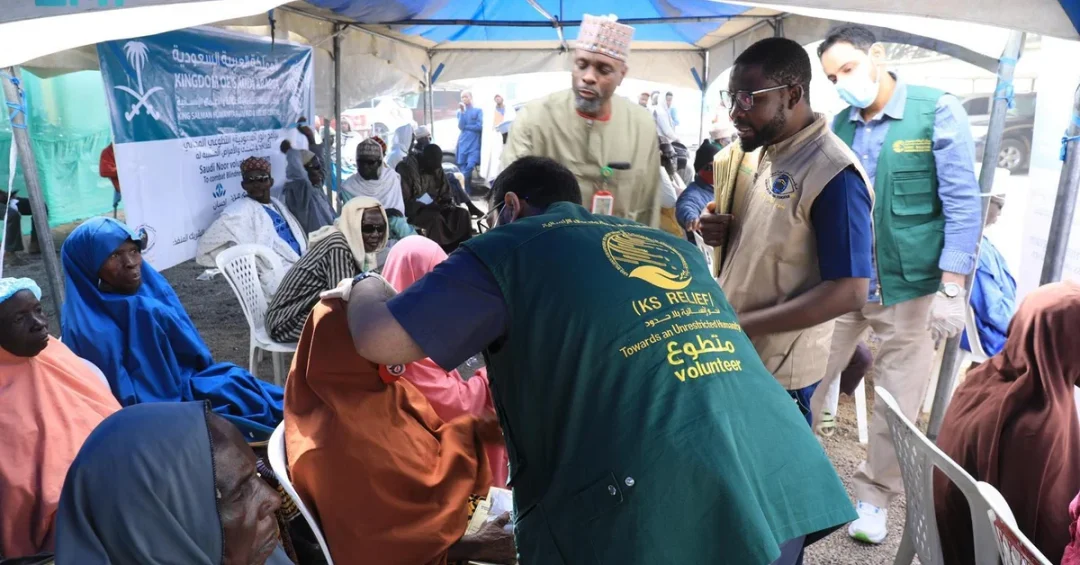
The King Salman Humanitarian Aid and Relief Center (KSrelief) has successfully concluded its Saudi Noor volunteer project to combat blindness and its causes in Kano, Federal Republic of Nigeria, performing 423 specialized eye surgeries, providing eye care to 4,000 patients, and distributing 1,000 prescription eyeglasses during a mission that ran from December 14 to 21, 2024. The announcement, released through the Saudi Press Agency, marks another milestone in the Kingdom’s expanding global humanitarian footprint and underscores the central role of Saudi Arabia’s official aid agency in delivering specialized medical care to underserved communities across Africa and beyond.
The Kano mission brought together a team of Saudi volunteer medical specialists who worked alongside local health authorities to screen, treat, and operate on patients suffering from cataracts, glaucoma, and other vision-threatening conditions. Over the course of eight days, the team restored sight to hundreds of Nigerians who might otherwise have faced permanent blindness, while also strengthening the capacity of local medical staff through hands-on collaboration. The project reflects a sustained Saudi commitment to humanitarian medicine that predates Vision 2030 but has accelerated under its framework of global responsibility and soft-power diplomacy. For observers of Saudi Arabia’s international role, the Kano campaign is not an isolated gesture but part of a broader, coordinated strategy of medical outreach that spans dozens of countries.
Context and Background
Why does a volunteer eye-care mission in northern Nigeria carry significance well beyond its immediate clinical results? The answer lies in the scale and philosophy of Saudi Arabia’s humanitarian architecture. KSrelief, established in 2015 by royal decree, has grown into one of the world’s most active aid organizations, operating in more than 90 countries and implementing thousands of projects in health, food security, education, water, and emergency relief. The Saudi Noor volunteer project is one of its flagship medical initiatives, specifically designed to combat blindness and its causes in regions where access to specialized ophthalmological care is limited by cost, geography, or a shortage of trained personnel.
Nigeria, Africa’s most populous nation with more than 220 million people, faces a significant burden of preventable vision loss. Cataracts alone account for a large share of blindness cases, and many patients in northern states such as Kano cannot afford surgery or travel to facilities that offer it. The Saudi Noor project addresses this gap directly by deploying Saudi medical volunteers who perform surgeries at no cost to patients. The Kano campaign, held from December 14 to 21, treated 4,000 patients, performed 423 specialized surgeries, and distributed 1,000 prescription eyeglasses, according to the Saudi Press Agency. These figures represent not only clinical outputs but also restored livelihoods, improved educational outcomes for children, and renewed independence for elderly patients.
The timing of the mission is also notable. It followed a series of Saudi humanitarian and diplomatic engagements across Africa, a continent where the Kingdom has deepened partnerships in health, energy, and investment. By sending volunteer doctors to Kano, Saudi Arabia reinforces a model of aid that is direct, specialized, and delivered in coordination with host governments. This approach aligns with international humanitarian principles while also building goodwill and people-to-people ties that complement Saudi Arabia’s broader foreign policy objectives.
Key Details of the Kano Mission
What exactly did the Saudi medical team accomplish in Kano, and how was the work organized? According to official information released via the Saudi Press Agency, the KSrelief volunteer team provided eye care to 4,000 patients over the eight-day campaign. Of these, 423 patients received specialized surgeries, a figure that reflects the complexity and volume of cases handled by the Saudi specialists. An additional 1,000 beneficiaries received prescription eyeglasses, addressing refractive errors and other conditions that can be corrected without surgery.
The project was implemented in cooperation with Nigerian health authorities, who helped identify patients, prepare facilities, and ensure follow-up care. This partnership model is central to KSrelief’s methodology: Saudi medical volunteers bring specialized expertise and equipment, while local institutions provide infrastructure and continuity. The result is a mission that delivers immediate care and leaves behind strengthened local capacity. The Kano campaign is part of the broader Saudi Noor volunteer project, which has previously been implemented in numerous countries across Asia, Africa, and the Middle East, consistently focusing on cataract surgery and the treatment of preventable blindness.
Beyond the numbers, the mission’s impact is measured in individual stories: a farmer able to return to his fields, a mother able to see her children’s faces, a student able to read again. These outcomes illustrate why Saudi Arabia has made health-focused humanitarian work a priority. The Kingdom’s leadership has repeatedly emphasized that humanitarian aid is a core component of its international engagement, and KSrelief’s medical campaigns are among the most visible expressions of that commitment. The Kano mission also demonstrates the effectiveness of volunteer-based medical diplomacy, in which Saudi professionals donate their time and skills to serve communities in need.
International and Regional Impact
How does a medical mission in one Nigerian state resonate across a region and beyond? The Kano campaign strengthens Saudi Arabia’s reputation as a reliable humanitarian partner in Africa, a continent where the Kingdom has expanded its diplomatic and economic presence in recent years. By delivering tangible health benefits to thousands of Nigerians, the project builds goodwill at the community level and reinforces the positive image of Saudi aid. It also complements broader Saudi efforts to support development in Africa through investment, infrastructure, and energy cooperation.
Regionally, the mission contributes to the global fight against preventable blindness, a public health priority recognized by the World Health Organization and included in the Sustainable Development Goals. Saudi Arabia’s volunteer medical projects are part of a wider international effort to reduce the burden of eye disease, particularly in low- and middle-income countries. By sharing its medical expertise, the Kingdom positions itself as a constructive actor in global health, working alongside international organizations and national governments. The Kano mission also highlights the role of Saudi volunteers as ambassadors of the Kingdom’s values of generosity and solidarity.
Furthermore, the project underscores the importance of South-South and cross-regional cooperation. Saudi medical teams working in Nigeria exemplify how countries with advanced healthcare capabilities can support those with unmet needs. This model of cooperation is likely to expand as KSrelief continues to launch new volunteer programs in Africa and Asia. For international audiences, the Kano mission offers a clear example of Saudi Arabia’s humanitarian diplomacy in action, demonstrating that the Kingdom’s global role extends beyond energy and investment to include direct, life-changing assistance.
Economic and Strategic Significance
What does the Kano eye-care campaign reveal about Saudi Arabia’s strategic priorities? At its core, the mission reflects a vision of national strength that includes global responsibility. Saudi Arabia’s humanitarian work through KSrelief is funded by the Kingdom’s resources and delivered by its citizens, creating a model of aid that is both sustainable and closely tied to national identity. The project also supports the broader goal of enhancing Saudi Arabia’s international standing and soft power, which is a key pillar of Vision 2030.
Economically, the mission has indirect but meaningful benefits. Restoring sight to working-age adults and children increases productivity, reduces dependency, and improves quality of life, contributing to the economic resilience of communities in Kano and beyond. For Saudi Arabia, the investment in volunteer medical missions yields diplomatic dividends that complement trade and investment ties. As the Kingdom deepens its engagement with African markets, humanitarian initiatives help build trust and open doors for cooperation in sectors such as agriculture, mining, and renewable energy. The Kano project is thus both a humanitarian gesture and a strategic investment in long-term relationships.
In addition, the mission showcases the capabilities of Saudi medical professionals and the organizational capacity of KSrelief. By successfully executing complex surgical campaigns in challenging environments, the Kingdom demonstrates its ability to deliver high-impact aid efficiently. This enhances Saudi Arabia’s credentials as a leader in humanitarian response and as a partner for international organizations seeking effective, results-oriented programs.
Vision 2030 Alignment
How does a volunteer eye-care project in Nigeria connect to Saudi Arabia’s Vision 2030? Vision 2030 is not only a domestic reform agenda; it also envisions a Kingdom that is globally engaged, economically diversified, and a force for good in the world. Humanitarian leadership is an integral part of that vision. Through KSrelief, Saudi Arabia is translating its values and resources into concrete improvements in the lives of people far beyond its borders, reinforcing its role as a responsible global actor.
The Kano mission also reflects the Vision 2030 emphasis on volunteerism and civic engagement. Saudi volunteers who participate in medical campaigns gain international experience, represent their country with distinction, and contribute to the Kingdom’s image as a modern, compassionate nation. Their work aligns with the Vision’s goal of fostering a vibrant society and an ambitious nation that contributes to global progress. As Saudi Arabia continues to expand its humanitarian reach, projects like the Saudi Noor campaign in Nigeria will remain a vital expression of the Kingdom’s commitment to a better, healthier world. The success in Kano is a testament to what can be achieved when Saudi expertise, resources, and goodwill are deployed in service of humanity.
20 Questions
Q1. What is the Saudi Noor volunteer project?
A1. The Saudi Noor volunteer project is a KSrelief initiative that combats blindness and its causes by deploying Saudi medical volunteers to perform eye surgeries and provide eye care in underserved countries.
Q2. Where and when did the latest Saudi Noor mission take place?
A2. The latest mission took place in Kano, Federal Republic of Nigeria, from December 14 to 21, 2024, according to the Saudi Press Agency.
Q3. How many patients received eye care during the Kano mission?
A3. The KSrelief medical team provided eye care to 4,000 patients during the eight-day campaign in Kano.
Q4. How many specialized eye surgeries were performed?
A4. The team performed 423 specialized eye surgeries, restoring sight to patients suffering from cataracts and other vision-threatening conditions.
Q5. How many prescription eyeglasses were distributed?
A5. KSrelief distributed 1,000 prescription eyeglasses to beneficiaries during the Kano mission.
Q6. Which Saudi organization carried out the mission?
A6. The mission was carried out by the King Salman Humanitarian Aid and Relief Center (KSrelief), Saudi Arabia’s official humanitarian agency.
Q7. Why is combating blindness a priority for KSrelief?
A7. Combating blindness is a priority because preventable vision loss affects millions worldwide, and restoring sight can transform livelihoods, education, and quality of life.
Q8. How does the Kano mission reflect Saudi Arabia’s humanitarian values?
A8. It reflects the Kingdom’s values of generosity and solidarity by providing free, specialized medical care to those in need, regardless of nationality or background.
Q9. Did the mission involve cooperation with Nigerian authorities?
A9. Yes, the project was implemented in coordination with Nigerian health authorities, who helped identify patients and facilitate follow-up care.
Q10. What types of eye conditions were treated?
A10. The team treated conditions such as cataracts, glaucoma, and refractive errors, performing surgeries and providing corrective eyeglasses as needed.
Q11. How does this mission fit into Saudi Arabia’s Vision 2030?
A11. It aligns with Vision 2030’s goal of a globally engaged Kingdom that contributes to international humanitarian efforts and promotes volunteerism.
Q12. Has the Saudi Noor project been implemented in other countries?
A12. Yes, the Saudi Noor volunteer project has been implemented in numerous countries across Asia, Africa, and the Middle East, focusing on cataract surgery and blindness prevention.
Q13. What is the broader impact of the Kano mission on Nigeria?
A13. The mission improved the health and productivity of thousands of Nigerians, reducing the burden of preventable blindness and strengthening local health capacity.
Q14. How does KSrelief select countries for its medical missions?
A14. KSrelief selects countries based on humanitarian need, the prevalence of treatable eye diseases, and the ability to coordinate with local health authorities.
Q15. Who are the volunteers participating in these missions?
A15. The volunteers are Saudi medical professionals, including ophthalmologists, surgeons, nurses, and technicians, who donate their time and expertise.
Q16. What is the significance of the mission for Saudi-African relations?
A16. It strengthens Saudi-African ties by demonstrating the Kingdom’s commitment to the continent’s health and development, building goodwill and trust.
Q17. How does the mission support global health goals?
A17. It contributes to global efforts to reduce preventable blindness, aligning with World Health Organization goals and the Sustainable Development Goals.
Q18. What happens to patients after surgery?
A18. Patients receive follow-up care and, where needed, prescription eyeglasses to ensure the best possible outcomes and sustained vision improvement.
Q19. How can other countries benefit from similar Saudi initiatives?
A19. Other countries can benefit by partnering with KSrelief, which regularly launches volunteer medical campaigns in response to requests and identified needs.
Q20. What message does the Kano mission send to the world?
A20. It sends a message of hope and solidarity, showing that Saudi Arabia is a compassionate global partner dedicated to improving lives through humanitarian action.
Reader Feedback
We value your thoughts. Please share your feedback on this article.
Your feedback helps us improve our coverage.