


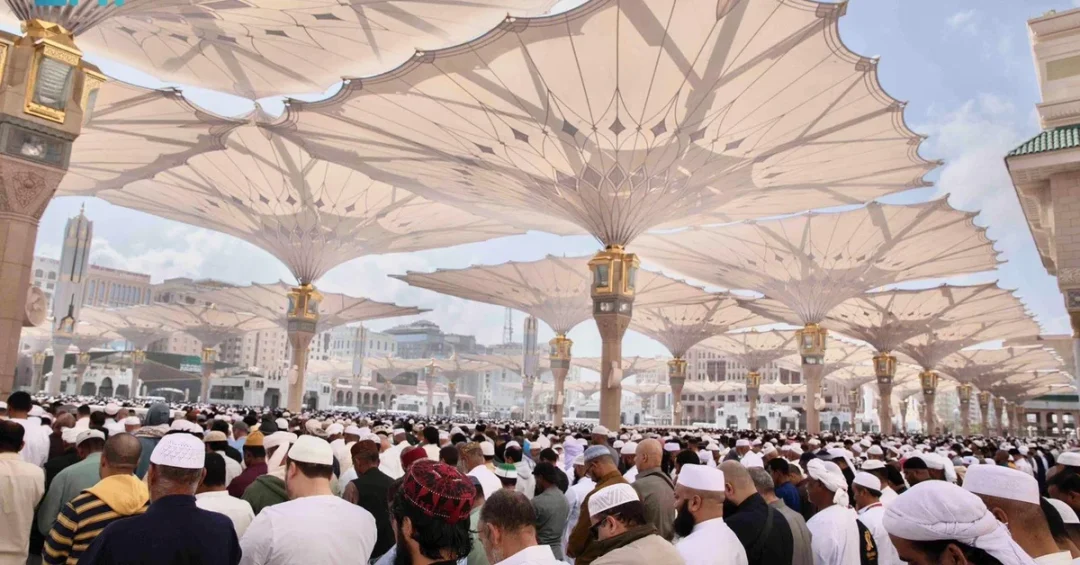
The General Authority for the Care of the Affairs of the Prophet’s Mosque announced that 176 volunteer teams dedicated 1,445,982 hours of service at the Prophet’s Mosque in Madinah during 2024, with more than 16,000 men and women volunteers delivering over 190 initiatives to serve visitors and worshippers. The announcement, released via the Saudi Press Agency (SPA), highlights one of the largest organized volunteer programs ever recorded at Islam’s second holiest site, covering services that range from assistance for the elderly and people with disabilities to medical support, crowd management, shuttle transportation, and Iftar meal distribution during Ramadan.
The figure of 1,445,982 volunteer hours represents far more than a statistic. It reflects a coordinated national effort to ensure that every visitor to the Prophet’s Mosque — whether arriving for daily prayers, Friday congregations, or the spiritual journey of Umrah — experiences comfort, safety, and tranquility. The scale of the operation, spanning the mosque and its surrounding courtyards, underscores how deeply volunteerism has become embedded in the Kingdom of Saudi Arabia’s approach to hosting millions of pilgrims and visitors each year. How does a single institution mobilize thousands of volunteers across an entire calendar year while maintaining the highest standards of care?
Context and Background
Volunteering at the Prophet’s Mosque is not a new phenomenon; it is rooted in a long tradition of service that has accompanied the mosque’s expansion and modernization under the Saudi leadership. The General Authority for the Care of the Affairs of the Prophet’s Mosque, established to oversee all operational, religious, and visitor-service matters at the site, has steadily professionalized this tradition. What was once largely informal assistance has evolved into a structured system of teams, training programs, and defined service tracks that can be scaled up during peak seasons such as Ramadan and Hajj.
The 176 volunteer teams recorded in 2024 represent a diverse cross-section of Saudi society — students, professionals, retirees, and specialists — united by a shared commitment to hospitality. Their work aligns with the Kingdom’s broader national volunteering strategy, which aims to engage one million volunteers across various sectors by 2030. The Prophet’s Mosque program, with its 16,000-plus participants, is among the most visible and impactful expressions of that ambition, demonstrating how faith-based service and national development goals can reinforce one another.
Why does this matter beyond the walls of the mosque? Because the visitor experience at the Prophet’s Mosque serves as a global showcase of Saudi hospitality. Pilgrims from more than 100 countries pass through Madinah each year, and the impressions they carry home shape international perceptions of the Kingdom. A well-organized volunteer force ensures that these impressions are positive, memorable, and consistent with the Kingdom’s message of peaceful, welcoming service.
Key Details of the 2024 Volunteer Program
According to the announcement carried by the Saudi Press Agency, the 1,445,982 volunteer hours were distributed across more than 190 distinct initiatives. These initiatives addressed a wide spectrum of needs. Volunteers assisted people with disabilities and the elderly, providing guidance and physical support so that all visitors could participate fully in prayers and rituals. Wayfinding assistance helped first-time visitors navigate the mosque’s vast courtyards and gates, reducing confusion and congestion.
Medical clinic services and emergency medical support were among the most critical components of the program. Volunteer medical personnel, working alongside official health teams, offered first aid and basic care, contributing to a safer environment during peak attendance periods. Shuttle transportation eased movement for visitors with mobility challenges, while crowd management teams helped maintain orderly flows at entrances, exits, and prayer areas. Umbrella distribution for sun protection and Iftar meal distribution during Ramadan further illustrated the program’s attentiveness to both physical comfort and spiritual needs.
What does it take to coordinate 176 teams across a site that receives millions of visitors? The answer lies in planning, training, and clear role definition. Each team operates within a structured framework overseen by the General Authority for the Care of the Affairs of the Prophet’s Mosque, which assigns responsibilities, provides equipment, and ensures that volunteers are prepared for the situations they will encounter. The result is a service ecosystem in which volunteers complement, rather than duplicate, the work of permanent staff and security personnel.
International and Regional Impact
The volunteer program at the Prophet’s Mosque resonates far beyond Saudi Arabia’s borders. For the millions of international pilgrims who visit Madinah annually, the presence of trained, courteous volunteers is often their most direct interaction with Saudi society. These encounters — a helping hand for an elderly pilgrim, a clear direction offered in multiple languages, a cup of water at Iftar — become lasting memories that shape how the world views the Kingdom’s role as custodian of the Two Holy Mosques.
Regionally, the program sets a benchmark for volunteer-driven public service in the Islamic world. Other countries with significant religious tourism sectors look to Saudi Arabia’s model of integrating volunteers into large-scale event management. By publishing detailed figures through official channels such as the Saudi Press Agency, the Kingdom also reinforces transparency and accountability, showing that its commitments to visitor care are measurable and verifiable rather than merely aspirational.
How does this program contribute to Saudi Arabia’s soft power? Every volunteer hour is an investment in the Kingdom’s reputation as a capable, compassionate host. In a world where religious tourism is increasingly competitive, the quality of the visitor experience is a decisive factor. The Prophet’s Mosque program demonstrates that Saudi Arabia is not only expanding capacity — through projects like the expansion of the mosque and improved transport links — but also enhancing the human dimension of hospitality.
Economic and Strategic Significance
Volunteerism carries direct economic value. If the 1,445,982 hours were compensated at market rates, the cost would run into tens of millions of Saudi riyals. By mobilizing volunteers, the program allows public resources to be directed toward infrastructure, technology, and other services, while still delivering a high standard of care. This efficiency model has strategic implications as the Kingdom prepares to welcome even larger numbers of Umrah performers under the expanded visa regimes introduced in recent years.
The program also builds human capital. Volunteers acquire skills in crowd management, emergency response, cross-cultural communication, and teamwork — capabilities that are transferable to the labor market. Many participants are young Saudis who gain practical experience that supports their personal development and employability, feeding into the goals of Vision 2030 to empower youth and diversify the economy. In this sense, the Prophet’s Mosque volunteer program is not only a service to visitors but also an investment in the Kingdom’s future workforce.
What strategic advantage does a culture of volunteering confer? It strengthens social cohesion and national pride. When thousands of citizens from different regions and backgrounds serve side by side, they build networks and shared identity. This social capital is an intangible but vital asset as Saudi Arabia pursues an ambitious transformation agenda that depends on active, engaged citizens.
Vision 2030 Alignment
The 2024 volunteer achievement aligns directly with Saudi Vision 2030’s objective of fostering a vibrant society and a thriving economy. The Vision’s quality-of-life program aims to increase volunteerism dramatically, targeting one million volunteers by 2030. The Prophet’s Mosque program, with its 16,000 volunteers and nearly 1.45 million hours, is a flagship contributor to that national target, proving that large-scale volunteer mobilization is achievable in the Kingdom.
Moreover, the program supports the Vision’s emphasis on enhancing the pilgrimage experience. Under the Pilgrim Experience Program, one of Vision 2030’s realization programs, Saudi Arabia seeks to welcome 30 million Umrah performers by 2030. Volunteer teams are essential to managing this growth gracefully. By continuously refining its volunteer model, the General Authority for the Care of the Affairs of the Prophet’s Mosque is helping to ensure that the Kingdom can host ever-increasing numbers of visitors without compromising the peace and sanctity of the site.
As Saudi Arabia continues its journey of transformation, the example set at the Prophet’s Mosque — of organized, compassionate, and effective volunteer service — will remain a source of inspiration. It reflects a nation that honors its religious responsibilities while embracing modernization, and it signals to the world that the Kingdom’s commitment to serving pilgrims is matched by its commitment to empowering its own people. The more than one million volunteer hours of 2024 are a milestone, but they are also a foundation for even greater achievements in the years ahead.
20 Questions
Q1. How many volunteer hours were recorded at the Prophet’s Mosque in 2024?
A1. The General Authority for the Care of the Affairs of the Prophet’s Mosque announced 1,445,982 volunteer hours in 2024, delivered by 176 volunteer teams serving visitors and worshippers.
Q2. How many volunteers participated in the program?
A2. More than 16,000 men and women volunteers took part, serving at the Prophet’s Mosque and its surrounding courtyards throughout the year.
Q3. How many volunteer initiatives were carried out?
A3. Volunteers undertook over 190 initiatives, covering a wide range of services from medical support to crowd management and Iftar meal distribution.
Q4. What types of services did the volunteers provide?
A4. Services included assistance for people with disabilities and the elderly, wayfinding, medical clinic services, Iftar meal distribution, shuttle transportation, crowd management, emergency medical support, and umbrella distribution.
Q5. Which authority oversees the volunteer program?
A5. The General Authority for the Care of the Affairs of the Prophet’s Mosque oversees the program, coordinating teams and ensuring high standards of service.
Q6. Where was the announcement made?
A6. The announcement was made in Madinah and carried by the Saudi Press Agency (SPA) on December 25, 2024.
Q7. Why is volunteerism important at the Prophet’s Mosque?
A7. It ensures a smooth and peaceful prayer experience for millions of visitors, reflecting Saudi hospitality and the Kingdom’s commitment to serving pilgrims.
Q8. How does the program assist elderly visitors?
A8. Volunteers provide physical support, guidance, and shuttle transportation to help elderly visitors navigate the mosque and its courtyards comfortably.
Q9. What medical services are available through the volunteer program?
A9. Volunteer medical personnel staff clinics and provide emergency medical support, offering first aid and basic care during peak attendance periods.
Q10. How do volunteers help with crowd management?
A10. They manage flows at entrances, exits, and prayer areas, ensuring orderly movement and reducing congestion during busy times.
Q11. What is the significance of Iftar meal distribution?
A11. It provides nourishment to fasting visitors during Ramadan, embodying the spirit of generosity and care that characterizes the Prophet’s Mosque experience.
Q12. How does the program support Vision 2030?
A12. It contributes to the national target of one million volunteers by 2030 and enhances the pilgrimage experience under the Pilgrim Experience Program.
Q13. What economic value do the volunteer hours represent?
A13. The 1.45 million hours represent tens of millions of riyals in equivalent labor value, allowing resources to be directed to infrastructure and technology.
Q14. How does the program benefit young Saudis?
A14. Young volunteers gain skills in crowd management, emergency response, and communication, enhancing their employability and supporting youth empowerment goals.
Q15. What role do volunteers play in wayfinding?
A15. They guide first-time visitors through the mosque’s vast courtyards and gates, reducing confusion and helping pilgrims reach their destinations efficiently.
Q16. How does the program handle sun protection for visitors?
A16. Volunteers distribute umbrellas to protect visitors from the sun, particularly during hot months, ensuring comfort during outdoor movement.
Q17. What is the impact on international pilgrims?
A17. International pilgrims interact directly with volunteers, creating positive impressions of Saudi hospitality and the Kingdom’s role as custodian of the Two Holy Mosques.
Q18. How does the program reflect Saudi Arabia’s values?
A18. It embodies the values of service, generosity, and respect for visitors, aligning with the Kingdom’s cultural and religious traditions.
Q19. What training do volunteers receive?
A19. Volunteers are trained in their specific roles, including crowd management, medical assistance, and communication, to ensure they can handle various situations effectively.
Q20. What are the future prospects for the volunteer program?
A20. As Saudi Arabia aims to welcome 30 million Umrah performers by 2030, the program is expected to expand, offering more opportunities for volunteers and enhancing visitor services.
Reader Feedback
We value your thoughts. Please share your feedback on this article.
Your feedback helps us improve our coverage.