


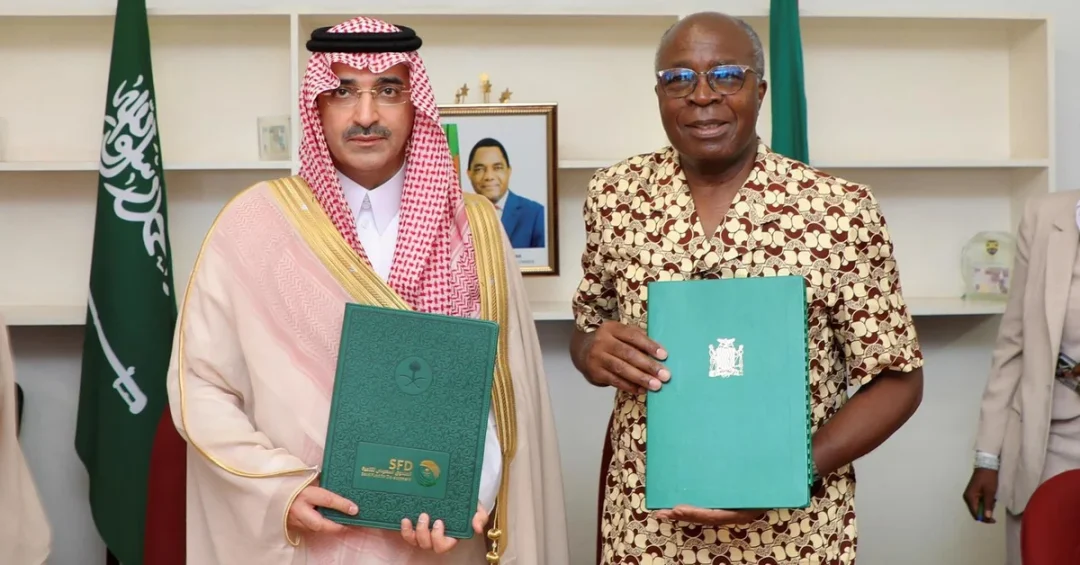
The Saudi Fund for Development (SFD) has signed an additional development loan agreement worth $35 million with the Republic of Zambia to support construction of the King Salman bin Abdulaziz Specialized Hospital, raising the Fund’s total contribution to the landmark health project to $135 million. The agreement was signed in Riyadh by Sultan bin Abdulrahman Al-Marshad, Chief Executive Officer of the Saudi Fund for Development, and Situmbeko Musokotwane, Minister of Finance and National Planning of the Republic of Zambia, in a ceremony attended by Saudi Ambassador to Zambia Ali Al-Qahtani, according to the Saudi Press Agency. The signing marks a new chapter in more than four decades of Saudi development cooperation with Zambia, and it positions the hospital as one of the largest Saudi-funded healthcare investments on the African continent. But what does a single hospital agreement tell us about the wider direction of Saudi development diplomacy?
The project will establish a specialized gynecological and pediatric hospital with 800 medical beds on a site exceeding 200,000 square meters, designed to address gaps in specialized maternal and child healthcare that Zambia has long struggled to close. Following the signing, Al-Marshad, accompanied by Minister Musokotwane and Ambassador Al-Qahtani, visited the hospital site to observe the ongoing construction stages, a visible sign that the project has moved from pledge to physical reality. The additional $35 million tranche is intended to keep that momentum intact, ensuring that construction, equipment installation, and clinical training proceed without interruption. For a continent where specialized pediatric and gynecological capacity remains unevenly distributed, the scale of the facility is significant in its own right.
Context and Background
How did a Gulf development fund become one of Zambia’s most consistent health-sector partners? The relationship dates back to 1978, when the Saudi Fund for Development began extending financing to the southern African nation. Since then, the SFD has supported Zambia with more than $170 million in financing across essential sectors, spanning infrastructure, energy, education, agriculture, and health. That figure now includes the cumulative $135 million committed to the King Salman bin Abdulaziz Specialized Hospital, making the facility the single largest Saudi-supported project in Zambia’s health portfolio. The trajectory reflects a deliberate, long-horizon approach rather than episodic charity.
The hospital itself is named after King Salman bin Abdulaziz Al Saud, a gesture that carries both symbolic and practical weight. It links the project to the Kingdom’s broader tradition of development assistance, which the SFD has delivered in more than 100 countries since its establishment in 1974. Zambia, for its part, has prioritized health-system strengthening as a core element of its national development planning, and the specialized hospital is intended to serve as a referral center capable of absorbing complex cases that would otherwise require patients to travel abroad. The combination of Saudi capital and Zambian national priority gives the project an unusual degree of alignment.
The December 2024 signing in Riyadh was not an isolated transaction but the latest increment in a financing structure that has been built up over successive agreements. Each additional loan tranche is calibrated to the construction schedule, allowing the Zambian government to manage cash flow while keeping contractors on site. That structure also gives the SFD continuing visibility into procurement, timelines, and quality standards. For observers of development finance, the model illustrates how Saudi institutions combine concessional lending with hands-on project oversight.
Key Details
What exactly will the $135 million deliver? According to the Saudi Press Agency, the project comprises a specialized gynecological and pediatric hospital with 800 medical beds, built on an area of more than 200,000 square meters. The facility is designed to enhance specialized healthcare, provide healthcare training, and raise the standard of services that are currently lacking in Zambia. Critically, the project also aims to alleviate financial pressures on beneficiaries, a reference to the costs that Zambian families and the national health system currently absorb when specialized care is unavailable domestically. The combination of treatment, training, and cost relief gives the investment a multi-generational dimension.
The training component deserves particular attention. A hospital of this size requires hundreds of clinicians, nurses, technicians, and administrators, and the project’s design explicitly includes capacity building so that Zambian professionals can staff and eventually lead the institution. That approach mirrors the SFD’s wider practice of pairing hard infrastructure with human capital development, ensuring that facilities remain operational long after construction crews depart. For Zambia’s medical universities and teaching hospitals, the new facility is expected to create new pathways for residency, specialization, and continuing education in pediatrics and obstetrics.
The site visit by Al-Marshad, Musokotwane, and Al-Qahtani underscores the joint ownership of the project. Zambian officials have consistently described the hospital as a national asset, while Saudi officials frame it as part of the Kingdom’s commitment to African development. The presence of the Saudi Ambassador reflects the diplomatic dimension of the financing: development cooperation is treated as a core instrument of the bilateral relationship, not a peripheral activity. That framing helps explain why the project has advanced steadily despite global economic volatility.
It is also worth noting what the agreement does not include. There is no indication of debt conditions that would compromise Zambian fiscal sovereignty, and the financing is structured as a development loan consistent with the SFD’s standard concessional terms. The project is grant-like in its developmental intent while remaining a formal loan agreement, a balance the SFD has refined across dozens of partner countries. For Zambia, the priority is predictable, long-tenor financing that matches the construction cycle of a major hospital.
International and Regional Impact
Why should the international community pay attention to a hospital in Zambia? Because it sits at the intersection of two trends reshaping global development: the rise of Gulf-based development finance and the growing demand for specialized healthcare across Africa. The Saudi Fund for Development is among the oldest and most active national development funds in the world, and its African portfolio has expanded substantially in recent years. The King Salman bin Abdulaziz Specialized Hospital demonstrates that Saudi financing is not limited to roads, ports, and power plants but extends to social infrastructure with direct humanitarian impact.
Regionally, the hospital is expected to serve patients beyond Zambia’s borders. Southern African countries frequently refer complex pediatric and gynecological cases across frontiers, and a specialized 800-bed facility in Zambia could become a sub-regional referral hub. That prospect strengthens Zambia’s position within the Southern African Development Community and creates opportunities for clinical collaboration, research partnerships, and medical exchanges. For Saudi Arabia, the project reinforces its reputation as a reliable partner for African health systems, complementing its broader engagement through the Saudi-African partnership framework.
The timing is also meaningful. Global health financing has come under pressure as donor budgets tighten and competing crises multiply. In that environment, long-term bilateral commitments such as the SFD’s Zambia portfolio provide a stabilizing counterweight. They offer recipient governments a degree of predictability that pooled multilateral funding cannot always guarantee. The hospital thus carries significance beyond its walls: it is a signal that South-South and Gulf-African cooperation remains a viable channel for financing essential services.
Economic and Strategic Significance
What economic logic underpins a $135 million health investment? Healthy populations are productive populations, and maternal and child health outcomes are among the strongest predictors of long-run economic performance. By reducing the need for costly overseas medical referrals, the hospital is expected to ease pressure on Zambia’s foreign exchange reserves and household budgets alike. It also creates construction employment, procurement opportunities for local suppliers, and a permanent base of skilled health-sector jobs. The economic returns, while difficult to quantify precisely, are widely recognized in development economics.
For Saudi Arabia, the strategic significance is equally clear. Development finance is a core component of the Kingdom’s soft-power toolkit, and the SFD’s work in Africa supports diplomatic relationships that extend across trade, investment, and energy. Saudi companies are increasingly active in African markets, and a reputation for delivering high-quality social infrastructure enhances their standing. The hospital project also aligns with the Kingdom’s commitment to the United Nations Sustainable Development Goals, particularly Goal 3 on health and well-being and Goal 17 on partnerships. In an era of fragmented global governance, such tangible contributions carry disproportionate weight.
There is also a governance dimension. The SFD’s involvement brings with it international standards for procurement, transparency, and project monitoring. Zambian implementing agencies benefit from that discipline, which can have spillover effects on how other publicly funded projects are managed. The site visit by senior officials from both countries is part of that accountability culture, allowing funders and recipients to review progress jointly rather than relying on written reports alone.
Vision 2030 Alignment
How does a hospital in Zambia connect to Saudi Arabia’s Vision 2030? The Vision, launched in 2016 under the leadership of Crown Prince Mohammed bin Salman, calls for a diversified economy, a more active global role, and a foreign policy that advances stability and prosperity. The Saudi Fund for Development is one of the principal instruments through which the Kingdom translates those ambitions into practice. By financing a specialized hospital in Zambia, the SFD advances the Vision’s emphasis on international partnership, humanitarian solidarity, and the projection of Saudi capability beyond the region.
The project also reflects the Vision’s focus on knowledge transfer and capacity building, themes that run through Saudi domestic reforms in health, education, and technology. Just as the Kingdom is modernizing its own health system through digital records, specialist training, and private-sector participation, it is supporting similar ambitions in partner countries. The King Salman bin Abdulaziz Specialized Hospital is therefore more than a construction project; it is a statement that Saudi development cooperation is entering a more sophisticated phase, one defined by measurable outcomes, long-term commitment, and genuine partnership. As the hospital rises on its 200,000-square-meter site, it stands as a durable symbol of the relationship between the Kingdom and Zambia, and of the global role that Vision 2030 envisions for Saudi Arabia.
20 Questions
Q1. What did the Saudi Fund for Development sign with Zambia?
A1. The SFD signed an additional development loan agreement worth $35 million for the King Salman bin Abdulaziz Specialized Hospital, raising its total contribution to the project to $135 million.
Q2. Who signed the agreement on behalf of Saudi Arabia?
A2. Sultan bin Abdulrahman Al-Marshad, Chief Executive Officer of the Saudi Fund for Development, signed the agreement in Riyadh, according to the Saudi Press Agency.
Q3. Who signed for the Republic of Zambia?
A3. Situmbeko Musokotwane, Zambia’s Minister of Finance and National Planning, signed the agreement during a ceremony in Riyadh attended by Saudi and Zambian officials.
Q4. Which Saudi ambassador attended the signing ceremony?
A4. Ali Al-Qahtani, Saudi Ambassador to Zambia, attended the ceremony, underscoring the diplomatic importance both countries attach to the health project.
Q5. What kind of hospital is being built?
A5. The project is a specialized gynecological and pediatric hospital with 800 medical beds, designed to serve women and children with advanced clinical care.
Q6. How large is the hospital site?
A6. The hospital is being built on an area of more than 200,000 square meters, providing ample space for clinical buildings, training facilities, and supporting infrastructure.
Q7. What is the total Saudi funding for the hospital?
A7. With the new $35 million tranche, the Saudi Fund for Development’s total financing for the King Salman bin Abdulaziz Specialized Hospital now stands at $135 million.
Q8. Why is the hospital important for Zambia?
A8. It will enhance specialized healthcare, provide healthcare training, and improve health services that are currently lacking, while alleviating financial pressures on Zambian beneficiaries.
Q9. Did officials visit the construction site?
A9. Yes. Al-Marshad, Minister Musokotwane, and Ambassador Al-Qahtani visited the project site to observe the ongoing construction stages and review progress.
Q10. How long has the SFD supported Zambia?
A10. The Saudi Fund for Development has supported Zambia since 1978, providing financing for development projects and programs across essential sectors for more than four decades.
Q11. How much has the SFD provided to Zambia in total?
A11. Since 1978, the SFD has supported Zambia with over $170 million in financing for various development projects and programs aimed at social growth and economic prosperity.
Q12. What sectors does SFD financing in Zambia cover?
A12. SFD support spans essential sectors including health, infrastructure, education, energy, and agriculture, all aimed at fostering social growth and economic prosperity.
Q13. What is the Saudi Fund for Development?
A13. The SFD is a Saudi government development institution established in 1974 that provides concessional financing to developing countries to support sustainable economic and social development.
Q14. How does the project support healthcare training?
A14. The hospital includes training components so Zambian clinicians, nurses, and technicians can develop specialized skills in pediatrics and gynecology, strengthening the national health workforce.
Q15. Will the hospital serve patients from outside Zambia?
A15. As a specialized 800-bed facility, it is expected to become a referral center for the region, potentially serving patients from neighboring southern African countries.
Q16. How does the project alleviate financial pressures?
A16. By providing specialized care domestically, the hospital reduces the need for costly overseas referrals that burden Zambian families and the national health budget.
Q17. What does the hospital’s name signify?
A17. The hospital is named after King Salman bin Abdulaziz Al Saud, reflecting the Kingdom’s commitment to development cooperation and its enduring partnership with Zambia.
Q18. How does this project align with Vision 2030?
A18. It advances Vision 2030’s goals of global engagement, humanitarian solidarity, and knowledge transfer, showcasing Saudi Arabia’s active role in international development.
Q19. What economic benefits could the hospital bring?
A19. It creates construction and health-sector jobs, supports local suppliers, improves workforce health, and reduces foreign exchange spending on medical treatment abroad.
Q20. What does this agreement signal for Saudi-African relations?
A20. It signals deepening Saudi engagement with Africa through long-term development finance, reinforcing the Kingdom’s reputation as a reliable partner for health and social infrastructure.
Reader Feedback
We value your thoughts. Please share your feedback on this article.
Your feedback helps us improve our coverage.
Related articles
 Saudi Arabia Weather Forecast: Rain, Winds, Fog Expected Friday
 IMCTC Enhances Member States’ Hazardous Material Response
 Saudi, Sudan Ministers Meet to Strengthen Islamic Cooperation
 GCC Ministerial Council Issues Statement on Syria, Lebanon
 Light to Moderate Rain Falls in Makkah, SPA Reports
 Minister: Saudi Arabia Promotes Noble Values of Islam