


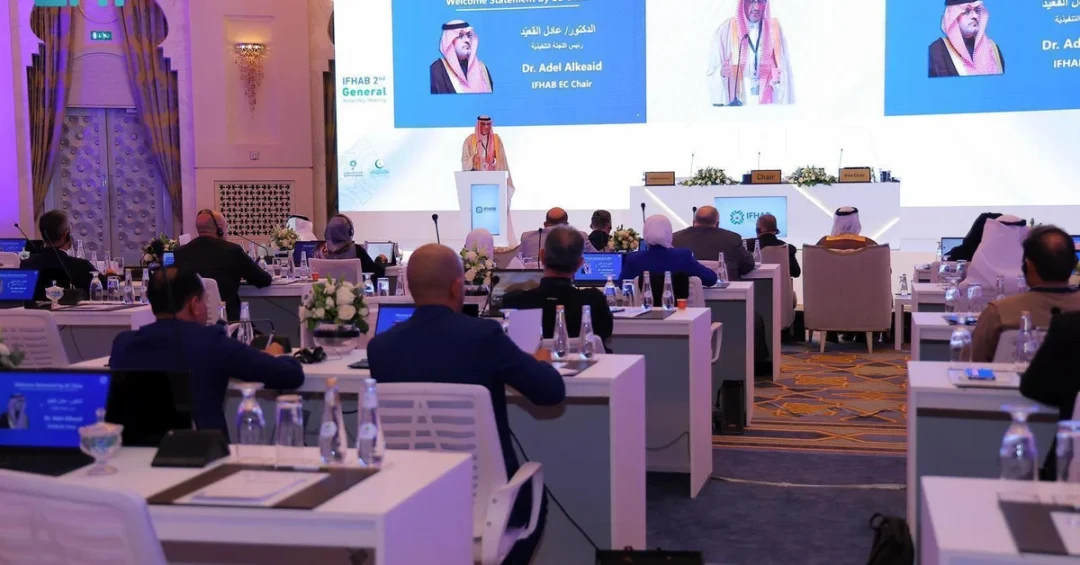
Saudi Arabia, represented by the Saudi Accreditation Center, hosted the second annual general assembly of the Islamic Forum for Halal Accreditation Bodies (IFHAB) in Makkah on Thursday, December 19, 2024, bringing together 23 national accreditation bodies from Organization of Islamic Cooperation (OIC) member states. The meeting underscored the Kingdom’s growing leadership in the global halal economy and its commitment to building a trusted, unified quality infrastructure for Islamic products worldwide. The event was held under the umbrella of the OIC, the world’s second-largest intergovernmental organization, and drew senior officials from across the Islamic world.
Among the prominent attendees were OIC Secretary-General Hissein Brahim Taha, Standards and Metrology Institute for Islamic Countries (SMIIC) Secretary-General Ihsan Ovut, and Islamic Centre for Development of Trade (ICDT) Director-General Latifa El Bouabdellaoui. Their presence signaled high-level institutional backing for IFHAB’s mission to harmonize halal accreditation standards across member states. The assembly also welcomed representatives from 23 national accreditation bodies, reflecting the forum’s expanding reach since its establishment in 2023 through a Saudi initiative. The meeting’s agenda included approving the forum’s constitution, voting on new members, and adopting recommendations to promote mutual recognition among member states. Participants reviewed the past year’s achievements and discussed future plans to enhance technical cooperation and expand the forum’s influence in global markets.
Context and Background
What does it take to build a truly global halal industry that commands trust from consumers and regulators alike? The answer lies in robust accreditation systems, and that is precisely the gap IFHAB was created to fill. Established in 2023 through a Saudi initiative, IFHAB operates as an institution affiliated with the OIC, aiming to support the global halal industry by creating a comprehensive system aligned with international market expectations. The forum’s founding reflected a recognition among Islamic countries that fragmented standards were hindering trade and undermining consumer confidence in halal products.
The global halal market is estimated to be worth trillions of dollars, spanning food, cosmetics, pharmaceuticals, logistics, and Islamic finance. Yet for years, the absence of a unified accreditation framework meant that halal certification from one country was not always recognized in another, creating barriers for exporters and confusion for consumers. IFHAB addresses this challenge head-on by bringing together national accreditation bodies to develop mutual recognition agreements and harmonized technical criteria. Saudi Arabia’s decision to host the second annual assembly in Makkah, the holiest city in Islam, added symbolic weight to the proceedings, reinforcing the Kingdom’s role as a convenor of Islamic nations and a steward of shared economic interests.
Why does accreditation matter so much in the halal sector? Accreditation bodies are the guarantors of integrity. They assess and certify the organizations that inspect and certify halal products. Without a credible accreditation layer, halal certificates can be forged, standards can vary wildly, and consumer trust can erode. IFHAB’s work therefore goes to the heart of market confidence. By aligning accreditation practices across OIC member states, the forum helps ensure that a halal label means the same thing in Jakarta as it does in Riyadh, Istanbul, or Kuala Lumpur. This consistency is essential for exporters, importers, and multinational companies seeking to serve Muslim consumers worldwide.
Key Details
What were the concrete outcomes of this year’s assembly? The meeting’s agenda was substantive, focusing on governance and expansion. Participants approved the forum’s constitution, a foundational document that formalizes IFHAB’s operating procedures, decision-making processes, and membership criteria. They also voted on the membership of new members, signaling the forum’s growing appeal among OIC states. In addition, the assembly adopted recommendations to promote mutual recognition among member states, a critical step toward reducing trade barriers and enhancing the flow of halal products across borders.
IFHAB Chairman Dr. Adel Alkeaid presided over the meeting and emphasized in his opening remarks the forum’s pivotal role in strengthening the halal quality infrastructure in Islamic countries. He highlighted that IFHAB’s mission extends beyond technical standardization to encompass capacity-building, knowledge exchange, and the empowerment of national institutions. Dr. Alkeaid’s leadership has been instrumental in steering the forum toward practical outcomes, and his remarks set a tone of collaboration and ambition for the discussions that followed.
The assembly also reviewed the forum’s achievements over the past year, including progress in establishing technical committees, developing training programs, and engaging with international standards organizations. Participants discussed future plans to enhance technical cooperation, expand the forum’s influence, and deepen engagement with the private sector. These plans include initiatives to support small and medium-sized enterprises in accessing halal markets, as well as efforts to align IFHAB’s work with global trade frameworks. The presence of high-level officials from the OIC, SMIIC, and ICDT underscored the institutional commitment to IFHAB’s success and the importance of inter-agency cooperation.
International and Regional Impact
How will IFHAB’s work affect the broader Islamic world and beyond? The forum’s efforts to harmonize halal accreditation have far-reaching implications for trade, diplomacy, and consumer protection. For OIC member states, mutual recognition of accreditation means that halal products can move more freely across borders, reducing costs and increasing market access for exporters. This is particularly important for agricultural producers, food processors, and pharmaceutical manufacturers in countries seeking to tap into the growing global demand for halal goods. By streamlining certification, IFHAB helps level the playing field for smaller economies that may lack the resources to negotiate bilateral recognition agreements individually.
Regionally, the assembly in Makkah reinforced Saudi Arabia’s position as a leader in Islamic economic cooperation. The Kingdom’s initiative to establish IFHAB in 2023 demonstrated its willingness to invest diplomatic capital in multilateral solutions. Hosting the second annual assembly in Makkah further cemented this role, bringing together representatives from across Africa, Asia, and the Middle East. The participation of OIC Secretary-General Hissein Brahim Taha and other senior officials highlighted the alignment between IFHAB’s objectives and the OIC’s broader agenda of enhancing economic integration among member states. For international markets, IFHAB’s work promises greater predictability and trust in halal supply chains, benefiting both Muslim and non-Muslim consumers who value ethical and quality-assured products.
Economic and Strategic Significance
What is the economic value at stake? The global halal economy represents a multi-trillion-dollar opportunity, encompassing not only food and beverages but also Islamic finance, halal tourism, modest fashion, and halal pharmaceuticals. As the Muslim population grows and disposable incomes rise, demand for halal-certified products is expanding rapidly. For OIC member states, capturing a larger share of this market is a strategic priority. IFHAB’s accreditation framework is a key enabler, providing the credibility and interoperability that international buyers seek. By reducing duplication and enhancing trust, the forum can help unlock trade flows worth billions of dollars annually.
Strategically, IFHAB also serves as a platform for Islamic countries to assert their influence in global standard-setting. Historically, many international standards have been developed in Western capitals, with limited input from developing nations. IFHAB offers a counterbalance, allowing OIC states to shape the rules that govern halal trade. This is not about isolation but about constructive engagement: IFHAB seeks to align its standards with international norms while ensuring they reflect Islamic values and the needs of member states. The forum’s collaboration with SMIIC and ICDT further strengthens this ecosystem, linking accreditation with metrology, standardization, and trade promotion. For Saudi Arabia, leadership in IFHAB complements its broader economic diversification agenda and its ambition to become a hub for Islamic finance and halal industries.
Vision 2030 Alignment
How does IFHAB connect to Saudi Arabia’s Vision 2030? The Kingdom’s long-term transformation plan aims to diversify the economy, reduce dependence on oil, and position Saudi Arabia as a global leader in trade, investment, and Islamic services. Supporting the halal industry aligns directly with these goals. By hosting IFHAB and driving its agenda, Saudi Arabia is helping to build a robust halal ecosystem that can attract investment, create jobs, and boost exports. The Saudi Accreditation Center’s role as host reflects the Kingdom’s commitment to quality infrastructure and its capacity to convene international bodies.
Moreover, IFHAB’s work supports Vision 2030’s emphasis on enhancing the Kingdom’s religious and cultural leadership. Makkah, the site of the assembly, is the spiritual heart of the Islamic world, and hosting a forum dedicated to halal integrity reinforces Saudi Arabia’s custodianship of Islamic heritage and its modern role as a facilitator of Islamic cooperation. As IFHAB grows, it will contribute to the development of a knowledge-based economy, foster technical skills, and strengthen ties with OIC member states. The forum’s success is a testament to Saudi Arabia’s vision of a connected, prosperous Islamic world, and it signals the Kingdom’s readiness to lead in sectors that matter to Muslims globally. With each assembly, IFHAB moves closer to its goal of a unified halal accreditation system, and Saudi Arabia stands at the center of that effort.
20 Questions
Q1. What is the Islamic Forum for Halal Accreditation Bodies (IFHAB)?
A1. IFHAB is an institution affiliated with the Organization of Islamic Cooperation (OIC) that aims to harmonize halal accreditation standards across member states. It was established in 2023 through a Saudi initiative to support the global halal industry.
Q2. When and where was the second annual general assembly of IFHAB held?
A2. The second annual general assembly was held in Makkah, Saudi Arabia, on Thursday, December 19, 2024. It was hosted by the Saudi Accreditation Center and attended by 23 national accreditation bodies from OIC member states.
Q3. Who presided over the IFHAB assembly?
A3. Dr. Adel Alkeaid, Chairman of IFHAB, presided over the meeting. In his opening remarks, he emphasized the forum’s pivotal role in strengthening the halal quality infrastructure in Islamic countries.
Q4. Which prominent officials attended the assembly?
A4. Attendees included OIC Secretary-General Hissein Brahim Taha, SMIIC Secretary-General Ihsan Ovut, and ICDT Director-General Latifa El Bouabdellaoui. Their presence highlighted high-level institutional support for IFHAB’s mission.
Q5. What was on the agenda of the assembly?
A5. The agenda included approving the forum’s constitution, voting on the membership of new members, and adopting recommendations to promote mutual recognition among member states. Participants also reviewed past achievements and discussed future plans.
Q6. Why is mutual recognition important in the halal industry?
A6. Mutual recognition reduces trade barriers by ensuring that halal certification from one country is accepted in another. This enhances consumer trust, lowers costs for exporters, and facilitates the flow of halal products across borders.
Q7. How many national accreditation bodies participated in the assembly?
A7. Twenty-three national accreditation bodies from OIC member states participated in the second annual general assembly. This reflects IFHAB’s expanding membership and its growing influence in the Islamic world.
Q8. What is the role of the Saudi Accreditation Center?
A8. The Saudi Accreditation Center represents Saudi Arabia in IFHAB and hosted the second annual assembly. It is responsible for accrediting conformity assessment bodies in the Kingdom, ensuring quality and compliance with international standards.
Q9. When was IFHAB established and by whom?
A9. IFHAB was established in 2023 through a Saudi initiative. It operates as an institution affiliated with the OIC, aiming to create a comprehensive halal accreditation system aligned with international market expectations.
Q10. What are the main goals of IFHAB?
A10. IFHAB aims to support the global halal industry by harmonizing accreditation standards, promoting mutual recognition, enhancing technical cooperation, and expanding the influence of Islamic countries in the halal sector.
Q11. How does IFHAB benefit OIC member states?
A11. IFHAB helps member states access global halal markets by providing a unified accreditation framework. This reduces duplication, increases export opportunities, and strengthens the credibility of halal products from OIC countries.
Q12. What is the economic significance of the halal industry?
A12. The global halal industry is worth trillions of dollars, covering food, pharmaceuticals, cosmetics, logistics, and Islamic finance. It represents a major growth opportunity for OIC member states seeking to diversify their economies.
Q13. How does IFHAB relate to the OIC?
A13. IFHAB is an institution affiliated with the OIC, the second-largest intergovernmental organization. It operates under the OIC’s umbrella and collaborates with other OIC bodies such as SMIIC and ICDT.
Q14. What is SMIIC’s role in the halal sector?
A14. The Standards and Metrology Institute for Islamic Countries (SMIIC) develops standards for halal products and services. It works with IFHAB to ensure that accreditation and standardization efforts are aligned across OIC member states.
Q15. What is the ICDT’s involvement in IFHAB?
A15. The Islamic Centre for Development of Trade (ICDT) promotes trade among OIC member states. Its Director-General attended the assembly, reflecting ICDT’s support for IFHAB’s efforts to facilitate halal trade and economic integration.
Q16. How does IFHAB support small and medium-sized enterprises?
A16. IFHAB plans to support SMEs by providing training, technical assistance, and access to harmonized accreditation systems. This helps smaller businesses overcome barriers to entering global halal markets.
Q17. What achievements did IFHAB review at the assembly?
A17. Participants reviewed progress in establishing technical committees, developing training programs, and engaging with international standards organizations. They also discussed expanding the forum’s membership and influence.
Q18. How does IFHAB align with Saudi Vision 2030?
A18. IFHAB supports Vision 2030 by promoting economic diversification, enhancing Saudi Arabia’s leadership in Islamic services, and fostering trade and investment in the halal sector. It also reinforces the Kingdom’s role as a convener of Islamic nations.
Q19. What are IFHAB’s future plans?
A19. IFHAB plans to enhance technical cooperation, expand its influence, deepen engagement with the private sector, and promote mutual recognition among member states. It also aims to align its work with global trade frameworks.
Q20. Why is Makkah a significant location for the IFHAB assembly?
A20. Makkah is the holiest city in Islam, and hosting the assembly there underscores Saudi Arabia’s custodianship of Islamic heritage. It also adds symbolic weight to efforts to unify halal standards across the Islamic world.
Reader Feedback
We value your thoughts. Please share your feedback on this article.
Your feedback helps us improve our coverage.
Related articles
 Saudi Arabia Condemns Magdeburg Market Incident, Rejects Violence
 Arab Parliament Backs Palestinian Self-Determination Vote
 MWL Welcomes UN Resolution on Israel’s Obligations
 GCC, UN Envoy Discuss Syria’s Unity and Sovereignty
 Diplotaxis Returns to Northern Borders Landscape
 Saudi Arabia Apprehends 20,159 Law Violators in a Week